AI Agents for Healthcare: The Next Stage of Digital Health Operations
Table of contents
- Key takeaways
- From Rules to Reasoning: How Healthcare AI Systems Differ
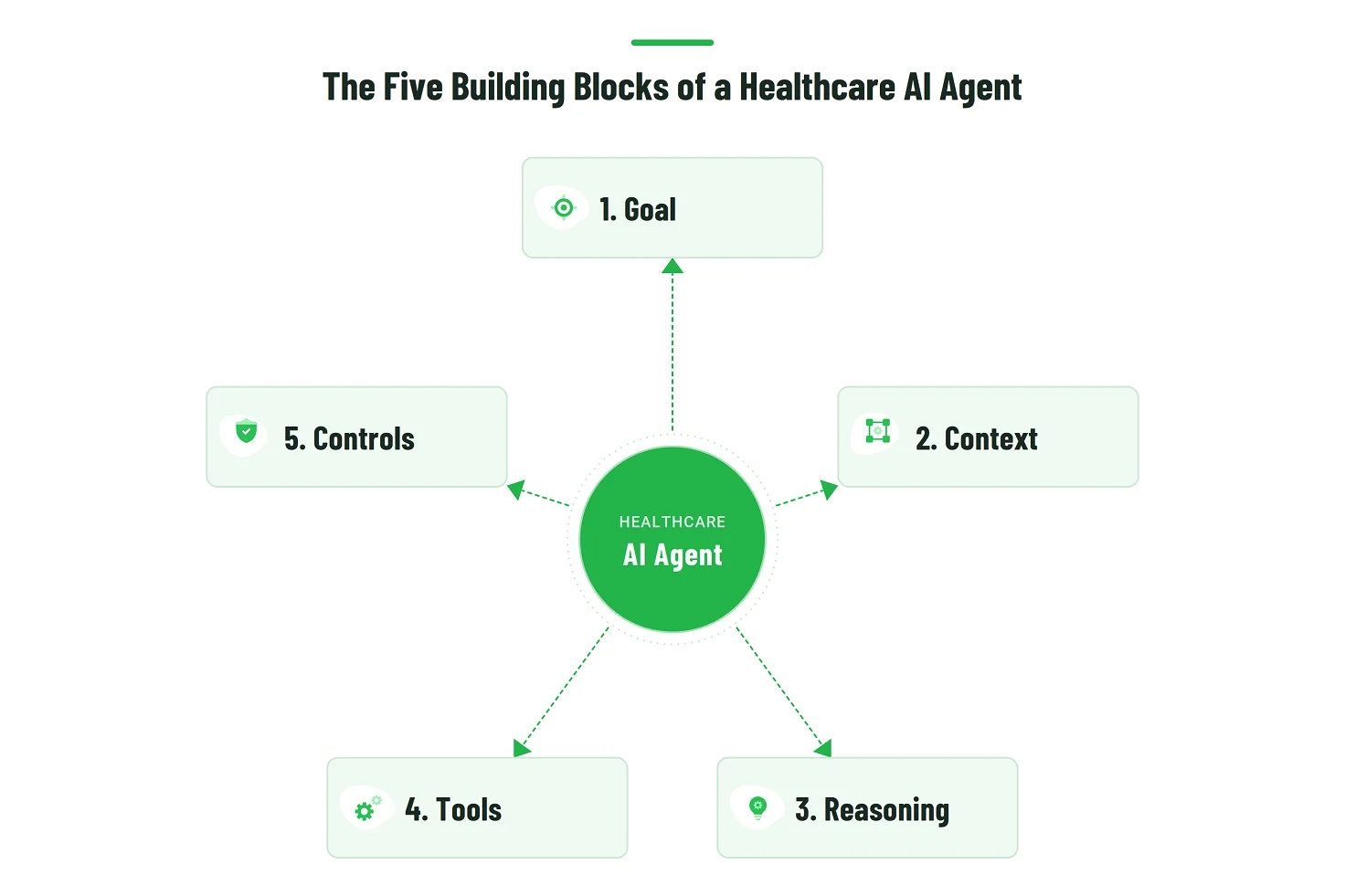
- The Five Building Blocks of a Healthcare AI Agent
- Goal: what the agent is trying to complete
- Context: clinical, operational, and organizational awareness
- Reasoning: determining the next best action
- Tools: systems the agent can interact with
- Controls: governance, permissions, and human oversight
- Top 6 AI Agent Use Cases in Healthcare
- Scheduling and no-show recovery agents
- Patient intake and pre-visit preparation agents
- Prior authorization agents
- Clinical documentation agents
- Revenue cycle management and coding review agents
- Post-discharge and chronic-care follow-up agents
- Multi-Agent Systems: Why One “Super AI Doctor” Is the Wrong Architecture
- Example: patient visit workflow
- Governance Architecture for Healthcare AI Agents
- Public cloud, private cloud, and on-premise deployment
- Audit trails: every action must be traceable
- Human-in-the-loop and controlled autonomy
- The Operational Risks Behind Healthcare AI Agents
- Hallucinations and reasoning failures
- Legal responsibility and the sepsis problem
- Cybersecurity and prompt injection
- Autonomy boundaries
- Conclusion
Healthcare organizations face rising workforce shortages, operational costs, clinician burnout, regulatory complexity, and fragmented technology. Medical professionals spend significant time on administrative tasks, including documentation, scheduling, prior authorizations, and care coordination, which reduces the time available for direct patient care.
AI agents offer a step change in healthcare by automating multi-step tasks, enabling organizations to coordinate workflows, manage operations, and interact across platforms. This automation frees clinicians to attend to direct patient care, while escalating decisions to humans when needed.
Consequently, organizations are adopting AI agents to handle patient engagement, administration, revenue cycle, and care coordination, delivering tangible support under human oversight and compliance, beyond isolated automation.
In this article, we explore how AI agents are transforming healthcare operations, where they create the greatest value, and what organizations should consider before deploying them at scale.
Key takeaways
- AI agents for healthcare expand on traditional automation: Traditional AI typically analyzes data or generates content; in contrast, these agents coordinate workflows, interact with enterprise systems, execute multi-step tasks, and escalate issues to humans where necessary.
- Healthcare organizations are moving from automation toward delegation: The strategic question is evolving from, “What AI can automate?” The question now is, “Which operational tasks can be securely delegated to governed AI systems, with human oversight?”
- The greatest near-term value arises from operational healthcare workflows: Scheduling, patient intake, prior authorization, documentation, coding review, and post-discharge follow-up are currently the most commercially impactful use cases for AI agents.
- Long-term success will be shaped by governance and controlled autonomy: Adopting healthcare AI effectively relies on model performance, auditability, cybersecurity, human-in-the-loop controls, infrastructure strategy, and clearly-defined autonomy boundaries.
From Rules to Reasoning: How Healthcare AI Systems Differ
Not every AI-powered healthcare system has the same autonomy, adaptability, or operational responsibility. Traditional rule-based automation follows predefined instructions. AI assistants generate responses, summarize information, and support decisions. AI agents expand these capabilities by coordinating workflows, interacting with connected systems, and executing multi-step tasks with limited supervision. Multi-agent systems enable specialized agents to collaborate across complex environments.
Understanding these distinctions is important because each model introduces different capabilities, integration requirements, governance considerations, and levels of organizational trust. The comparison below illustrates how these system types differ in practice across healthcare workflows.
|
System type |
What it does |
Healthcare example |
Governance complexity |
|
Rule-based automation |
Follows fixed rules |
Appointment reminder |
Low |
|
AI assistant |
Generates or summarizes |
Drafts discharge summary |
Medium |
|
AI agent |
Executes workflow |
Checks eligibility, books visit, updates EHR, triggers billing |
Higher |
|
Multi-agent system |
Coordinates specialized agents |
Intake agent + coding agent + review agent + follow-up agent |
Highest |
The Five Building Blocks of a Healthcare AI Agent
Healthcare AI agents function as coordinated systems, not standalone models. Their effectiveness depends on interconnected components that enable objective understanding, contextual awareness, decision-making, system interaction, and governance.
Goal: what the agent is trying to complete
Every healthcare AI agent operates around a defined objective, such as scheduling appointments, processing prior authorizations, coordinating discharge workflows, or monitoring patient follow-ups. Clearly defined goals help ensure agents remain predictable, efficient, and operationally safe.
Context: clinical, operational, and organizational awareness
Healthcare workflows depend heavily on context. Effective AI agents draw information from EHRs, scheduling systems, payer platforms, clinical guidelines, patient histories, and organizational policies to make decisions that align with real clinical and operational conditions.
Reasoning: determining the next best action
Reasoning enables AI agents to evaluate information, prioritize actions, and adapt to changing situations instead of following rigid workflows. In healthcare environments, this may involve escalating cases to clinicians, validating documentation, or checking whether actions meet safety and compliance requirements.
Tools: systems the agent can interact with
AI agents become operationally valuable when they can interact with enterprise systems such as EHRs, billing platforms, CRMs, laboratory systems, messaging tools, and care coordination applications. These integrations allow agents to retrieve data, update records, trigger workflows, and coordinate actions across departments.
Controls: governance, permissions, and human oversight
Healthcare AI agents must operate within strict governance frameworks that define permissions, escalation rules, approval requirements, and compliance controls. Role-based access, audit logging, and human oversight are essential for maintaining patient safety, regulatory compliance, and organizational trust.
Together, these building blocks enable AI agents to deliver measurable operational improvements and reliable support for complex healthcare workflows, while maintaining safety and compliance.
Top 6 AI Agent Use Cases in Healthcare
Healthcare organizations are moving beyond experimental AI deployments and focusing on operational use cases that reduce friction across clinical, administrative, and patient-facing workflows. The strongest AI agent implementations are not designed to replace clinicians. Instead, they augment care teams by handling repetitive coordination tasks, orchestrating processes across fragmented systems, accelerating response times, and reducing the manual workload placed on healthcare staff.
Not every healthcare workflow requires the same level of autonomy. Some agents operate primarily as intelligent assistants with strong human oversight, while others can independently execute lower-risk operational tasks within predefined governance boundaries. The table below outlines several of the most commercially relevant AI agent use cases in healthcare, together with their operational value, expected autonomy level, and oversight requirements.
|
Use case |
Main value |
Autonomy level |
Human oversight |
|
Scheduling and no-show recovery |
Better capacity utilization |
Medium |
Staff monitors exceptions |
|
Patient intake and pre-visit preparation |
Lower admin burden and better data quality |
Medium |
Staff reviews edge cases |
|
Prior authorization |
Faster approvals and less manual work |
Medium |
Human review for complex cases |
|
Clinical documentation |
More time for patient care |
Low to medium |
Clinician signs off |
|
RCM and coding review |
Cleaner claims and fewer denials |
Medium |
Billing and coding team validates |
|
Post-discharge and chronic-care follow-up |
Better engagement and retention |
Medium |
Clinical escalation required |
Scheduling and no-show recovery agents
Technology
AI-powered scheduling agents analyze appointment data to detect last-minute cancellations and available slots. They automatically suggest appointment times based on the urgency of visits, clinician schedules, patient preferences, and previous communication. These agents send reminders, fill canceled appointments from waitlists, and reschedule missed visits — without the intervention of front-desk staff for each action.
More advanced scheduling agents can identify high-priority patients for rapid rescheduling and factor in additional variables, such as provider expertise, patient geography, and reliability. However, they do not determine medical necessity or override human clinical judgment.
Business result
For healthcare organizations operating at scale, scheduling inefficiencies directly affect revenue, clinician productivity, and patient access to care. Intelligent scheduling agents help maximize provider utilization, reduce empty appointment slots, improve patient throughput, and reduce administrative overhead associated with manual coordination.
The operational impact often includes lower no-show rates, improved clinic efficiency, shorter scheduling cycles, and reduced strain on front-desk personnel.
Risk
Poorly governed scheduling automation can create operational confusion. An agent may assign the wrong visit type, fail to recognize escalation-worthy symptoms, create scheduling conflicts, or overwhelm clinicians with improperly balanced calendars.
Healthcare providers need clear escalation rules, scheduling constraints, and human review for high-risk or sensitive cases.
Best fit
These agents are particularly valuable for hospitals, specialty clinics, imaging centers, dental networks, and high-volume outpatient organizations seeking to improve appointment utilization without continuously expanding administrative staffing.
Patient intake and pre-visit preparation agents
Technology
Intake agents collect administrative and clinical details before appointments through digital conversations or forms. They gather elements like demographic data, insurance status, consent, symptoms, medications, referrals, and pre-visit questions; they do not make clinical decisions or interpret nuanced medical details beyond data capture.
The agent structures and routes this information into the EHR or practice management system, while identifying missing fields, inconsistencies, or documentation gaps before the appointment begins.
Business result
Pre-visit automation eases administrative friction for patients and care teams. Organizations gain faster check-in, fewer data-entry tasks, cleaner patient records, and more efficient preparation.
Clinicians also receive richer contextual information before the visit, allowing them to spend less time gathering routine details and more time on diagnosis, treatment, and patient interaction.
Risk
If governance and validation controls are weak, intake agents may misinterpret symptoms, collect incomplete information, mishandle protected health data, or introduce inaccuracies into downstream clinical workflows.
Because intake often becomes the first operational touchpoint in the care journey, reliability and privacy safeguards are especially important.
Best fit
Patient intake agents are highly effective for multi-location provider groups, urgent care networks, telehealth platforms, specialty practices, and healthcare systems aiming to streamline front-office operations while improving the patient onboarding experience.
Prior authorization agents
Technology
Prior authorization agents assemble necessary documentation, check payer rules, compose requests, and track status. They identify cases requiring clinical or administrative review and can adapt workflows for new payer requirements. They do not decide medical appropriateness or handle novel exceptions unaided.
Some agents monitor evolving payer policies and dynamically adapt submission workflows to insurer requirements.
Business result
Prior authorization delays contribute heavily to administrative fatigue, reimbursement bottlenecks, and delayed patient care. AI agents can significantly reduce manual coordination work, accelerate approval cycles, improve submission completeness, and minimize repetitive communication between providers, payers, and internal staff.
The result is faster treatment initiation, fewer authorization-related delays, and more efficient revenue-cycle operations.
Risk
Authorization workflows involve complex payer logic, policy variability, and clinically sensitive decisions. An improperly configured agent may submit incomplete documentation, misinterpret authorization requirements, or fail to quickly escalate urgent exceptions.
Without robust oversight, these failures can affect reimbursement timelines, operational efficiency, and patient outcomes.
Best fit
These agents are especially valuable for provider organizations, specialty care networks, diagnostic centers, and surgical practices where prior authorization processes create significant administrative drag and operational inefficiency.
Clinical documentation agents
Technology
Clinical documentation agents draft notes from encounter transcripts, summarize histories, and organize patient information. While they can suggest EHR fields and formats, they cannot approve final documentation, make medical inferences, or validate diagnostic or treatment accuracy.
In advanced implementations, agents support specialty-specific templates, identify missing documentation elements, and assist with longitudinal patient summaries.
Business result
Documentation automation reduces clinician burnout, shortens after-hours charting, improves consistency, and speeds record completion. Physicians and care teams gain more time for direct patient interaction.
Healthcare organizations also benefit from more complete records, stronger coding readiness, and improved operational efficiency across downstream workflows.
Risk
Clinical documentation carries substantial accuracy and compliance responsibilities. Agents may hallucinate details, omit important medical context, generate ambiguous language, or encourage overly passive review behavior if clinicians approve outputs too quickly.
Human validation remains essential, particularly for diagnostic, treatment-related, or legally sensitive documentation.
Best fit
These agents are especially relevant for healthcare organizations seeking to reduce clinician administrative overload while preserving physician oversight and maintaining documentation quality standards.
Revenue cycle management and coding review agents
Technology
RCM and coding review agents review documentation, propose billing codes, flag inconsistencies, and indicate missing items per payer rules. They prompt human coding review when uncertain, but do not finalize code choices or resolve ambiguous scenarios without staff input.
Some systems can also support audit preparation, reimbursement optimization, coding validation, and real-time claim quality analysis across large operational environments.
Business result
Healthcare providers often lose revenue through denied claims, incomplete coding, missing documentation, and delayed reimbursement cycles. Intelligent revenue-cycle agents help improve coding precision, strengthen clean-claim rates, reduce denials, and accelerate payment processing without increasing the number of billing staff.
These capabilities become particularly valuable in organizations handling large claim volumes across multiple specialties or payer environments.
Risk
Improper coding practices or insufficient oversight may expose the organization to compliance risks, reimbursement disputes, audit risks, or billing inaccuracies. Because financial workflows intersect directly with regulatory obligations, human review remains critical for sensitive billing decisions.
Best fit
RCM and coding agents are highly effective for hospitals, multi-specialty provider groups, ambulatory care organizations, and healthcare enterprises seeking stronger reimbursement performance and more operationally resilient revenue-cycle processes.
Post-discharge and chronic-care follow-up agents
Technology
Follow-up agents send post-discharge reminders, collect routine patient feedback, schedule follow-ups, and monitor reported symptoms. They escalate alerts for at-risk patients or concerns to clinical staff, but do not diagnose new conditions or manage care escalation autonomously.
Advanced implementations integrate with remote monitoring systems, wearable devices, or chronic disease management programs.
Business result
Consistent follow-up improves continuity of care, strengthens patient engagement, reduces avoidable readmissions, and supports long-term adherence to treatment. It also helps healthcare organizations maintain stronger relationships with patients between visits, while reducing manual outreach workloads for clinical staff.
For value-based care environments, these operational improvements can directly influence both outcomes and reimbursement performance.
Risk
Patient follow-up workflows involve meaningful clinical responsibility. An agent may fail to recognize deteriorating symptoms, operate outside approved communication boundaries, or delay escalation of urgent situations.
Clear escalation logic, clinically approved response protocols, and well-defined scope limitations are therefore essential.
Best fit
These agents are particularly valuable for hospitals, chronic-care programs, telehealth providers, rehabilitation organizations, and healthcare systems focused on reducing readmissions, improving care continuity, and strengthening long-term patient engagement.
Multi-Agent Systems: Why One “Super AI Doctor” Is the Wrong Architecture
The future of healthcare AI is unlikely to revolve around a single universal agent replacing clinicians or consolidating every workflow into one centralized intelligence layer. Healthcare operations are simply too specialized, regulated, context-sensitive, and operationally fragmented for a monolithic AI model to function safely or efficiently across every scenario.
Instead, the emerging model is a coordinated ecosystem of specialized AI agents working alongside clinicians, administrators, billing teams, care coordinators, and patients.
- Healthcare work is too specialized for one universal agent
Healthcare workflows involve radically different responsibilities, risk profiles, compliance requirements, and decision boundaries. Scheduling logic differs from claims management. Clinical documentation differs from chronic-care monitoring. Prior authorization differs from patient communication.
Trying to force all these functions into a single, generalized “super-agent” creates operational opacity, governance complexity, and increased failure risk.
Specialized agents allow organizations to apply tighter controls, narrower scopes, clearer accountability, and domain-specific optimization to each workflow.
- Multi-agent systems create better control and accountability
A multi-agent architecture enables healthcare organizations to separate operational responsibilities across dedicated digital workers with clearly defined permissions and escalation paths.
This approach improves transparency because each agent operates within a known domain, making monitoring, auditing, troubleshooting, compliance management, and human oversight significantly more manageable.
Instead of a single opaque system making broad decisions, organizations gain a governed operational structure in which responsibilities remain compartmentalized and observable.
- Orchestration is what turns agents into a digital workforce
Individual agents become substantially more valuable when they can coordinate tasks, exchange context, and operate within a larger workflow ecosystem. Orchestration layers allow healthcare organizations to connect specialized agents into structured operational pipelines that mirror real clinical and administrative processes.
This orchestration model enables healthcare providers to build scalable digital workforces rather than isolated automation tools.
Example: patient visit workflow
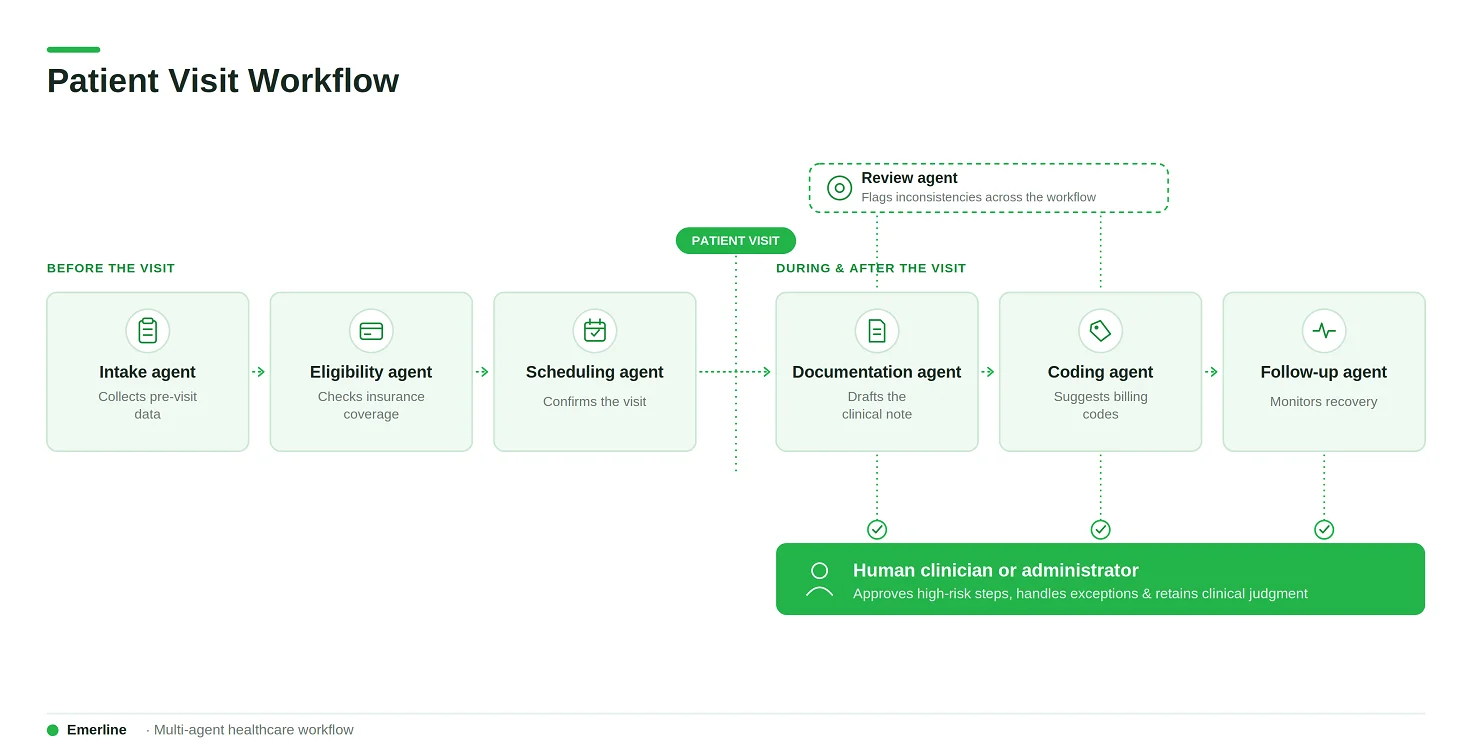
A single patient journey may involve multiple specialized AI agents operating together across administrative, clinical, and operational stages. The workflow below illustrates how coordinated agents can support end-to-end healthcare processes while keeping human clinicians and administrators involved in higher-risk decisions and approval points.
- Intake agent collects pre-visit data.
- Eligibility agent checks insurance.
- The scheduling agent confirms the visit.
- The documentation agent drafts the clinical note.
- The coding agent suggests billing codes.
- Follow-up agents monitor recovery.
- Review agent flags inconsistencies.
- Human clinician or admin approves high-risk steps.
Governance Architecture for Healthcare AI Agents
Healthcare organizations cannot treat AI agents as isolated productivity tools. Once agents gain capabilities such as accessing EHRs, modifying billing systems, scheduling appointments, communicating with users, or controlling patient-facing workflows, they become operational actors inside regulated environments. That changes the governance model entirely.
The core question is no longer whether an agent produces accurate output. The real question is whether the organization can monitor, explain, constrain, audit, and intervene in agent behavior at every critical point in the workflow.
In healthcare, trust architecture matters because AI agents do not simply generate information; they also process it. Depending on their capabilities, they may take actions such as triggering system tasks, transferring data between platforms, influencing clinical schedules, or directly impacting patient outcomes. As agent autonomy and functional scope grow, organizations need equally mature control frameworks covering infrastructure, permissions, escalation logic, observability, compliance, and human oversight.
Therefore, a healthcare AI agent environment must be designed as a governed operational system rather than a standalone AI deployment.
Public cloud, private cloud, and on-premise deployment
Healthcare organizations adopt AI agents under very different infrastructure constraints, compliance obligations, and risk tolerances. As a result, deployment architecture becomes a strategic decision rather than a purely technical one.
Public cloud deployment provides rapid scalability, elastic compute capacity, accelerated AI experimentation, and advanced managed AI services. It suits organizations prioritizing innovation speed, distributed operations, or large-scale analytics. This approach requires robust governance for identity management, data residency, encryption, tenant isolation, and third-party risk management.
Private cloud deployment delivers stronger environmental control while maintaining many operational benefits of cloud-native systems. Organizations often choose this model to balance modernization with stricter governance, compliance, or workload segmentation needs. Private environments can simplify alignment with security policies and minimize exposure to infrastructure risks.
On-premise deployment is vital for healthcare systems with stringent regulatory requirements, legacy infrastructure dependencies, highly sensitive data, or strict latency needs. Organizations selecting this model often keep AI inference and orchestration within tightly controlled internal boundaries to avoid exposing critical systems to external exposure.
In practice, many healthcare organizations adopt hybrid deployment strategies in which certain agent workloads run in cloud environments, while sensitive operational systems remain internally controlled.
The right deployment model depends on several variables, including:
- Regulatory exposure
- Data sensitivity
- Existing infrastructure maturity
- Latency requirements
- AI workload intensity
- Security posture
- Operational governance strategy
Mature healthcare organizations design architecture around controllability and resilience, not just cloud ideology.
Audit trails: every action must be traceable
Healthcare AI agents must operate inside fully observable environments.
Every recommendation an agent makes, every workflow decision, every escalation, every system access event, and every automated action, such as modifying records, sending notifications, or launching processes, should be traceable through structured audit logs. Without traceability, organizations cannot properly investigate incidents, validate compliance, explain operational behavior, or establish accountability.
Auditability becomes especially important when AI agents:
- Modify patient-related records
- Trigger operational workflows
- Access regulated systems
- Influence financial processes
- Participate in clinical support activities
- Interact across multiple applications
A mature audit framework should capture:
- What the agent did
- Why the agent acted
- Which systems and data were accessed
- Which tools were used
- Whether human approval occurred
- What escalation logic was triggered
- What model or workflow version generated the action
- Timestamps and identity context
This level of observability is critical not only for compliance investigations, but also for operational debugging, governance reviews, incident analysis, and long-term trust in agent-driven workflows.
Healthcare organizations increasingly recognize that explainability without traceability is insufficient. If an action cannot be reconstructed after the fact, the operational risk profile becomes unacceptable.
Human-in-the-loop and controlled autonomy
The future of healthcare AI is not unrestricted automation. It is a controlled autonomy.
Healthcare organizations are increasingly implementing layered governance models in which AI agents operate within explicitly defined authority boundaries. Humans retain responsibility for high-risk decisions, exceptions, approvals, and clinical judgment. According to the Boston Consulting Group analysis on healthcare AI agents, this model is becoming central to enterprise AI adoption strategies across healthcare systems.
Instead of asking whether agents should be autonomous or supervised, organizations are defining which types of actions may be automated safely under specific operational conditions.
In practice, different healthcare workflows require different autonomy levels, depending on:
- Clinical risk
- Financial impact
- Regulatory exposure
- Data sensitivity
- Operational criticality
- Reversibility of actions
The table below demonstrates how healthcare organizations typically separate low-risk automation from workflows that require mandatory human review, escalation, or approval. It also highlights how governance maturity increases as agent autonomy increases.
|
Autonomy level |
What the agent can do |
Example |
Human control |
|
Suggest |
Generate a recommendation or draft |
Drafts clinical note |
Human approves |
|
Prepare |
Gather data and prepare the next step |
Prepare prior authorization documents |
Staff reviews before submission. |
|
Act with review |
Execute low-risk workflow steps after checks. |
Reschedule a routine appointment. |
Staff monitors exceptions |
|
Act autonomously |
Complete narrow, low-risk tasks. |
Sends appointment reminder |
Human monitors performance |
|
Stop and escalate |
Refuse action and route to a human. |
Possible sepsis warning or medication concern. |
Clinician takes over |
Controlled autonomy allows organizations to capture operational efficiency without abandoning accountability. The goal is not to remove humans from healthcare workflows, but to ensure humans remain strategically positioned where judgment, interpretation, ethics, and responsibility are essential.
The Operational Risks Behind Healthcare AI Agents
AI agents can dramatically reduce administrative friction, accelerate workflows, improve coordination, and increase operational throughput. But as organizations delegate more work to autonomous systems, they also introduce new categories of technical, legal, operational, and cybersecurity risk.
The challenge is not whether healthcare AI agents are beneficial. The challenge is whether organizations can govern them safely at scale.
Healthcare leaders should therefore approach AI agents the same way they approach clinical infrastructure: with layered controls, escalation pathways, observability, access governance, and clearly defined operational boundaries.
Hallucinations and reasoning failures
AI agents can produce highly confident outputs that are partially incorrect, logically flawed, or contextually unsafe.
In healthcare environments, these failures carry far greater consequences than ordinary productivity mistakes. An inaccurate recommendation, omitted detail, or incorrect workflow action may affect patient safety, reimbursement, operational continuity, or compliance exposure.
The risk becomes even more significant when agents autonomously chain multiple decisions across connected systems.
Healthcare organizations, therefore, cannot rely solely on output quality benchmarks. They need governance mechanisms that continuously validate:
- Agent reasoning quality
- Data integrity
- Escalation logic
- Exception handling
- Workflow boundaries
Human-in-the-loop review remains essential for high-risk scenarios, especially when workflows involve diagnosis, clinical interpretation, medication-related processes, or irreversible operational actions.
The safest healthcare AI architectures are not those that attempt to eliminate humans entirely, but those that strategically position human judgment where ambiguity or risk increases.
Legal responsibility and the sepsis problem
One of the most important governance questions in healthcare AI is deceptively simple:
Who is responsible if the agent makes the wrong decision?
Consider a scenario where an AI agent fails to escalate sepsis risk indicators during post-discharge monitoring. Even if the agent contributed to the failure, accountability does not transfer to the AI system itself.
Current healthcare and privacy regulations generally place responsibility on:
- Healthcare organizations
- Covered entities
- Controllers and processors
- Clinicians
- Regulated vendors
- Operational leadership
The AI agent is not a legal actor.
This distinction is critically important because organizations sometimes overestimate the degree to which AI autonomy transfers operational responsibility away from humans. In reality, accountability frameworks still remain fundamentally human and organizational.
As healthcare AI adoption accelerates, organizations will need clearer governance around:
- Escalation policies
- Approval authority
- Documentation standards
- Clinical oversight
- Workflow accountability
- Vendor responsibility allocation
The more autonomous the workflow becomes, the more essential governance clarity becomes.
Cybersecurity and prompt injection
AI agents create entirely new attack surfaces by accessing systems, retrieving information, invoking tools, manipulating data, and executing operational actions like updating records or communicating across platforms.
Unlike passive AI models, agents may interact directly with:
- EHR systems
- Billing infrastructure
- Internal APIs
- Communication platforms
- Scheduling systems
- Operational databases
These expanded capabilities dramatically increase the potential cybersecurity threat landscape, given agents’ direct access and ability to interlink various sensitive healthcare systems.
One of the most important emerging risks is Prompt Injection, where malicious instructions manipulate agent behavior, override safeguards, or trigger unintended actions. The OWASP Top 10 for LLM Applications 2025 report identifies Prompt Injection as the leading security risk category for large language model systems. The same framework also highlights Sensitive Information Disclosure as a major concern.
For healthcare organizations, these risks are especially serious because AI agents may simultaneously interact with regulated patient information and operational systems.
Modern healthcare AI security strategies increasingly require:
- Strict permission segmentation
- Tool access controls
- Context isolation
- Input validation
- Continuous monitoring
- Action verification
- Identity-aware orchestration
- Secure execution environments
As agent ecosystems mature, cybersecurity architecture will become just as important as model performance.
Autonomy boundaries
Not every healthcare workflow should allow autonomous action.
Some workflows are relatively low risk and reversible. Others involve clinical judgment, patient safety, financial compliance, or regulatory exposure. Treating all workflows equally creates unnecessary operational danger.
That is why healthcare organizations are increasingly adopting tiered autonomy models where agents may:
- Act automatically
- Act with human review
- Recommend only
- Escalate without acting
- Never operate autonomously at all
The governance objective is not to prevent AI agents from acting. The objective is to define precisely:
- Where agents may act independently
- Where approval becomes mandatory
- Where escalation is required
- Where humans remain fully responsible
This governance-first approach aligns closely with evolving global regulatory direction.
The European Union’s AI Act increasingly classifies AI-based medical software as high-risk infrastructure, requiring safeguards around:
- Risk mitigation
- Human oversight
- Transparency
- Data quality
- Monitoring
- Operational accountability
Healthcare organizations that define autonomy boundaries early will likely scale AI adoption more safely and more sustainably than organizations pursuing unrestricted automation.
Conclusion
The future of AI agents in healthcare is not full autonomy. It is controlled autonomy: specialized agents integrated into real operational workflows, governed by explicit rules, monitored through auditable systems, and supervised by accountable humans.
At Emerline, we help healthcare organizations design and engineer AI-powered agents that align innovation with operational control. From healthcare AI strategy and multi-agent orchestration to secure application modernization, workflow automation, cloud infrastructure, and governed AI integration, our teams help businesses build practical, scalable, and compliance-conscious AI ecosystems prepared for real-world healthcare operations.
Published on Jun 4, 2026