Multi-Agent Orchestration and the Shift to AI-Driven Workflows
Table of contents
- Key takeaways
- What Is Multi-Agent Orchestration?
- Single-Agent vs Multi-Agent AI: When Does Orchestration Matter?
- The Economics of MAO: Where ROI Comes From
- What Does Multi-Agent Orchestration Cost?
- How Multi-Agent Orchestration Improves Quality and Control
- Business Use Cases Where MAO Creates Real Value
- Strategic research and market intelligence
- Customer service and complaint resolution
- Supply chain and logistics coordination
- Compliance-heavy document workflows
- Internal operations and back-office workflows
- The Biggest Risks and Barriers to MAO Adoption
- How to Start with Multi-Agent Orchestration: A Practical Roadmap
- Step 1: Audit the workflows with the highest payoff potential
- Step 2: Start with a simple two-agent pattern
- Step 3: Add a human-in-the-loop for critical decisions
- Step 4: Define KPIs before expanding
- Step 5: Scale only after proving value
- Build vs Buy: Choosing the Right MAO Approach
- Conclusion
- Frequently Asked Questions
- Is multi-agent orchestration the same as agentic AI?
- Does multi-agent orchestration always cost more than a single-agent setup?
- How many agents does a typical MAO system need to start?
Many organizations use AI as a productivity layer, such as chatbots, copilots, or isolated prompt-based tools that support employees with specific tasks. While these solutions improve efficiency for individual tasks, they often do not fundamentally change how work flows across the business.
For many organizations, the next stage of AI adoption is more structural. Instead of supporting individuals, AI begins to take on defined roles within workflows, contributing to decision-making, execution, and coordination. This is where the shift from isolated tools to interconnected systems becomes visible.
Multi-agent orchestration (MAO) enables that transition. It allows multiple AI components to operate together as a coordinated system, introducing role distribution, interaction logic, and process continuity. In this model, AI starts to resemble a team rather than a single assistant.
The result is a fundamental change in how AI is applied, from helping one person complete a task to executing parts of a broader business workflow with consistency and control.
Key takeaways
- Multi-agent orchestration advances businesses beyond isolated AI tools by enabling coordinated, AI-driven workflows. Instead of handling individual tasks, MAO brings together multiple agents with defined roles, operational continuity, and strong oversight.
- MAO creates value by improving workflows, rather than only enhancing model output. The impact is direct: automation replaces manual labor, cycle times decrease, rework is reduced, and teams can manage more volume without additional staff.
- MAO is most effective when reliability, validation, and governance are required. Specialized roles, review stages, policy checks, and approvals ensure AI systems are traceable, auditable, and production-ready.
- MAO adoption succeeds by starting small and growing with evidence. The most effective approach is to start with a targeted workflow and apply a simple solution first.
What Is Multi-Agent Orchestration?
Multi-agent orchestration is the structured coordination of multiple AI agents that perform distinct roles within a shared system, working together to complete tasks, execute workflows, or support decision-making.
Rather than relying on a single model or assistant, MAO organizes specialized agents into a cohesive environment where each component has a defined responsibility. One agent may retrieve data, another may interpret it, a third may generate outputs, and a fourth may validate or trigger downstream actions. The orchestration layer governs how these agents interact, exchange context, and sequence their operations.
At its core, MAO introduces control mechanisms that go beyond simple prompt-response interactions. It defines how tasks are distributed, how information flows between agents, how dependencies are managed, and how outcomes are validated before moving to the next step. This enables AI to function as a coordinated system with internal logic.
Several key characteristics that typically define multi-agent orchestration include:
- Role specialization
Each agent is designed to perform a specific function, reducing ambiguity and improving consistency in how tasks are handled. - Structured communication
Agents exchange information through defined interfaces or shared context, rather than operating in isolation. - Task sequencing and dependency management
The system controls the order in which agents act, ensuring that outputs from one stage become valid inputs for the next. - State awareness
Orchestrated systems maintain context across steps, allowing workflows to progress logically rather than resetting with each interaction. - Validation and control layers
Additional agents or rules can verify outputs, enforce constraints, or trigger fallback mechanisms when needed. - Extensibility
New agents can be introduced without redesigning the entire system, making it easier to evolve workflows over time.
In essence, MAO provides the operational framework that allows multiple AI agents to function as a coordinated unit, turning fragmented capabilities into structured, repeatable processes.
Single-Agent vs Multi-Agent AI: When Does Orchestration Matter?
Not every AI use case requires orchestration. In fact, many early implementations rely on a single model performing a clearly defined task. The distinction is not about replacing one approach with another, but about understanding when workflow complexity justifies a more structured system.
| Signal | Single-agent is enough | Orchestration is worth it |
|---|---|---|
| Task structure | Linear, single input → output | Multiple steps, multiple sources |
| Risk of error | Low, easily caught | Errors compound downstream |
| Volume | Occasional, ad hoc | High-volume or recurring |
| Review requirement | Spot checks | Systematic validation needed |
Single-agent AI tends to work well in environments where tasks are linear, predictable, and relatively low-risk. Generating a draft email, summarizing a document, answering a straightforward query, or extracting structured data from a known format — these are all scenarios where a single model can deliver consistent value without additional coordination layers. The logic is simple, the input-output relationship is clear, and the cost of occasional inaccuracies is manageable.
The situation changes when workflows become more fragmented. As soon as work involves multiple steps, such as gathering data from different sources, interpreting it, validating assumptions, and producing an actionable result, the limitations of a single-agent setup become more visible. In these cases, multi-agent orchestration starts to provide a more reliable structure.
This is particularly relevant in high-volume or cross-functional processes, where outputs are passed between teams or systems. Here, orchestration helps maintain continuity, ensures intermediate results are handled properly, and reduces the likelihood of failures between steps. It also becomes critical in error-sensitive environments, where even small inconsistencies can lead to downstream issues.
It is important to emphasize that multi-agent systems are not inherently “better.” They introduce additional complexity, including more components, more dependencies, and greater design effort. For simple tasks, that complexity can be unnecessary and even counterproductive.
However, when reliability, traceability, and process control become more important than simplicity, orchestration becomes a practical necessity rather than an architectural preference. This is the point at which organizations typically move from experimenting with AI tools to designing structured systems, often with support from an experienced AI development company that can align technical design with real business workflows.
The Economics of MAO: Where ROI Comes From
The financial value of multi-agent orchestration does not come solely from model output. It emerges from how effectively the system reduces friction across an entire workflow.
One of the most immediate sources of return is the reduction of expert time spent on preparation and coordination. In many business processes, the most expensive part is not the final decision, but the effort required to gather inputs, structure information, validate assumptions, and refine initial outputs. Orchestrated agents can absorb a large share of that preparatory work, allowing experienced professionals to focus on judgment, escalation, and approval rather than repetitive groundwork.
Another important driver of ROI is the compression of process timelines. In traditional workflows, tasks often move sequentially between people or systems, with delays accumulating at each handoff. Multi-agent systems can execute multiple steps in parallel, collecting data, analyzing inputs, cross-checking results, and formatting outputs simultaneously. This parallelism reduces idle time and accelerates end-to-end execution, especially in processes where delays are driven more by coordination than by task complexity.
Error reduction also plays a significant role in the economic equation. In a single-agent setup, outputs often require careful human verification before they can be trusted. With orchestration, validation can be embedded directly into the workflow. One agent can review another’s output, compare it against source data, or apply rule-based checks before the result is passed forward. This layered approach reduces the likelihood of costly mistakes, rework cycles, and operational disruptions.
Scalability is another area where MAO changes the cost structure. In manual or loosely automated processes, increasing throughput typically requires adding headcount. Orchestrated systems enable organizations to handle larger volumes of requests, documents, or transactions within a single operational framework. This is particularly valuable in environments with fluctuating demand, where workload spikes would otherwise require temporary staffing or overtime.
It is also important to evaluate ROI at the workflow level rather than at the level of individual model calls. A multi-agent system may appear more expensive if measured only by token usage or cost per execution. However, the more relevant metric is whether the overall process becomes faster, requires fewer manual interventions, and produces more reliable outputs. In many cases, higher per-run costs are offset by lower total process costs.
The strongest business case for MAO typically emerges in workflows characterized by repeated handoffs and extensive review effort. The more a process depends on collecting information from multiple sources, passing work between roles, and validating outputs before action, the greater the opportunity for orchestration to streamline execution and eliminate inefficiencies.
Another often overlooked benefit is reduced rework. In many organizations, hidden costs accumulate through second-round edits, corrections, clarifications, and follow-up checks. By improving first-pass quality, orchestrated systems reduce the need for these additional cycles, creating savings that extend beyond direct labor reduction.
The impact becomes even more pronounced in high-volume or recurring processes. While a single use case may not justify orchestration on its own, repeated execution across hundreds or thousands of instances amplifies even modest gains in speed, accuracy, and coordination.
Finally, MAO improves how organizations utilize high-value talent. Instead of replacing specialists, it shifts their focus from routine preparation to higher-impact activities. This reallocation of effort often generates more value than automation alone. For organizations evaluating these trade-offs, structured AI consulting can help identify where orchestration delivers the most measurable return.
What Does Multi-Agent Orchestration Cost?
Understanding the cost of multi-agent orchestration requires a broader perspective than just model pricing. While token usage and API costs are visible and easy to quantify, they represent only a portion of the total investment.
The true cost structure of MAO includes several additional layers. Designing orchestration logic, defining how agents interact, how tasks are sequenced, and how decisions are validated requires careful architectural planning. Integrating the system with existing platforms, data sources, and business applications introduces further complexity, particularly in enterprise environments with fragmented systems.
Testing and validation are also more demanding. Multi-agent workflows must be evaluated not only at the level of individual outputs, but also in terms of how agents interact over time. Edge cases, failure scenarios, and unexpected dependencies need to be identified and addressed before the system can operate reliably in production.
Observability and monitoring add another layer of cost, but they are essential for maintaining control. Organizations need visibility into how agents behave, how decisions are made, and where failures occur. Without proper monitoring, even a well-designed system can become opaque and difficult to manage.
Human-in-the-loop design is another important consideration. In many workflows, certain steps require human approval or intervention. Designing these checkpoints, deciding where human oversight is needed and how it is integrated into the system, adds to both the initial implementation effort and the ongoing operational costs.
From a purely operational perspective, several factors directly influence the cost of running a multi-agent system:
- Number of agent interactions: Each additional step in the workflow increases computational overhead and coordination complexity.
- Token consumption: More interactions and longer context chains lead to higher usage costs.
- Iteration depth (number of refinement cycles): Iterative processes in which agents refine outputs across multiple cycles can significantly increase execution cost.
- Model tier selection: Using higher-capability models improves output quality but increases per-call expense.
- Retrieval volume: Systems that rely heavily on external data sources or retrieval-augmented generation incur additional processing costs.
- System integrations: Connecting to external APIs, databases, or enterprise systems adds both development and runtime overhead.
- Monitoring and evaluation setup: Continuous tracking, logging, and performance evaluation require dedicated infrastructure.
- Human-in-the-loop checkpoints: Manual review stages introduce labor costs but often improve overall system reliability.
At first glance, a multi-agent workflow may appear more expensive than a simple single-agent task when measured per execution. However, this comparison can be misleading. If orchestration reduces rework, lowers error rates, shortens process time, and minimizes manual intervention, the overall economics can still be significantly more favorable.
In practice, the question is not whether MAO costs more per run, but whether it reduces the total cost of completing a business process. When evaluated at that level, orchestration often proves not just viable but economically advantageous in the right scenarios.
How Multi-Agent Orchestration Improves Quality and Control
As organizations operationalize AI, the focus shifts from what AI can produce to how reliably and transparently it does so. Multi-agent orchestration adds structure, accountability, and control to AI-driven workflows.
One of MAO’s most important advantages is its ability to break complex work into clearly defined, accountable steps. Instead of relying on a single model to interpret, reason, and generate output in one pass, orchestrated systems distribute responsibility across multiple agents. Each agent performs a specific function, such as data collection, validation, transformation, or decision support, making the process easier to monitor and debug. When something goes wrong, teams can trace the issue to a specific stage rather than reverse-engineering an opaque output.
This structured approach also enables built-in validation layers. A reviewer agent can systematically check another agent's output against predefined criteria, source data, or logical consistency rules. For example, in a document analysis workflow, one agent may extract key insights while another verifies whether those insights align with the original content. This reduces the risk of unchecked inaccuracies moving downstream.
Beyond validation, MAO allows organizations to enforce compliance and governance more rigorously. A policy agent can evaluate outputs against internal standards, regulatory requirements, or business rules before they are approved for use. This is particularly relevant in industries where even minor deviations, such as incorrect financial reporting or non-compliant messaging, can have serious consequences.
Equally important is the ability to introduce controlled decision points. An orchestrator can enforce approval gates for high-risk actions, ensuring that certain outputs, including financial decisions, contract approvals, or customer-impacting communications, require human validation before execution. This creates a balanced model where automation accelerates workflows without removing critical oversight.
Together, these mechanisms make AI systems far more governable and auditable. Instead of acting as a "black box," orchestrated environments show which AI agents contributed to an outcome and where checks were applied along the way.
Business Use Cases Where MAO Creates Real Value
While the concept of multi-agent orchestration may sound promising, its tangible impact is best seen in specific business applications. The following scenarios illustrate how MAO repeatedly provides practical and measurable operational benefits.
Strategic research and market intelligence
In research-heavy environments, MAO can coordinate multiple analytical tasks simultaneously. One agent monitors competitors and aggregates recent activity; another synthesizes market trends from multiple data sources; and a third drafts structured reports. A final agent can generate executive-ready briefings tailored to specific stakeholders. This reduces the manual effort typically required to compile, validate, and present strategic insights, while also improving consistency across outputs.
Customer service and complaint resolution
Customer support workflows often involve multiple steps that must be handled quickly and accurately. MAO can orchestrate intake (capturing the issue), classification (understanding intent and urgency), policy validation (checking eligibility for refunds or actions), and response generation. Additional agents can update CRM systems, recommend escalation paths, or trigger automated resolutions. The result is faster response times with more consistent adherence to internal policies.
Supply chain and logistics coordination
Supply chains are inherently dynamic and sensitive to disruptions. MAO enables real-time coordination across multiple decision points: detecting delays, analyzing shipment issues, identifying alternative suppliers, recalculating costs, and recommending corrective actions. By distributing these responsibilities across specialized agents, businesses can respond more quickly to disruptions while maintaining operational continuity.
Compliance-heavy document workflows
Industries such as finance, insurance, and legal services depend on rigorous document review. MAO can orchestrate policy checks, contract analysis, risk identification, and structured summarization. One agent may review clauses, another may flag potential compliance issues, and a third may prepare a concise summary for human approval. This layered approach reduces review time while maintaining high standards of accuracy and accountability.
Internal operations and back-office workflows
Routine operational processes, such as invoice validation, procurement support, reporting, and knowledge base updates, often consume significant time without adding strategic value. MAO can streamline these activities by coordinating data extraction, validation, formatting, and system updates. This not only accelerates execution but also reduces manual errors and improves internal consistency across departments.
The Biggest Risks and Barriers to MAO Adoption
Despite its potential, multi-agent orchestration introduces distinct challenges that organizations must address carefully. Without thoughtful design and governance, the same mechanisms that enable coordination can also amplify complexity and risk.
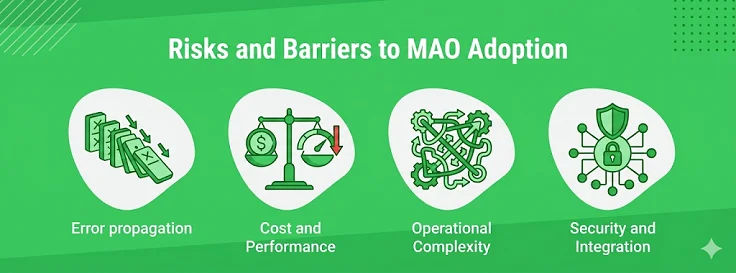
One of the most critical concerns is error propagation. In a multi-agent workflow, outputs are often passed between agents. If an early-stage agent introduces an inaccuracy, subsequent agents may unknowingly build on it, reinforcing the mistake. This creates a cascading effect in which errors become harder to detect as they move through the system. Without explicit validation layers, MAO can produce outputs that appear coherent but are fundamentally flawed.
Cost and performance considerations also become more pronounced. Multi-agent systems typically involve longer interaction chains, increased token usage, and more complex reasoning loops. Each additional step adds computational overhead, which can drive up costs and increase latency. In time-sensitive scenarios, this trade-off between depth of reasoning and response speed must be carefully managed.
Operational complexity is another major barrier. As the number of agents grows, so does the difficulty of maintaining visibility into how the system behaves. Debugging becomes more challenging because responsibility is distributed across multiple components. When something goes wrong, teams may struggle to determine whether the issue originated from a specific agent, the orchestration logic, or interactions between agents. This “diffuse responsibility” can slow down troubleshooting and reduce confidence in the system.
Security and integration risks must also be considered. Multi-agent workflows often require deep integration with internal systems, such as CRMs, ERPs, data warehouses, and external APIs. Without well-defined access controls and governance policies, this can expose sensitive data or create unintended vulnerabilities. Organizations must ensure that each agent operates within clearly defined permissions and that data flows are properly secured.
Finally, there is a human factor that cannot be overlooked: trust. Fully automated, multi-step decision-making can feel opaque or unpredictable to business stakeholders. Even when the system performs well, teams may hesitate to rely on it without clear visibility and control mechanisms. Building trust requires more than technical reliability — it requires being able to show, on demand, how and why a decision was made.
In practice, successful MAO adoption depends on balancing ambition with discipline. The goal is not simply to orchestrate more agents, but to design systems where coordination enhances reliability rather than undermines it.
How to Start with Multi-Agent Orchestration: A Practical Roadmap
You don’t need to overhaul your architecture to start multi-agent orchestration. The best implementations begin with focused, high-impact use cases, then expand as value is demonstrated. The aim is not the number of agents, but to introduce orchestration that genuinely improves work execution.
Step 1: Audit the workflows with the highest payoff potential
Start by identifying processes where orchestration can remove friction, reduce cost, or improve reliability. The strongest candidates typically share several characteristics:
- Repeated handoffs between people, teams, or systems
- Large volumes of unstructured or semi-structured information
- Noticeable delays caused by coordination or waiting time
- High reliance on manual review and validation
- A meaningful cost of error, rework, or inconsistency
These are the environments where MAO can compress effort, reduce latency, and introduce structured quality control.
Step 2: Start with a simple two-agent pattern
Avoid overengineering at the beginning. A two-agent setup, typically a worker agent and a controller (or reviewer) agent, is often enough to demonstrate value.
- The worker agent performs the primary task (e.g., drafting, analysis, classification).
- The controller agent validates, refines, or approves the output.
This pattern is easier to test, less expensive to run, and significantly more transparent than a complex multi-role system. It also provides a controlled environment to refine orchestration logic before scaling further.
Step 3: Add a human-in-the-loop for critical decisions
Automation should not replace judgment where risk is high. Introduce human validation layers for decisions that carry operational, financial, or legal consequences. This is particularly important for:
- Approvals that trigger downstream actions
- Financial transactions or cost-related decisions
- Customer-facing commitments or communications
- Legal, regulatory, or compliance-sensitive outputs
Human-in-the-loop checkpoints ensure that speed does not come at the expense of accountability.
Step 4: Define KPIs before expanding
Before adding complexity, establish how success will be measured. Without clear metrics, it becomes difficult to justify further investment or identify where orchestration actually delivers value.
Common KPIs include:
- Cycle time (how long a process takes end-to-end)
- Throughput (volume handled over a given period)
- Cost per case or transaction
- Review effort (time spent on validation and corrections)
- Error rate and rework frequency
- Escalation rate (cases requiring manual intervention)
These metrics provide a baseline for evaluating whether additional agents or orchestration layers are improving outcomes.
Step 5: Scale only after proving value
Expansion should be deliberate. Add new agents or increase orchestration complexity only when there is a clear, measurable improvement in performance, cost, or quality.
Premature scaling often leads to unnecessary complexity, higher costs, and reduced transparency. In contrast, incremental growth, guided by real performance data, ensures that each addition contributes tangible value to the workflow.
Build vs Buy: Choosing the Right MAO Approach
Once the initial value of multi-agent orchestration is established, the next strategic decision is how to implement it at scale. There is no single “correct” approach, only the one that aligns with the organization’s priorities, constraints, and long-term goals.
Some companies prioritize speed and ease of adoption. For these teams, starting with an existing orchestration platform is often the most practical option. Prebuilt tools can accelerate experimentation, reduce setup effort, and provide ready-made components for managing agents, workflows, and integrations. Frameworks such as LangGraph, CrewAI, and Microsoft's Semantic Kernel fall into this category, each trading flexibility for setup speed in different ways. This approach works well when the goal is to validate use cases quickly or deploy solutions with limited customization.
Other organizations operate in more complex environments where integration depth, governance, and control are critical. In these cases, building a custom orchestration layer may be more appropriate. A tailored approach allows teams to define how agents interact with internal systems, enforce strict access controls, and align orchestration logic with specific business processes. While this requires more upfront investment, it provides greater flexibility and long-term alignment with enterprise architecture.
For many businesses, the most effective strategy lies between these two extremes. A hybrid model that combines platform capabilities with custom development offers a balance between speed and control. Teams can leverage existing tools for standard functionality while extending them to meet specific integration, compliance, or performance requirements.
| Criterion | Platform-first | Custom-built | Hybrid |
|---|---|---|---|
| Time to first value | Fastest | Slowest | Moderate |
| Governance & control | Limited to platform | Full control | Control where it matters |
| Integration depth | Standard connectors | Arbitrary depth | Standard + custom where needed |
| Best fit | Validating a use case | Regulated, complex orgs | Most mid-to-large enterprises |
Ultimately, the decision is less about technology and more about the operating model. Organizations should consider:
- How quickly they need to deliver value
- How complex their workflows and integrations are
- How critical governance and compliance requirements are
- How much internal capability they have to build and maintain orchestration systems
Choosing the right approach early can significantly influence both the cost structure and the long-term sustainability of MAO initiatives.
Conclusion
Multi-agent orchestration marks a shift in enterprise AI, evolving from standalone tools to integrated, collaborative systems within core processes. This change helps organizations move to consistent, managed execution instead of isolated, one-off efforts.
The real benefit of MAO is not in sheer agent intelligence, but in bringing organization and control to intricate workflows. By clarifying responsibilities, embedding verification steps, minimizing redundant work, and supporting smarter decisions, MAO delivers tangible improvements in process efficiency and outcomes when used judiciously.
Still, implementing MAO brings its own hurdles, including increased complexity, budget impacts, and new oversight requirements. Achieving success is dependent on smart execution, strong metrics, and thoughtful scaling.
Organizations wanting to move from pilot programs to true workflow transformation must focus beyond using AI for isolated tasks. The greatest return comes from orchestrating how work happens across systems and teams, delivering smarter, more reliable operations aligned with strategic aims.
Frequently Asked Questions
Is multi-agent orchestration the same as agentic AI?
Not exactly. Agentic AI refers to individual AI agents capable of autonomous
reasoning and action. Multi-agent orchestration is the layer that coordinates
several such agents — assigning roles, sequencing tasks, and validating
outputs — so they function as one system rather than separate tools.
Does multi-agent orchestration always cost more than a single-agent setup?
Per execution, usually yes — more agent calls mean more tokens and more
coordination overhead. Measured at the workflow level, though, orchestration
often lowers total cost by reducing rework, manual review, and error-driven
delays.
How many agents does a typical MAO system need to start?
Most successful implementations start with two — a worker agent that performs
the task and a controller agent that validates it — before adding roles.
Updated on Jun 10, 2026