How to Turn AI-Generated Code into Production-Ready Web Applications: An Engineering Guide
Table of contents
- Quick Answer: The Web Engineering Gap
- Key takeaways
- Defining the Engineering Gap: Prototype vs. Production Web System
- What is AI-generated web application code?
- What is a production-ready web application?
- Capability Matrix: AI vs. Production Web Systems
- Why AI-Generated Web Applications Fail in Production
- 1. Weak full-stack architecture
- 2. Browser security model violations
- 3. API design and governance gaps
- 4. Performance engineering deficiencies
- 5. Missing observability layer
- Engineering Transformation Framework
- 1. Web architecture decoupling
- 2. Full-stack security hardening
- 3. API engineering and validation
- 4. Frontend performance engineering
- 5. Edge delivery optimization
- 6. DevSecOps and infrastructure as Code (IaC)
- 7. Distributed observability integration
- Production Readiness Checklist (Web-Focused)
- Typical Production Scenario: AI Web Portal Failure and Recovery
- Phase 1: Prototype success
- Phase 2: Production failure
- Phase 3: Engineering transformation
- When AI Is Enough - and When Engineering Is Mandatory
- Use case routing blueprint
- Frequently Asked Questions
- Strategic Direction: Partner with Emerline for Advanced Web Optimization and Custom Software Engineering
The rise of generative AI has fundamentally changed how web applications are built inside modern organizations. Today, product teams can generate full-stack web applications in minutes using natural language prompts - spanning React-based Single Page Applications (SPAs), Next.js Server-Side Rendering (SSR) platforms, and API-driven Node.js or Python backends.
However, this acceleration exposes a structural gap in modern software delivery: AI optimizes for code generation speed, while organizations require system reliability, security, and operational resilience.
In practice, most AI-generated web applications are locally functional but architecturally incomplete. They lack separation of concerns, production-grade security boundaries, performance engineering, and cloud-native deployment discipline. As these prototypes transition from isolated developer environments into distributed production systems, organizations must introduce formal engineering controls across the entire web stack.
This guide defines the framework required to transform AI-generated web code into secure, scalable, and production-ready web platforms.
Quick Answer: The Web Engineering Gap
AI can rapidly generate functional web applications - including UI components, REST/GraphQL APIs, and backend logic - but production-ready systems require robust web engineering. This includes secure authentication architecture, API governance, browser security controls (CSP, CORS, SameSite cookies), frontend performance optimization (Core Web Vitals), CI/CD automation, and distributed observability. Without these layers, AI-generated web applications inevitably fail under real-world traffic, security constraints, and operational load.
Key takeaways
- Architectural fragmentation risk: AI generates functional UI and API components but fails to maintain consistent system architecture across the full web stack.
- Production failure is not a code problem: Most failures occur not in code syntax or basic logic, but in missing non-functional requirements: security, scalability, observability, and deployment discipline.
- The browser as a hostile execution environment: Web applications operate in a public browser boundary where Content Security Policy (CSP), Cross-Origin Resource Sharing (CORS), token storage, and XSS mitigation are mandatory engineering concerns.
- Performance is a financial metric: Unoptimized JavaScript bundles, hydration issues, and missing Content Delivery Network (CDN) strategies directly degrade conversion rates, user retention, and infrastructure costs.
- DevSecOps is mandatory, not optional: CI/CD pipelines, infrastructure-as-code, and automated testing frameworks define whether AI-generated code can be safely deployed and maintained at scale.
Defining the Engineering Gap: Prototype vs. Production Web System
What is AI-generated web application code?
AI-generated web application code consists of frontend and backend artifacts produced by large language models from natural language prompts. Typical outputs include:
- React / Vue / Angular UI components
- Next.js SSR or SPA scaffolds
- Node.js / FastAPI backend endpoints
- CRUD-based database integrations
- Basic authentication flows and simple form validation logic
However, these outputs are generated in isolation. The fundamental limitation is structural: AI does not model system-wide constraints such as concurrency behavior, distributed failure modes, network boundaries, or deployment topology. It produces locally correct code, not globally consistent systems.
What is a production-ready web application?
A production-ready web application is a distributed system designed to operate reliably under real-world internet conditions. It must satisfy the following properties:
- Secure across browser, API, and cloud infrastructure layers.
- Resilient under concurrent traffic spikes and database connection exhaustion.
- Optimized for sub-second latency across global networks and volatile mobile connections.
- Maintainable across multiple collaborative engineering teams.
- Observable in real time across the full user request lifecycle.
- Deployable via automated, zero-downtime CI/CD pipelines.
Capability Matrix: AI vs. Production Web Systems
| System Dimension | AI-Generated Web Code | Production Web Application |
| UI Components | Functional visual layouts and basic state hooks. | Modular, component-driven, performance-budgeted architecture. |
| Backend APIs | Basic CRUD endpoints; missing runtime validation. | Versioned, schema-validated, and rate-limited APIs. |
| Authentication | Insecure defaults (e.g., JWTs stored in localStorage). | OAuth2 / OIDC + secure HttpOnly cookie strategy. |
| Browser Security | Completely missing CSP, CORS, or CSRF headers. | Hardened security header matrix and origin validation. |
| Performance Engineering | Oversized bundles, un-split code, hydration lag. | Core Web Vitals optimized with multi-tier edge caching. |
| CI/CD Pipelines | Manual local deployment or zip-file hosting uploads. | Fully automated delivery with blue-green/canary gates. |
| Observability | Disconnected console logs; no runtime insight. | Full-stack distributed tracing + Real User Monitoring (RUM). |
| Scalability | Single-instance execution profile; fragile state. | Cloud-native distributed systems with horizontal scaling. |
Why AI-Generated Web Applications Fail in Production
AI-generated systems fail not because they are syntactically incorrect, but because they are architecturally incomplete. When exposed to malicious request patterns, variable network speeds, and concurrent user loads, prototypes collapse across five vectors:
1. Weak full-stack architecture
AI tends to collapse architectural layers to make code run immediately with minimal setup. Frontend and backend logic are frequently tightly coupled, business logic leaks into presentation views, and shared state is unmanaged or inconsistently scoped. This leads to monolithic codebases that cannot be scaled or modified without full system rewrites.
2. Browser security model violations
Because AI solutions are domain-agnostic, they omit the mandatory security configurations required to run in a public browser. Common vulnerabilities include overly permissive CORS policies (Access-Control-Allow-Origin: *), token storage in localStorage (making them vulnerable to Cross-Site Scripting [XSS] theft), missing Content Security Policies (CSP), and a lack of Cross-Site Request Forgery (CSRF) mitigation strategies. These issues transform a functional UI into a data exposure surface.
3. API design and governance gaps
AI-generated APIs typically lack the controls required for large-scale interoperability. They routinely omit API versioning strategies (e.g., /api/v1 vs /api/v2), lack input schema validation (leaving endpoints open to injection or payload crashes), and miss rate limiting and request throttling. Standardized error contracts are non-existent, leading to information leakage through raw stack traces.
4. Performance engineering deficiencies
AI-generated frontend systems frequently violate Core Web Vitals thresholds. They deliver massive, un-split JavaScript bundles that drive up Interaction to Next Paint (INP) and Largest Contentful Paint (LCP) latency. For Server-Side Rendered (SSR) applications, this results in extreme hydration mismatches, where the client-side DOM structure drifts away from the server-rendered HTML payload, locking up the main execution thread.
5. Missing observability layer
Without a distributed observability strategy, production web applications run blind. There is no frontend error tracking to catch runtime JavaScript failures in end-user browsers, no distributed tracing across API layers to monitor database latency, and no correlation between frontend user events and backend server logs, preventing root-cause analysis during incidents.
Engineering Transformation Framework
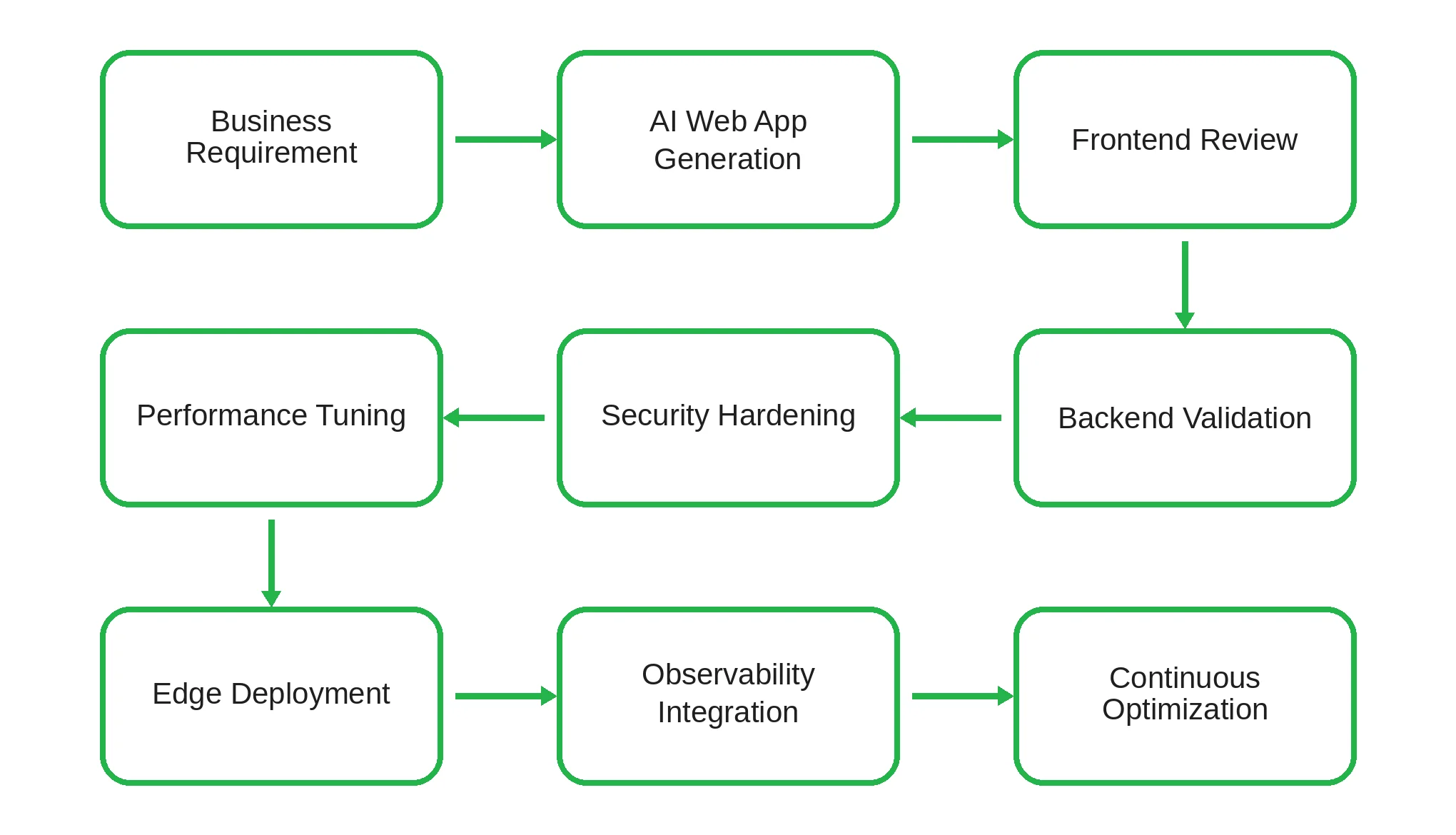
Transitioning AI-generated code into an production-grade web asset requires a structured, multi-tier engineering pipeline:
1. Web architecture decoupling
Break apart the monolithic outputs produced by AI. Separate frontend and backend concerns entirely by introducing an explicit API-first design model or a BFF (Backend-for-Frontend) tier. Isolate presentation elements from state orchestration using modular UI paradigms, and enforce clear boundary controls over business logic.
2. Full-stack security hardening
Align the codebase with OWASP Top 10 web standards. Move authentication handling from vulnerable browser variables into secure, HttpOnly, Secure, and SameSite=Strict cookie domains to immunize the application against XSS token harvesting. Configure application edge proxies to emit strict security response headers:

3. API engineering and validation
Wrap all generated endpoints in strict runtime schema validation libraries (such as Zod, Pydantic, or native OpenAPI enforcement). Establish a clear API versioning pathway and configure request rate limiters at the API gateway layer to prevent denial-of-service vectors and system abuse.
4. Frontend performance engineering
Enforce strict performance budgets across all route builds. Remediate AI-generated frontend debt by implementing automatic code splitting, route-based lazy loading, and intelligent asset optimization. Optimize Core Web Vitals to guarantee sub-second rendering speeds across desktop and mobile form factors.
5. Edge delivery optimization
Deploy compiled static web assets to global Content Delivery Networks (CDNs) to move application delivery closer to the user. Implement robust caching strategies at the edge, utilizing serverless edge functions for localized request routing, personalization, and A/B testing without hitting origin backend servers.
6. DevSecOps and infrastructure as Code (IaC)
Automate the build and deployment lifecycles completely to eliminate manual configuration errors. Pack application components into multi-stage Docker containers to minimize attack surfaces and deployment sizes. Script cloud topology using declarative IaC tools (like Terraform), and orchestrate deployments through automated CI/CD pipelines utilizing blue-green or canary release gates.
7. Distributed observability integration
Weave end-to-end monitoring into both client and server layers. Deploy frontend error tracking (such as Sentry) to catch unhandled browser exceptions, integrate Real User Monitoring (RUM) to audit live Core Web Vitals, and route backend telemetry through OpenTelemetry or Datadog, leveraging unique correlation tracing IDs to map single browser actions down to specific microservice transactions.
Production Readiness Checklist (Web-Focused)
Before decommissioning sandbox infrastructure and routing production web traffic to your application, infrastructure and development teams must validate the following parameters:
- Component modularity: UI elements are decoupled from business logic and broken into maintainable, performance-budgeted trees.
- State management scoping: Global and local state hydration models are cleanly defined with no memory leaks or redundant re-renders.
- API schema enforcement: All public endpoints utilize structural type validation to reject malformed or malicious network payloads.
- Token storage hardening: No private access keys, cryptographic tokens, or session configurations are exposed to browser localStorage.
- Security header compliance: Edge nodes correctly broadcast strict CSP, CORS, X-Frame-Options, and HSTS response profiles.
- Automated test coverage: Code changes must clear unit tests, cross-layer integration testing, and automated end-to-end user journeys (via Playwright or Cypress).
- CI/CD pipeline automation: Main branch promotions automatically trigger linting, vulnerability scanning, and containerized blue-green deployments.
- Observability trace correlation: Frontend RUM identifiers are securely appended to outgoing request headers, allowing complete distributed trace mapping.
Typical Production Scenario: AI Web Portal Failure and Recovery
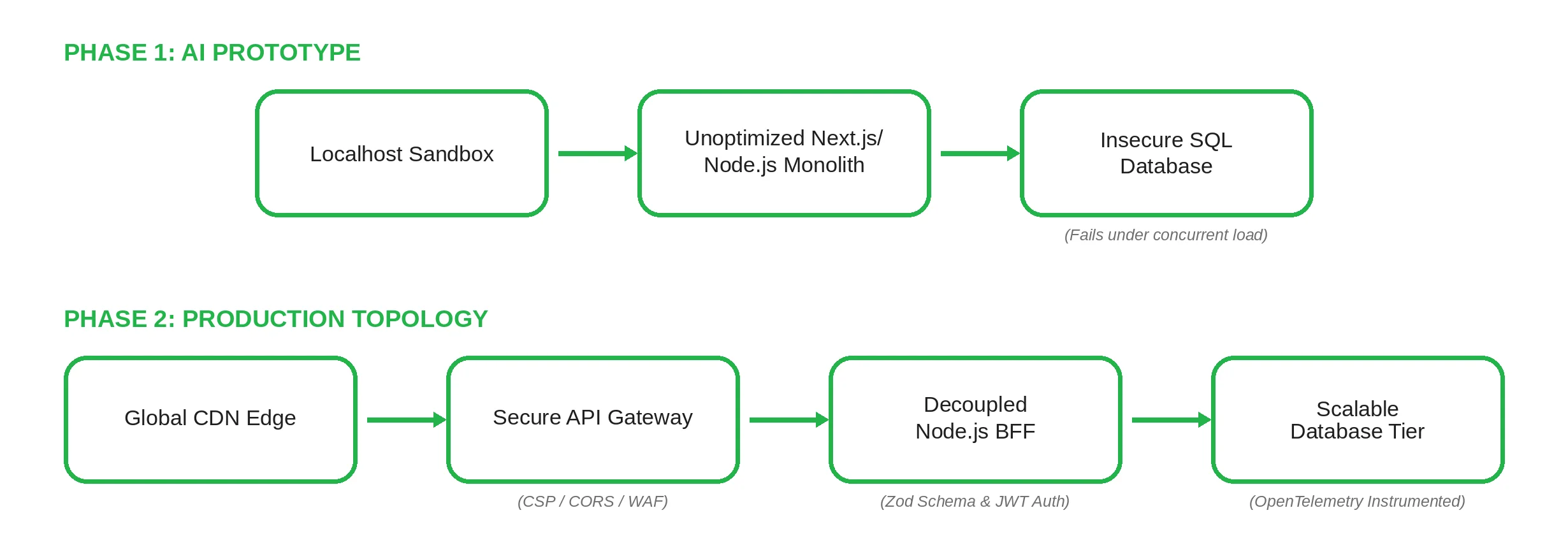
Consider a standard large-scale scenario: a line-of-business product group utilizes generative AI to rapidly build a new customer-facing account portal using Next.js and Node.js.
Phase 1: Prototype success
The application functions flawlessly in local developer sandboxes. It handles mock data quickly, screens render correctly on internal monitors, and basic CRUD flows work as intended.
Phase 2: Production failure
Once deployed to a cloud staging tier and exposed to real-world security scans and concurrent users, the application breaks. Unoptimized bundle sizes create severe rendering lag over mobile networks, the lack of input validation allows SQL injections to pass to the database layer, missing CORS policies expose API endpoints to foreign origins, and unhandled promise rejections crash the Node.js instances under moderate user concurrency.
Phase 3: Engineering transformation
Emerline engineering teams restructure the platform topology into a production-ready estate:
- Frontend optimization: Next.js is configured for optimized edge delivery, splitting pages into lightweight modules and hosting them via a global CDN.
- API hardening: A secure API Gateway is placed ahead of the backend, enforcing strict cross-origin restrictions, rate-limiting rules, and mandatory input validation via Zod schemas.
- Authentication modernization: Insecure storage models are replaced with encrypted session tokens handled exclusively via secure HttpOnly cookie protocols.
- Operational assurance: OpenTelemetry hooks are woven into the application layers, giving engineers instant insight into user experiences and database transaction times via centralized dashboards.
When AI Is Enough - and When Engineering Is Mandatory
Generative AI tools are highly effective when mapped to suitable web application use cases. Understanding the boundaries of autonomous code generation prevents systemic technical debt.
Use case routing blueprint
| Web Use Case | AI Alone | AI + Engineering Team |
| Static informational websites & marketing landing assets | Sufficient | Optional |
| Internal administrative dashboards & simple CRUD utilities | Risky | Recommended |
| Public customer-facing web portals | Deficient | Mandatory |
| Core Software-as-a-Service (SaaS) web platforms | Deficient | Mandatory |
| E-commerce engines & payment-integrated storefronts | Deficient | Mandatory |
| Highly regulated digital banking web applications | Deficient | Mandatory |
| High-concurrency, real-time Single Page Applications | Deficient | Mandatory |
Frequently Asked Questions
- Do we need to rewrite all our AI-generated UI components during modernization?
No. You do not need to discard the visual layout or component presentation layers created by AI. Web engineering focus is directed at refactoring the underlying architecture: decoupling data fetching from the UI blocks, optimizing component rendering cycles, wrapping fields in input validation schemas, and introducing structured state management.
- Can low-code web application engines completely replace traditional web code?
Low-code platforms (such as Retool or Microsoft Power Apps) are excellent solutions for internal administration tools, data entry forms, and departmental tracking applications. However, for high-traffic public web portals, complex SaaS platforms, and digital products that require pixel-perfect design control, optimized performance profiles, and multi-region deployment flexibility, custom web engineering remains essential.
- What happens if an AI-generated web app lacks a Content Security Policy (CSP)?
Without a strictly configured CSP header, a web application is highly vulnerable to Cross-Site Scripting (XSS) injections and data exfiltration. If a malicious script gains execution access to the browser session, it can read unprotected local storage keys, capture user keystrokes, and transmit sensitive data out to untrusted foreign domains without triggering any server-side alerts.
Strategic Direction: Partner with Emerline for Advanced Web Optimization and Custom Software Engineering
Transitioning an unmanaged AI prototype into a secure, globally performant, and horizontally scalable web platform requires an engineering partner with deep specialized capabilities across modern client-side architectures, serverless edge networks, and rigorous cloud security frameworks. Accelerating velocity should never mean compromising on platform governance. Simple architectural omissions in data validation tiers or domain security configurations can expose your corporate infrastructure to severe data leaks, system performance degradation, and critical failure points under live user concurrent loads.
As a strategic technology partner with more than a decade of dedicated software engineering excellence, Emerline helps startups, mid-market businesses, and large-scale organizations convert complex, high-friction development tasks into seamless digital solutions. Our unique advantage stems from our comprehensive technology stack expertise and full-cycle development DNA - spanning agile web engineering, UI/UX optimization, and scalable cloud solutions. We understand the fine balance between rapid prototyping and long-term stability, ensuring your full-stack web and cloud architectures support business growth while completely eliminating technical debt from your core applications.
Our elite engineering and cloud teams collaborate directly with your product owners, security officers, and technology leads to clean technical debt, integrate siloed line-of-business platforms, and deploy performant cloud-native solutions tailored to your exact regulatory and operational constraints.
Contact our web architects today to arrange a comprehensive technical readiness evaluation of your current web applications, streamline your global compliance footprint, and establish a secure, automated source of operational truth.
Published on Jul 8, 2026