AI Agents for Manufacturing: How Autonomous AI Is Transforming Industry
Table of contents
- Key takeaways:
- AI Agents for Manufacturing and Their Benefits
- What are AI agents for manufacturing?
- Business benefits of AI agents in manufacturing
- Increased efficiency and throughput
- Enhanced quality control and fewer defects
- Optimized supply chain management
- Process automation and optimization
- Data-driven decision-making
- Predictive maintenance and reduced downtime
- Resource optimization and sustainability
- Improved innovation and customization
- AI Agents vs. Traditional Automation in Manufacturing
- Rule-based automation
- RPA (robotic process automation)
- Analytics dashboards
- Manufacturing AI agents
- Key Components of AI Agents in Manufacturing
- Input layer: collecting operational context
- Brain layer: reasoning, planning, and context management
- Action layer: executing and coordinating workflows
- AI Agent Use Cases in Manufacturing
- Predictive maintenance and equipment reliability
- Production line optimization
- Supply chain risk management
- Warehouse automation and inventory optimization
- AI-powered defect detection and quality control
- Real-time operational monitoring
- Energy management and sustainability optimization
- How AI Agents Work in Manufacturing
- Stage 1: Real-time data collection and operational awareness
- Stage 2: Contextual analysis and adaptive learning
- Stage 3: Autonomous decision-making and workflow execution
- Stage 4: Exception handling and operational adaptation
- Stage 5: Enterprise integration and cross-system orchestration
- Challenges and Best Practices
- Key challenges
- Legacy PLC connectivity
- Poor data quality
- Alert fatigue
- Change resistance
- Best practices for successful AI agent adoption
- Start with a single high-impact use case
- Use a phased rollout and shadow mode
- Maintain human-in-the-loop governance
- Continuously monitor model drift
- Define strict operational safety boundaries
- The Future of AI Agents in Manufacturing: Key Trends
- AI-enhanced digital twins
- Multimodal AI agents
- Manufacturing-specific foundation models
- Deeper human-AI collaboration
- Greater interoperability and standardization
- Conclusion
Manufacturing is entering a new operational era shaped by intelligent automation, real-time industrial data, and increasingly autonomous decision-making systems. Global manufacturers are under growing pressure to improve production efficiency, reduce operational costs, strengthen supply chain resilience, address labor shortages, and respond more quickly to fluctuating market demand — all while maintaining product quality and minimizing downtime.
With this explosion of data, the primary challenge now extends beyond automation: to thrive in this new environment, continuous interpretation and coordinated action across production lines, warehouses, procurement systems, and enterprise platforms become essential. This shift sets the stage for new approaches to data-driven decision-making. In response to this complex landscape, enterprises are accelerating investment in artificial intelligence across industrial operations to address these new demands.
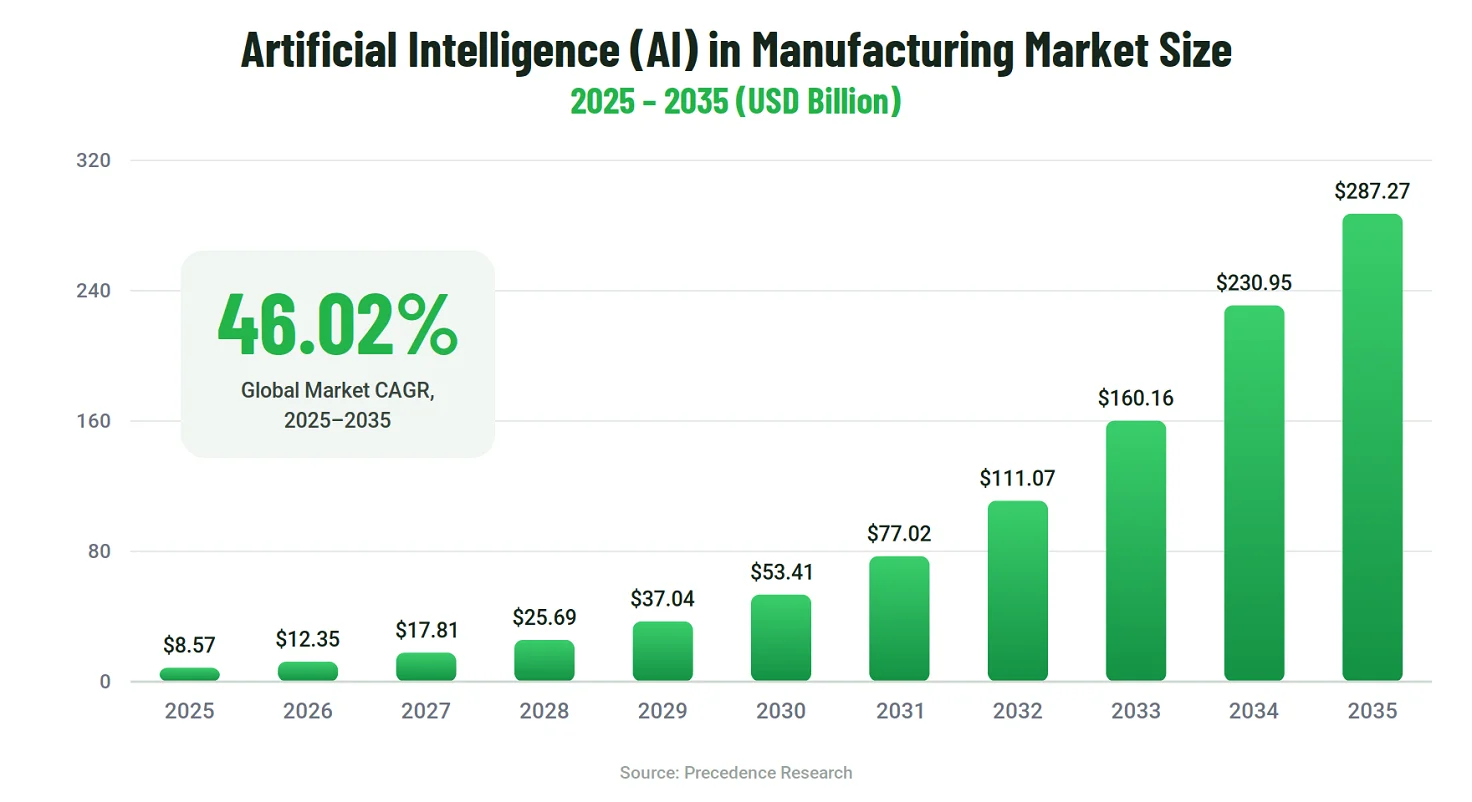
This focus on AI is apparent in recent market projections. According to market research, the global AI in the manufacturing market reached approximately USD 8.57 billion in 2025 and is projected to grow from USD 12.35 billion in 2026 to nearly USD 287.27 billion by 2035, expanding at a remarkable CAGR of 46.02% over the period. As investment surges, the deployment of AI is also evolving.
Equally important is the change in how AI is applied in practice, moving from isolated models to more integrated operational agents. This transition is at the core of the current industry transformation.
Traditional AI systems analyze data and generate forecasts, supporting decision-making. AI agents build on this by executing tasks, coordinating workflows, and escalating issues for human review. In manufacturing, they manage maintenance, optimize scheduling, detect quality deviations, and synchronize operational data.
Consequently, this technological shift prompts a new strategic conversation around industrial AI adoption. Manufacturing leaders are no longer only asking, “What processes can we automate?” Increasingly, the more important question becomes: “What operational responsibilities can intelligent systems safely manage?” That distinction marks the transition from automation to operational delegation.
AI agents now support production planning, factory coordination, maintenance, logistics, supply-chain visibility, and decision support under defined governance and human oversight.
In summary, understanding how AI agents are transforming manufacturing requires a closer examination of multi-agent architectures and the strategic considerations involved in large-scale deployment. The following sections will explore these topics in detail.
Key takeaways:
- AI agents move manufacturing beyond static automation. Unlike traditional rule-based systems, these agents interpret real-time industrial data. They coordinate workflows and adapt operational decisions dynamically across production environments.
- Manufacturers are adopting AI agents to improve efficiency, resilience, and operational visibility. These systems support predictive maintenance, production optimization, and quality control. They help with inventory coordination and supply-chain management, which reduces downtime and manual intervention.
- The future of industrial AI is operational delegation, not just analytics. Manufacturers now ask which responsibilities intelligent systems can safely manage, focusing on more than just task automation.
- Successful AI agent adoption depends on governance as much as technology. Long-term value requires reliable data pipelines and secure integrations. It also needs human oversight, operational safeguards, and phased deployment strategies. These must align with real manufacturing workflows.
AI Agents for Manufacturing and Their Benefits
Modern manufacturing environments depend on constant coordination between machines, production systems, suppliers, warehouse operations, quality-control processes, and enterprise software platforms. As industrial ecosystems become more connected and data-intensive, manufacturers need systems capable not only of analyzing information, but also of responding dynamically to operational changes in real time.
This is where AI agents begin to redefine industrial operations.
What are AI agents for manufacturing?
AI agents for manufacturing are intelligent software systems that can autonomously or semi-autonomously monitor, interpret data, make decisions, coordinate workflows, and execute tasks within interconnected manufacturing systems.
Unlike traditional automation, which follows rigid instructions, AI agents adapt to changing conditions, analyze multiple data sources, and take actions based on operational goals, constraints, and real-time events.
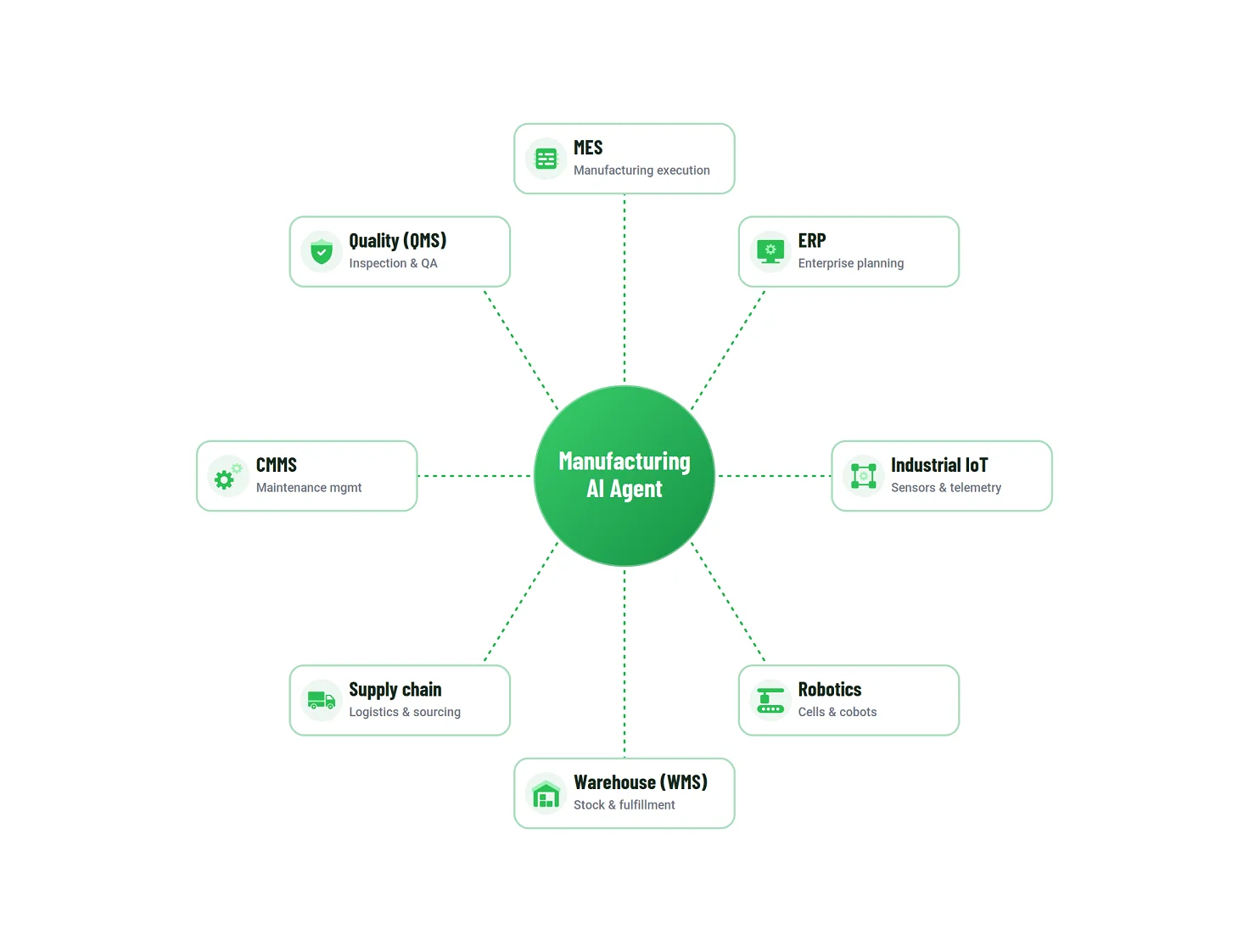
In manufacturing environments, AI agents may interact with:
- Manufacturing execution systems (MES)
- ERP platforms
- Industrial IoT sensors
- Robotics systems
- Warehouse management software
- Supply-chain platforms
- Predictive maintenance tools
- Quality-control systems
These agents optimize schedules, coordinate inventory, monitor equipment, detect anomalies, manage logistics, and escalate issues to human operators as needed.
Advanced implementations use multiple specialized AI agents collaborating across production, maintenance, quality assurance, procurement, logistics, and planning workflows.
As manufacturers move from isolated automation toward intelligent operational orchestration, the business value of AI agents becomes increasingly measurable across efficiency, resilience, quality, and decision-making.
Business benefits of AI agents in manufacturing
When deployed strategically, AI agents help manufacturers build faster, more adaptive, data-driven industrial operations that can continuously respond to operational complexity.
Increased efficiency and throughput
AI agents continuously monitor production flows, machine utilization, workforce allocation, and operational bottlenecks to improve throughput across manufacturing environments. By dynamically adjusting schedules, balancing workloads, and coordinating production activities in real time, manufacturers can reduce idle time, shorten production cycles, and improve overall equipment effectiveness.
Enhanced quality control and fewer defects
Manufacturing AI agents strengthen quality assurance by detecting anomalies, identifying process deviations, and monitoring production consistency across assembly lines. Through computer vision, sensor analysis, and real-time inspection workflows, agents help manufacturers reduce defect rates, improve product consistency, and minimize costly recalls or rework.
Optimized supply chain management
AI agents improve supply-chain coordination by simultaneously analyzing inventory levels, supplier performance, logistics conditions, procurement cycles, and demand fluctuations. These systems help manufacturers anticipate disruptions, optimize replenishment strategies, reduce inventory imbalances, and maintain smoother material flows across distributed operations.
Process automation and optimization
Industrial AI agents streamline repetitive operational workflows across production planning, maintenance scheduling, reporting, procurement coordination, warehouse operations, and administrative tasks. Unlike static automation systems, agents continuously adapt workflows based on changing operational conditions, which helps manufacturers improve responsiveness and reduce manual intervention.
Data-driven decision-making
Manufacturing organizations generate enormous volumes of operational data that often remain underutilized. AI agents consolidate and interpret information from industrial systems, production equipment, sensors, and enterprise platforms to deliver actionable operational insights. This enables leadership teams to make faster, more informed decisions grounded in real-time industrial intelligence, rather than delayed reporting cycles.
Predictive maintenance and reduced downtime
AI agents help manufacturers move from reactive maintenance toward predictive operational management. By continuously monitoring equipment behavior, vibration patterns, temperature fluctuations, and historical performance data, agents can identify early signs of equipment degradation and trigger maintenance workflows before failures disrupt production.
Resource optimization and sustainability
Manufacturers increasingly use AI agents to optimize energy consumption, raw material utilization, waste reduction, and production efficiency. Intelligent operational coordination helps organizations improve sustainability metrics, reduce operating costs, and support environmental compliance objectives.
Improved innovation and customization
AI agents enable greater manufacturing flexibility by supporting adaptive production environments that can handle customized products, variable production runs, and rapidly changing customer requirements. This allows manufacturers to accelerate product innovation while maintaining operational efficiency across increasingly personalized production models.
AI Agents vs. Traditional Automation in Manufacturing
Manufacturing has long relied on automation (from rule-based workflows to RPA and operational dashboards) to improve efficiency and process execution through predefined logic.
AI agents introduce a different operational model. Instead of simply executing programmed instructions, they can analyze changing conditions, reason across multiple data sources, coordinate decisions, and dynamically adapt workflows in real time. This shift enables manufacturing environments to move from reactive automation to more adaptive, intelligent operational systems.
The following comparison summarizes the key differences between traditional automation and manufacturing AI agents.
| System | What it does | Key limitation |
|
Rule-based automation |
Executes predefined workflows and deterministic business logic | Cannot adapt dynamically to changing operational conditions or unexpected scenarios |
| RPA (robotic process automation) | Automates repetitive digital tasks across interfaces and back-office systems | Limited contextual reasoning and weak adaptability outside predefined workflows |
| Analytics dashboards | Visualizes operational data, KPIs, and production metrics | Supports human decision-making, but does not act autonomously |
| Manufacturing AI agent | Monitors operations, analyzes conditions, coordinates decisions, triggers actions, and continuously improves workflows | Requires strong governance, operational safeguards, and human oversight |
Rule-based automation
Traditional automation follows predefined logic and routines and excels at repetitive, predictable tasks such as assembly-line coordination or machine scheduling.
However, rule-based systems struggle in environments where production conditions change frequently or where operational decisions require contextual interpretation. Any process deviation usually requires manual intervention or system reconfiguration.
RPA (robotic process automation)
RPA platforms automate repetitive digital tasks, such as data entry, invoice processing, production reporting, and ERP updates. In manufacturing environments, RPA is often used to reduce administrative overhead and improve operational consistency across back-office processes.
Though effective for structured workflows, RPA systems do not reason or adapt easily to changes or unexpected events without further programming.
Analytics dashboards
Manufacturing analytics platforms help organizations monitor KPIs, machine utilization, quality metrics, energy consumption, and supply chain performance. These systems provide valuable operational visibility and support data-driven decision-making.
However, dashboards remain passive systems. They visualize information but do not independently make decisions, coordinate workflows, or trigger operational actions without human involvement.
Manufacturing AI agents
Unlike static automation, AI agents combine data and context to enable adaptive decisions in manufacturing environments.
AI agents may coordinate predictive maintenance workflows, optimize production scheduling, identify quality anomalies, escalate operational risks, synchronize supply chain actions, or assist frontline teams in real time. They can also interact with ERP, MES, IoT, and industrial control systems across multiple operational layers.
Because these systems influence real production processes, they require strong governance frameworks, safety controls, auditability, and human oversight to ensure reliable and secure operation at scale.
Read our article on RPA in manufacturing to see how traditional automation complements modern AI-driven environments. Discover where robotic process automation offers the greatest operational value alongside AI agents.
Key Components of AI Agents in Manufacturing
AI agents in manufacturing are not single-purpose automation tools. They operate as interconnected systems that combine data processing, contextual reasoning, and operational execution to support real-time industrial workflows.
To function effectively, AI agents process information from multiple sources, interpret operational context, make decisions, and coordinate actions across systems. This enables them to support adaptive manufacturing operations at scale.
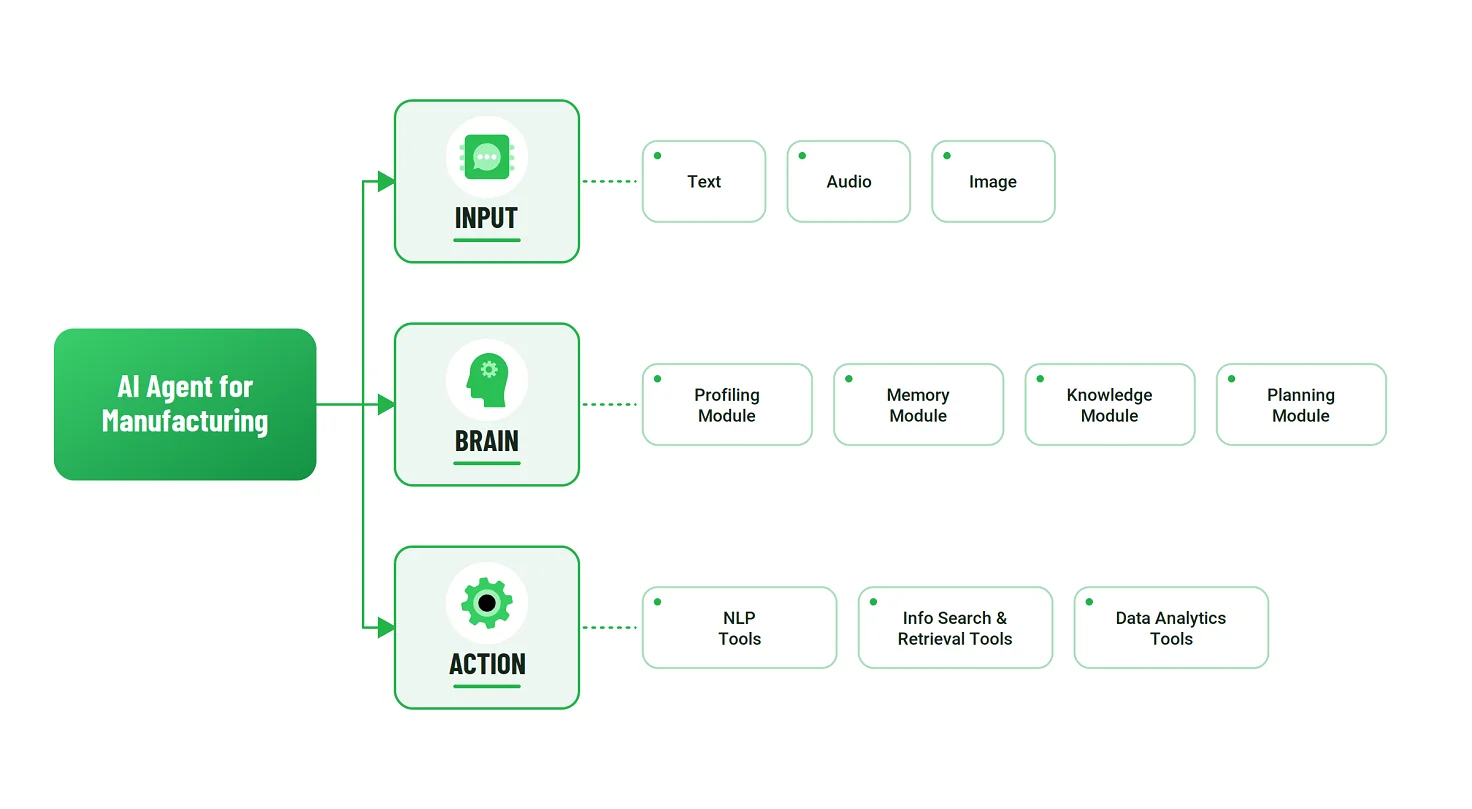
The diagram below illustrates how these functions are structured into three foundational layers, each building on the others to form the core of modern manufacturing AI agents: Input, Brain, and Action.
Input layer: collecting operational context
The Input layer enables the AI agent to receive and interpret information from multiple industrial and enterprise environments. In manufacturing, operational data is highly fragmented and may originate from production systems, IoT devices, ERP platforms, quality-control systems, operator interfaces, documents, images, or voice interactions.
Modern manufacturing AI agents increasingly support multimodal input processing, including:
- Text-based production data and reports
- Audio signals and operator communications
- Visual inputs such as images, video streams, or defect-detection feeds
This layer is essential because manufacturing decisions depend on multiple data sources. AI agents must gather operational context to understand production conditions and risks before recommending actions.
Without reliable input pipelines, even advanced AI systems cannot maintain accurate situational awareness inside dynamic production environments.
Brain layer: reasoning, planning, and context management
The Brain layer serves as the AI agent's decision-making core. This is where operational context is interpreted, priorities are evaluated, and workflows are coordinated.
Modern manufacturing AI agents typically combine several specialized modules:
- Profiling module — analyzes operational patterns, machine behavior, workflow history, or user interactions.
- Memory module — preserves contextual continuity across tasks, production cycles, and operational events.
- Knowledge module — accesses internal documentation, production standards, maintenance procedures, and enterprise knowledge bases.
- Planning module — determines the next best action, coordinates workflows, and adapts execution logic as conditions evolve.
Together, these modules allow AI agents to move beyond rigid rules toward adaptive reasoning.
For example, instead of simply reporting a machine anomaly, the AI agent may evaluate historical maintenance records, production schedules, inventory availability, and operational priorities before recommending or initiating corrective actions.
This layer transitions AI systems from analytics to active participation in operations.
Action layer: executing and coordinating workflows
The Action layer allows the AI agent to interact directly with manufacturing systems, enterprise applications, and operational workflows.
Once the agent determines an appropriate action, it can use connected tools and integrations to:
- Retrieve operational information
- Trigger workflows
- Generate alerts
- Coordinate maintenance actions
- Update enterprise records
- Support quality-control decisions
- Assist production teams in real time
Typical action-layer capabilities include:
- NLP and conversational interfaces
- Information retrieval systems
- Analytics and optimization tools
- Integrations with ERP, MES, SCADA, CRM, and IoT platforms
This layer is critical because value is created through coordinated execution. AI agents are most useful when insights are translated into controlled, traceable actions across environments.
At the same time, these actions must remain governed by safety controls, permissions, escalation rules, and human oversight to ensure operational reliability and compliance within production environments.
AI Agent Use Cases in Manufacturing
AI agents are increasingly being deployed across manufacturing environments to improve operational efficiency, reduce downtime, enhance quality control, and strengthen supply chain resilience. Unlike traditional automation systems, AI agents can continuously analyze changing production conditions, coordinate decisions across multiple systems, and trigger actions in real time.
Their value is most evident in complex environments that depend on large volumes of operational data, connected equipment, ERP systems, warehouse infrastructure, and dynamic supply chains.
The following sections provide specific examples of how AI agents address critical manufacturing needs and deliver measurable impact.
Predictive maintenance and equipment reliability
Unplanned equipment downtime remains one of the most expensive operational risks in manufacturing. AI agents help organizations move from reactive maintenance to predictive, condition-based maintenance strategies.
By continuously analyzing machine telemetry, vibration patterns, temperature fluctuations, maintenance history, and operational anomalies, AI agents can identify early signs of potential equipment failure before breakdowns occur.
Once risk thresholds are detected, the system can:
- Automatically schedule maintenance activities
- Generate CMMS work orders
- Recommend corrective actions
- Adjust production schedules to minimize operational disruption
This approach improves equipment reliability, extends asset lifespan, and reduces costly production interruptions.
Organizations implementing advanced predictive maintenance strategies increasingly rely on intelligent software that combines IoT monitoring, analytics, and AI-driven operational coordination.
Production line optimization
Manufacturing AI agents can continuously monitor throughput, cycle times, machine utilization, and production flow to identify operational bottlenecks across production lines.
Instead of relying solely on static scheduling logic, AI agents dynamically adapt workflows based on real-time production conditions. This may include:
- Redistributing workloads
- Adjusting production priorities
- Rerouting jobs between machines or production cells
- Optimizing scheduling parameters
These capabilities help manufacturers maintain smoother production flow, improve Overall Equipment Effectiveness (OEE), and increase operational agility under changing demand conditions.
Supply chain risk management
Supply chain disruptions continue to create significant operational challenges for manufacturers. AI agents help organizations improve supply chain resilience by monitoring ERP data, supplier lead times, inventory levels, procurement workflows, and demand fluctuations in real time.
When potential risks are detected, AI agents can:
- Identify possible material shortages
- Detect supplier delays
- Trigger procurement adjustments
- Recommend alternative sourcing options
- Notify operational teams before disruptions impact production
This proactive approach helps reduce stockouts, minimize production delays, and improve continuity across manufacturing operations.
Warehouse automation and inventory optimization
Modern operations need continuous visibility into inventory and warehouse utilization. AI agents support automation by monitoring stock, turnover, demand changes, and replenishment patterns across facilities.
Based on operational conditions, the agent can:
- Predict stockout or overstock risks
- Initiate replenishment workflows
- Dynamically rebalance inventory allocation
- Optimize SKU distribution across locations
This enables manufacturers to improve warehouse efficiency, reduce excess inventory costs, and maintain healthier inventory levels.
AI-powered defect detection and quality control
When integrated with industrial vision systems and quality-management platforms, AI agents can significantly improve quality assurance processes.
These systems continuously analyze visual inspection data and production signals to:
- Detect and classify defects in real time
- Isolate nonconforming products
- Trigger QMS workflows
- Recommend corrective production adjustments
- Optimize upstream machine parameters
This helps manufacturers reduce scrap rates, improve product consistency, and strengthen overall quality-control operations, while accelerating issue resolution across production lines.
Real-time operational monitoring
Manufacturing AI agents can continuously monitor IoT sensor streams, machine behavior, environmental conditions, and production performance indicators across industrial facilities.
When abnormal conditions or operational risks emerge, the system can:
- Detect unusual equipment behavior
- Escalate critical operational events
- Recommend corrective actions
- Adjust parameters within predefined safety thresholds
This real-time responsiveness enables faster incident management, reduces operational downtime, and helps prevent cascading failures across interconnected manufacturing systems.
Energy management and sustainability optimization
Energy efficiency and sustainability have become strategic priorities for many manufacturers. AI agents help organizations optimize energy consumption by coordinating operational workloads and monitoring facility-level resource utilization.
These systems can:
- Monitor real-time energy consumption
- Optimize HVAC and facility controls
- Reduce machine power usage during peak demand periods
- Coordinate energy-intensive workloads more efficiently
- Support ESG and sustainability reporting initiatives.
By aligning efficiency with sustainability goals, manufacturers can reduce energy costs and improve environmental performance.
How AI Agents Work in Manufacturing
Manufacturing AI agents function as adaptive operational systems. Their role goes beyond information gathering or generating recommendations; they monitor production environments in real time, interpret operational context, coordinate decisions, and trigger actions across interconnected industrial systems.
Unlike traditional automation, which depends on predefined workflows, AI agents continuously learn from changing production conditions and dynamically adapt their behavior as operations evolve. This allows manufacturers to respond more quickly to disruptions, optimize production flows more intelligently, and maintain greater operational resilience across complex environments.
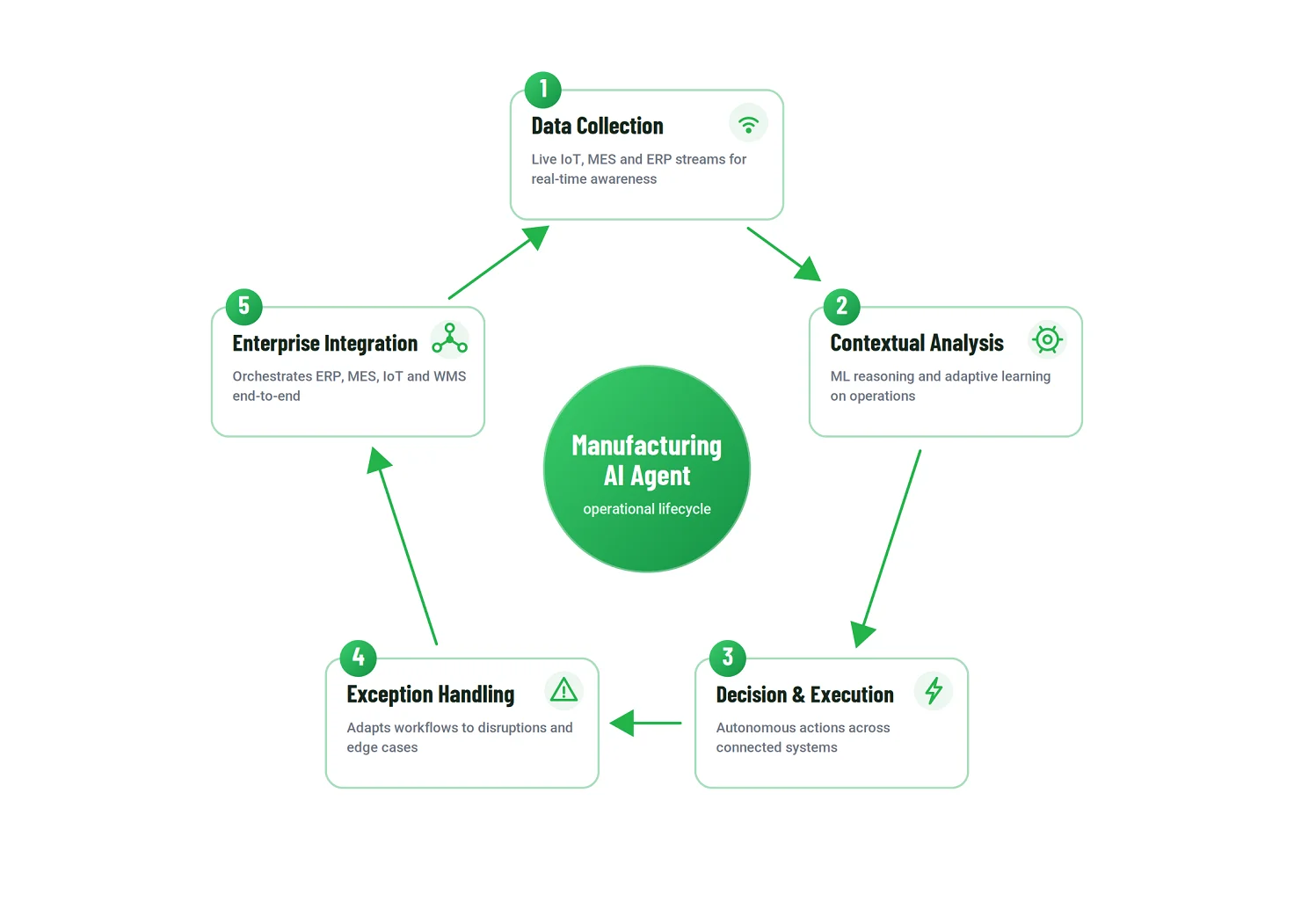
To clarify the operational lifecycle of a manufacturing AI agent, let's examine its main stages.
Stage 1: Real-time data collection and operational awareness
AI agents begin by continuously collecting live operational data from across the manufacturing ecosystem. This may include:
- IoT sensor streams
- Machine telemetry
- Production-line status
- Environmental conditions
- Warehouse activity
- ERP and MES data
- Quality-control systems
The goal is to maintain constant situational awareness across the factory floor.
Unlike static reporting systems that provide periodic snapshots, AI agents operate on a continuously updated operational context. This allows them to detect emerging issues, monitor production performance, and identify operational risks in real time as conditions change.
In modern manufacturing environments, this real-time perception layer forms the foundation for intelligent operational decision-making.
Stage 2: Contextual analysis and adaptive learning
Once operational data is collected, AI agents analyze it using machine learning models, reasoning systems, and contextual decision frameworks.
At this stage, the agent may:
- Detect production anomalies
- Identify performance deviations
- Forecast maintenance risks
- Recognize supply chain disruptions
- Evaluate workflow inefficiencies
AI agents adapt to evolving operational patterns. They learn from historical events, outcomes, maintenance history, and real-time feedback to improve decisions.
This adaptive capability is especially important in manufacturing environments where conditions, workloads, and operational constraints constantly change.
Stage 3: Autonomous decision-making and workflow execution
After evaluating the operational context, the AI agent can independently trigger actions designed to maintain production continuity and operational efficiency.
Depending on the use case, this may include:
- Adjusting production schedules
- Rerouting manufacturing tasks
- Reallocating resources
- Triggering maintenance workflows
- Escalating operational risks
- Coordinating supply chain actions
Unlike rigid, rule-based automation, AI agents can dynamically determine the most appropriate response to changing business conditions, rather than relying solely on predefined workflows.
This enables manufacturing systems to become more responsive, resilient, and operationally agile.
Stage 4: Exception handling and operational adaptation
Manufacturing environments are inherently unpredictable. Equipment failures, supplier delays, quality deviations, and production disruptions can occur at any time.
When unexpected events arise, AI agents can evaluate the situation, identify corrective actions, and adapt workflows accordingly. For example, the system may:
- Isolate operational anomalies
- Trigger escalation procedures
- Recommend alternative workflows
- Adjust production priorities
- Coordinate cross-department responses
Over time, the agent learns from these operational incidents and improves future responses through continuous feedback and performance analysis.
This capability helps manufacturers reduce downtime, improve operational continuity, and respond more effectively to disruptions.
Stage 5: Enterprise integration and cross-system orchestration
AI agents become significantly more valuable when connected to enterprise manufacturing systems.
Modern manufacturing AI environments often integrate with:
- ERP platforms
- MES systems
- Warehouse management systems
- Supply chain platforms
- CMMS environments
- IoT infrastructure
- Quality-management systems
These integrations allow AI agents to synchronize activities across departments and operational layers, rather than optimizing isolated tasks.
As a result, manufacturers gain more coordinated production planning, faster operational response, improved resource utilization, and greater visibility across end-to-end manufacturing workflows.
Challenges and Best Practices
Despite their potential, implementing AI agents in manufacturing introduces both technical and organizational complexity. Manufacturing environments often feature fragmented infrastructure, legacy industrial systems, operational constraints, and strict safety requirements, making AI deployment more challenging than traditional software development.
Successful adoption depends not only on AI capabilities themselves, but also on governance, rollout strategy, operational readiness, and long-term system management.
Below are some of the most common implementation challenges manufacturers face, along with the practices that help organizations deploy AI agents more successfully and safely.
Key challenges
Implementing AI agents is both a technology and operational transformation effort. Industrial environments often include legacy infrastructure, fragmented data, strict safety requirements, and established processes. These factors can create technical and organizational barriers to adoption.
Legacy PLC connectivity
Many manufacturing facilities still rely on legacy PLCs, industrial controllers, and older operational systems that were not designed for modern AI integration.
These environments often lack:
- Standardized APIs
- Modern communication protocols
- Real-time data accessibility
- Interoperability with cloud and analytics platforms
As a result, organizations frequently require middleware layers, custom connectors, or industrial integration frameworks to enable secure communication between AI agents and production infrastructure.
Poor data quality
AI systems depend heavily on reliable operational data. In manufacturing environments, however, data is often fragmented, incomplete or inconsistent, and stored across disconnected systems.
Poor-quality data can significantly reduce:
- Model accuracy
- Forecasting reliability
- Anomaly-detection performance
- Operational trust in AI outputs
Without strong data governance and preprocessing pipelines, even advanced AI systems struggle to deliver reliable operational value.
Alert fatigue
AI systems can generate large volumes of operational notifications, warnings, and recommendations. If alerts become excessive or poorly prioritized, operators may begin ignoring them altogether.
This phenomenon, often referred to as alert fatigue, reduces trust in the system and weakens operational responsiveness.
Manufacturing AI environments require carefully designed escalation logic, prioritization frameworks, and contextual filtering to ensure that alerts remain actionable rather than disruptive.
Change resistance
Operational teams may initially hesitate to trust AI-driven decision systems, especially in environments where production reliability and safety are critical.
Employees may fear:
- Reduced control over workflows
- Operational disruption
- Job displacement
- Unpredictable automated decisions
Without proper communication, training, and governance, organizational resistance can slow adoption even when technical implementation is successful.
Best practices for successful AI agent adoption
Successful AI agent adoption requires more than deploying advanced models. Leading manufacturers use phased implementation, strong governance, high-quality data, and human oversight. These practices lower risk while building trust, stability, and business value.
Start with a single high-impact use case
Organizations typically achieve better outcomes when they begin with narrowly scoped, high-value operational scenarios such as predictive maintenance, quality control, or warehouse optimization.
This approach helps demonstrate measurable business value before expanding AI deployment across broader manufacturing operations.
Use a phased rollout and shadow mode
Rather than enabling full autonomy immediately, many manufacturers first deploy AI agents in “shadow mode.”
In this model, the system observes workflows, generates recommendations, and validates decisions without directly controlling operations. This allows organizations to evaluate reliability, refine workflows, and build operational confidence before enabling autonomous execution.
Maintain human-in-the-loop governance
Human oversight remains essential, especially in high-risk manufacturing environments.
AI agents should initially support operators and decision-makers rather than fully replace operational control. Human-in-the-loop governance helps maintain accountability, improve trust, and reduce operational risk during adoption phases.
Continuously monitor model drift
Manufacturing conditions evolve constantly due to changing production environments, supplier variability, equipment aging, and operational adjustments.
Continuous monitoring helps organizations identify model drift, maintain accuracy, and retrain AI systems as operational conditions change over time.
Define strict operational safety boundaries
AI agents should operate within clearly defined permissions, escalation paths, and safety controls.
Organizations should establish:
- Operational guardrails
- Approval requirements
- Fallback procedures
- Audit logging
- Emergency override mechanisms
These controls are critical for ensuring reliability, compliance, and safe operation inside industrial environments.
Successful AI adoption in manufacturing is rarely achieved through rapid automation alone. The most effective implementations combine intelligent systems with strong governance, phased operational rollout, high-quality data practices, and continuous human oversight. When approached strategically, AI agents can become a powerful operational layer that improves resilience, efficiency, and long-term manufacturing agility.
The Future of AI Agents in Manufacturing: Key Trends
Manufacturing AI agents are evolving rapidly from isolated operational tools into intelligent coordination systems capable of managing increasingly complex industrial environments. As AI infrastructure matures, manufacturers are beginning to integrate AI agents more deeply into production operations, supply chains, quality management, sustainability initiatives, and enterprise decision-making.
Several technological and operational trends are expected to shape the next generation of manufacturing AI systems.
AI-enhanced digital twins
Digital twins are becoming significantly more sophisticated as AI capabilities are integrated into virtual manufacturing environments.
Modern digital twins no longer simply mirror physical assets. They increasingly simulate operational behavior, forecast equipment performance, model production scenarios, and optimize workflows dynamically using AI-driven reasoning.
This allows manufacturers to test operational strategies, predict disruptions, optimize maintenance planning, and improve resource utilization before implementing changes on the factory floor.
Multimodal AI agents
Future manufacturing AI agents will increasingly combine multiple forms of operational input within a single intelligent system.
These multimodal environments may integrate:
- Text-based operational data
- Images and video streams
- Machine telemetry
- Audio signals
- IoT sensor inputs
- Operator communications
By combining multiple data types simultaneously, AI agents gain richer contextual awareness and improve decision-making across complex industrial workflows.
Manufacturing-specific foundation models
The emergence of manufacturing-focused foundation models is expected to significantly improve industrial AI performance.
Unlike general-purpose AI systems, these models are trained on manufacturing-specific datasets, operational terminology, maintenance workflows, industrial documentation, production logic, and engineering environments.
As a result, they can better understand industry-specific processes, equipment behavior, operational constraints, and manufacturing decision patterns.
Deeper human-AI collaboration
The future of manufacturing AI is increasingly centered on augmentation rather than workforce replacement.
AI agents will continue evolving into operational copilots that provide:
- Real-time production guidance
- Contextual recommendations
- Risk analysis
- Maintenance support
- Workflow optimization assistance
Rather than replacing manufacturing teams, these systems will increasingly support faster decision-making and help operators manage growing operational complexity more effectively.
Greater interoperability and standardization
Industrial interoperability is becoming a growing priority across manufacturing ecosystems.
Industry organizations and technology vendors are actively developing standards and communication protocols that allow AI agents, industrial systems, IoT platforms, and enterprise applications to work together more seamlessly.
Improved interoperability will help reduce integration complexity and enable manufacturers to build more connected, scalable, and vendor-neutral AI ecosystems across production environments.
Conclusion
AI agents are transforming manufacturing, enabling organizations to replace static automation with adaptive, data-driven operations. Examples of AI applications include predictive maintenance, production optimization, supply chain coordination, and quality control. These systems improve efficiency, resilience, and visibility across complex industrial environments.
However, long-term value relies on robust architecture, secure integrations, operational governance, and a rollout strategy aligned with real manufacturing workflows, not just AI models alone.
If your organization is exploring AI agents for manufacturing, partner with Emerline to design and implement scalable AI solutions tailored to your operational goals, infrastructure, and industry requirements. Contact us to accelerate your digital transformation.
Published on Jun 19, 2026