AI Agents for E-Commerce: Smarter Digital Commerce
Table of contents
- Key takeaways:
- AI Agents for E-commerce and the Benefits They Offer
- Business and operational benefits of AI agents in E-commerce
- Strategic and business benefits
- Operational and functional benefits
- Automation, AI Tools, and AI Agents: Three Levels of Intelligent Commerce
- Key Components of an AI Agent in E-Commerce
- Perception layer
- Reasoning layer
- Memory layer
- Action layer
- AI Agent Use Cases in E-commerce
- Customer service and support agents
- Personalized shopping and recommendation agents
- Dynamic pricing agents
- Inventory and supply chain optimization agents
- Product content generation agents
- Fraud detection and risk management agents
- When the Buyer Is an AI Agent: Open Protocols and Agentic Checkout
- What E-Commerce Businesses Must Consider Before Deploying AI Agents
- Fragmented commerce data
- Integration complexity and organizational resistance
- Over-automation risks
- High implementation and maintenance demands
- Limited transparency and explainability
- The Future of AI Agents in E-Commerce
- The evolution of agentic commerce
- Governance, trust, and responsible AI adoption
- Strategic responsibilities for E-commerce leaders
- Conclusion
E-commerce is experiencing a digital transformation, because autonomous AI systems now analyze customer behavior, coordinate decisions, personalize interactions, and execute commercial workflows in real time. As online retail becomes increasingly competitive, brands must improve conversion rates, optimize operations, deliver personalized experiences, and respond quickly to evolving customer intent.
This shift is accelerating the emergence of agentic commerce.
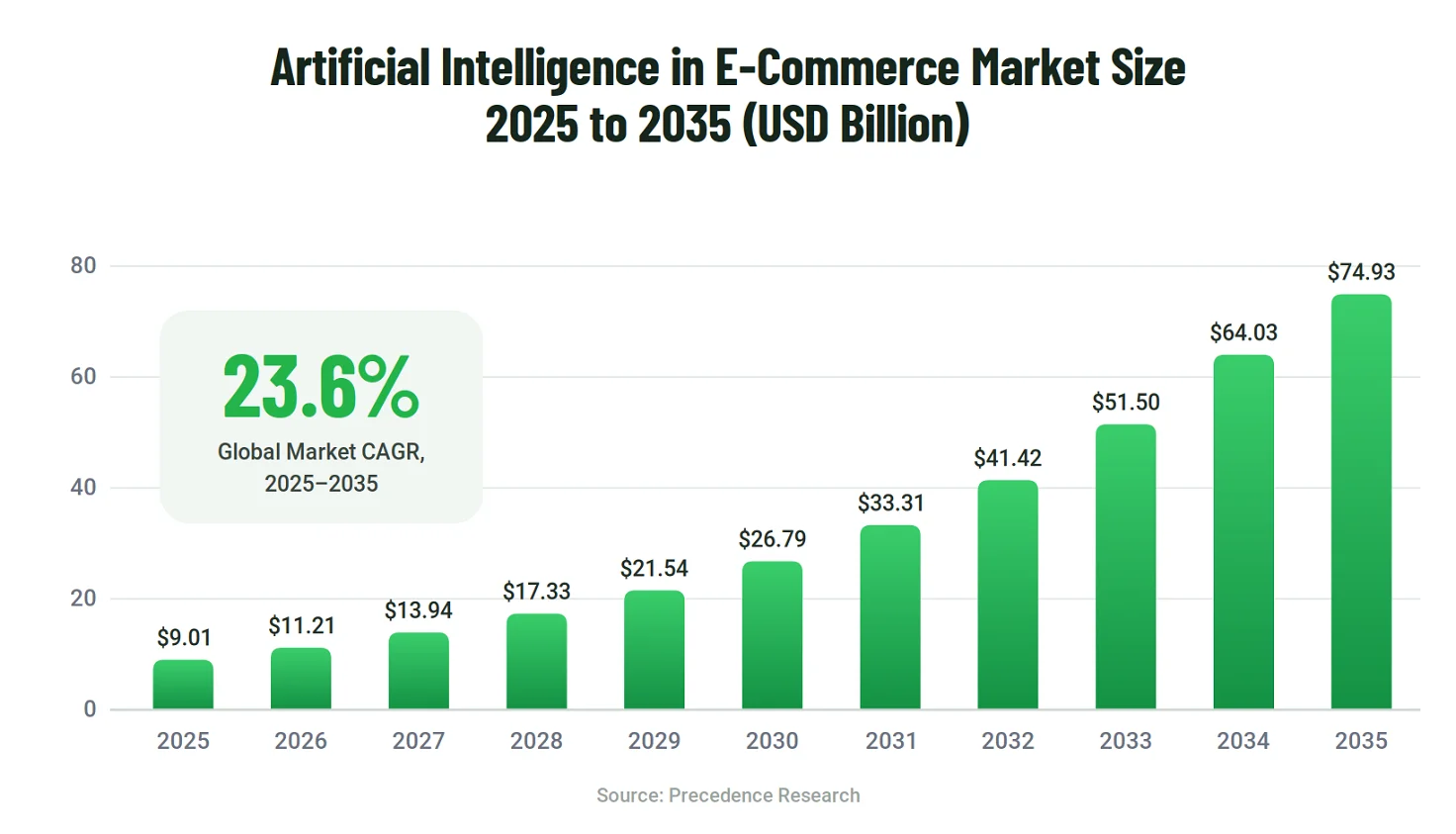
According to market projections, global artificial intelligence in the E-commerce market is expected to grow from $9.01 billion in 2025 to nearly $74.93 billion by 2035, expanding at a CAGR of 23.59%. At the same time, McKinsey estimates that agentic commerce could generate up to $1 trillion in orchestrated revenue within the US B2C retail market alone by 2030, while global projections may reach between $3 trillion and $5 trillion. Industry adoption is also rapidly expanding: forecasts suggest that by 2028, 33% of E-commerce enterprises will integrate agentic AI capabilities into their operations, compared to less than 1% today.
Retailers increasingly recognize the strategic importance of these systems. Research shows that 93% of E-commerce businesses already see AI agents as a competitive advantage capable of improving operational responsiveness, customer engagement, and digital commerce performance.
AI-driven suggestive selling is a key growth lever. AI agents will drive hyper-personalized discovery, contextual offers, and autonomous assistance. As the market moves from automation to intelligent coordination, AI agents are redefining how digital commerce is designed, managed, and optimized.
Key takeaways:
- AI agents are transforming E-commerce, advancing from basic automation to intelligent orchestration. These modern systems analyze data, coordinate workflows, and autonomously manage both operational and customer-facing tasks.
- Retailers are quickly investing in AI-driven commerce. Market projections show rapid growth in AI-powered E-commerce, and businesses increasingly see AI agents as a competitive advantage.
- AI agents increase operational efficiency and customer experience. They enable hyper-personalized recommendations, dynamic pricing, inventory optimization, and fraud detection, which helps businesses boost conversions, streamline operations, and cut costs.
- Achieving optimal results with AI agents relies on strong governance, seamless integration, and high-quality data. Gradual implementation, reliable connections to business data, and operational safeguards ensure effective oversight.
AI Agents for E-commerce and the Benefits They Offer
Modern E-commerce ecosystems must manage vast product catalogs, fragmented customer journeys, omnichannel interactions, and shifting demand. Retailers now need systems that go beyond automating single tasks to dynamically coordinate decisions and respond in real time. AI agents are redefining digital commerce operations by meeting these demands.
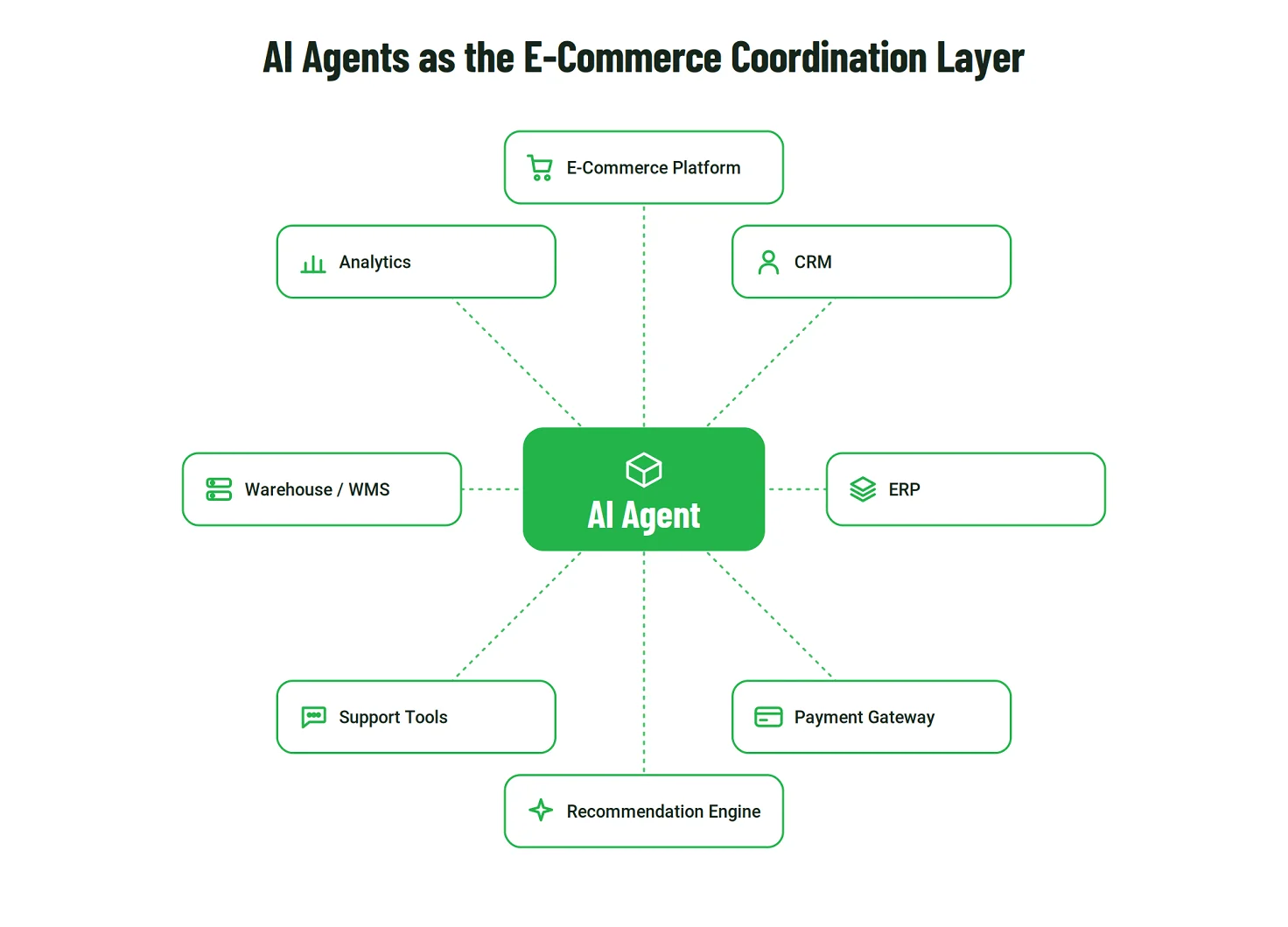
AI agents in E-commerce are intelligent software systems capable of autonomously analyzing data, making contextual decisions, coordinating workflows, and executing operational or customer-facing tasks across digital retail environments.
Unlike traditional automation, AI agents adapt to changing business conditions and interact with systems such as E-commerce platforms, CRMs, ERPs, payment gateways, recommendation engines, support tools, warehouse systems, and analytics tools.
In practice, AI agents may optimize product recommendations, personalize storefront experiences, coordinate pricing strategies, automate customer interactions, monitor fraud risks, manage inventory allocation, or support merchandising decisions in real time.
As online retail becomes increasingly data-driven and operationally complex, AI agents are evolving into an intelligent coordination layer that connects customer experience, business operations, and strategic decision-making.
Business and operational benefits of AI agents in E-commerce
When used strategically, AI agents help E-commerce companies build adaptive, data-driven, and responsive retail systems. Their value impacts engagement, efficiency, inventory, revenue, and business growth.
Strategic and business benefits
These benefits influence long-term commercial growth, organizational adaptability, operational resilience, and competitive positioning across digital retail markets.
- Product evolution and smarter decisions
To enable faster merchandising and product decisions, AI agents analyze customer behavior, product performance, and trends. Businesses spot emerging demand and refine offerings with real-time behavioral intelligence.
- Resource optimization and workforce transformation
AI agents automate repetitive operational tasks across support, merchandising, reporting, catalog management, and customer interaction workflows. This reduces operational overhead while allowing employees to focus on strategic, creative, and relationship-driven responsibilities that require human judgment and business expertise.
- Market expansion and knowledge management
AI agents help retailers scale into new regions, marketplaces, and customer segments by coordinating multilingual support, localized recommendations, dynamic pricing adaptation, and knowledge retrieval across distributed commerce operations. They also centralize operational intelligence, making institutional knowledge more accessible across teams and workflows.
Operational and functional benefits
These benefits directly improve day-to-day retail operations, customer experience management, transactional efficiency, and real-time commercial performance.
- Hyper-personalization and conversion
AI agents dynamically tailor product recommendations, search results, promotions, content, and customer interactions based on behavioral signals, browsing patterns, historical purchases, and contextual intent. This creates more individualized shopping experiences that improve customer engagement, increase basket size, and strengthen conversion rates across digital channels.
- Smart inventory and revenue management
To optimize stock allocation and pricing decisions, AI agents continuously monitor inventory levels, purchasing trends, supply-chain conditions, and demand fluctuations. This helps retailers reduce overstocks and stockouts, improve fulfillment efficiency, maximize product availability, and protect revenue opportunities during demand volatility.
- Advanced risk mitigation
AI agents identify suspicious behavior, monitor transactions, and flag potential fraud in real time. They aid compliance and risk assessment, reducing financial losses and ensuring smoother customer experiences.
Automation, AI Tools, and AI Agents: Three Levels of Intelligent Commerce
Automation, AI tools, and AI agents are often confused in E-commerce, but they represent distinct technologies with varying levels of intelligence and value.
Traditional automation executes set workflows based on rules. While AI tools add intelligence to generate content, analyze data, or assist with tasks, they still rely on humans. AI agents go further: they understand goals, make decisions, and interact with business systems using minimal human input.
Recognizing these differences helps organizations identify where AI can deliver the most value. The following comparison shows how each approach operates and contributes to E-commerce.
| Feature/dimension | Traditional automation tools |
AI-tools (non-agentic AI) |
AI agents |
| Core operating principle | Execute predefined workflows based on fixed rules, triggers, and conditions. | Use machine learning models or LLMs to generate, analyze,classify, or recommend content for a specific task. | Combine reasoning, planning, memory, and tool integration to achieve business goals autonomously. |
| Level of autonomy | Low. Performs only the actions explicitly programmed by humans. | Moderate. Produces intelligent outputs but typically requires human instructions and approval. | High. Independently determines actions, sequences tasks, and adapts. |
| Adaptability | Limited. Works effectively only with predefined scenarios and rules. | Flexible within a specific domain but lacks broader situational understanding. | Highly adaptive. Adjusts strategies, learns from context, and handles dynamic environments. |
| Human involvement | Continuous involvement is necessary to create, maintain, and update workflow. | Human guidance is required for prompts, validation, and decision-making. | Primarily exception-based oversight. Humans intervene mainly for approvals, governance, or to resolve non-standard situations. |
| Decision-making capability | None. Follows programmed logic without evaluating alternatives. | Limited. Can generate recommendations but does not independently act on them. | Advanced. Evaluates options, prioritizes actions, and makes context-aware decisions within defined boundaries. |
| System interaction | Usually operates within a single application or workflow. | Can connect to external systems but generally acts only when instructed. | Actively coordinates multiple platforms, APIs, databases, and business apps. |
| Learning and context retention | No memory or contextual awareness. | Limited session-based context depending on the model. | Maintains context, remembers previous interactions, and uses historical information to improve performance. |
| E-commerce example | Automatically sends an order confirmation email after purchase. | Generates product descriptions or marketing copies for catalogue pages. | Manages the entire returns process by validating requests, updating the CRM, coordinating logistics, and issuing refunds automatically. |
| Primary business outcome | Process efficiency and reduction of repetitive manual work. | Faster content creation, analysis, and support of decision-making. | End-to-end operational optimization, autonomous execution, and scalable business growth. |
Traditional automation improves digital process efficiency by automating repetitive, predictable tasks with predefined rules. These systems bring consistency and efficiency, but can’t adapt to change or surprises without human help.
AI tools, powered by machine learning and large language models, generate content, analyze data, and aid decision-making. They help marketers, customer service teams, and analysts in E-commerce by performing tasks, but they still rely on humans for guidance and evaluation.
AI agents represent the next stage in this evolution and bring the capabilities of 'agentic commerce' to life. Agentic commerce refers to the use of autonomous systems, like AI agents, that can act on behalf of a business to achieve commercial goals. Rather than focusing on isolated tasks, AI agents operate around goals and outcomes. By combining reasoning, planning, memory, and integration with business systems, AI agents in agentic commerce can independently determine which actions to take to achieve a desired result. Instead of merely generating a recommendation or completing a single step in a workflow, an agent can coordinate multiple actions across platforms, adapt to changing conditions, and continue working until the objective is achieved.
This distinction is particularly important in E-commerce environments, where business processes often span multiple systems and require ongoing decision-making.
Consider a product return request. An automation tool might trigger a confirmation email. An AI tool could generate a personalized response explaining the return policy.
An AI agent, however, could validate the request, check eligibility criteria, update customer records, create a return label, initiate a refund, coordinate with logistics providers, and keep the customer informed throughout the process, with minimal human involvement.
For this reason, AI agents should not be viewed simply as more powerful AI tools. The shift is not merely technological, but operational. Automation focuses on executing predefined tasks; AI tools assist with individual tasks; and AI agents focus on achieving business outcomes. In other words, the transition from automation to AI agents reflects a move from task-oriented assistance to goal-oriented execution. This change has the potential to fundamentally reshape how E-commerce organizations operate, scale, and serve their customers.
Key Components of an AI Agent in E-Commerce
AI agents in E-commerce are built from interconnected components that perceive, reason, remember context, and act, enabling these agents to manage complex workflows beyond simple automation.
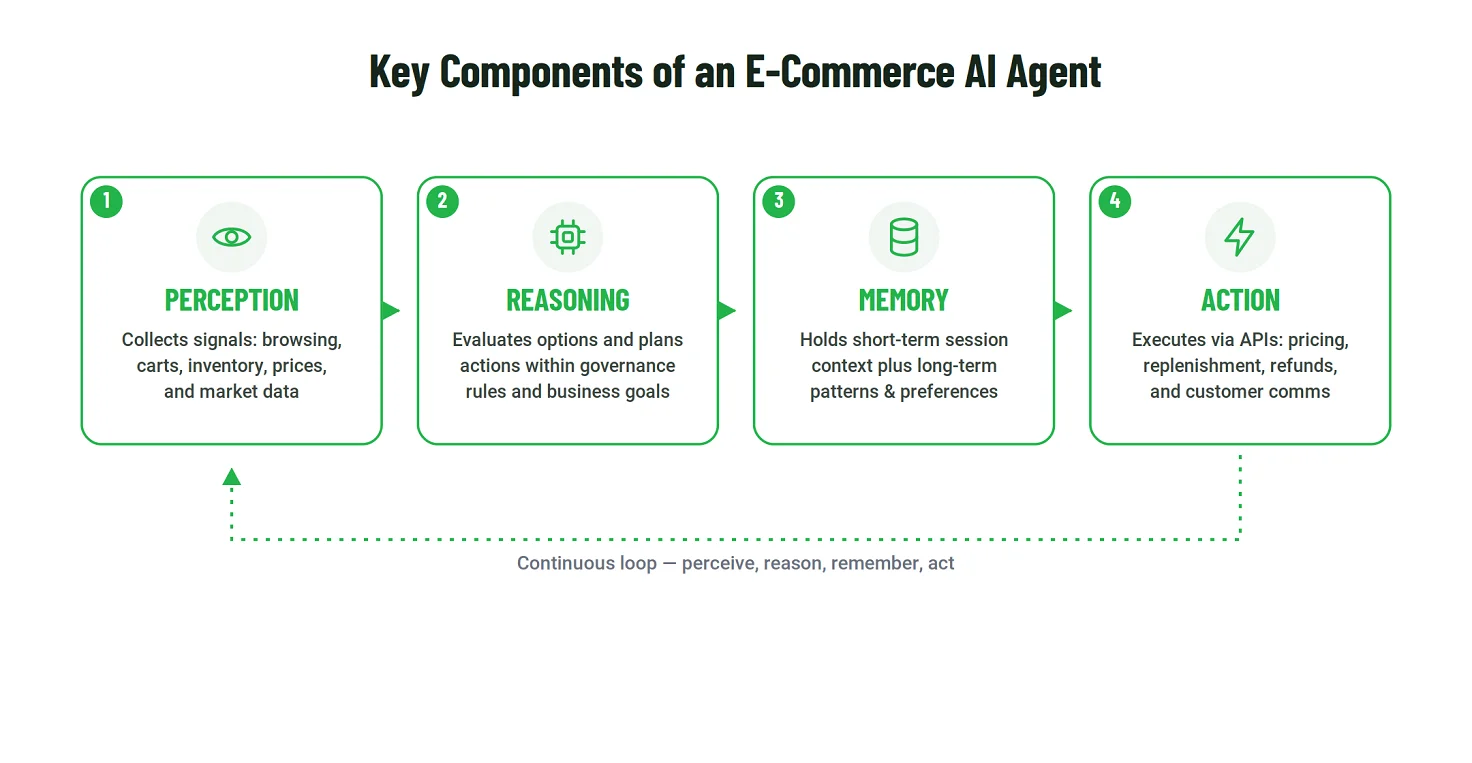
Most AI agents have four core layers: perception, reasoning, memory, and action. Each transforms raw data into business outcomes, allowing agents to understand, decide, remember, and execute tasks across systems.
Perception layer
The perception layer is the agent’s sensory system. It collects and interprets data from sources, such as customer interactions, operational metrics, inventory, market trends, and external signals, to support decision-making.
In E-commerce, the perception layer tracks browsing, searches, abandoned carts, feedback, stock, competitor pricing, and shipping. This current view is essential for informed decisions.
Reasoning layer
Often referred to as the agent's "brain," the reasoning layer analyzes incoming information, evaluates possible options, and determines how to achieve a given objective. Modern AI agents combine large language models with planning and reasoning mechanisms, enabling them to assess situations, prioritize tasks, and make context-aware decisions.
For instance, an agent noticing rising product demand and low inventory can evaluate responses, forecast outcomes, and choose strategies based on business goals and constraints.
To ensure reliability, this layer uses governance rules, business policies, and safeguards to ensure that decisions align with profit, compliance, and brand standards.
Memory layer
Memory lets agents retain context across interactions. Without it, each request is isolated, limiting the agent’s ability to provide personalized experiences.
Short-term memory tracks current customer requests, tasks, and session details. Long-term memory stores purchase patterns, preferences, demand trends, supplier metrics, and recurring issues.
Together, these memory types enable informed decisions and consistent, personalized experiences.
Action layer
The action layer turns decisions into outcomes. By integrating with APIs and business systems, the agent performs tasks in the E-commerce environment.
Depending on its role, an AI agent may update product information, modify pricing, initiate replenishment orders, generate customer communications, process refunds, coordinate logistics, or trigger marketing campaigns. Rather than merely recommending actions to human users, the agent can execute them autonomously while remaining within predefined operational boundaries.
| Component | Primary role | E-commerce example |
| Perception layer | Continuously monitors and interprets data from customers, operations, and external sources. | Detects that a best-selling product is experiencing unusually high demand while available inventory is rapidly decreasing. |
| Reasoning layer | Evaluates information, sets priorities, and determines the optimal course of action. | Concludes that inventory shortages may occur and develops a plan to secure additional stock while protecting profit margins. |
| Memory layer | Stores and retrieves contextual and historical information to support better decisions. | Uses previous supplier performance data to identify which vendor consistently delivers replenishment orders fastest. |
| Action layer | Executes tasks through connected systems, apps, and APIs. | Places a replenishment order automatically, updates inventory forecasts, and adjusts product availability information on the storefront. |
AI Agent Use Cases in E-commerce
AI agents go beyond automating tasks by using real-time data, context, decision-making, and integration with systems. In E-commerce, they manage processes like customer service, product discovery, inventory optimization, and fraud prevention to boost efficiency, enhance customer experiences, and increase revenue.
Below are some of the most impactful applications of AI agents across the modern E-commerce ecosystem.
Customer service and support agents
Best fit: Retailers with high inquiry volumes — order tracking, returns, account questions — across channels and time zones.
Technology: Unlike scripted E-commerce chatbots, these agents grasp intent, maintain context, and integrate seamlessly with business systems. They resolve order status, trigger returns and refunds, update accounts, and escalate sensitive cases directly to humans.
Business result: The reference case is Klarna: its AI assistant handled 2.3 million conversations in its first month — two-thirds of all customer service chats, equivalent to the workload of 700 full-time agents — while cutting average resolution time from 11 minutes to under two. Looking ahead, Gartner predicts that by 2029, agentic AI will autonomously resolve 80% of common customer service issues, reducing operational costs by 30%.
Risk: Wrong answers on pricing or policy questions can put the brand at risk. Klarna’s return to human agents for complex cases proves that escalation paths are critical, not optional.
Personalized shopping and recommendation agents
Best fit: Tailor-made for stores with complex catalogs and diverse audiences, where generic merchandising leaks revenue.
Technology: Agents analyze browsing, search, and cart activity, as well as context such as season and location. They adapt recommendations, promotions, and abandoned-cart recovery in real time.
Business result: Personalization is one of the best-quantified levers in retail: McKinsey estimates it can raise revenue by 5-15% and improve marketing efficiency. The scale of the opportunity has been visible for years: back in 2013, McKinsey estimated that 35% of what consumers purchase on Amazon came from algorithmic recommendations — a dated but telling benchmark.
Risk: Over-personalization can feel invasive and raise privacy and consent questions; recommendation logic also needs auditing for bias toward certain products or sellers.
Dynamic pricing agents
Best fit: Industries where demand swings and price battles are constant: electronics, fashion, travel — and marketplace sellers that compete on price daily.
Technology: Agents track competitor prices, demand, inventory, and promotions. They dynamically adjust pricing within strict business rules—floors, ceilings, margin targets, and brand constraints.
Business result: Margins are protected from both over-discounting and missed demand spikes, and the store reacts to market moves faster than any manual repricing team. McKinsey reports that its dynamic pricing clients have seen sales growth of 2-5% and margin growth of 5-10%.
Risk: Unconstrained pricing agents can wreck margins or create viral PR disasters. Hard rules and alerts are non-negotiable.
Inventory and supply chain optimization agents
Best fit: Retailers with multi-warehouse or multi-marketplace operations and pronounced seasonal or campaign-driven demand.
Technology: Agents forecast demand using historical trends and real-time signals. They spot stock risks instantly, trigger replenishment, propose alternative suppliers, and rapidly adjust merchandising to prevent disruption.
Business result: Fewer stockouts and overstocks, more efficient fulfillment, and working capital freed from excess inventory. McKinsey estimates that AI-driven forecasting can reduce errors by 20-50% and cut lost sales from product unavailability by up to 65%.
Risk: Forecasts are only as good as the data behind them. Fragmented or stale inventory data leads to confidently wrong orders — the data foundation comes first.
Product content generation agents
Best fit: Catalogs with thousands of SKUs, frequent launches, or multiple marketplaces and locales to maintain.
Technology: Agents turn technical specifications into customer-friendly, brand-consistent descriptions. They keep product information up to date across channels and maintain structured, machine-readable product data that AI shopping assistants rely on.
Business result: Catalog updates that took weeks, now are revised in hours, content stays consistent at scale, and products become easier to find — for humans and for AI agents alike.
Risk: Unreviewed generated content can misstate product facts, which is a liability, not a typo. Brand guidelines plus human spot-checks remain part of the workflow.
Fraud detection and risk management agents
Best fit: Retailers with heavy transaction flows, high-value goods, or significant cross-border sales.
Technology: Agents analyze transaction patterns, customer behavior, device and geolocation signals, and payment data. When orders exceed risk thresholds, they trigger additional verification, place orders on hold, or escalate for manual review.
Business result: Lower fraud losses with fewer false positives — legitimate customers see less friction, not more. Mastercard reports that clients of its AI-based Decision Intelligence scoring see roughly 20% higher fraud detection rates and 30% fewer false declines.
Risk: Overly aggressive thresholds block real buyers and quietly damage conversion; detection models need continuous monitoring and tuning.
When the Buyer Is an AI Agent: Open Protocols and Agentic Checkout
Everything above describes agents working for the retailer. Meanwhile, agents working for the customer are advancing even faster, forcing merchants to re-evaluate why they optimize.
The infrastructure was consolidated within months. In September 2025, Stripe and OpenAI released the Agentic Commerce Protocol (ACP), an open standard that lets businesses sell through AI agents using their existing commerce stack. In January 2026, Google and Shopify — together with Etsy, Target, Walmart, Wayfair, and other retailers — launched the Universal Commerce Protocol (UCP), an open standard covering the journey from discovery to checkout to post-purchase support, compatible with agent protocols such as MCP, A2A, and the Agent Payments Protocol (AP2). Assistants like ChatGPT, Gemini, and Microsoft Copilot are becoming shopping surfaces in their own right.
Merchants face a new battleground: discoverability and conversion. AI agents only recommend (or buy) what they can parse. Here’s what matters most now:
- Machine-readable product data: Structured feeds, complete attributes, and accurate availability and pricing become foundational: in agent-driven journeys, the product feed is the storefront.
- Checkouts and payments ready for agents. Rules like ACP and UCP show how agents make carts, pick options, and pay with safe codes — while the merchant stays in charge and keeps the customer engaged.
- Visibility in answer tools. Discovery moves from search pages to chat suggestions, so brands must learn how AI picks for fit and trust — a skill growing next to classic SEO.
- New analytics. When the “visitor” is an agent, traffic, attribution, and conversion need to be rethought.
Brands that treat product data as an API will dominate AI-driven discovery. Those clinging to traditional SEO risk vanishing from purchase journeys that bypass search results entirely. Preparing your store for AI shopping agents (feeds, protocols, and answer-engine optimization) demands a deep dive. That article is coming soon.
What E-Commerce Businesses Must Consider Before Deploying AI Agents
AI agents offer growing potential, but deploying them in E-commerce introduces significant technical and operational complexity, especially for businesses with fragmented infrastructure and diverse customer interactions.
Adoption depends on AI capabilities, data quality, integration strategy, oversight, and workflow management. Effective E-commerce teams see AI agents as a gradual transformation, not a one-time project.
Fragmented commerce data
The challenge:
Many retailers operate across disconnected commerce platforms, ERP systems, CRM environments, marketing tools, warehouse systems, and third-party marketplaces. When data remains inconsistent or siloed, AI agents may generate inaccurate recommendations, pricing adjustments, inventory forecasts, or customer-service decisions.
Best practice:
Centralize operational data before scaling AI agents. Use CDPs, unified analytics, and real-time APIs to create reliable sources for agent decisions.
Integration complexity and organizational resistance
The challenge:
AI agents must interact deeply with commerce infrastructure, operational workflows, and customer-facing systems. At the same time, internal teams may hesitate to trust autonomous systems, particularly when employees fear disruption to established responsibilities or decision-making processes.
Best practice:
Adopt AI agents gradually. Start with advisory roles where humans approve agent actions. Concurrently, train staff and update workflows to ease adoption.
Over-automation risks
The challenge:
Completely autonomous commerce workflows can create operational vulnerabilities when unexpected market conditions, inaccurate data, or system errors occur. Uncontrolled automation may lead to pricing inconsistencies, inventory issues, customer-service failures, or reputational damage.
Best practice:
Set operational guardrails and escalation rules. Use financial limits, anomaly detection, approvals, and human oversight for critical decisions.
High implementation and maintenance demands
The challenge:
Developing proprietary AI agent ecosystems from scratch often requires significant engineering investment, AI expertise, and infrastructure resources, as well as continuous operational maintenance. For many retailers, building entirely custom architectures may slow adoption and unnecessarily increase costs.
Best practice:
Use proven AI frameworks, cloud platforms, and composable commerce tools where possible. Focus resources on customizing business-specific elements and optimizing workflows.
Limited transparency and explainability
The challenge:
As AI agents become more autonomous, understanding why they made a particular operational decision becomes increasingly difficult. Limited explainability can weaken internal trust, complicate compliance requirements, and create operational uncertainty during high-impact decisions.
Best practice:
Implement decision tracking and audit mechanisms. Use logs, explainable outputs, and traceable recommendations to maintain visibility into AI actions.
Organizations that achieve the strongest results with AI agents typically balance automation with governance, operational oversight, and phased implementation. In E-commerce, sustainable AI adoption depends as much on operational discipline as on the technology itself.
The Future of AI Agents in E-Commerce
AI trends in digital commerce are moving far beyond traditional automation and recommendation engines. Retailers are increasingly adopting intelligent systems that coordinate decisions, manage workflows, personalize customer journeys, and execute operational tasks with minimal human intervention. As E-commerce ecosystems become more interconnected and data-intensive, AI agents are expected to evolve into a core operational layer powering everything from merchandising and logistics to customer engagement and autonomous purchasing experiences.
The evolution of agentic commerce
The first generation of AI in E-commerce focused primarily on basic automation tools, including rule-based chatbots, static recommendation engines, and predictive analytics systems designed to improve customer engagement and streamline repetitive workflows.
The next stage brought specialized AI agents for dynamic pricing, inventory optimization, marketing, customer service, and coordination. These help retailers respond intelligently to customer behavior and market changes in real time.
Next, AI agents will operate more autonomously, negotiating transactions, coordinating procurement, personalizing purchases, and handling multi-step workflows across platforms. Rather than isolated tools, AI will act as orchestration layers that manage complex interactions in digital commerce.
Governance, trust, and responsible AI adoption
As AI agents gain autonomy, strong governance is crucial. Preventing hallucinations and inaccurate outputs is essential to avoid negative impacts on pricing, communication, inventory, or transactions.
To reduce these risks, AI agents should use verified data from operational sources. Transparent reasoning, traceability, and escalation paths are key for trustworthy AI.
Retailers must address recommendation bias, privacy, compliance, and ethical data use. Customer trust relies on explainability, audits, permissions, and human review of crucial decisions.
As AI agents become more deeply embedded in digital commerce operations, governance will evolve from a technical consideration into a strategic business requirement.
Strategic responsibilities for E-commerce leaders
Success for leaders relies on building scalable strategies, not chasing trends. Organizations gain value by focusing on a few high-impact use cases with measurable improvements. Retailers will likely pilot customer support automation, inventory optimization, merchandising, or dynamic pricing, and validate results with controlled tests.
Long-term success depends on investment in data quality, system interoperability, and integration. AI agents need accurate, unified business data for reliable decisions.
The future of AI in E-commerce depends on balancing innovation, governance, trust, and control. Companies that blend intelligent automation and responsible practices will be best positioned in digital commerce.
Conclusion
AI agents are rapidly becoming a foundational layer of modern E-commerce operations. What began as isolated automation and recommendation systems is evolving into intelligent, adaptive commerce orchestration that coordinates customer experiences, operational workflows, merchandising strategies, inventory decisions, and real-time business actions across interconnected retail ecosystems.
For E-commerce organizations, AI agents present opportunities beyond efficiency. They offer greater responsiveness, personalization, and resilience, helping digital commerce environments adapt to changing expectations and pressures.
At the same time, successful adoption requires more than simply deploying AI models. Long-term business value depends on high-quality data, robust integrations, governance frameworks, operational transparency, and carefully designed human oversight. The organizations that approach AI agents strategically, balancing innovation with control, will be best positioned to sustainably scale intelligent commerce.
Whether your goal is customer engagement, inventory optimization, automated support, fraud prevention, or fully agentic workflows, AI agents are redefining modern E-commerce.
If your organization is considering AI agents for E-commerce, contact Emerline to discuss how we can help you design and implement solutions aligned with your business model, operations, and growth strategy.
Published on Jun 15, 2026