Choosing a Payment Gateway Software Development Company: Top US Vendors Compared
Table of contents
- The variables that actually drive the decision
- Key takeaways
- Build, Buy, or Orchestrate: An Honest Framework for Getting This Right
- Buy: Use a PSP directly
- Orchestrate: A custom routing layer across multiple PSPs
- Build: A fully proprietary gateway
- A 2026 addition: It's not just which vendor, it's which rails
- Quick self-test
- How We Evaluated Payment Software Development Companies
- PCI DSS scope and tokenization strategy
- Card network expertise
- Multi-PSP orchestration and resilience
- 3DS2, Strong Customer Authentication, and fraud prevention
- ACH and NACHA compliance
- Proven delivery experience
- Comparing Payment Software Development Companies
- A Closer Look at the Leading Payment Software Development Companies
- EPAM Systems
- Emerline
- Praxent
- DICEUS
- Softeq
- ELEKS
- Chetu
- Intellectsoft
- Payment Architecture Decisions That Matter Most
- Choose the right tokenization strategy
- Reduce PCI scope wherever possible
- Design every transaction to be idempotent
- Treat settlement as a separate engineering problem
- Separate critical services through event-driven architecture
- Score risk across multiple signals
- Treat 3DS2 as both a security and business decision
- Design for future payment rails
- The US Compliance Landscape for Payment Platforms
- PCI DSS: protecting cardholder data
- Card network rules: beyond PCI DSS
- NACHA: a different rulebook for ACH payments
- State licensing requirements
- SOC 2 Type II: operational trust beyond payments
- State privacy laws continue to expand
- What Does Payment Software Development Cost?
- Ongoing costs often overlooked during planning
- The factors that have the greatest impact on cost
- Six Questions That Reveal Real Payment Expertise
- Conclusion
- Frequently Asked Questions
- What's the difference between a payment gateway and a payment processor?
- Do we need PCI DSS compliance if we build a custom payment gateway?
- Is fraud detection really performed in real time?
- When is a payment orchestration layer a better choice than a single PSP?
- How long does it take to build a custom payment gateway?
- Which ongoing costs are most often underestimated?
Most comparisons of payment software development companies begin in the wrong place. They open with a ranked list, a feature matrix, and a set of logos; they skip the decision that determines whether any of those companies are relevant to your situation.
That decision is whether to build, buy, or orchestrate. It sounds like a preliminary question. In practice, it determines your Payment Card Industry Data Security Standard (PCI DSS) compliance footprint for the next several years, the latency profile of every transaction you process, and the operational overhead you incur when a card network updates its requirements. Getting it wrong early is expensive to reverse. Getting it right early makes the vendor selection that follows more straightforward.
The variables that actually drive the decision
- Latency compounds in ways that aren't obvious until scale.
A fraud check that adds 400 milliseconds per transaction is invisible when you are processing a hundred transactions a day. At a hundred thousand, it is a measurable drag on checkout conversion, and conversion loss at that volume has a number attached to it that your finance team will notice. The architecture decisions that feel acceptable in early testing tend to become constraints once the system is running under real load.
- PCI DSS scope is an ongoing cost, not a one-time compliance exercise.
The more cardholder data your system handles directly, the broader your compliance scope becomes. The broader your scope, the larger and more expensive your annual audit, the more controls you need to maintain, and the more surface area you expose to regulatory scrutiny. A well-considered architecture can deliberately reduce that scope. An unconsidered one expands it by default.
- Vendor lock-in is a trade-off with two sides, not a problem with one solution.
Building proprietary payment infrastructure eliminates the per-transaction fees charged by payment service providers. It also means your organization now owns fraud modeling, network uptime, and card scheme relationships that the PSP used to manage on your behalf. Neither path is inherently wrong. Both carry costs that are easy to underestimate when the decision is framed purely as a build-versus-buy cost comparison.
This guide starts where the decision actually begins: with a candid assessment of the build vs. buy vs. orchestrate question and the variables that should drive it in your situation.
From there, it applies a transparent, verifiable methodology to evaluate companies that develop custom payment infrastructure in the US market, covering technical capability, compliance track record, integration depth, and the engagement model that determines whether a vendor relationship holds up beyond the initial delivery. This matters most for fintech companies building payment capabilities on top of regulated financial infrastructure.
If you already know what you need to build and are looking for a shortlist, go to the company profiles further down the page. If you are still working through the architecture decision, start with the section that follows.
Key takeaways
- Architecture drives compliance. PCI DSS scope is determined as much by system design as by security controls.
- Choose the right development path. Hosted PSPs, orchestration platforms, and custom gateways each solve different business problems and suit different stages of payment maturity.
- Evaluate vendors beyond technology stacks. Production payment expertise shows up in architectural decisions, compliance knowledge, and verifiable delivery experience.
- Plan for operating costs. Certification, infrastructure, fraud prevention, and compliance updates continue long after launch.
- Build for future growth. Rail-agnostic architecture and modular payment services make it easier to support new payment methods without rebuilding the platform.
Build, Buy, or Orchestrate: An Honest Framework for Getting This Right
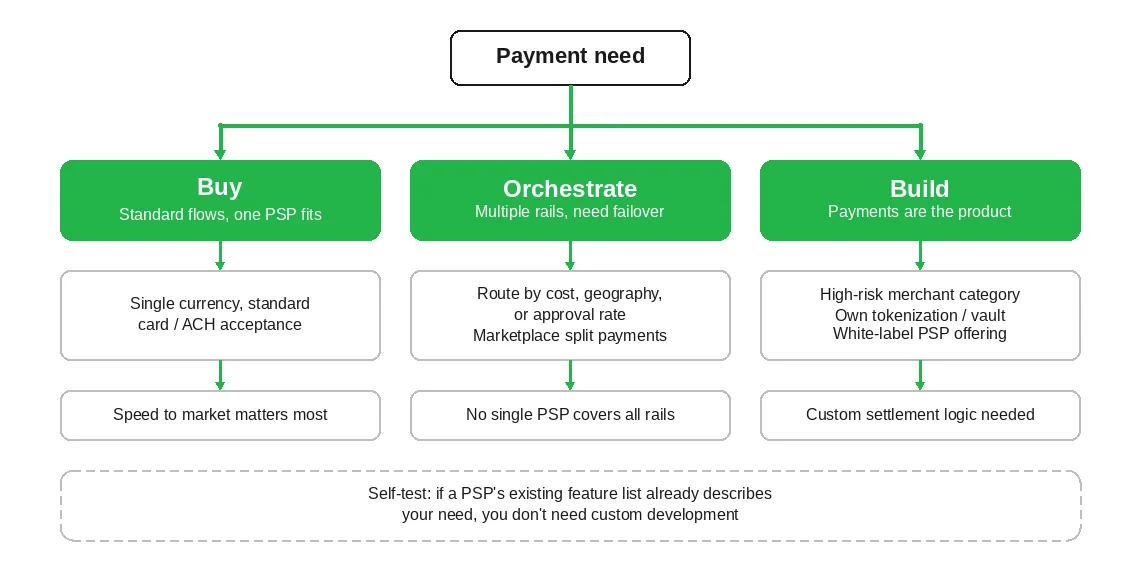
Most companies approach this decision backward, because they evaluate vendors before clarifying the payment infrastructure their situation actually requires. The result is predictable: companies that would be well-served by a payment service provider will commission custom builds they'll struggle to maintain, while platforms that genuinely need orchestration settle for a single payment service provider and discover its limits at the worst possible moment. The three-path framework below is designed to correct that.
Buy: Use a PSP directly
Stripe, Adyen, Braintree, Authorize.Net, and their peers
This is the right path for many companies. A mature PSP handles card network relationships, fraud tooling, chargeback management, PCI DSS compliance scope, and uptime — operational responsibilities that consume meaningful engineering and compliance resources when owned in-house. If your payment flows fit within a PSP's existing feature set, buying rather than building is not a compromise; it's the economically rational choice.
This path fits when:
- Your volume and transaction profile are standard: single-currency acceptance, conventional card and ACH flows, and no custom split-payment logic between multiple recipients.
- Processor switching based on real-time cost or approval rate optimization is not part of your operating model.
- Time-to-market carries more weight than infrastructure ownership, and the per-transaction fee is a cost of doing business, not a strategic problem to engineer around.
Orchestrate: A custom routing layer across multiple PSPs
This is where most growth-stage and enterprise payment operations belong, and where the build-vs-buy framing tends to mislead. Orchestration is a distinct architectural pattern that gives you PSP flexibility without the full operational burden of owning a gateway. You own the routing logic; the PSPs own the rails.
This path fits when:
- Resilience is non-negotiable: if a processor goes down or begins declining transactions at an anomalous rate, your system needs to automatically route to an alternative — without manual intervention.
- You are actively optimizing authorization rates, processing costs, or geographic coverage across multiple processors, and a single PSP's routing decisions are not sufficient to meet your margin or conversion requirements.
- Your payment method mix spans cards, ACH, BNPL, and digital wallets, in combinations that no single PSP can handle with equal depth.
- You operate a marketplace or multi-vendor platform that requires split payments, sub-merchant settlement, or revenue distribution across multiple recipients at the transaction level.
Build: A fully proprietary gateway
Custom gateway development is the right answer for a specific and relatively narrow set of situations. It carries the highest upfront cost, the longest timeline, and the most sustained operational ownership of any path on this framework. For the companies that genuinely need it, none of that changes the outcome.
This path fits when:
- Your merchant category is declined or priced punitively by mainstream processors, and the economics of high-risk acquiring make owning your own gateway the only viable long-term model.
- Tokenization and card vaulting need to sit entirely within your own infrastructure, whether for regulatory reasons, data architecture requirements, or the commercial value of the vault itself.
- Payments are not a feature of your product; they are the product. You are building a PSP, launching an embedded finance offering, or delivering a white-label payment platform that other businesses will operate under their own brand.
- Your settlement logic, such as escrow arrangements, delayed payouts, and multi-party revenue-share distributions, is sufficiently bespoke, so that no available off-the-shelf tool can accommodate it without becoming a liability.
A 2026 addition: It's not just which vendor, it's which rails
Card-network thinking still dominates most build-vs-buy conversations, but the underlying infrastructure of US payments has shifted in ways that the framework above doesn't fully capture.
FedNow and the Clearing House's Real-Time Payments network now settle funds between bank accounts in seconds rather than days. For a deeper look at how this account-to-account infrastructure works end to end, see our guide to open banking. A custom gateway built without at least a considered position on instant-payment rails is already operating on assumptions that are aging out. Similarly, if your platform needs to support BNPL as a first-class checkout option or B2B settlement flows that touch stablecoins or digital assets, the orchestrate-or-build path becomes increasingly difficult to avoid. The same logic applies to bank-initiated alternatives to card billing, such as Variable Recurring Payments, which are rapidly maturing as a Direct Debit alternative in the UK and EU. Most established PSPs still treat these as peripheral capabilities rather than core payment methods, which means their native support reflects that prioritization.
Rail selection is no longer a post-architecture detail. It belongs in the same conversation as processor selection. For platforms being built or significantly re-architected in 2026, it should influence the build-vs-buy decision itself.
Quick self-test
Before moving to any vendor evaluation, apply this filter: if you can describe your payment requirement using the pricing-page language of a PSP, you do not need custom development. Instead, you need a well-configured PSP and possibly a lightweight orchestration layer on top. If your description includes terms like "split settlement," "escrow," "white-label," "our own vault," or "custom acquiring," you are in build territory, regardless of how the initial scoping conversation frames it.
How We Evaluated Payment Software Development Companies
Choosing a payment software development partner isn't simply about company size, hourly rates, or years in business. Payments operate in one of the most tightly regulated technology domains, where architecture decisions directly influence compliance, operational resilience, transaction costs, and customer trust.
That's why our evaluation focuses on technical and operational capabilities that can be independently verified. Each criterion below reflects questions you can raise during vendor discussions and expect clear, evidence-based answers to.
PCI DSS scope and tokenization strategy
PCI DSS compliance is often presented as a simple checkbox, but the implementation approach can significantly affect both development complexity and long-term operating costs.
One of the first questions to ask is which Self-Assessment Questionnaire (SAQ) the proposed architecture is designed to support. An SAQ A approach — where cardholder data never reaches your infrastructure — creates a much smaller compliance footprint than an SAQ D environment, where your organization assumes responsibility for protecting sensitive payment data.
A vendor with real payment expertise should be able to explain these architectural trade-offs, describe how tokenization is implemented, and justify why a particular compliance model fits your business.
Card network expertise
Building payment software requires much more than integrating with a payment gateway.
Production payment systems operate within the rules established by major card networks, including Visa and Mastercard, which govern areas such as interchange qualification, merchant category codes (MCCs), dispute management, and chargeback processing.
Experienced payment engineering teams understand how these rules influence system design, transaction routing, and operational processes.
Multi-PSP orchestration and resilience
Many modern payment platforms connect to multiple payment service providers to improve approval rates, reduce costs, or support geographic expansion.
When evaluating vendors, look beyond claims of "multi-provider support." Ask how routing decisions are made, what triggers failover between providers, how health monitoring works, and how these scenarios are tested before production deployment.
A resilient orchestration layer should continue processing payments, even when one provider experiences degraded performance or temporary outages.
3DS2, Strong Customer Authentication, and fraud prevention
Fraud prevention has become a balance between reducing financial risk and maintaining a smooth customer experience.
Rather than relying on broad claims about AI-powered fraud detection, ask practical questions about the solution itself. Which data signals feed the fraud models? How are authentication decisions made? What mechanisms exist to minimize false declines, while remaining compliant with 3D Secure 2 (3DS2) and Strong Customer Authentication (SCA) requirements?
Teams with production experience can discuss measurable outcomes, not just the technologies involved.
ACH and NACHA compliance
If your payment platform supports Automated Clearing House (ACH) or bank transfers, card expertise alone is not enough.
ACH payments follow the National Automated Clearing House Association (NACHA) Operating Rules, which define requirements for authorization, settlement, returns, and risk management. These processes differ substantially from card payments and require dedicated implementation knowledge.
Vendors with genuine payment experience understand these distinctions and design systems that appropriately address both payment rails.
Proven delivery experience
Perhaps the simplest validation method is asking for evidence.
Look for named clients (where confidentiality allows), documented case studies, measurable business outcomes, and technical examples that demonstrate experience with payment systems in production.
Strong vendors rely on verifiable delivery history rather than broad claims about innovation or technical excellence.
Comparing Payment Software Development Companies
No payment software development company fits every project. Some specialize in large-scale payment infrastructure for financial institutions, while others focus on embedded payments, merchant platforms, or payment hardware. The comparison below highlights each company's primary strengths, technical focus, industry credentials, and independent Clutch rating, helping you narrow your shortlist before moving into technical discussions.
| Company | Best fit | Technical specialization |
Compliance/certifications |
Clutch rating |
| EPAM Systems | Large banks, payment networks, and financial infrastructure | Enterprise payment platforms, wholesale systems, payment rails, blockchain solutions | Public company (NYSE: EPAM) | 5.0 |
| Emerline | Regulated fintechs building payment platforms, gateway orchestration, or compliance-driven financial products | Open banking, payment gateways, AML and fraud prevention, payment orchestration, audit-ready architectures |
ISO 27001, ISO 9001, ISO 55001, ISO 22301, Microsoft Solutions Partner |
4.9 |
| Praxent | Community banks, credit unions, lenders, and financial institutions, modernizing digital channels | Legacy modernization, digital banking UX, frontend transformation over existing payment infrastructure | SOC 2 | 4.8 |
| DICEUS | SMBs and mid-market organizations, building payment gateways alongside broader fintech platforms | Custom payment gateway development, EMV/NFC payments, contactless solutions, multi-currency processing | PCI DSS | 4.9 |
| Softeq | Payment hardware vendors, POS providers, embedded payment devices, and IoT solutions | Embedded engineering, POS software, firmware-to-cloud integration, payment terminals |
ISO 27001, ISO 9001 |
4.9 |
| ELEKS | Mid-market fintechs and banking platforms requiring custom payment architecture | Enterprise payment architecture, core and mobile banking platforms, digital transformation |
ISO 27001, ISO 9001, SOC 2 Type II |
4.8 |
| Chetu | Merchant platforms, ISVs, PSPs, and multi-PSP integrations | Payment gateway integrations (Fiserv, Elavon, Braintree, EMV, Tenerum), payment application development |
PCI-DSS-compliant integrations (project-specific) |
4.3 |
| Intellectsoft | Organizations combining payment modernization with broader digital transformation initiatives | Open banking, blockchain, biometric authentication, enterprise fintech consulting | Certifications vary by engagement and technology stack | 4.9 |
A Closer Look at the Leading Payment Software Development Companies
The comparison table offers a quick overview, but selecting a payment software development partner often depends on the details. Some companies specialize in wholesale payment infrastructure, while others focus on merchant platforms, embedded payment devices, or banking modernization. The profiles below show where each vendor stands out, the types of projects that best suit them, and the considerations to discuss before starting an engagement.
EPAM Systems
Overview: EPAM Systems is a publicly traded global software engineering company (NYSE: EPAM) with an established Open Banking & Payments practice serving banks, payment providers, and financial market infrastructure organizations. From consulting and platform engineering to API strategy and enterprise-scale payment modernization, its services align with complex institutional needs.
Technical specialization: EPAM has demonstrated particular strength in institutional payment infrastructure. A notable example is its work with Fnality International, where it contributed to blockchain-based settlement infrastructure supporting cross-border and multi-currency transactions while integrating with existing banking systems. This infrastructure is designed for financial institutions rather than traditional merchant payment processing.
Best fit: Large banks, payment networks, market infrastructure providers, and enterprises building wholesale payment or interbank settlement platforms.
Honest limitation: EPAM's delivery model is optimized for large-scale transformation programs and complex enterprise environments. Organizations looking for a lightweight merchant gateway or a rapid MVP may find its consulting-led approach more extensive than their project requires.
Emerline
Overview: Emerline is an enterprise software development company with more than 800 engineers, Microsoft Solutions Partner status, and ISO 27001, ISO 9001, ISO 22301, and ISO 55001 certifications. Across the US, UK, and Australia, the company delivers technology solutions for regulated industries, including fintech, healthcare, and insurance.
Technical specialization: Emerline specializes in payment-adjacent financial infrastructure, including open banking platforms, AML and fraud prevention systems, compliance automation, and audit-ready financial architectures. Its publicly documented projects include an open banking lending platform that reduced underwriting costs by 60% while accelerating processing by 85%, as well as an AML platform that achieved a fourfold improvement in threat detection while significantly reducing false positives.
Best fit: Financial institutions and regulated fintech companies building payment capabilities within broader ecosystems that include open banking, fraud prevention, compliance, and governance requirements.
Honest limitation: Emerline's strongest public references focus on the layers surrounding payment processing, including fraud prevention, AML, and open banking integration, rather than card authorization itself. If your project centers on a dedicated card payment gateway, discussing gateway-specific experience during discovery will help confirm the right technical fit.
Praxent
Overview: Praxent is a Texas-based software consultancy focused exclusively on financial services. For banks, credit unions, lenders, and fintech companies, the firm combines digital product strategy with engineering to modernize customer-facing financial platforms.
Technical specialization: Rather than replacing existing payment infrastructure, Praxent specializes in modernizing the user experience around it. Its teams build new frontend applications and digital banking experiences while integrating with established payment rails through custom APIs. This approach allows institutions to improve customer interactions without rebuilding core systems.
Best fit: Community banks, credit unions, and lenders looking to refresh digital payment experiences while preserving existing backend infrastructure.
Honest limitation: Praxent's expertise is strongest in digital banking and user experience. Organizations building custom payment engines or transaction-processing infrastructure from the ground up may require a partner with deeper backend payment engineering capabilities.
DICEUS
Overview: DICEUS develops custom software for banking, insurance, retail, healthcare, and fintech organizations. Within that broader enterprise portfolio, payment solutions represent one part of its work.
Technical specialization: Its payment expertise includes custom PCI DSS-compliant gateways, EMV and NFC payment solutions, multi-currency processing, subscription billing, and integrations with major payment providers. Public projects also demonstrate experience with self-service payment terminals and retail payment infrastructure.
Best fit: Small and mid-sized businesses seeking a single engineering partner for payment functionality alongside wider fintech, retail, or enterprise software initiatives.
Honest limitation: Public case studies emphasize technical implementation more than measurable business outcomes. During vendor evaluation, it's worth requesting payment-specific references with quantified production results.
Softeq
Overview: Founded in Houston, Softeq combines embedded engineering, firmware development, cloud software, and enterprise applications. Its client portfolio includes technology companies such as Intel, NVIDIA, and Verizon.
Technical specialization: Unlike most vendors in this comparison, Softeq works extensively at the application layer and below. Its payment projects combine firmware, embedded software, POS devices, NFC technologies, secure hardware components, and cloud connectivity into a unified engineering stack.
Best fit: Organizations developing payment hardware, including POS terminals, kiosks, self-service devices, and embedded payment solutions.
Honest limitation: If your project focuses exclusively on web or mobile payment software without dedicated hardware, Softeq's embedded engineering expertise may exceed the technical scope you actually need.
ELEKS
Overview: ELEKS is an enterprise software engineering company with a dedicated financial services practice covering digital banking, payment systems, and core banking modernization.
Technical specialization: The company's strengths lie in architecture-driven engineering, enterprise integration, transaction processing, and large-scale banking platforms. Public case studies also demonstrate experience optimizing financial systems for performance and scalability.
Best fit: Banks and fintech companies building long-term enterprise platforms where system architecture, resilience, and maintainability take priority over rapid feature delivery.
Honest limitation: Although ELEKS has extensive fintech experience, its publicly available payment-specific case studies are more limited than those of vendors whose portfolios focus directly on payment gateway implementations.
Chetu
Overview: Chetu has developed one of the most extensive publicly documented portfolios of payment integration projects, supporting payment processors, ISOs, merchant service providers, and software vendors.
Technical specialization: Its experience covers EMV certification, POS integration, ACH payments, PCI-compliant tokenization, Fiserv integrations, merchant portals, and connections with payment platforms such as Stripe, PayPal, Braintree, and Authorize.Net.
Best fit: Businesses extending or integrating existing payment ecosystems, including merchant platforms, POS applications, PSPs, and ISO/MSP software.
Honest limitation: Chetu's portfolio emphasizes integration across many payment technologies, rather than building proprietary payment gateways from scratch. If you're planning a fully custom payment platform, it's worth discussing previous projects with a similar scope.
Intellectsoft
Overview: Intellectsoft develops enterprise software for financial organizations, with expertise spanning mobile banking, open banking, blockchain, and digital transformation. Its client list includes organizations such as the London Stock Exchange and Experian.
Technical specialization: Alongside implementation services, Intellectsoft provides technology consulting for payment modernization and open banking initiatives. Its engineering capabilities include blockchain integration, biometric authentication, API strategy, and secure mobile banking platforms.
Best fit: Organizations beginning payment modernization initiatives that require both architectural guidance and implementation support from the same partner.
Honest limitation: Most publicly documented projects focus on banking platforms and open banking, rather than merchant-facing payment gateways. Companies building checkout or gateway products should request examples of comparable implementations.
Payment Architecture Decisions That Matter Most
A modern payment platform is defined more by its architecture than by the programming languages or frontend frameworks used to build it. Real engineering expertise shows in decisions that shape compliance scope, operational resilience, transaction reliability, and the ability to support new payment methods without rebuilding the platform from scratch.
The patterns below indicate that a payment system has been designed for production rather than simply developed to process transactions.
Choose the right tokenization strategy
One of the earliest architectural decisions is where sensitive card data should reside; that choice shapes the rest of the payment design.
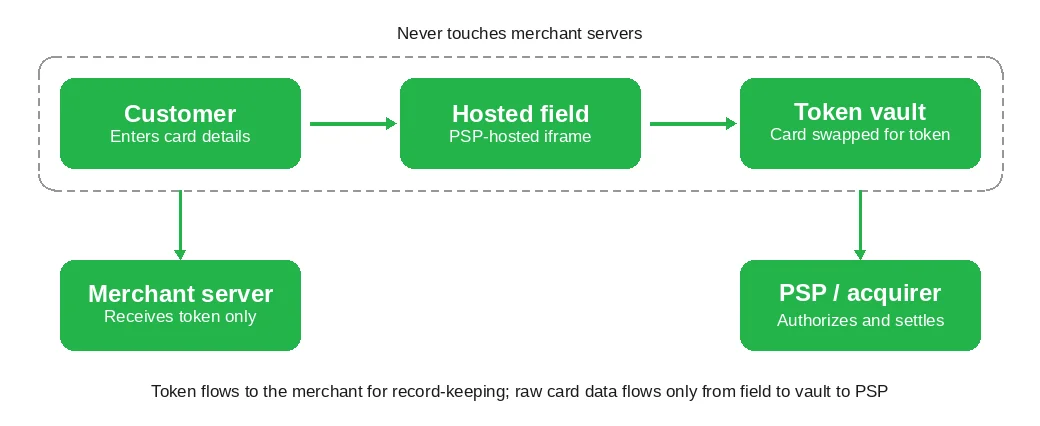
A hosted fields approach delegates card entry to an iframe served directly by the PSP. Since raw cardholder data never reaches your infrastructure, many implementations can qualify for the lighter PCI DSS SAQ A compliance model. The trade-off is reduced control over the checkout experience because the payment fields are rendered and managed by the PSP.
A token vault architecture offers greater flexibility. Your application works with payment tokens while card data is stored either by a trusted third party or within your own PCI-compliant vault. This provides more control over payment flows and customer experiences, but also expands your PCI DSS responsibilities. The same tokenization logic increasingly extends beyond checkout pages — see how it applies to voice-based payment channels.
Reduce PCI scope wherever possible
This principle follows directly from the earlier storage decision: minimize the infrastructure that processes sensitive payment information.
Production payment platforms typically reduce PCI scope by combining early tokenization, network segmentation, encrypted communication channels, and hosted card capture. Every component removed from the cardholder data environment reduces audit effort, operational complexity, and long-term compliance costs.
Good payment architecture is often not defined by what handles payment data, but by what never has to.
Design every transaction to be idempotent
Payment networks retry requests. APIs retry requests. Network connections fail.
Without proper safeguards, those retries can produce duplicate charges, duplicate orders, or inconsistent payment states. At that point, the issue becomes a trust problem with the customer.
Production payment systems, therefore, assign an idempotency key to every request that can create a financial transaction. Regardless of how many times the request is repeated, the payment is processed only once, ensuring predictable behavior, even during network interruptions.
Treat settlement as a separate engineering problem
Authorizing a payment and reconciling financial records are two different processes.
As payment platforms expand across currencies, regions, and payment providers, they must reconcile PSP settlement reports against internal ledgers, account for exchange-rate timing differences, and distinguish authorization events from actual fund settlements and payouts.
Well-designed reconciliation services continuously identify discrepancies, rather than leaving finance teams to resolve them manually at the end of the day or month.
Separate critical services through event-driven architecture
Payment platforms handling thousands of concurrent transactions cannot rely on a single application to handle every operation.
Modern architectures divide responsibilities into independent services responsible for authorization, fraud detection, settlement, notifications, reporting, and other business capabilities. These services exchange events through messaging platforms, such as Apache Kafka, allowing each component to scale independently.
The result is a system where temporary delays in fraud analysis, reporting, or notifications do not interrupt payment authorization itself. This separation also simplifies future expansion, because new payment methods can be introduced as additional services rather than as modifications to the platform's core.
Score risk across multiple signals
Fraud prevention has evolved well beyond static rule engines.
Modern payment platforms combine device fingerprinting, behavioral analytics, transaction history, geolocation, account velocity, and other contextual signals to estimate transaction risk before completing authorization. Rather than relying on a single decision point, these models aggregate multiple asynchronous data sources that become available within milliseconds of one another.
The objective is not simply to stop fraudulent transactions, but to reduce false declines that frustrate legitimate customers, while maintaining an acceptable level of risk.
Treat 3DS2 as both a security and business decision
3DS2 and SCA are often viewed as regulatory requirements, but they also influence customer experience and financial liability.
Additional authentication adds another step to the payment journey, potentially increasing friction during checkout. At the same time, properly implemented authentication shifts liability for certain categories of fraud away from the merchant under applicable card network rules.
The right implementation, therefore, balances conversion rates, customer experience, fraud exposure, and regulatory obligations, rather than simply enabling 3DS2 wherever possible.
Design for future payment rails
Payment ecosystems continue to evolve. Card payments increasingly coexist with account-to-account transfers, instant payment networks, Buy Now, Pay Later (BNPL), digital wallets, and emerging digital asset infrastructure.
Architectures tightly coupled to traditional card processing often require significant redevelopment when a new payment rail is introduced.
A more sustainable approach treats every payment method as a pluggable interface behind a common orchestration layer. Whether the next addition is FedNow, RTP, BNPL, or stablecoin settlement, the platform extends via new connectors, rather than through fundamental architectural changes.
The US Compliance Landscape for Payment Platforms
Building payment software in the United States means navigating multiple regulatory and industry frameworks rather than a single standard. PCI DSS, card network rules, ACH requirements, privacy legislation, and state licensing obligations each govern different parts of a payment platform.
Understanding where these frameworks overlap — and where they don't — is just as important as understanding the technology itself. Misunderstanding their differences often leads to unnecessary compliance costs, architectural rework, or legal risk later in the project.
PCI DSS: protecting cardholder data
The PCI DSS applies to any organization that stores, processes, or transmits cardholder data.
However, compliance isn't simply about passing an audit. The effort depends largely on your system architecture. Decisions such as using hosted payment fields, early tokenization, or a dedicated token vault determine which SAQ your organization qualifies for. That classification directly influences audit scope, documentation requirements, and ongoing compliance costs.
In many payment projects, reducing PCI scope begins with architectural design rather than relying solely on security controls.
Card network rules: beyond PCI DSS
Compliance with PCI DSS does not automatically mean compliance with Visa, Mastercard, American Express, or Discover operating rules.
Each card network publishes its own requirements governing areas such as chargeback processing, merchant category code (MCC) usage, interchange qualification, dispute handling, and transaction acceptance.
These are contractual obligations that exist alongside PCI DSS. For payment platforms intended for production, both technical security standards and the operational rules established by the card networks must be addressed.
NACHA: a different rulebook for ACH payments
Organizations supporting ACH payments need to consider an entirely separate compliance framework.
The NACHA Operating Rules define how ACH transactions are authorized, initiated, settled, returned, and disputed. They also establish requirements for customer notifications, record retention, and error resolution.
Although ACH and card payments often coexist within the same platform, PCI DSS does not govern ACH processing. Mature payment architectures treat card and bank-transfer compliance as distinct workstreams, rather than assuming one framework covers both.
State licensing requirements
Not every payment business requires a money transmitter license, but many do.
Whether licensing applies depends on the business model, not the software itself. Organizations that facilitate payments between third parties, hold customer funds, or move money on behalf of others may be subject to state Money Transmitter License (MTL) requirements.
Because these obligations vary across jurisdictions and depend on legal interpretations, licensing decisions should be made in consultation with experienced legal counsel. Software vendors can support the technical implementation, but they should not determine the licensing strategy.
SOC 2 Type II: operational trust beyond payments
For SaaS providers and B2B payment platforms, SOC 2 Type II has become an important complement to PCI DSS.
Unlike PCI DSS, SOC 2 does not focus specifically on cardholder data. Instead, it evaluates how an organization manages security, availability, confidentiality, processing integrity, and privacy over an extended period of operation.
When evaluating a development partner, ask two questions to clarify the shortlist path: 1) does the company itself maintain SOC 2 Type II compliance, and 2) does the solution it builds support your own future SOC 2 audit as your business grows.
State privacy laws continue to expand
Payment platforms process much more than payment credentials. They also handle names, addresses, email accounts, purchase histories, device information, and other categories of personal data.
This brings them under state privacy laws, such as the California Consumer Privacy Act (CCPA), and similar laws enacted in states like Virginia and Colorado.
These privacy frameworks address issues such as data retention, consumer access requests, deletion rights, and disclosure obligations. They complement, but do not replace, PCI DSS. While PCI DSS focuses specifically on protecting cardholder data, state privacy laws govern the broader lifecycle of personal information collected throughout the payment process.
What Does Payment Software Development Cost?
Payment software projects range from a straightforward hosted checkout integration to a fully custom payment gateway supporting multiple payment rails, advanced fraud prevention, and enterprise-grade compliance.
The estimates below are based on multiple industry reports and pricing guides published by software engineering firms in 2026. They are planning ranges rather than fixed quotes. The final budget depends on your architecture, compliance scope, and functional requirements; therefore, validate each project through a detailed discovery phase before development begins.
| Path | Cost | Timeline |
|
Third-party integration (Stripe/Adyen/Braintree hosted checkout) |
$8,000-$30,000 | 2-6 weeks |
|
Custom orchestration layer (multi-PSP routing, retries, reconciliation, split payments) |
$40,000-$150,000 | 2-5 months |
|
Full custom gateway (own tokenization, fraud stack, multi-currency, full PCI scope) |
$100,000-$400,000+ | 4-12+ months |
For organizations building a fully independent payment platform, the upper end of the budget can extend well beyond the figures shown above. Projects targeting PCI DSS Level 1, proprietary tokenization, payment facilitator (PayFac) capabilities, or highly sophisticated fraud detection frequently require investments between $250,000 and $1 million or more, with implementation timelines ranging from 8 to 18 months.
In practice, the biggest cost driver is rarely the development vendor itself. The architecture you choose and the compliance obligations that come with it have a much greater impact on the final investment.
Ongoing costs often overlooked during planning
Development is only part of the overall investment. Beyond build costs, operating a payment platform also involves recurring technical, compliance, and infrastructure costs, including:
- PCI DSS compliance: approximately $15,000–$70,000 for initial certification, plus $10,000–$30,000 annually for recertification, penetration testing, and ongoing compliance activities.
- Infrastructure and cloud operations: typically $2,000–$15,000 per month, depending on transaction volume, redundancy requirements, and service availability targets.
- Payment network and acquiring bank integrations: if implemented directly rather than inherited through a PSP, expect approximately $10,000–$40,000 per card network integration and $8,000–$25,000 per acquiring bank API.
The factors that have the greatest impact on cost
Regardless of project type, the following decisions influence the budget more than almost anything else, so focus on them first:
- PCI DSS scope: Whether your architecture qualifies for SAQ A or requires a full SAQ D environment is often the single largest cost driver.
- Supported payment methods: Every additional payment rail, card network, wallet, or bank transfer method introduces new integration and testing effort.
- Fraud prevention capabilities: Device intelligence, behavioral analytics, machine learning models, and risk orchestration add both implementation complexity and operational cost.
- Hardware support: POS terminals, NFC devices, kiosks, and other payment hardware significantly expand engineering scope compared with software-only platforms.
- Long-term operations: Compliance renewals, infrastructure growth, monitoring, and platform maintenance should be treated as ongoing operating expenses rather than one-time project costs.
Six Questions That Reveal Real Payment Expertise
A polished website and an impressive client list don't always mean deep payment engineering experience. Before choosing a development partner, ask a few technical questions that quickly reveal whether the team has delivered production payment systems or only payment-related software.
- "Which SAQ type is your proposed architecture designed for, and why?"
A vendor should be able to explain how its architecture affects your PCI DSS scope, not just say it's "PCI compliant." - "How does your platform handle duplicate webhook deliveries?"
The answer should include idempotency and transaction consistency, not simply retry logic. - "What false-decline rate have you achieved on comparable fraud implementations?"
This separates measurable production experience from generic claims about AI-powered fraud detection. - "Who is responsible for PCI DSS recertification after go-live?"
Clarifying long-term ownership helps uncover ongoing compliance costs before the contract is signed. - "Can you share examples of clients processing similar transaction volumes?"
Look for verifiable production experience rather than broad statements about industry expertise. - "What happens to our source code, infrastructure, and data if we decide to end the engagement?"
This helps identify potential vendor lock-in and confirms that you'll retain control over your platform.
Conclusion
There is no universal approach to payment software development because every business is at a different point in its payment maturity journey.
If you need to accept online payments quickly, a hosted payment solution from a trusted PSP may be enough. As transaction volumes grow, adding an orchestration layer can improve authorization rates, increase resilience, and reduce dependence on a single provider. When payments become a core part of your product or business model, investing in a custom payment platform gives you the flexibility to control the customer experience, integrate new payment methods, and evolve as business requirements change.
If you're planning to build or modernize a payment platform, Emerline helps fintech companies, financial institutions, and enterprise businesses design secure, compliant, and future-ready payment solutions, from payment gateway integrations to enterprise-scale financial infrastructure. Reach out to our experts, and we'll be happy to discuss your goals and help you identify the right development approach for your business.
Frequently Asked Questions
Choosing the right payment architecture often raises as many questions as selecting the right development partner. Below are answers to some of the questions organizations most frequently ask when planning a payment software project.
What's the difference between a payment gateway and a payment processor?
A payment gateway securely captures, encrypts, and forwards customer payment information to the payment ecosystem. A payment processor communicates with card networks and financial institutions to authorize, route, and settle the transaction.
Many custom payment projects focus on building the gateway while integrating with an established processor, rather than replacing the entire payment processing infrastructure.
Do we need PCI DSS compliance if we build a custom payment gateway?
Yes. Developing a custom payment gateway does not eliminate PCI DSS obligations; in many cases, it increases them.
The level of compliance depends on your architecture. Solutions that keep cardholder data away from your infrastructure generally have a smaller compliance footprint, while platforms that directly process or store sensitive payment data require broader PCI DSS controls and more extensive validation.
Is fraud detection really performed in real time?
Not exactly.
Most production fraud platforms operate in near real time. They evaluate transactions across multiple data sources — including device intelligence, behavioral signals, transaction history, and risk models — that become available with slightly different latencies.
Understanding this distinction helps separate realistic vendor capabilities from overly simplified marketing claims.
When is a payment orchestration layer a better choice than a single PSP?
Payment orchestration becomes valuable when a business needs more flexibility than a single payment provider can offer.
Typical scenarios include routing transactions across multiple processors, improving authorization rates, enabling automatic failover during outages, supporting regional payment methods, or combining multiple payment rails within a single platform.
How long does it take to build a custom payment gateway?
Implementation time depends primarily on the platform's scope rather than the development team alone.
A hosted PSP integration can often be completed within a few weeks, while a fully custom gateway, including tokenization, fraud prevention, reconciliation, and support for multiple payment methods, typically requires several months. The biggest factors influencing the timeline are PCI DSS scope, compliance requirements, and the number of payment rails being integrated.
Which ongoing costs are most often underestimated?
Many organizations focus on initial development while overlooking the long-term operational costs of running a payment platform.
The most commonly underestimated expenses include:
- PCI DSS recertification and security assessments
- Infrastructure growth as transaction volumes increase
- Continuous fraud model tuning as attack patterns evolve
- Updates required to accommodate changing card network rules and regulatory requirements
These costs persist throughout the platform's lifetime and should be incorporated into long-term planning from the outset.
Published on Jul 28, 2026