Common Payment Gateway Integration Challenges: Business Risks and Architectural Solutions
Table of contents
- Quick answer
- Key takeaways:
- When a Direct Payment Gateway Integration Stops Being Enough
- Challenge 1: Different Gateway APIs Make Consistent Payment Handling Harder
- The solution: Create one internal language for payments
- Challenge 2: Network Failures Can Turn One Payment Into Two Charges
- The solution: Protect customers from duplicate charges during failures
- Challenge 3: Unreliable Payment Updates Can Put Orders and Payments Out of Sync
- The solution: Keep payment and order records in sync
- Challenge 4: Fraud Controls Can Protect Revenue and Still Hurt Conversion
- The solution: Match verification to transaction risk
- Challenge 5: Letting Card Data Reach Core Systems Expands Compliance Scope
- The solution: Keep raw card data away from core systems
- Challenge 6: A Single Payment Provider Can Turn Its Outage Into Lost Sales
- The solution: Switch providers without losing control of transaction state
- Challenge 7: Payment and Payout Records Don't Always Match
- The solution: Connect payment records with actual payouts
- Challenge 8: Adding New Payment Methods Can Force Checkout Rework
- The solution: Let checkout adapt to available payment methods
- How Emerline Helps With Complex Payment Integrations
- Payment Gateway Integration Questions to Ask Before You Build, Scale, or Migrate
- Disclaimer
A payment integration has a simple job: help customers pay reliably without creating unnecessary cost, risk, or operational work. Problems begin when the payment setup can no longer do that consistently. Revenue is at risk when legitimate transactions fail, internal teams spend more time investigating issues, and changes to providers or payment methods become increasingly expensive.
The difficulty is that a payment does not happen entirely inside your own systems. Part of the transaction depends on payment providers, banks, and networks, so payment status may arrive late, change after checkout, or remain unclear when something fails. As operations become more complex, these problems are harder to manage reliably.
This article examines eight common payment gateway integration challenges, the costs and risks behind them, and the architectural decisions that can reduce their impact without adding complexity the company does not need. While most companies start by searching for payment gateway solutions, true scalability often requires moving toward payment orchestration.
For clarity, we use payment provider as a general term for an external company that processes or supports payments. A payment gateway refers specifically to the technical interface that connects a company's payment flow to that provider.
Quick answer
A reliable payment integration keeps transaction records accurate and makes failures recoverable. The essentials are safe retries, confirming payment status independently of what the customer sees in checkout, and keeping raw card data away from core systems. Companies using several providers may also need a central layer for routing and provider-specific rules. This is commonly called a payment orchestration layer.
Key takeaways:
- An unclear transaction outcome can be more costly than a declined payment:
If no one can immediately tell whether a transaction went through, a temporary issue can lead to duplicate charges, unnecessary refunds, delayed orders, and support work. The real risk is often not the initial failure, but the uncertainty it creates afterward.
- A backup payment provider does not guarantee business continuity:
Sending payments somewhere else during an outage sounds simple. But if the original transaction status is unclear, retrying it through another provider can create a second problem instead of solving the first.
- Keeping card data out of core systems can reduce compliance costs:
The fewer internal systems that handle raw card data, the fewer systems may need to meet the full set of related security and compliance requirements. Routing sensitive payment data directly to specialized payment infrastructure can lower security exposure and, depending on the setup, reduce how much of the environment falls within the PCI DSS scope.
- An integration that is cheap to launch can become expensive to change:
A direct connection to one provider may be the right choice at the start. The cost often appears later, when adding a provider, market, or payment method requires changes across checkout, operations, and reporting.
When a Direct Payment Gateway Integration Stops Being Enough
The limitations of a direct integration usually surface when payment requirements start to expand. A company may start with one payment provider and a simple checkout setup. As it enters new markets, it may need additional providers and local ways to pay. What began as one straightforward connection now has to accommodate different provider rules and workflows.
Three pressures tend to expose the limits of that setup:
- Dependence on one provider can put checkout availability outside your control. If there is only one way to process a payment, an outage at that provider can prevent customers from completing purchases until service is restored.
- New reporting and compliance needs can require changes beyond checkout. Providers and financial partners may structure transaction data and reports differently. If those assumptions are built into multiple parts of the product, new reporting or regulatory requirements can trigger changes across several systems. Matching provider payouts to internal records can become harder for the same reason.
For a broader fintech product, payment architecture also has to fit the surrounding data, accounting, and compliance workflows. For example, a completed payment may need to mark an invoice as paid, update accounting records, and feed into tax reporting without creating conflicting information across systems.
The issue is not the direct integration itself. Problems arise when one provider's rules start shaping checkout, refunds, reporting, and other workflows. At that point, changing the payment setup can affect several parts of the product instead of one isolated connection.
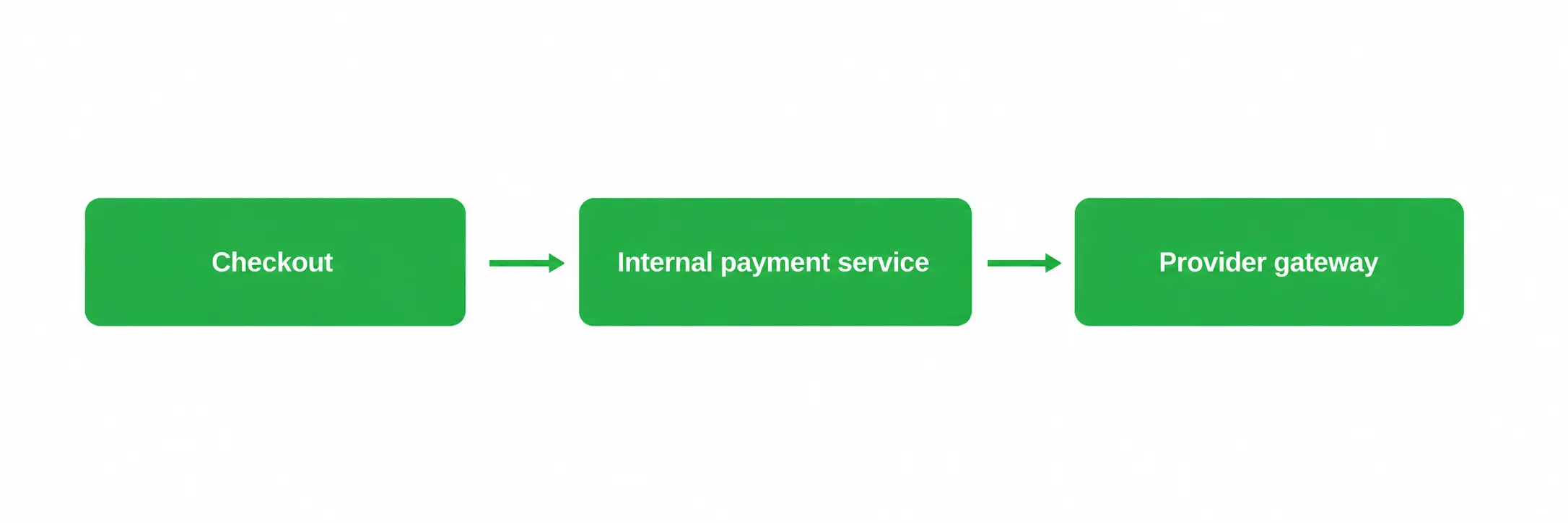
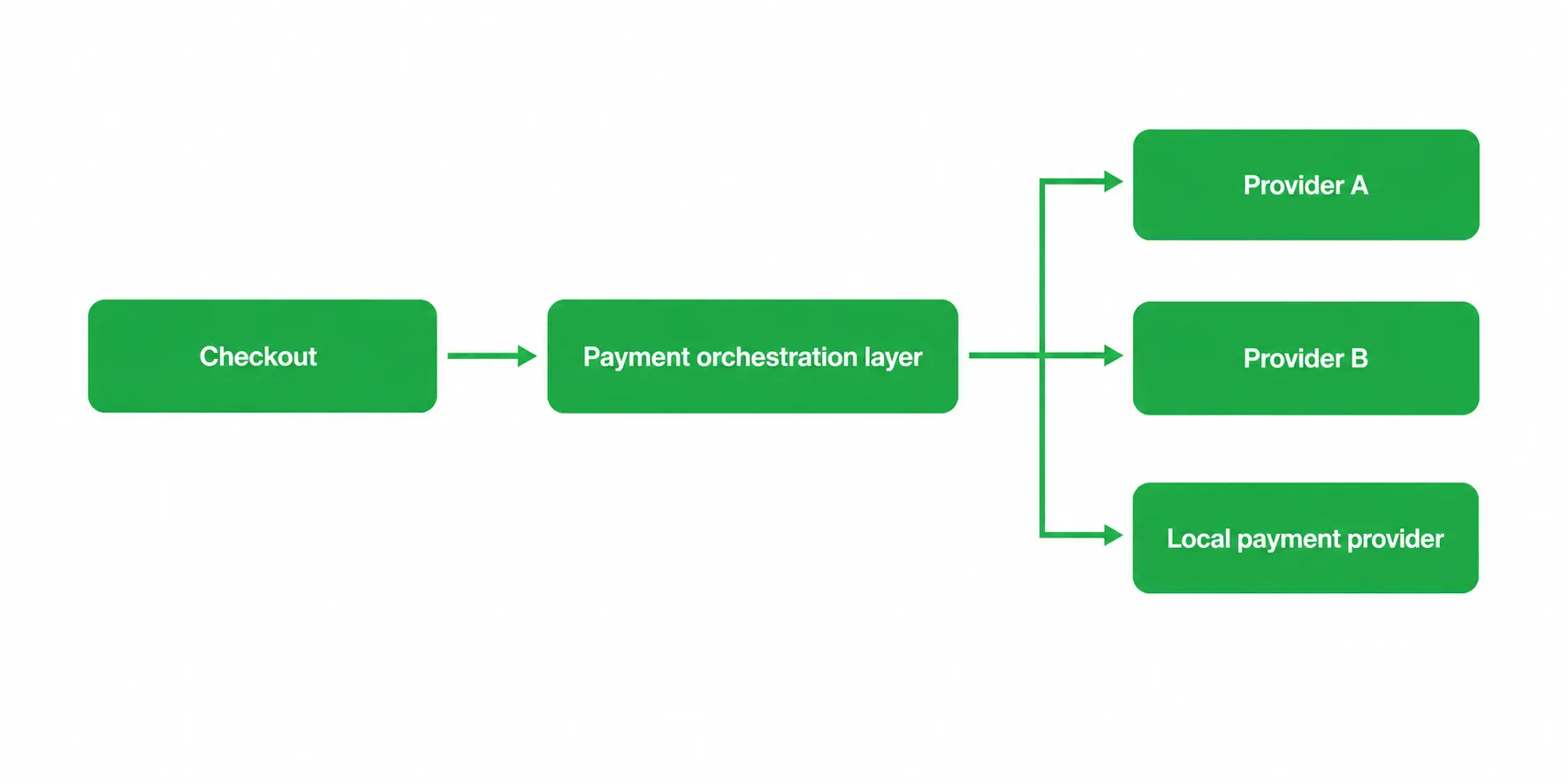
The architectural options are easier to compare side by side:
Direct integration
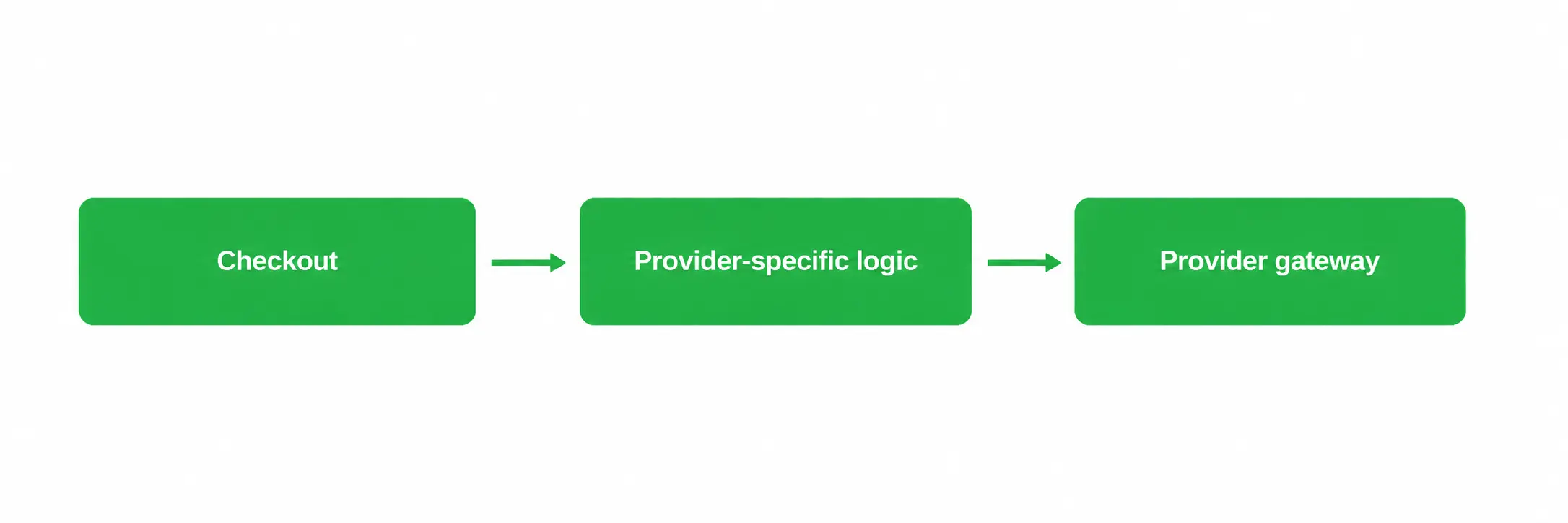
Separated payment logic
Multi-provider orchestration
Separating provider-specific logic does not require payment orchestration. It can be moved out of checkout into a dedicated internal payment service, creating a stable boundary between the product and the provider. This is often described as a payment abstraction layer. In larger enterprise environments, this abstraction may be implemented as a dedicated payment service or enterprise middleware, which translates provider-specific APIs before payment data reaches core business systems.
For example, when expanding into a European market and adding a local payment method or digital wallet, the company can keep most provider-specific changes inside the payment layer instead of broadly reworking checkout.
Payment orchestration becomes relevant when the company needs to manage several providers, route transactions between them, apply centralized rules, or support failover. A payment orchestration layer can provide those capabilities without spreading provider-specific logic across the rest of the product. The additional architecture is worthwhile only when the flexibility and resilience it provides justify the cost of building or operating it.
The challenges below show how this complexity appears in day-to-day payment operations.
Challenge 1: Different Gateway APIs Make Consistent Payment Handling Harder
Customers and internal teams need the same basic answer regardless of which provider processes a transaction: did the payment succeed, fail, or require another action?
Payment providers do not always communicate those outcomes in the same way. A declined transaction, for example, may arrive as an error from one provider and as a successful API response with a refused status from another. Providers can also use different request formats, authentication methods, and error codes. If each integration handles those differences independently, the same payment outcome can trigger different behavior across checkout, support, refunds, or reporting.
The solution: Create one internal language for payments
A common internal payment model gives the rest of the product one consistent way to understand transaction states and errors, regardless of which provider is used. Each provider has its own connector that translates between its API and the shared model. Keeping provider-specific logic behind these connectors also helps contain API changes, so a provider update does not require changes across checkout and other payment workflows.
The model should normalize outcomes that mean the same thing across providers without discarding details that still matter. For instance, two providers may both report a declined payment while using different reason codes or rules for what can happen next. Those provider-specific details should remain available for support, retry decisions, refunds, disputes, and analysis.
For example:
Provider response: card_declined_51
↓
Internal meaning: Payment declined
Retry: No
Next action: Offer another payment method
The same normalized payment data can feed reporting and finance systems more consistently. Where downstream systems require a specific financial messaging format, such as ISO 20022, the relevant payment and settlement data can be translated at that boundary rather than forcing the core payment model to mirror one external standard. ISO 20022 itself defines different message types for different financial processes, including payment-status and account-reporting messages.
This gives customers more consistent payment handling and provides support, operations, and finance teams with a clearer view of each transaction. Provider differences remain available where they matter without spreading into the rest of the product.
Challenge 2: Network Failures Can Turn One Payment Into Two Charges
A customer clicks Pay, the gateway receives the request, but the connection drops before your system gets a response. The customer sees a frozen checkout and tries again.
The problem is that a missing response does not necessarily mean the payment failed. The first request may already have been processed, leaving the system unsure whether retrying it will complete the purchase or charge the customer twice.
For the company, that uncertainty can mean refunds, support work, disputes, and damaged customer trust. The integration, therefore, needs a way to retry interrupted requests without creating a second financial transaction.
The solution: Protect customers from duplicate charges during failures
Safe retries rely on idempotency: the same payment operation can be repeated without creating a second financial action. Each operation, such as authorizing a payment, collecting the authorized funds, or issuing a partial refund, receives its own idempotency key. The system keeps that key with the operation's state or result, so a repeated request can return what is already known instead of starting the operation again.
When retrying the operation, the system sends the same key again, so a provider that supports idempotency can recognize the repeated request. Providers keep these keys only for a defined period, known as the idempotency time-to-live (TTL). Retry policies, therefore, need to follow the TTL documented for the relevant API, because protection may no longer apply after that period.
This protection should also apply when two requests arrive simultaneously.
The flow below shows how the system can prevent the same operation from being processed twice:
Payment operation + idempotency key
↓
Has this operation already been started or completed?
↓
Yes → Return the existing or in-progress state
No → Process the operation and record the result
Subscriptions make these safeguards especially important because renewals often happen when the customer is not actively completing checkout. These are often called off-session payments. Each scheduled renewal is a separate payment operation: repeated attempts for that renewal should follow the same idempotency rules, while the next billing cycle starts a new operation. The system should also distinguish temporary failures from those that require customer action, helping recover revenue without unnecessary attempts.
The setup also needs clear customer permission to use saved payment details for future charges and must handle any authentication requirements that apply when those details are stored or later used.
Retries are unavoidable when networks or external providers fail. What matters is making them safe and predictable: repeating the same operation should not create a duplicate charge, refund, or other unintended financial action.
Challenge 3: Unreliable Payment Updates Can Put Orders and Payments Out of Sync
Checkout is only one moment in a transaction. A bank may confirm the payment later, a refund may be processed afterward, or a dispute may appear days later.
That is why the checkout page cannot be the only source of truth. Providers report later changes through automated background notifications (webhooks). If an update is missed, arrives out of order, or cannot be trusted, internal systems can fall out of sync with the provider.
In businesses where payment status feeds an ERP or fulfillment process, this can also disrupt the order-to-cash (O2C) cycle, the flow from order processing through fulfillment and payment recording. An order that remains pending may delay inventory allocation, warehouse fulfillment, or other downstream steps. A refund may also be completed without the change reaching support or finance.
The solution: Keep payment and order records in sync
Before an update changes an order or payment status, the system needs to know it can be trusted. Providers often include a signature with webhook messages, allowing the receiving system to verify that the update came from the provider and was not altered.
Legitimate updates can still arrive late, out of order, or more than once. A delayed event should not be able to reverse a valid payment state incorrectly. The integration can prevent this by checking event versions or timestamps where available and allowing only valid state transitions. It also needs to recognize repeated events to avoid processing the same change twice.
Incoming events can be stored before processing, so they are not lost if another internal service is temporarily unavailable. A reliable internal buffer can hold them until downstream systems recover.
There is another risk when a payment update must change an internal record and notify other systems at the same time. If the record is updated but the notification fails, other systems may never receive it. A transactional outbox addresses this by recording the internal change and the outgoing event together, then publishing the event after the internal record has been saved successfully. This helps keep downstream systems aligned with the payment record.
Some transactions will still remain unresolved. Rather than leave them pending indefinitely, the system can check their status with the provider. This fallback status check helps recover updates that never arrived or could not be processed.
The result is fewer incorrect order states and less manual investigation, while support, finance, and customer-facing systems work from the same transaction history.
Challenge 4: Fraud Controls Can Protect Revenue and Still Hurt Conversion
Extra payment verification can reduce fraud, but it can also cost legitimate sales. If checks are too weak, fraud losses and chargebacks can rise. If every customer has to complete an additional verification step, more valid purchases may be abandoned.
This is where 3-D Secure (3DS) comes into play. 3DS is a technical authentication protocol that can help meet UK and EU Strong Customer Authentication (SCA) requirements when they apply. It allows the bank that issued the customer's card to assess an online transaction and decide whether it can proceed without an additional customer step or requires further authentication.
The solution: Match verification to transaction risk
The goal is not to eliminate security checks, but to avoid adding friction when the transaction can safely proceed without it.
- Keep lower-risk purchases moving when the rules allow it. UK and EU SCA requirements allow some transactions to proceed without an additional authentication step when specific conditions are met. These exemptions can include certain low-risk transactions and payments to payees the customer has previously marked as trusted. Whether an exemption applies depends on the regulatory conditions and payment providers involved, so it should not be treated as a guaranteed way to avoid additional verification.
- Ask for stronger verification when the risk is higher. Transaction and device signals can help identify purchases that warrant an additional check. The important point is that verification responds to risk rather than treating every transaction the same way.
Done well, this keeps unnecessary verification steps out of lower-risk purchases while applying stronger checks where fraud exposure is higher. The company protects conversion without weakening the controls that limit fraud and chargebacks.
Challenge 5: Letting Card Data Reach Core Systems Expands Compliance Scope
The more internal systems that handle raw card details, the more infrastructure, processes, and people may fall within payment security requirements. That can increase the cost of security controls, compliance assessments, monitoring, and ongoing maintenance. It also increases the potential impact of a security incident.
This matters under PCI DSS, which sets security requirements for environments that store, process, or transmit cardholder data, as well as systems that can affect the security of that environment.
The solution: Keep raw card data away from core systems
Instead of sending card details through the application's own servers, checkout can collect them through payment fields hosted by a PCI DSS-compliant provider. The sensitive data goes directly to the payment provider or an isolated tokenization service, while the application receives a token, a substitute value that can be used for payment operations without requiring the application to handle the original card number.
With provider-hosted fields, the separation looks like this:
Customer enters card details
↓
Provider-hosted payment field / tokenization service
↓
Raw card data → Payment provider
Token → Your application
The application can then process the payment flow without handling the original card number itself.
For companies that need more control over the payment flow or work with several providers, a dedicated tokenization or payment-data proxy layer can support the same objective of isolating card data from the core product. If the company operates that layer itself, however, it remains within the relevant PCI DSS scope. The trade-off is greater control over payment routing in exchange for more security and compliance responsibility.
This architecture can reduce the amount of payment infrastructure the company must secure and assess, but it does not remove PCI DSS obligations or automatically exempt the business from assessments.
Even when payment capture is outsourced, the merchant's own e-commerce environment may still have PCI DSS requirements, so reducing scope does not mean eliminating ongoing security work.
The practical benefit is fewer internal systems that need to handle sensitive payment data. That can reduce recurring compliance and security work while limiting the number of systems exposed to card-data risk.
Challenge 6: A Single Payment Provider Can Turn Its Outage Into Lost Sales
A payment provider can become unavailable even when the rest of the product is working normally. Outages, elevated error rates, or other service failures can interrupt checkout and leave the company dependent on how quickly that provider recovers.
A backup provider can reduce that dependency, but switching providers has to preserve the state of transactions already in progress. Otherwise, a measure intended to keep payments running can create new transaction and operational risks.
The solution: Switch providers without losing control of transaction state
When a provider starts timing out or returning repeated errors, the payment layer can automatically pause new requests to it so checkout does not keep waiting on the same failure. A circuit breaker provides this safeguard.
If another provider can process the payment, the system can route a new attempt there. Failover allows the payment flow to switch to an eligible backup provider when the primary one is unavailable. In active-active setups, where more than one provider remains ready to process payments, dynamic routing can automatically send a clearly failed attempt to an eligible backup provider within the customer's active checkout session before showing an error.
A backup provider is only useful for a particular payment if it can actually process it. The required payment method and currency must be supported, the right merchant account and bank-processing arrangements must be in place for that market, and any saved payment credentials needed for the transaction must be usable with that provider. Payment method and feature availability can vary by provider and configuration.
There is one important safeguard. If a payment request reaches the first provider but its final status is unknown, the system should not immediately submit the same payment elsewhere. It first needs to determine what happened to the original attempt. Otherwise, a failover can turn an outage into a duplicate charge.
The goal is not to promise uninterrupted payment processing. It is to keep an outage at one provider from stopping payments that the company can safely and legitimately process elsewhere.
Challenge 7: Payment and Payout Records Don't Always Match
A successful customer payment does not necessarily match the amount or timing of the payout that reaches the company. Processing fees, refunds, currency conversion, and payout schedules can make sales records diverge from bank deposits. Matching those provider payouts with internal payment records is known as settlement reconciliation.
With several payment providers or markets, finance teams have to trace these mismatches across reports, currencies, and payout dates. When that work is manual, month-end close takes longer, discrepancies are harder to investigate, and missing payouts or incorrect fees can go unnoticed.
The solution: Connect payment records with actual payouts
Finance teams need one reliable view of what customers paid, what providers deducted, and what ultimately reached the company.
- Bring payout and account data into one internal format. Banks and providers often deliver financial data in different structured formats. Translating these inputs into a common internal format allows payouts, fees, refunds, and currency effects to be matched against the transactions that created them.
- Add a financial ledger when specific business requirements justify it. A financial ledger provides a traceable record of monetary movements, making it easier to understand where balances came from and how they changed. This becomes valuable when a company handles stored balances, split payments, strict audit requirements, or multiple currencies and entities. For a simpler merchant setup, however, building and operating such a ledger may cost more than the reconciliation problem justifies.
Automated matching can then compare incoming payouts with internal transaction records and flag mismatches for review. The team can focus on the records that do not match instead of checking every payout manually. This approach is illustrated in our benefits-platform case study, where transaction metadata was used to automate reconciliation and reduce manual reporting work.
The result is less manual reconciliation, a faster month-end close, and earlier visibility into missing payouts, unexpected fees, or exchange-rate effects.
Challenge 8: Adding New Payment Methods Can Force Checkout Rework
A payment option that works well in one market may be less relevant in another. As a company expands, it may need additional options such as open banking and local instant bank payments, as well as buy now, pay later (BNPL) services and digital wallets.
If checkout is tightly tied to specific payment methods, each addition can require changes across the customer-facing flow, payment logic, testing, and release processes. For example, adding a local bank payment method to a checkout designed only for cards may require different screens, confirmation steps, and payment logic. What should support growth instead becomes another development project and another part of checkout to maintain.
The solution: Let checkout adapt to available payment methods
Instead of hardcoding every option into checkout, server-side payment logic can determine which methods are available for a transaction and send the checkout interface instructions describing what to display. Factors can include the customer's market, currency, cart value, or device.
The checkout then presents the options available for that purchase, while the payment layer applies the rules behind them. If the company already uses payment orchestration, those rules can live in one place. By sending these instructions dynamically, the system can adapt what checkout displays without hardcoding every payment method into the interface.
The same checkout could, therefore, show cards and a digital wallet in one market, but cards and a local bank-payment option in another. This can reduce the amount of region-specific logic embedded directly in checkout.
This does not eliminate engineering work for every new payment method. Some options still require different customer flows, regulatory checks, or provider-specific handling. The benefit is that these differences do not have to spread through the core checkout every time a new option is introduced.
That makes it easier to launch new payment methods and enter new markets without requiring a broad checkout rebuild. It also helps keep maintenance costs from rising with every additional option.
How Emerline Helps With Complex Payment Integrations
Payment integration becomes a different kind of project when changing one provider can affect checkout, transaction records, compliance scope, or financial reporting. At that point, the challenge is no longer simply connecting to another gateway. It is changing the payment setup without creating new revenue, security, or operational risks.
Through our payment gateway integration services, Emerline helps companies assess where those dependencies exist and decide which parts of the payment architecture need to change. Depending on the business and its current setup, this can include:
- Separating payment logic. Provider-specific connectors and payment orchestration make it easier to add or replace providers and payment methods without repeatedly reworking checkout.
- Reducing data exposure and downtime risk. Hosted payment fields, tokenization, safe retries, and controlled provider switching can reduce PCI DSS scope and limit the impact of provider or network failures.
- Improving payment visibility. Normalized transaction data and automated reconciliation give finance and operations teams a clearer view of payment status, fees, and actual payouts.
An engagement can start with an assessment of transaction flows, provider dependencies, payment-data exposure, and finance workflows. This helps identify which changes can remove the most operational risk or manual work before the company invests in additional payment infrastructure.
Payment Gateway Integration Questions to Ask Before You Build, Scale, or Migrate
Choosing a payment integration is also a long-term operating decision. The answers below focus on the choices that affect cost, flexibility, and ownership after launch.
- How should a company budget for a payment gateway integration?
The implementation quote is only the visible part of the cost. For budgeting, it helps to separate one-time costs such as integration, onboarding, migration, and compliance setup from ongoing costs such as provider fees, monitoring, support, and reconciliation. A third category is the cost of change: adding a market or payment method, switching providers, or adapting to new requirements. This makes it easier to compare payment options based on what they are likely to cost over several years rather than on launch price alone.
- Should a company build payment orchestration in-house or buy it as a service?
The question is really about ownership. An internal orchestration layer gives the company more control over routing, integrations, payment data, and future changes. But that also means having enough engineering capacity to operate, secure, and evolve the platform.
A third-party product shifts some of that work outside the company but introduces another vendor and commercial dependency. Building can make sense when payment flexibility is strategically important, and the company is prepared to own the capability over time. Buying can be a better fit when orchestration is primarily an operational need and reducing internal engineering effort matters more than keeping it in-house.
- When does a merchant of record make more sense than a direct payment integration?
A direct payment setup gives the company more control over providers, customer payment flows, and processing costs. It also leaves more of the operational and compliance work with the business.
A Merchant of Record (MoR) changes more than the payment integration. Because the MoR acts as the seller of record for the transaction, it can take on payment processing, indirect tax collection and remittance, refunds, chargebacks, and some of the compliance obligations associated with the sale. This also changes how sales, taxes, fees, and payouts need to flow into the company's finance and ERP processes.
This can be attractive when entering multiple markets that would otherwise require significant internal tax and payment operations. The trade-off is a different fee structure and less direct control over parts of the payment relationship. The exact accounting treatment depends on the commercial arrangement and applicable accounting rules, so the decision is broader than choosing a payment integration. It comes down to whether the service cost is justified by the operational and compliance burden the company no longer has to carry.
- Which payment metrics should leadership monitor after launch?
System availability shows whether payments could be processed, but not whether the setup was performing well for the business. Leadership also needs to see where revenue is being lost, where payment operations are becoming unreliable, and what it costs to collect each successful payment.
That usually means looking at conversion measures such as checkout completion and payment success, reliability signals such as provider incidents and unresolved transactions, and financial measures such as processing costs, refunds, disputes, and reconciliation mismatches. For card-heavy businesses, the authorization rate can add another useful signal because it shows how often issuers approve payment attempts.
The picture becomes more useful when these measures are broken down by provider, market, or payment method. A healthy company-wide average can otherwise hide an expensive problem in one part of the business.
- What should a company agree with a payment provider before signing?
The transaction price is only one part of the commercial relationship. Start with cash flow: when payouts arrive and whether the provider can hold or reserve part of the company's funds. Then look at processing costs, including currency conversion, refunds, and dispute fees.
The agreement should also make operational responsibilities clear, including support and availability commitments during incidents, how API changes will be communicated, and how security and compliance responsibilities are divided. Outsourcing payment processing does not automatically transfer all PCI DSS responsibility to the provider.
Finally, consider the exit before signing the contract. Clarify whether payment data can be exported, whether saved payment details can be migrated, and what happens when the relationship ends. A good provider agreement, therefore, answers two questions at once: what will it cost to work with this provider, and what could it cost to leave?
Disclaimer
This article is provided strictly for informational purposes and does not constitute technical, security, compliance, or legal advice. The integration practices, security protocols, and troubleshooting frameworks discussed reflect general software engineering standards alongside the FinTech expertise of Emerline. Always tailor these integration strategies to your organization's specific payment ecosystem, data protection policies, and compliance obligations.
Published on Aug 28, 2026