Top 10 Payment Gateways for Businesses in 2026: A Complete Comparison
Table of contents
- Key takeaways:
- Payment Gateway Comparison at a Glance
- How to Choose a Payment Gateway for Your Business
- Start with your payment model
- Check geographic and payment-method coverage
- Calculate total payment cost
- Evaluate checkout and authorization performance
- Review finance and operations workflows
- Assess integration effort and vendor lock-in
- Hosted vs. Integrated Payment Gateway Models
- Hosted checkout
- Embedded components
- API-driven integration
- Payment Gateway Pricing: Flat Rate vs. Interchange Plus
- How flat-rate pricing works
- How interchange-plus pricing works
- Which pricing model fits which business
- Hidden payment gateway fees
- Top 10 Payment Gateways for Businesses in 2026
- Stripe: When payments need to evolve with the product
- Helcim: When growth should lower processing costs
- PayPal and Braintree: Turning familiarity into completed payments
- Authorize.Net: Extending an existing merchant setup
- Adyen: Reducing fragmentation across markets and channels
- Square: Keeping store and online operations in sync
- Checkout.com: Using payment data to improve international performance
- Shopify Payments: Removing payment work inside Shopify
- Airwallex: Connecting global payments with multi-currency settlement
- Amazon Pay: Shortening checkout for the right audience
- The Technical Blueprint: From Provider Choice to Production-Ready Payments
- A five-step roadmap for operational readiness
- 1. Define the payment architecture and compliance scope
- 2. Validate the complete payment journey before launch
- 3. Keep payments and business records aligned
- 4. Connect post-payment events with finance and operating systems
- 5. Confirm that the business can recover from payment failures
- Payment Gateway Integration Timelines
- When Payment Gateway Integration Make Business Sense
- Final Recommendation: Choose the Payment Setup You Can Still Trust at Scale
- Disclaimer
Payment gateways do their best work unnoticed. A customer pays, the order moves forward, and the money reaches the right account. That quiet reliability is the value businesses expect from payment gateway integration services.
Growth changes the equation. Enter another market, add subscriptions or local payment methods, or start processing more refunds, and a setup that once worked well can begin to cost time and margin. Finance chases payouts that do not match internal records. Support handles avoidable payment failures. Engineering inherits exceptions that never appeared in the demo.
Digital payments are still expanding. Statista projects worldwide transaction value to reach $37.45 trillion in 2026 and $46.25 trillion by 2031, representing a compound annual growth rate of 4.31%. The number of digital payment users is expected to approach 3.99 billion by then.
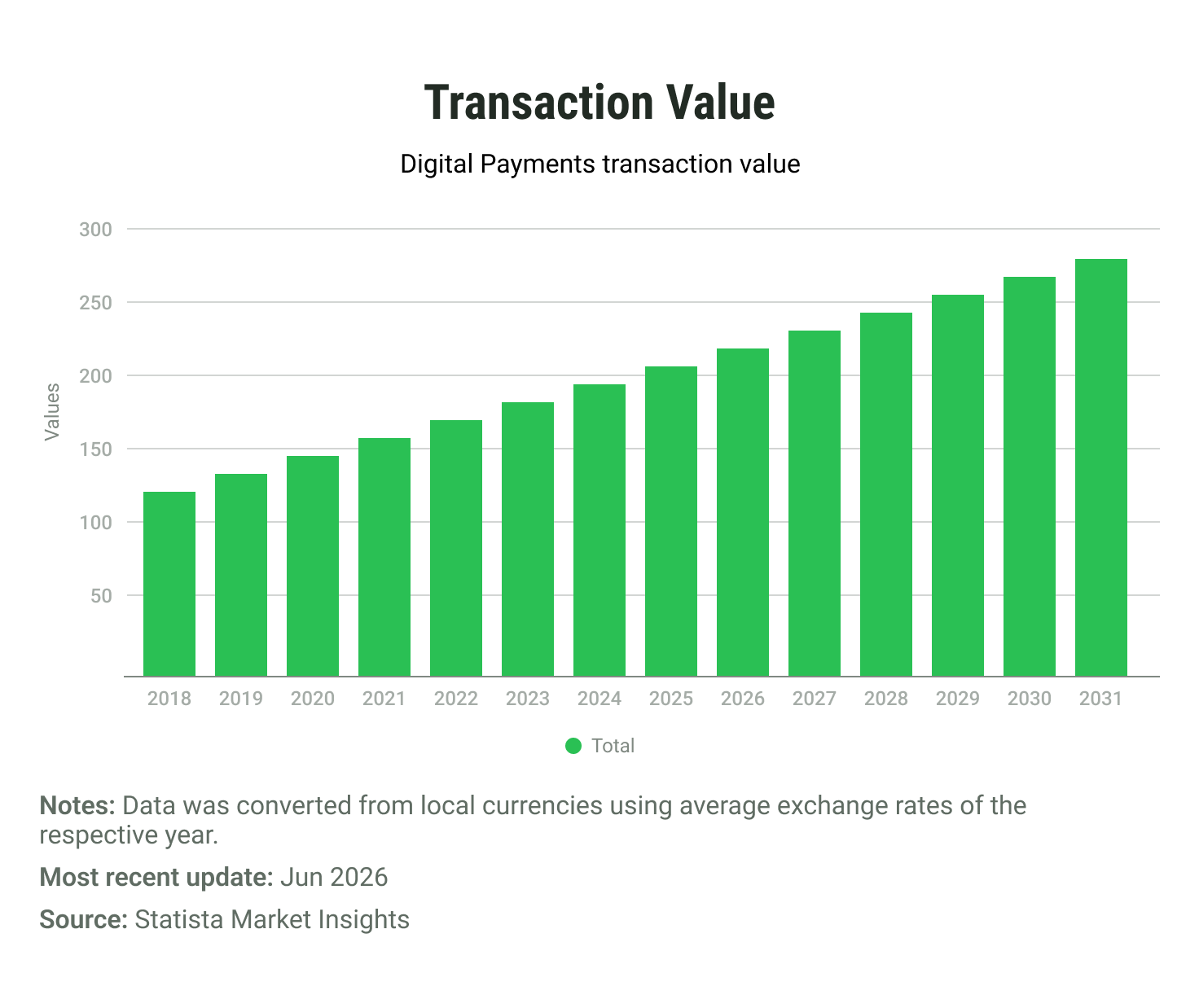
Source: Statista Market Insights. The forecast covers consumer-to-business digital commerce and mobile point-of-sale payments, not B2B transactions.
More volume does not make provider selection easier. It adds trade-offs. One provider may be inexpensive for domestic cards. Another may work better across borders. A third may get you live quickly but offer little control over checkout or payment logic.
So asking which gateway is “best” will only take you so far. The more useful question is this: Which provider fits how your business sells, gets paid, handles refunds, and plans to grow?
This guide compares 10 widely used payment solutions to help you narrow the field to the providers that actually fit your business. We look at what each option may cost beyond the advertised rate, how much work it takes to integrate, and which trade-offs could later affect payment performance, finance operations, or your ability to expand.
Key takeaways:
- International expansion can quickly inflate standard processing rates:
Domestic fees may look competitive on paper, but cross-border sales often add extra layers of cost. PayPal, for example, may apply a 1.5% international transaction fee on top of currency conversion charges, significantly changing unit economics. - The cheapest option at launch may not remain cost-effective at scale:
As transaction volume grows, the pricing model matters more. Helcim lowers its markup at higher processing volumes, while Authorize.Net may combine monthly, transaction, and batch fees that gradually erode margins. - Hosted checkout reduces compliance scope, not merchant responsibility:
A provider-hosted payment page can narrow PCI DSS scope, but the business still has to validate compliance and manage its share of security risk. - A successful initial charge is only the beginning of the payment lifecycle:
The operational pressure often starts after checkout. Refunds, renewals, disputes, delayed payouts, and webhook failures can disrupt cash flow when the integration is not built to handle exceptions reliably.
Payment Gateway Comparison at a Glance
The providers below solve different payment problems. Use the table as a first-pass filter: start with the issue you need to fix, then check whether the provider fits your markets and whether its main limitation is acceptable.
| Solution | Consider it when | Where it fits | Main constraint |
| Stripe | Your product roadmap includes new billing models, seller payouts, or other custom payment flows | Digital products, SaaS, platforms, and marketplaces | More control creates more engineering and operational ownership |
| Helcim | Card volume is growing, and finance needs greater visibility into underlying processing costs | U.S. and Canadian businesses with growing card volume | Merchant availability is centered on the United States and Canada |
| PayPal and Braintree | Customers expect PayPal, while the business also needs cards, wallets, or recurring payments | Consumer-facing checkout and customizable payment flows | The products have different pricing, capabilities, and integration paths |
| Authorize.Net | You already have a merchant account and want to add online payments without a full migration | Established U.S. and Canadian payment setups | Gateway and processor fees must be assessed together |
| Adyen | Regional providers and sales channels are fragmenting payment data and operations | Global enterprises and omnichannel retailers | Onboarding and implementation are designed for complex enterprise requirements |
| Square | Store and online sales currently sit in separate systems | Retail, restaurants, and service businesses in supported markets | Less suited to multi-country and multi-provider payment architectures |
| Checkout.com | Approval rates and decline patterns vary materially across markets | High-volume international digital businesses | A meaningful comparison requires a custom quote and internal transaction data |
| Shopify Payments | An external payment setup is adding fees or reconciliation work inside Shopify | Eligible Shopify merchants | Availability and functionality depend on the merchant’s country and the Shopify ecosystem |
| Airwallex | Cross-border payments, currency conversion, and settlement across markets are creating extra cost or operational work | International E-commerce, SaaS, marketplaces, and platforms | Merchant availability, payment methods, and pricing vary by country |
| Amazon Pay | A meaningful share of customers already use Amazon, and checkout entry creates friction | E-commerce businesses in supported merchant markets | Usually more useful as an additional payment method than a primary infrastructure |
Product scope and merchant availability were checked in July 2026. Eligibility and available features may vary by merchant country, business model, and account terms.
Once you have a shortlist, the next step is to test it against your payment flows, markets, costs, and internal systems.
How to Choose a Payment Gateway for Your Business
Provider comparisons become useful only when they reflect how your business actually operates. The choice can affect whether customers complete payment, how much sensitive data enters your systems, and how much manual work falls to finance, support, and engineering.
Before comparing rates or API documentation, map the journey from the customer clicking Pay to the money reaching your bank account. That usually reveals requirements that a feature list will miss.
Start with your payment model
A straightforward E-commerce store may only need one-time payments and occasional refunds. A SaaS company has to manage renewals and failed charges. A marketplace may need to onboard sellers and split payouts, while an omnichannel retailer has to connect online and in-store transactions.
From there, the requirements become more concrete. Are payments one-time or recurring? Does the full amount go to your company? Will you need partial refunds, saved payment methods, invoices, deposits, delayed charges, or payouts to third parties? The answers quickly rule out providers that cannot support the way your business collects and moves money.
Check geographic and payment-method coverage
“Global coverage” can mean several things. A provider may accept cards issued in a country without onboarding businesses based there. It may support a customer’s local currency but convert the funds before transferring them to the merchant.
Two terms are worth separating:
- Presentment currency is what the customer sees and pays.
- Settlement currency is what the business ultimately receives.
Businesses should also check which local payment methods are available, whether the provider can process payments locally in their key markets, and which legal entities can open merchant accounts. Local processing can affect approval rates, settlement options, and costs. A long list of supported countries does not guarantee the same payment performance, settlement options, or costs in every market.
Calculate total payment cost
A headline processing rate is only a starting point. The useful calculation reflects the company’s actual mix of domestic and international cards, currencies, average transaction values, refunds, disputes, and payouts.
Monthly platform fees, currency conversion, cross-border charges, hardware, fraud tools, and internal engineering work can also change the result. A provider that is economical for domestic sales may become less attractive once international payments account for a larger share of revenue. The pricing section below examines flat-rate, interchange-plus, and additional payment fees in more detail.
Evaluate checkout and authorization performance
A smooth checkout helps customers reach the payment step, but it does not guarantee that the transaction will be approved.
The authorization rate, sometimes called “the approval rate,” is the share of attempted payments that the customer’s bank, also called the issuing bank, approves. It can be affected by customer geography, payment method, authentication requirements, local processing, and how declines are handled.
Businesses should therefore assess both sides of performance: whether customers can complete the checkout without unnecessary friction and whether the provider can process those payments effectively in the markets that matter. Reporting should also make it possible to distinguish customer errors, suspected fraud, authentication failures, and issuer declines.
Review finance and operations workflows
The work does not end when a payment is approved. Finance must match each order and gateway transaction ID against the provider’s settlement batch, the corresponding bank deposit, and the relevant ERP clearing account, where payment amounts are recorded until the payout is confirmed. Support needs visibility into refunds and failed charges. Subscription businesses need to recover unsuccessful renewals without billing the same customer twice.
This matching process is known as reconciliation. Before choosing a provider, check whether its reports, payout data, refund tools, dispute workflows, and accounting integrations fit the teams that will use them. Small reporting gaps can turn into hours of repetitive work as transaction volume grows.
Assess integration effort and vendor lock-in
The initial launch is only part of the integration decision. A business may later need to move beyond hosted checkout, add another provider, or replace the current one. That becomes much harder when gateway-specific logic is embedded throughout the product or when transaction data and saved payment methods cannot be moved easily.
Custom payment flows often justify experienced payment gateway integration services, particularly when they require software integration across subscriptions, marketplace payouts, ERP or accounting systems, or multiple providers. The goal is not maximum customization. It is an architecture that the business can operate and adapt without rewriting core product logic every time its payment strategy changes.
The result should be a practical requirements brief covering the payment flows, markets, costs, and internal systems the provider must support. The business can then use it to compare solutions, request pricing, and estimate the integration effort.
With that brief in hand, the next decision is how to implement checkout: through a hosted page, embedded components, or an API-driven payment flow.
Hosted vs. Integrated Payment Gateway Models
Choosing a payment gateway model is a business decision before it is a technical one. It affects how quickly the company can launch, how much control it keeps over checkout, and how much development, security, and ongoing maintenance remains in-house.
Most providers offer more than one way to add checkout. The provider may host the complete payment page, supply components that sit inside the company’s website or app, or support a custom payment flow built around APIs.
Hosted checkout
With a hosted checkout, the customer is typically redirected to a page operated by the payment provider. This is usually the fastest option because the business does not have to build and maintain the payment form itself. It suits straightforward E-commerce flows, early-stage products, and teams that prioritize speed and simplicity. The business still needs to connect payment results with orders, refunds, and finance records.
Embedded components
Embedded components place provider-managed payment fields inside the company’s website or app. Customers remain within the same experience, while sensitive payment details are collected through components supplied by the provider. This gives the business more control over branding and checkout flow without requiring a fully custom payment form. The team still owns the surrounding order logic, validation, error handling, and post-payment processes.
API-driven integration
An API-driven integration gives the business the greatest control over payment logic and how transactions connect with the rest of the product. It can support complex subscriptions, marketplace payouts, saved payment methods, routing rules, and different payment journeys across markets. That flexibility requires substantial engineering resources. Partnering with experienced fintech development experts helps navigate this complexity when standard checkout options cannot support a real commercial or operational requirement.
Checkout continuity can influence payment completion, but it is not a guarantee. A redirect may add friction, while a familiar hosted page may build trust. Speed, mobile usability, authentication, and error handling matter in every model.
The table below summarizes the main trade-offs. PCI DSS scope refers to the systems, processes, and security controls the business must include in its payment security validation. Both launch speed and compliance scope depend on the provider and the way the integration is built.
| Comparison point | Hosted checkout | Embedded components | API-driven integration |
| Checkout and control | Payment takes place on a provider-operated page, with limited control over the journey | Provider-managed payment fields appear inside the website or app, giving the business more control over the surrounding experience | Checkout and payment logic can be tailored to the product and business model |
| Delivery and ownership | Fastest to launch; fewer payment UI elements to build and maintain | Moderate implementation effort; the merchant owns the checkout logic around the components | Longest to implement; highest testing, monitoring, and maintenance burden |
| Typical PCI DSS scope | Usually the narrowest scope. A provider-hosted redirect may qualify for SAQ A under PCI DSS v4.0.1 if all eligibility criteria are met. The merchant must still validate compliance and ensure the redirect page is protected against unauthorized changes. | May qualify for SAQ A when all payment-page elements come directly from a PCI DSS-compliant provider. The merchant must also verify that checkout is protected against script manipulation attacks | Architecture-dependent and potentially broader if merchant systems handle sensitive payment data. |
| Best fit | Straightforward E-commerce, MVPs, and teams with limited development capacity | Businesses that want an on-site checkout without building every payment element | SaaS platforms, marketplaces, and complex international payment flows |
| Main trade-off | A redirect may add friction, and the business has less control over checkout | The prebuilt fields reduce development, but failure handling and post-payment workflows still belong to the business | Greater flexibility comes with higher build and operating costs, and failures in custom logic can affect revenue and reconciliation |
These models can also be combined. A business might use hosted checkout for one product and APIs for subscriptions or marketplace payouts.
PCI DSS scope follows the actual architecture. Provider-hosted pages and fields can reduce the systems in scope, but the merchant remains responsible for validating compliance, monitoring the provider’s status, and understanding how responsibilities are divided.
A hosted flow usually makes sense when speed and reduced compliance scope matter more than complete checkout control. Embedded components suit businesses that need an on-site experience without a fully custom payment form. API-driven integration becomes more valuable when subscriptions, routing, marketplace payouts, or operational automation directly affect revenue.
The choice also affects total cost. Transaction fees are only part of the calculation. Development, compliance, maintenance, and support all contribute to what the payment setup costs to operate.
Payment Gateway Pricing: Flat Rate vs. Interchange Plus
Payment gateway pricing rarely comes down to one percentage. The final cost depends on both the provider’s pricing model and the transactions your business actually processes.
Flat-rate and interchange-plus pricing are two common approaches. Neither is automatically cheaper. The better fit depends on average transaction value, card mix, geography, sales channels, and processing volume.
How flat-rate pricing works
With flat-rate pricing, the provider charges a predefined percentage, often with a fixed amount added to each transaction. The calculation is easy to understand, which helps businesses forecast costs and calculate unit economics.
The published rate may still change when a transaction involves an international card, currency conversion, or another payment method. Stripe’s standard U.S. pricing illustrates the difference: a domestic card payment costs 2.9% plus 30 cents, with another 1.5% added for an international card and 1% when currency conversion is required. A $100 payment would therefore cost $3.20 domestically and $5.70 when both additions apply. If the payment is later refunded, Stripe generally does not return the original processing or currency conversion fees, so the merchant still absorbs that cost.
Flat-rate pricing trades some cost transparency for simpler billing. As volume grows, businesses should check whether that convenience still outweighs the potential savings of a cost-based model.
How interchange-plus pricing works
Interchange-plus pricing separates the fee into its underlying components:
- Interchange goes to the bank that issued the customer’s card.
- Assessment or network fees go to the card network.
- Provider markup goes to the processor or acquiring provider.
The amount can vary by card type, transaction channel, and market. This gives the business more visibility into the cost of each payment, but monthly expenses become less predictable and statements more complex.
Which pricing model fits which business
The table below compares the practical trade-offs between the two models. It is a starting point rather than a rule, since the better fit depends on transaction value, card mix, geography, and operating priorities.
| Pricing model | Main advantage | Main trade-off | Often suitable for |
| Flat rate | Easier forecasting and simpler statements | Limited visibility into underlying card costs | Startups, smaller businesses, and teams that value operational simplicity |
| Interchange plus | Greater cost transparency and potential savings on some card mixes | Variable fees and more complex reporting | Businesses with meaningful volume, larger transaction values, or varied card types |
A fixed per-transaction charge has a much greater effect on a $5 order than on a $500 invoice. Geography, refunds, sales channels, card mix, and the ability to negotiate custom terms can matter just as much as total processing volume.
Hidden payment gateway fees
The processing rate is only one part of the cost. Other charges may appear after an international sale, refund, dispute, or transfer to the company’s bank account. The table below shows where those costs arise and what to clarify before signing a contract.
| Fee | When it applies | Business impact | What to ask the provider |
| Cross-border and foreign exchange (FX) | The card was issued abroad, or the transaction requires currency conversion | Can add several percentage points to an international payment. Stripe’s standard U.S. additions are 1.5% for an international card and 1% for conversion. | What makes a payment cross-border, and what foreign-exchange markup applies? |
| Refund costs | The business returns all or part of a payment | The original processing and conversion fees may be retained. Stripe does not generally return these fees under standard pricing. | Which fees are returned after a full or partial refund? |
|
Dispute fees |
A customer challenges a payment through their bank | Creates an immediate cost and may affect available cash. Stripe lists a $15 dispute-received fee and a separate $15 dispute-countered fee, which is returned if the merchant wins. | Which fees apply, and which are returned after a successful defense? |
| Setup, monthly, gateway, or minimum fees | Charged during onboarding, for account or gateway access, or when minimum processing commitments are not met | Creates a fixed cost even when transaction volume is low | Are there any one-time or recurring charges that apply regardless of volume? |
| Batch and payout fees | Funds are settled or transferred to a bank account | Frequent or accelerated payouts may raise operating costs | Is the fee charged per batch, payout, currency, or payout speed? |
|
Platform fees |
An E-commerce platform charges for using an external provider | A lower processing rate may still produce a higher total cost | Are platform charges added to the provider’s own fees? |
Fixed and platform charges can materially change the comparison. Authorize.Net’s public U.S. gateway-only plan lists a $25 monthly fee, 10 cents per transaction, and a 10-cent daily batch fee. Shopify lists additional third-party provider fees of 2% on Basic, 1% on Grow, 0.6% on Advanced, and 0.2% on Plus.
Examples use public pricing checked in July 2026. Stripe and Authorize.Net figures are based on their U.S. rates. Shopify fees vary by plan and merchant market. Actual pricing also depends on the product, payment method, volume, and negotiated agreement.
Before signing an agreement, finance should model a domestic payment, an international payment with currency conversion, a refund, a dispute, and a payout. The result is a practical cost model that finance and procurement teams can use to compare provider quotes under the same assumptions.
Emerline’s recommendation: Do not choose a flat-rate gateway simply because its headline rate is easy to understand. First, model the costs of cross-border payments, currency conversion, refunds, disputes, and payouts. If these costs have a significant effect on margins, compare interchange-plus pricing and consider local processing, stronger fraud controls, or smart routing.
Smart routing automatically sends a payment to the provider or local processor best suited to approve it at an acceptable cost. More advanced payment logic is worthwhile only when the expected savings, higher approval rates, or ability to keep accepting payments during a provider outage justify the added complexity.
In those cases, experienced payment gateway integration services can help turn the cost model into a payment setup that the business can operate and expand.
This cost model gives us a consistent basis for comparing the 10 providers in the next section.
Top 10 Payment Gateways for Businesses in 2026
The earlier table helps build a shortlist. The comparison below looks at the commercial case for each solution: who benefits most, how pricing is structured, and what business value could justify the integration.
| Provider | Best for | Pricing model |
Key business value |
| Stripe | Products with evolving billing and payment logic | Pay as you go, with custom pricing available | Add subscriptions, marketplace flows, and new payment journeys without replacing the platform |
| Helcim | Growing U.S. and Canadian businesses | Interchange plus | Reduce provider markup as processing volume grows |
| PayPal and Braintree | Businesses serving PayPal users and needing flexible card or wallet payments | Product-, market-, and account-specific | Combine a familiar payment option with customizable checkout flows |
| Authorize.Net | Established U.S. businesses with an existing merchant setup | Monthly gateway fees or an all-in-one flat rate | Add online payments without replacing the current processor |
| Adyen | Enterprise and omnichannel commerce | Processing fee plus payment-method costs | Consolidate online and in-person payments across markets |
| Square | Businesses selling both online and in person | Flat rates by plan and channel | Keep payments connected with point-of-sale and daily operations |
| Checkout.com | High-volume international digital businesses | Custom flat rate or interchange++ (interchange fee + card scheme fees + acquirer markup) | Use local processing and payment data to improve international performance |
| Shopify Payments | Eligible Shopify merchants | Plan- and market-dependent | Keep checkout, orders, refunds, reporting, and payouts in one system |
| Airwallex | International businesses accepting payments and managing settlement across currencies | Region-specific blended or interchange++ pricing, plus payment-method and FX fees where applicable | Combine global payment acceptance, local methods, and multi-currency settlement in one platform |
Pricing models and availability were checked in July 2026. Actual rates and features depend on merchant location, payment methods, volume, industry, and negotiated terms.
The pricing model alone does not determine the winner. What matters is whether the provider’s commercial value outweighs the integration effort and ongoing operational work.
Stripe: When payments need to evolve with the product
Stripe can shorten the path from a new revenue idea to a working payment flow. Subscriptions, usage-based billing, seller payouts, and custom checkout journeys can remain on the same platform as the product evolves.
The trade-off is ownership. Additional Stripe products may increase costs beyond basic processing, while custom flows require reliable handling of webhooks, failed charges, refunds, and reconciliation.
Bottom line: Stripe earns its complexity when payment logic contributes to product or revenue growth. A conventional E-commerce store may get the same result from a simpler setup.
Helcim: When growth should lower processing costs
Helcim’s value becomes clearer when higher volume should improve payment economics rather than simply increase the total fee bill. Its disclosed markup falls automatically as processing volume grows.
Finance still needs to calculate the effective rate across the actual card mix. Interchange-plus statements are less predictable, and the platform does not provide the geographic reach of a global acquiring provider.
Bottom line: Helcim is a credible option when cost transparency and growing North American card volume matter more than international scale.
PayPal and Braintree: Turning familiarity into completed payments
PayPal can make checkout feel easier for customers who already have an account and prefer not to enter payment details again. Braintree gives the business more control over cards, wallets, and recurring payments.
The two should not be treated as a single, interchangeable product. They have different integration paths, commercial terms, and capabilities. Brand recognition may help, but it does not remove the need to test checkout performance and total cost.
Bottom line: Choose from the PayPal ecosystem when access to its customers has clear commercial value, then select the specific product that supports the required payment flow.
Authorize.Net: Extending an existing merchant setup
Authorize.Net allows an established business to add online payments, recurring billing, customer profiles, and fraud controls while retaining its existing merchant-account provider.
That continuity can reduce migration work, but it also means the gateway fee may represent only one part of the total cost. Processor charges, monthly fees, transactions, and batches must be assessed together.
Bottom line: Authorize.Net is useful when preserving the current payment relationship matters more than adopting a simpler pay-as-you-go model.
Adyen: Reducing fragmentation across markets and channels
Adyen’s strongest business case is consolidation. Online, mobile, and in-store transactions can feed into the same payment and reporting environment rather than remaining split across separate regional systems.
That can simplify operations and reconciliation, but only when the business has enough scale and internal payment ownership to use the platform effectively.
Bottom line: Adyen creates value when fragmented payment operations are already causing cost, reporting, or customer-experience problems. It is excessive for a straightforward online checkout.
Square: Keeping store and online operations in sync
Square connects payments with point-of-sale tools, invoices, inventory, and other parts of daily commerce. The business value is less manual work between the website, the checkout counter, and back-office operations.
The benefit grows as the company adopts more of the Square ecosystem. That also increases platform dependency and provides less flexibility for complex international routing.
Bottom line: Square fits businesses that want one operating system for physical and digital sales, rather than a highly customized global payment layer.
Checkout.com: Using payment data to improve international performance
Checkout.com becomes relevant when payment declines, local processing, and market-by-market performance have a measurable effect on revenue. Detailed transaction data can help payment teams understand why results differ across countries.
Custom pricing means finance cannot make a useful comparison from a public rate alone. The business needs a detailed proposal and enough internal data to test the expected improvement.
Bottom line: Checkout.com makes sense when international payment performance is large enough to justify tailored terms and a more involved integration.
Shopify Payments: Removing payment work inside Shopify
For businesses registered in a country where Shopify Payments is available and that meet Shopify’s eligibility requirements, the main benefits are operational simplicity and lower platform costs. Transactions processed through Shopify Payments are generally not subject to Shopify’s additional third-party transaction fee, which ranges from 0.2% to 2% by plan on Shopify’s U.S. pricing page. Orders, refunds, reporting, and payouts remain in one administrative environment instead of being reconciled across separate platforms. A currency conversion fee may still apply when the payment currency differs from the merchant’s payout currency.
Shopify Payments is designed and operated by Shopify, with Stripe acting as a banking partner. Since the solution is native to Shopify, businesses that also process payments outside Shopify need a separate payment provider or merchant setup. An external provider may still be justified by broader market coverage or specialized payment methods, but those benefits must outweigh the additional fees and operational work.
Bottom line: Shopify Payments is the natural baseline for an eligible Shopify store unless a specific coverage or functionality gap justifies another provider.
Airwallex: Connecting global payments with multi-currency settlement
Airwallex combines online payment acceptance with local payment methods and multi-currency settlement. Businesses can collect and settle funds in the same supported currency, which can reduce unnecessary conversions when they operate across markets or use the funds for international expenses.
The broader platform can simplify cross-border payment operations, but available payment methods, pricing, and settlement currencies depend on the merchant’s location and configuration. Finance should therefore compare the value of connected payment acceptance and currency management against the cost and complexity of adopting a broader financial platform.
Bottom line: Airwallex makes sense when international payment acceptance and multi-currency settlement need to work together rather than remain in separate systems.
Amazon Pay: Shortening checkout for the right audience
Amazon Pay allows existing Amazon customers to reuse their saved payment and address details, reducing the number of fields and steps required at checkout. For this audience, the shorter flow can reduce friction and help lower cart abandonment.
Adding it also creates another payment and reconciliation flow. The potential checkout benefit should therefore be tested against the size of the relevant customer segment.
Bottom line: Amazon Pay works best as a complementary checkout option for the right audience, not as the foundation of a complex payment operation.
By now, you should be able to narrow the field to two or three realistic candidates. Put each one through the same payment scenarios, cost assumptions, integration requirements, and operational workflows. This will show which provider works best not only at checkout, but across finance, support, and engineering once the system is live.
The Technical Blueprint: From Provider Choice to Production-Ready Payments
The value of a payment integration is not limited to accepting a card. It must also prevent duplicate charges, keep orders and subscriptions in the correct state, and give finance a clear path from each transaction to the final payout. At Emerline, we build the payment flow around these operational outcomes, then select the technical components needed to support them.
A five-step roadmap for operational readiness
1. Define the payment architecture and compliance scope
The first step is to map one-time payments, subscriptions, refunds, marketplace payouts, and other required money flows. This determines which system owns each payment status and which systems are subject to PCI DSS requirements. Provider-managed fields and tokenization, which replace card details with a secure reference, help keep raw card details outside company systems, reducing security exposure and compliance work.
2. Validate the complete payment journey before launch
The payment flow is then built and tested in the provider’s sandbox, a test environment where no real funds are processed. The team confirms that checkout, authentication, payment confirmation, and customer messaging work together before the integration reaches production. Secure provider components keep card details outside company systems while allowing the application to process the payment through a token, or secure reference. This reduces launch risk by validating the customer journey before real transactions are involved.
3. Keep payments and business records aligned
Every provider transaction should have a clear match in the company’s order, customer, or subscription data. The integration keeps these records synchronized across completed payments, declines, pending states, and authentication events. Idempotency controls (technical safeguards that ensure the same payment request is processed only once) prevent repeated clicks or network retries from creating duplicate charges. This gives finance and support a dependable transaction history and reduces disputes, reconciliation gaps, and corrective work.
4. Connect post-payment events with finance and operating systems
The payment lifecycle continues after checkout. Renewals, delayed confirmations, refunds, disputes, and payout updates often arrive through webhooks, automated notifications sent by the provider. These events must update the customer-facing product, as well as ERP, accounting, reconciliation, and revenue recognition systems. Each event should be verified, processed once, and linked to the correct financial and operational record. Keeping these systems aligned reduces reporting delays, reconciliation gaps, incorrect subscription states, and manual finance work.
5. Confirm that the business can recover from payment failures
In our experience, payment setups often run into problems after launch because connected systems handle failures inconsistently. Payment testing should therefore cover declines, network timeouts, delayed refunds, fraud blocks, retries, and authentication failures. For each scenario, the team should confirm the customer message, the resulting order or subscription status, and the corresponding finance record. This gives support, finance, and engineering a clear recovery process when a payment fails.
A payment flow is ready for production when these scenarios can be handled without duplicate charges, incorrect records, or avoidable manual work. The time required depends on the complexity of the payment architecture, the number of connected systems, and the recovery scenarios that must be tested.
Payment Gateway Integration Timelines
The provider alone does not determine the delivery timeline. The table below shows three common implementation paths and the work each one typically involves. The more payment flows, connected systems, and recovery scenarios the business needs, the longer delivery usually takes.
| Integration level | Typical scope | Indicative timeline | What the business gets |
| Out-of-the-box | A ready-made plugin or hosted checkout for a supported E-commerce platform | 1 to 3 business days | A configured and tested checkout ready to accept live payments, with limited customization |
| Custom single-provider integration | An API or SDK integration for a custom web or mobile product | 2 to 4 weeks | Payment flows connected with subscriptions, refunds, authentication, business records, and failure handling |
| Multi-gateway architecture | Several providers with market-specific routing or fallback logic | 1.5 to 3 months | Greater payment continuity, market-specific routing, and unified reporting and reconciliation across providers |
These estimates cover the implementation work and assume the team has mapped the payment flows and prepared the systems the integration must connect with. Merchant onboarding, compliance reviews, hardware setup, or gaps in internal APIs can still move the launch date. Accounting for these dependencies early gives the business a more reliable schedule and reduces last-minute cost and launch risk.
In our experience, accepting a successful payment is usually the easy part. The real work starts with retries, delayed webhooks, subscription changes, fraud checks, and failures that can otherwise create duplicate charges, conflicting records, and cash flow problems.
Payment gateway integration services help put the monitoring, recovery, and reconciliation processes around the provider. That gives the business a payment flow it can rely on without leaving finance, support, and engineering to resolve recurring production issues, while the in-house team stays focused on the core product.
A realistic timeline balances launch speed with the work required to keep payments accurate and recoverable once the system goes live.
When Payment Gateway Integration Make Business Sense
Not every payment project requires specialist support. A standard provider plugin may be enough for a business that sells in one market, accepts straightforward one-time payments, and has simple refund and reporting needs. The case changes when payments begin to affect several parts of the operation.
- Payments depend on core business systems. Subscriptions, marketplace payouts, customer access, ERP records, and accounting entries all rely on accurate payment data. When these systems fall out of sync, finance and support inherit the manual work.
- Growth adds markets or providers. Local payment methods, regional acquiring, smart routing, and failover can improve coverage and payment continuity. They also introduce rules that the business must apply consistently across checkout, reporting, and reconciliation.
- Payment exceptions start affecting performance. Failed renewals, refund errors, disputes, and payout mismatches can delay revenue, increase support volume, and make cash flow harder to track. At that point, the problem extends well beyond the payment form.
- The internal team cannot own the payment layer long-term. Product engineers may be able to launch the first integration, but monitoring, provider changes, incident recovery, and ongoing optimization create permanent ownership. That work can pull the team away from features that differentiate the product.
External support makes sense when the business value is clear. At Emerline, we focus on the controls and integrations that reduce operational effort, limit revenue risk, and support expansion. Payment gateway integration services should make the payment setup easier to run, not simply more advanced.
Final Recommendation: Choose the Payment Setup You Can Still Trust at Scale
The final decision is not simply which gateway should process the payment. It is how much payment complexity your business is prepared to own after launch.
A provider may look inexpensive and easy to integrate until international transactions, refunds, failed renewals, disputes, and new markets enter the picture. That is when the real cost becomes visible, not only in fees, but in the time finance, support, and engineering spend keeping payments on track.
Choose the simplest setup that supports the business without limiting its next stage of growth. It should remain clear when something fails: finance can trace the money, support can explain the transaction, and engineering can recover the flow without risking another charge.
Emerline helps companies find that balance and turn it into a production-ready payment operation, from provider selection and architecture to integration and failure handling. Discuss your payment gateway integration with Emerline.
Disclaimer
This article is provided for informational purposes only and does not constitute financial, legal, tax, or professional regulatory advice. The information, fee estimates, and market comparisons contained herein are accurate as of early 2026 and are subject to change by third-party providers without prior notice. The evaluation presented reflects the general technical perspective and engineering expertise of Emerline. Payment gateway architecture, fee structures, compliance requirements, and security protocols vary significantly; therefore, the recommendations in this article should be adapted based on your specific business context and risk profile.
Published on Aug 11, 2026