How to Integrate Multiple Payment Gateways Into One Platform: An Enterprise Architecture Guide
Table of contents
- Quick Answer
- Key takeaways:
- What Is a Multi-Payment Gateway Architecture?
- Why Businesses Use Multiple Payment Gateways
- Higher payment authorization rates
- Global market expansion and local payment methods
- Reduced vendor lock-in and commercial cost optimization
- Business continuity and disaster recovery
- Regulatory compliance and regional requirements
- Single Payment Gateway vs. Multiple Payment Gateways
- Enterprise Architecture for Multi-Gateway Payment Platforms
- The Core Components of a Payment Orchestration Platform: A Deeper Technical View
- Unified payment API
- Routing engine
- Gateway connectors
- Tokenization service
- Fraud detection
- Transaction monitoring
- Settlement and reconciliation
- Reporting layer
- Payment Routing Strategies
- Geographic routing
- Cost-based routing
- Success rate optimization
- Commercial load balancing
- Intelligent failover
- Security and Compliance Considerations
- PCI DSS scope and data isolation
- Key security management practices
- Common Challenges When Integrating Multiple Payment Gateways
- API and error-model inconsistencies
- Currency support and conversion
- Settlement and reporting differences
- Refund logic
- Dispute operations
- Compliance complexity
- Best Practices for Payment Gateway Integration
- Microservices isolation and API-first principles
- Resiliency and fault tolerance patterns
- Observability infrastructure
- Payment Gateway Integration Checklist
- Typical Enterprise Implementation Scenario
- Context and challenge
- Solution architecture
- Illustrative business outcomes
- Build vs. Buy: Should You Develop Your Own Payment Orchestration Layer?
- Future Trends in Payment Infrastructure
- Smarter routing and observability
- Open banking and real-time payments
- Embedded payments and digital wallets
- Global orchestration and emerging settlement models
- Why Companies Choose Emerline
- Frequently Asked Questions About Multi-Gateway Architecture
- When does adding another payment gateway make sense?
- How many payment gateways does a business need?
- Can payment orchestration be introduced gradually?
- How should legacy transactions be handled when moving to a new payment architecture?
- What happens to stored payment methods and subscriptions when a gateway changes?
- How should the ROI of a multi-gateway platform be measured?
- Will an orchestration layer slow down checkout?
- Who should own payment orchestration after launch?
- Disclaimer
A single payment gateway keeps early operations relatively simple, but growth often exposes the limits of relying on one provider. Connecting additional gateways, such as Stripe, Adyen, or PayPal, as well as regional providers, may seem like the most straightforward fix.
That is where the complexity begins. Every provider handles APIs, payment states, webhooks, and settlements differently. Once those inconsistencies spread across checkout, billing, and reporting, even a routine provider change can turn into a risky platform-wide project.
A more scalable approach is to manage providers through a unified payment orchestration layer. This guide explains how enterprises can design that architecture for intelligent routing, controlled failover, secure payment handling, and lower-risk platform change.
Quick Answer
Place multiple payment gateways behind a centralized orchestration layer rather than connecting each provider directly to checkout, billing, and other core systems. A unified API and modular connectors then keep provider-specific logic contained, enabling intelligent routing, controlled failover, centralized monitoring, and lower-risk gateway changes.
Key takeaways:
- Direct integrations increase the cost of change:
Once provider-specific SDKs and payment logic enter checkout or billing, every new connection creates dependencies across the wider platform. Adding a gateway may be quick, but replacing or upgrading it later can require changes across multiple systems.
- Consistent payment states reduce integration and operational work:
A payment orchestration layer gives the business one model for payment requests, states, errors, and lifecycle events. Consistent handling reduces provider-specific work and manual intervention while giving engineering, support, and finance teams a clearer view of each transaction.
- The lowest processing fee does not guarantee the best financial outcome:
A cheaper route can become more expensive if it produces more declines, slower responses, or greater fraud exposure. Smart routing should balance total processing cost with authorization rates, geography, risk, latency, and current gateway health.
- Isolating card data can reduce compliance complexity:
With gateway-agnostic tokenization, most core systems can work with tokens instead of raw card details. This can limit card-data exposure, reduce provider dependency, and potentially narrow PCI DSS scope.
What Is a Multi-Payment Gateway Architecture?
A multi-payment gateway architecture allows a platform to process transactions through more than one payment provider. Those providers can be integrated directly into business applications or managed through a dedicated orchestration layer. This choice determines how much provider-specific complexity reaches the wider platform.
For readability, this guide uses “payment provider” as an umbrella term for external payment connections. Technically, however, the roles differ: payment gateways route payment data to the processing infrastructure, while orchestration platforms abstract multiple providers and decide how transactions are routed between them. Acquirers handle the merchant side of card processing, including authorization connectivity, acquiring risk, and settlement. Payment service providers (PSPs) may combine several of these functions within one commercial offering. These differences affect not only integration design, but also fees, authorization performance, settlement timing, provider dependency, and operational risk.
Three concepts help explain how this complexity is managed in practice:
- A single-gateway architecture connects checkout, billing, and other systems to one provider. It is relatively simple to operate, but availability, pricing, geographic coverage, and payment methods remain dependent on that vendor. An outage can interrupt payment acceptance, while pricing or provider changes may affect costs across the business.
- Payment orchestration contains provider-specific complexity within a dedicated layer. It manages connectors, routing rules, and payment states, such as authorized, captured, or refunded, and can coordinate failover, tokenization, and monitoring. This gives the business more control over where transactions are processed as provider performance, availability, or costs change.
- A unified payment API gives core systems one consistent interface for payment operations. Checkout and billing can initiate, query, and refund payments without accounting for the different APIs and workflows used by each provider. When a gateway is added or replaced, fewer changes are required across core systems, reducing integration effort and delivery risk.
At the architecture level, enterprises typically choose among three models:
| Architecture model | How it works | Business implication |
| Single gateway architecture | Core applications connect to one provider | Simpler to launch and operate initially, but creates greater provider dependency |
| Direct multi-gateway architecture | Core systems integrate separately with several gateways | Expands provider choice, but increases maintenance and operational complexity |
| Orchestrated multi-gateway architecture | Applications use a unified API, while an orchestration layer manages provider connectors and shared payment logic | Centralizes payment operations and reduces the impact of provider changes on core systems |
Why Businesses Use Multiple Payment Gateways
Choosing an architecture is only half the decision. The investment becomes worthwhile when additional processing paths improve outcomes that the business can measure, from completed payments and market entry to margin, uptime, and regional flexibility.
Higher payment authorization rates
Cross-border payments can be declined even when the card is valid and funds are available. The issuing bank may have limited context about an overseas merchant or treat an unfamiliar acquiring route as higher risk, among other factors.
Routing eligible transactions through a gateway connected to a domestic acquirer can improve approval odds. At enterprise volumes, even a modest uplift can recover meaningful revenue.
Global market expansion and local payment methods
Checkout preferences vary by market. European customers may expect iDEAL, while Alipay is widely used in China. Brazil’s Pix and India’s UPI follow a different model, operating as instant account-to-account (A2A) payment rails rather than traditional card gateways. Supporting the payment methods and rails customers already use allows businesses to localize checkout without rebuilding the core commerce platform for each market. This can speed up market entry and reduce friction at checkout.
Reduced vendor lock-in and commercial cost optimization
A payment provider influences more than its headline fee. Contract terms, cross-border charges, volume tiers, service levels, and access to new capabilities all shape the commercial relationship. Multiple gateways give finance, procurement, and payment teams more negotiating leverage. They also enable least-cost routing (LCR), which allocates eligible volume based on total processing costs, cross-border fees, contractual commitments, volume discounts, and authorization performance.
The objective is not simply to find the lowest fee. A more useful measure is the cost per successful payment, particularly when approval rates, fraud exposure, and customer experience vary by route.
Business continuity and disaster recovery
A second gateway is valuable only when it provides a genuinely usable alternative route. It may offer limited protection if it relies on the same region, acquiring connection, or supporting infrastructure as the primary provider. The platform must also distinguish between a confirmed failure and a payment whose final status is still unknown. Retrying the latter without safeguards can result in duplicate charges or conflicting records.
With provider health checks, controlled failover, and idempotency controls that prevent duplicate charges, eligible transactions can move to a secondary route when the primary one becomes unavailable. That limits checkout disruption and revenue loss during outages and peak demand.
Regulatory compliance and regional requirements
Payment businesses face different regulatory requirements across jurisdictions, with each affecting a distinct part of the payment stack. Privacy laws such as the General Data Protection Regulation (GDPR) and the California Consumer Privacy Act (CCPA) apply to personal data, while payment regulations may introduce requirements around authentication, licensing, processing, or local acquiring. Data-residency and localization rules can also limit where certain information is stored or processed, although cross-border transfers may be permitted when the required safeguards are in place.
Regional providers and acquiring relationships can make it easier to adapt payment operations to local market requirements without changing the wider platform architecture. Compliance still goes beyond provider selection. Businesses need clear control over payment data, access, and the responsibilities shared with external providers.
Single Payment Gateway vs. Multiple Payment Gateways
Whether multiple gateways justify the investment depends on the trade-off between greater control and higher operating complexity. The comparison below shows the main architectural and operational differences between relying on one provider and managing several through an orchestration layer.
Here, the multi-gateway model assumes a centralized orchestration layer. Connecting several providers directly to checkout and billing typically creates a heavier maintenance burden.
| Decision area | Single-gateway model | Orchestrated multi-gateway model |
| Resilience and continuity | One external provider remains a critical dependency, even if it has backup infrastructure. If that provider becomes unavailable, the business has no alternative processing route under its own control. | Independent provider routes can support continuity through monitoring and controlled failover. Before retrying a payment, the platform must confirm whether the previous attempt succeeded or failed to avoid duplicate charges. |
| Provider control and market reach | Geographic coverage, payment methods, acquiring relationships, and API changes depend largely on one provider. Provider-issued tokens may also increase switching costs. | The provider mix can be selected across markets, acquiring routes, and payment methods, although proprietary features and provider-issued tokens may still limit portability. |
| Routing and commercial optimization | Routing is fixed or limited to the provider’s own capabilities and commercial model. | Eligible transactions can be allocated based on authorization performance, geography, risk, gateway health, and total cost per successful payment. |
| Operating and financial complexity | Fewer integrations generally mean simpler reconciliation, fewer settlement formats, and lower engineering, security, and vendor-management overhead. | More providers require stronger normalization, monitoring, reconciliation, and governance. A unified ledger helps keep settlement, fees, refunds, and disputes consistent across providers. |
For enterprises, the decision ultimately comes down to whether greater control over payment infrastructure justifies the additional engineering and operational overhead.
Enterprise Architecture for Multi-Gateway Payment Platforms
A multi-gateway platform should give checkout, billing, and other commerce systems one stable way to initiate and track payments. Provider-specific APIs, routing decisions, and lifecycle events remain behind that boundary, where they can be managed consistently.
The architecture must support two directions of communication:
- Request path: Operations such as authorization, capture, and refund.
- Event path: Provider webhooks, disputes, and settlement updates that may arrive later.
Both paths must update the same transaction record to avoid conflicting statuses, duplicate actions, and reconciliation gaps.
If the orchestration layer becomes unavailable, the business may be unable to accept new payments or determine the final status of transactions already in progress. Recovery therefore needs to restore payment processing while minimizing the risk of losing critical transaction state. The orchestration API, routing, and state-management components should be deployed for high availability. Define a recovery time objective (RTO) and recovery point objective (RPO) for the orchestration platform and payment ledger, and test provider failover separately from platform-level disaster recovery.
The diagram below shows how payment requests move from commerce systems to external providers and how later provider events return to the same payment record.
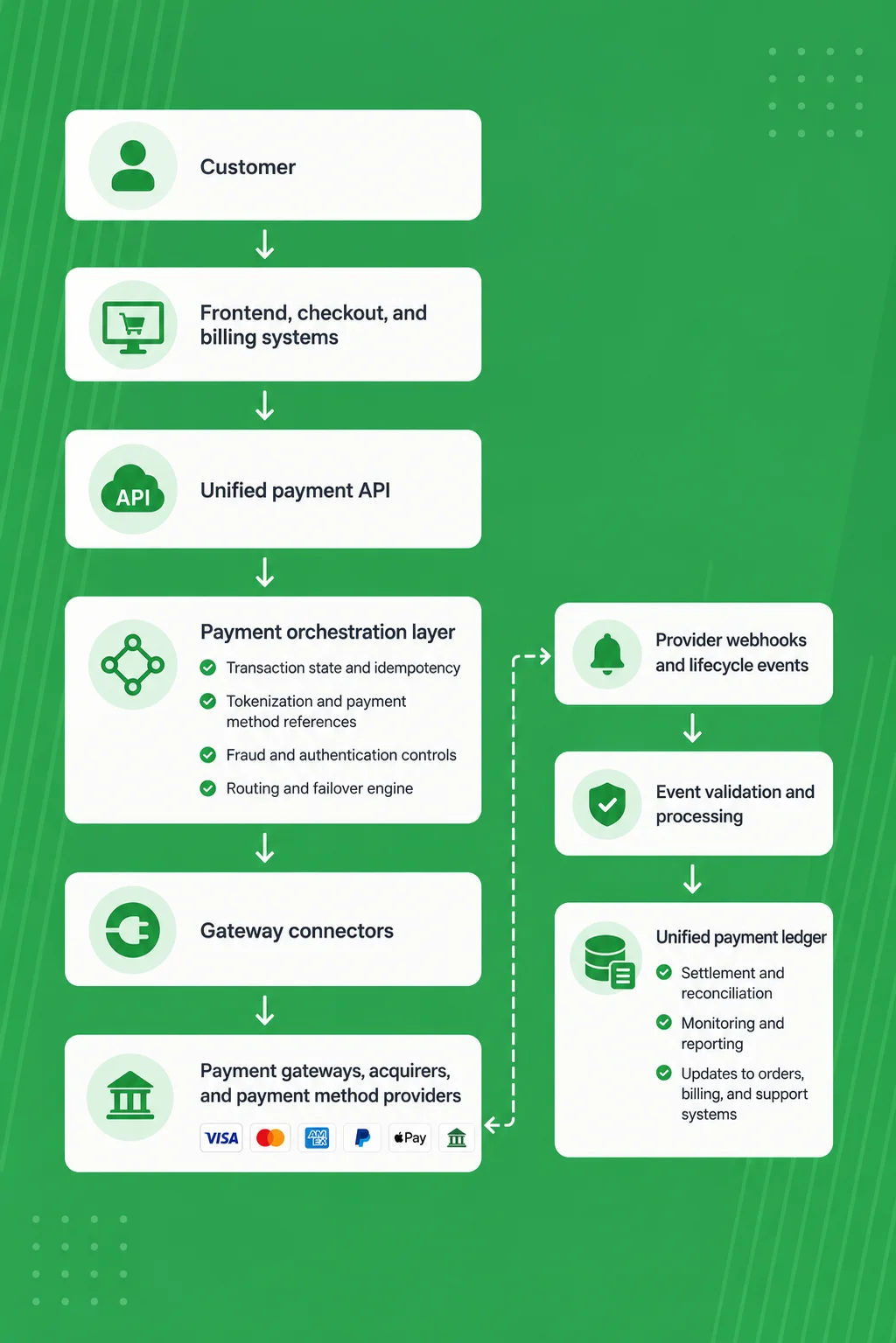
Customer. The customer initiates the purchase and chooses a payment method. The checkout experience remains consistent regardless of which provider processes the payment.
Frontend, checkout, and billing systems. These systems capture the payment intent and business context, such as amount, currency, and order ID. Hosted fields or tokenization can keep raw card data out of core applications.
Unified payment API. The API gives business applications one stable interface for authorization, capture, refunds, and payment-status queries while hiding provider-specific APIs.
Payment orchestration layer. This layer coordinates the payment lifecycle, maintains consistent payment states, applies shared rules, and manages routing across providers.
Fraud and authentication controls. These controls assess transaction risk and trigger additional verification when required.
Routing and failover engine. The engine selects an eligible provider based on cost, geography, authorization performance, risk, and provider health. Fallback is used only when another attempt is safe.
Gateway connectors. Connectors translate common payment requests into provider-specific formats and normalize responses, errors, and statuses.
Payment providers. External gateways, PSPs, acquirers, and regional partners (for example, Worldpay, Braintree, or Authorize.net) connect the platform to payment rails. Their capabilities can differ by market and payment method.
Event processing and unified payment ledger. Provider updates are applied to a central payment record, giving finance, operations, and support teams a consistent view of transaction status.
This separation makes provider changes easier to contain and gives the business a reliable source of payment state throughout the transaction lifecycle. It also creates the foundation for routing, reconciliation, monitoring, and reporting, which the following section examines in more detail.
The Core Components of a Payment Orchestration Platform: A Deeper Technical View
While the previous section outlined the high-level flow, implementing an orchestration platform requires clear ownership for each component. Unclear boundaries quickly lead to duplicated payment states, inconsistent routing decisions, and manual work for finance and operations. A production platform needs one shared payment model, with each component responsible for a distinct part of the transaction lifecycle.
Unified payment API
The API should represent business operations rather than mirror the endpoints of individual gateways. Checkout and billing need stable contracts for authorization, capture, void, refund, and payment-status retrieval, even when providers implement those operations differently.
The challenge is avoiding two extremes: exposing every provider field, which spreads complexity, or reducing the API so much that you lose necessary business capabilities. By keeping provider-specific exceptions behind a stable contract, the platform can add, replace, or upgrade gateways with fewer changes to checkout and billing.
Routing engine
A routing engine should first determine which providers are eligible for a transaction. It excludes providers that do not support the required market, currency, payment method, authentication flow, or regulatory conditions. Only then should it compare eligible options using processing cost, authorization performance, risk, commercial commitments, and current provider health.
Rules also need to be versioned and auditable. When approval rates or costs change, payment teams should be able to understand which policy selected a provider and adjust it without releasing a new checkout code.
Gateway connectors
A connector should translate, not decide. It handles provider-specific authentication, API mapping, webhooks, and version changes, while commercial and routing rules remain centralized elsewhere. This makes changes easier to govern, audit, and apply consistently across providers.
A well-defined connector model reduces the effort required to add or upgrade providers. Proprietary gateway features may still require exceptions, but those exceptions should not redefine the platform’s common payment model.
Tokenization service
Tokenization affects both payment-data exposure and how easily the business can change providers. Hosted fields, client-side capture, or a secure vault can keep raw card details outside most core systems. Yet, the ownership of the resulting token matters. A token issued by one gateway may not be usable through another, leaving recurring payments tied to the original provider.
Where portability is a business requirement, the architecture may use gateway-agnostic vault tokens or network tokens based on the EMV payment tokenization framework. Unlike gateway-issued tokens, network tokens are not tied to a specific gateway and can support routing across different acquiring paths.
To preserve that flexibility, the enterprise should control its Token Requestor setup, including the relevant Token Requestor ID (TRID), either directly or through an independent tokenization provider acting on its behalf. This reduces gateway dependency and supports credential lifecycle management. The tokenization model also affects PCI DSS scope, migration cost, and the continuity of stored-payment use cases.
Fraud detection
Fraud controls have to balance two losses: money lost to fraudulent transactions and revenue lost when legitimate customers are rejected. The platform may combine shared risk policies with signals and authentication capabilities provided by individual gateways. Those controls must work with routing rather than against it.
A route with a low processing fee is not economical if it introduces more false declines, fraud exposure, or customer friction. The goal is to approve more legitimate payments while keeping fraud losses and false declines within acceptable limits.
Transaction monitoring
Infrastructure health alone does not show whether the payment platform is performing well. A gateway may be technically available while producing slower responses or more declines in a particular market.
Effective monitoring must directly support revenue retention by identifying hidden payment failures before they impact customers. To achieve this, telemetry should connect technical health with business outcomes, focusing on key signals:
- Gateway latency and API timeout rates.
- Authorization rates mapped by region and currency.
- Unresolved transactions and webhook processing delays.
This view becomes most useful when teams can compare performance across different providers to guide routing decisions. Without current performance data, dynamic routing is largely operating in the dark.
Settlement and reconciliation
The customer-facing payment may succeed, but the final payout to the merchant might be short because a fee, refund, or adjustment is recorded incorrectly. The unified ledger must also account for FX differences in multi-currency payments and interchange-related fee variances reflected in final settlement.
Reconciliation compares the platform’s ledger with provider settlement files, payouts, fees, refunds, disputes, and adjustments. With several providers, the platform must account for different reporting formats, currencies, identifiers, and settlement schedules. Automation should match expected and actual outcomes, then send unresolved differences into an exception workflow. This reduces manual investigation, exposes revenue leakage, and gives finance greater confidence in period-end reporting.
Reporting layer
Reporting should begin with the unified ledger, not with a collection of provider dashboards. A common data model allows operations teams to track provider health, product teams to understand payment-method performance, and finance teams to compare fees and settlement results. Measures such as authorization rate, cost per successful payment, fallback frequency, dispute levels, and reconciliation exceptions then have the same meaning across providers. Without that shared foundation, different teams can reach different conclusions about the same payment activity.
These components depend on one another. Routing without monitoring lacks reliable performance signals. Reporting without a unified ledger produces inconsistent numbers. Tokenization tied to one gateway weakens the portability promised by the orchestration layer.
The platform becomes operable when each component has a clear responsibility, but all of them work from the same transaction state.
Payment Routing Strategies
Connecting several gateways creates options. Routing determines whether those options improve payment performance or simply add operational complexity. A routing engine applies predefined business rules at transaction time to determine which eligible provider should process each payment. Enterprises usually combine several routing strategies rather than rely on a single rule.
Geographic routing
Geographic routing uses transaction context, such as customer market, currency, payment method, and issuer information, to select an appropriate provider or acquiring route. Where local acquiring is available, it can improve authorization odds and reduce cross-border costs.
Cost-based routing
Cost-based routing compares eligible providers based on the full cost of processing a payment, including transaction fees, cross-border and currency-conversion costs, transaction value, and commercial commitments. The cheapest route is not always the most economical if it also produces more declines or retries. For this reason, enterprises often optimize for cost per successful payment rather than the lowest advertised fee.
Success rate optimization
Success rate optimization uses rolling authorization data to direct eligible transactions toward routes that perform better for a particular segment. At enterprise volumes, even a modest improvement in approval rates can recover meaningful revenue. Policies should respond to reliable trends rather than isolated fluctuations.
Commercial load balancing
In a payment routing context, load balancing is not just about distributing server infrastructure traffic. It also supports commercial allocation by distributing transactions across several eligible providers based on regional capacity limits, pricing tiers, or contractual volume commitments. Sending a controlled share of live traffic through secondary providers also helps confirm that fallback routes remain operational when needed.
Intelligent failover
Intelligent failover should distinguish a confirmed provider failure from an uncertain payment outcome. For synchronous card payments, a timeout does not necessarily mean the authorization failed, so the platform should not immediately send the same payment to another provider.
If supported, the orchestration layer can first cancel or void the original attempt. Otherwise, it should mark the transaction as pending and resolve its status asynchronously rather than keep checkout waiting. A secondary authorization can proceed with idempotency controls only after the first attempt is confirmed unsuccessful, canceled, or reversed. If the outcome remains uncertain, the customer should receive a clear pending or next-step message rather than risk a duplicate charge.
Seamless fallback is possible only when no additional customer authentication is needed. If the customer must verify the payment again, for example, through a 3D Secure (3DS) challenge used to support Strong Customer Authentication (SCA), the customer-facing flow must resume.
The most effective routing policy is one that balances payment completion with cost, risk, and operational complexity.
Security and Compliance Considerations
Keeping sensitive card data out of core systems can reduce breach exposure and PCI DSS compliance effort. This becomes increasingly important as every additional payment provider introduces new credentials, data flows, and privileged operations. The goal is to expand payment capabilities without allowing operational risk and governance costs to grow at the same pace.
PCI DSS scope and data isolation
A practical starting point is gateway-agnostic tokenization, where card details are captured through a secure payment flow and replaced with tokens before they reach core checkout, billing, or internal systems. Tokenization can reduce the number of systems included in the cardholder data environment (CDE), potentially lowering the effort required for PCI DSS compliance, although the exact scope depends on the architecture.
Tokenization alone does not determine PCI DSS validation requirements. For E-commerce, those requirements also depend on how card data is collected, which payment functions are outsourced, and whether merchant-controlled systems can affect the security of the payment page. Hosted payment components can limit the merchant’s direct handling of card data, while capturing it directly brings more systems and controls into scope.
Key security management practices
Beyond tokenization, a multi-gateway platform needs a few foundational controls that protect payment data, prevent unauthorized actions, and reduce the cost of incidents.
- Securing data in transit and at rest. Payment information must be protected while moving between systems and while stored. Use strong cryptography for network connections, together with strong encryption and tightly controlled key management for sensitive stored data.
- Protecting system credentials and webhooks. A leaked API key can expose a provider connection, while an unverified webhook can trigger an incorrect refund or order update. Store provider credentials and webhook secrets in a centralized, secure vault, authenticate incoming events, and prevent replayed or duplicate messages from triggering the same financial action twice.
- Controlling authentication and access. Customer authentication mechanisms such as 3D Secure can support fraud controls and Strong Customer Authentication (SCA) requirements where applicable. Internally, permissions should limit who can issue refunds, change routing rules, or manage provider credentials, while audit logs make sensitive actions traceable. The platform must also preserve the payment state when customer authentication interrupts the transaction flow.
Together, these controls limit the impact of payment-data breaches and unauthorized actions while making provider access easier to govern and simplifying compliance reviews and incident investigations.
Common Challenges When Integrating Multiple Payment Gateways
Adding gateways is usually the easy part. The real challenge is keeping provider-specific complexity out of checkout, billing, finance, and customer support. If those differences spread across the platform, they increase engineering and operating costs, complicate financial operations, and create additional friction for customers and market expansion.
API and error-model inconsistencies
The same payment action or failure may be handled differently by each provider. Without a common model, every new integration adds development, testing, and maintenance effort, while inconsistent error handling increases the risk of incorrect retries or payment states.
A connector layer should absorb these provider-specific differences and present core systems with one consistent set of payment operations, statuses, and errors.
Currency support and conversion
Currency coverage is not simply a question of whether a provider accepts a particular currency. It also affects available payment methods, settlement options, conversion costs, and cross-border fees. A route that works technically may therefore be an expensive commercial choice. These factors should be handled centrally, so that routing decisions reflect both currency support and the full cost of processing the transaction.
Settlement and reporting differences
Settlement rarely works the same way across providers. Payout timing, settlement currencies, fees, and reporting formats can differ, and settlement information may arrive on different timelines.
That inconsistency makes reconciliation harder, can complicate cash-flow planning, and increases the manual effort required to explain why processed payment amounts do not match final payouts. A unified ledger should bring settlement records into one consistent view and flag discrepancies across fees, refunds, and disputes.
Refund logic
A refund that looks simple to the customer may follow a different process depending on the provider. Timing, partial refunds, repeated refunds, and the distinction between voiding an authorization and refunding a completed payment are not always handled consistently.
Without normalization, those differences create extra work for support and finance teams and increase the risk of processing errors. The orchestration layer should provide one refund operation across providers, with connectors translating it into the required provider-specific workflow.
Dispute operations
Disputes often make operational complexity especially visible. Reason codes, evidence requirements, response deadlines, and case-management processes differ across providers, forcing teams to work across multiple portals and data sources.
A unified dispute workflow can give teams one place to manage cases across providers. This reduces manual work and lowers the risk of missing response deadlines as payment volume grows.
Compliance complexity
Adding a provider can also change data-handling, authentication, and regional compliance responsibilities. When those responsibilities are unclear, new integrations can increase compliance work and make expansion into new markets more difficult.
The platform should keep these responsibilities clearly defined and document what remains with the business and what is handled by each provider. This makes new integrations easier to assess without duplicating compliance logic across core applications.
In practice, the cost of a multi-gateway platform is driven less by the number of providers than by the differences the platform must absorb across payment processing, currencies, settlement, refunds, disputes, and compliance.
Best Practices for Payment Gateway Integration
The challenges above cannot be solved by adding more provider-specific logic. A reliable payment gateway integration strategy needs clear service boundaries, safe handling of repeated requests, and enough operational visibility to detect provider issues before they disrupt checkout or affect revenue.
Microservices isolation and API-first principles
Isolating payment logic behind a dedicated payment layer allows most provider changes to be implemented without corresponding updates to core checkout, billing, or order systems. Keep gateway SDKs, authentication, request mappings, and error translation inside that boundary rather than spreading provider-specific logic across business applications.
Use a stable internal API with clearly defined, versioned schemas for payment operations such as authorization, capture, void, refund, and status retrieval. OpenAPI can be used to document and govern this contract.
This separation allows commerce and integration teams to develop and test independently, reducing coordination costs, regression risk, and the engineering effort required to upgrade or replace a gateway.
Resiliency and fault tolerance patterns
Payment operations are not ordinary API calls. A duplicate request can mean a duplicate charge, while an aggressive retry after a timeout can send the same payment to another provider before the first outcome is known.
- Idempotency first. Assign a unique idempotency key to every operation that changes payment state, including authorization, capture, void, and refund. This prevents repeated or concurrent requests from creating duplicate financial operations. A distributed processing lock should expire automatically after a defined time-to-live (TTL), so that a failed or abandoned request does not block future processing indefinitely. The idempotency record should remain available after the lock expires, and if the original outcome is still unknown, the platform must resolve it before creating another provider attempt. A repeated request should return the stored result or current status rather than repeat the financial action.
- Circuit breakers around provider calls. Repeated errors or degraded performance should temporarily remove an unhealthy gateway from new routing decisions. The circuit should open only after a defined failure or latency threshold is reached, not after a single error. This prevents one provider from slowing down the wider checkout flow while preserving traffic for healthy routes.
- Bounded retries and timeouts. Retry only transient technical failures, using exponential backoff and a defined attempt limit. Connection and read timeouts should reflect the provider, payment method, and service-level expectations. There is no universal 3,000-millisecond threshold that is appropriate for every integration. Most importantly, an unknown outcome must be resolved before the platform retries through another provider.
Observability infrastructure
A provider can remain technically available while becoming slower or producing more declines in a particular market. That means infrastructure uptime alone does not show whether the payment platform is performing well.
Centralized telemetry should connect technical health with payment outcomes. Useful signals include:
- Gateway latency, timeouts, and HTTP 4xx/5xx distributions;
- Rolling authorization rates by provider, card brand, payment method, and region;
- Webhook processing latency, duplicate events, and processing backlogs;
- Circuit-breaker activity, fallback frequency, and unresolved transactions;
- Mean time to resolution (MTTR) for provider-related incidents.
Shared transaction identifiers and structured logs should make the full payment history traceable across the original request, provider attempt, webhook, and fallback route. This shortens incident investigation and helps finance resolve reconciliation differences without piecing together records from several systems.
Together, these practices reduce duplicate transactions, contain provider failures, and lower the cost of operating, upgrading, and changing the payment platform.
If you are also evaluating external engineering partners, see our article choosing a payment gateway software development company: top US vendors compared for practical guidance on the technical, compliance, and long-term delivery criteria to assess.
Payment Gateway Integration Checklist
Before expanding live traffic across providers, confirm that the architecture, security controls, and operating model work together to protect revenue and limit operational risk. An executive review should verify these critical foundations:
- Architectural isolation. Are external payment providers accessed through a shared payment layer rather than connected directly to checkout, billing, or other core systems?
- Financial safety. Are idempotency, retry, and timeout controls in place to prevent repeated requests from creating duplicate financial actions? If a payment outcome is unknown, is it resolved before another provider is attempted?
- Security and compliance. Is sensitive card data kept out of core systems where possible? Are provider credentials protected? Are PCI DSS responsibilities and system boundaries clearly understood?
- Failure testing. Have critical failure scenarios, including provider outages, timeouts, delayed events, and fallback behavior, been tested before live traffic is expanded?
- Failover and visibility. Can the platform move eligible traffic to an alternative provider when it is safe to do so, and can teams monitor authorization performance, unresolved payments, and provider degradation?
A platform is ready to scale across providers when routing flexibility, transaction safety, compliance, and operational visibility are all in place.
Typical Enterprise Implementation Scenario
The following scenario is illustrative. It shows how a multi-gateway architecture can address common enterprise payment constraints, but the figures should not be treated as reported client results.
Context and challenge
Consider a digital commerce platform expanding across North America, Europe, and APAC while relying on a single payment provider. As transaction volume grows, several problems begin to surface. Cross-border decline rates reach an illustrative 18% in some new markets. Customers cannot always use familiar regional payment methods, processing fees rise, and occasional provider outages interrupt checkout during high-traffic periods.
The business now has to improve payment performance without rebuilding its commerce platform separately for each region.
Solution architecture
The company introduces a payment orchestration layer between its commerce systems and external providers. Checkout and billing continue to use one internal payment API, while the orchestration platform manages three regional gateway connections.
The new architecture includes:
- a unified payment API for authorization, capture, refund, and status operations
- gateway-agnostic tokenization through an independent vault
- routing based on market, payment method, processing cost, authorization performance, and provider health
- controlled failover for confirmed technical failures
- a shared payment ledger for lifecycle tracking, settlement, and reconciliation
A purchase in Germany might follow this path:
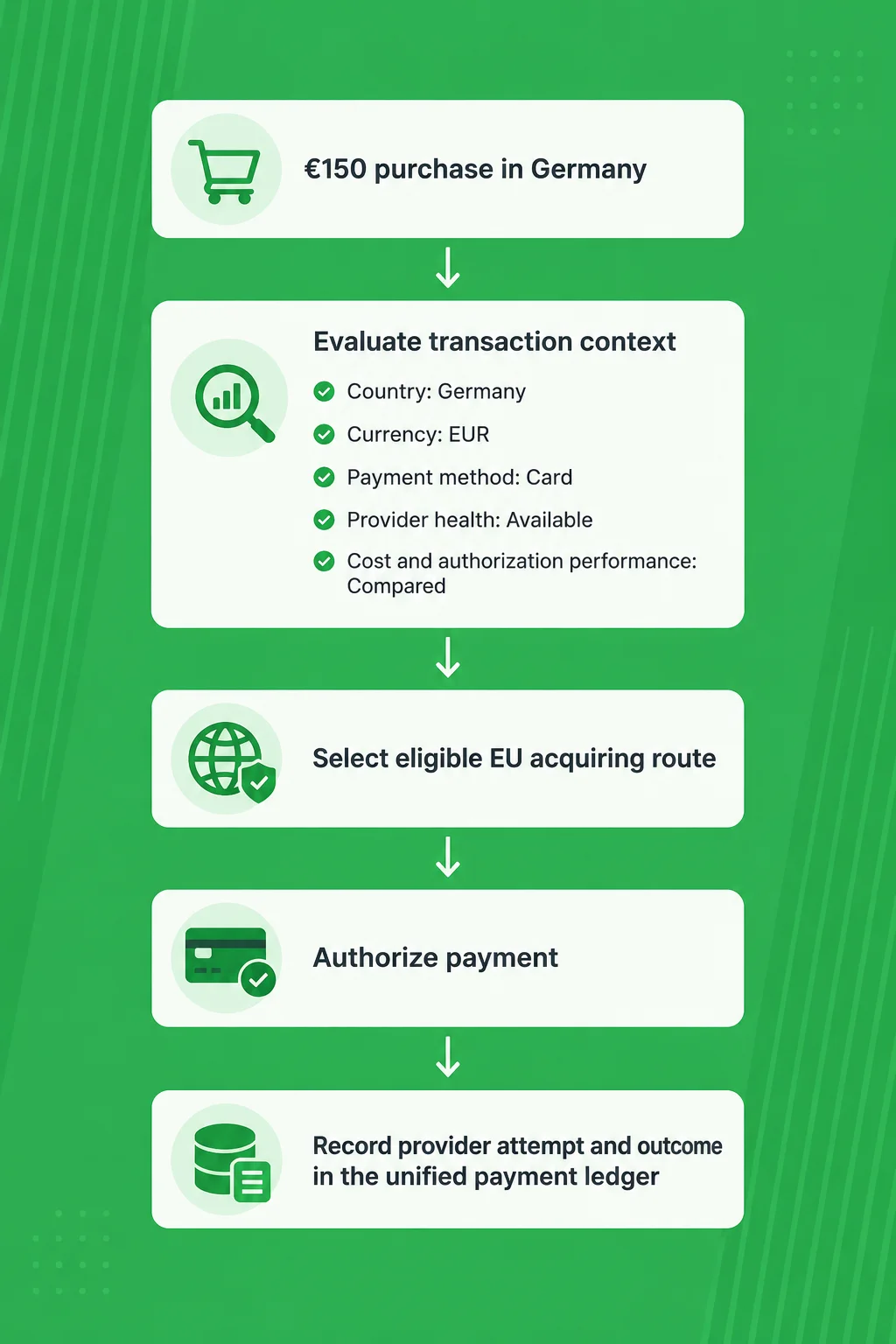
The routing decision remains outside checkout. That means the business can adjust provider priorities, add local methods, or redirect traffic during an outage without changing the customer-facing commerce flow.
Illustrative business outcomes
In this modeled scenario, the architecture produces three measurable improvements:
- Higher authorization performance: Routing eligible transactions through regional acquiring paths improves overall payment approval rates by an illustrative 11%, recovering transactions that might otherwise have been declined.
- Greater operational resilience: During a 45-minute primary-provider outage, controlled failover keeps eligible payments moving through a secondary gateway and limits checkout disruption.
- Lower processing costs: Least-cost routing distributes volume according to provider pricing, cross-border fees, and authorization performance, producing an illustrative 22% reduction in total processing costs.
The value comes from more than adding backup providers. The orchestration layer gives the business one place to control routing, availability, payment economics, and regional expansion without spreading provider-specific logic across the wider commerce platform.
Build vs. Buy: Should You Develop Your Own Payment Orchestration Layer?
Once the target architecture is clear, the next decision is whether to build the orchestration layer internally or use a managed platform. The trade-off is not simply control versus speed. Enterprises need to compare time to market, engineering capacity, long-term operating cost, customization needs, and the level of vendor dependency they are prepared to accept.
The table below compares the two approaches across the main decision factors.
| Decision area | Build | Buy |
| Time to market | Requires significant upfront engineering. A production-grade multi-provider payment layer can take roughly 6 to 12 months of dedicated development. | Faster starting point because core orchestration capabilities and provider connectivity already exist, although integration and migration work are still required. |
| Control and customization | Full control over routing logic, payment data, provider integrations, and the product roadmap. | Provides standard capabilities, but customization depends on the vendor’s architecture and roadmap. |
| Engineering and operating cost | Higher upfront and ongoing costs for connectors, provider API changes, reliability, monitoring, security, and platform ownership. | Lower initial engineering burden, but platform fees, integration costs, vendor management, and ongoing internal ownership still contribute to total cost. |
| Vendor dependency | Greater control over provider choice and portability, provided the architecture avoids provider-specific dependencies. | Introduces dependency on the orchestration vendor, making data portability, contract terms, and exit conditions important. |
| Best fit | Best suited to high-scale businesses with differentiated routing, data, or operational requirements. | Better suited to most businesses that need multi-provider capabilities without making payment infrastructure a major internal engineering investment. |
For most businesses, buying or using a hybrid model is the lower-risk starting point. Building becomes more compelling at very high payment volumes, particularly when the business also has routing, data, regional, or operational requirements that standard platforms cannot support efficiently. Even a 1% reduction in processing fees can translate into hundreds of thousands of dollars in annual savings at that scale, making relatively small efficiency gains financially material.
A hybrid model can offer a practical middle ground. A vendor provides standard connectivity and orchestration capabilities, while internal teams retain control over areas that create business differentiation, such as routing policy, payment data, reporting, or customer experience.
The decision should ultimately be based on the total cost of ownership rather than the initial implementation cost. A custom platform requires long-term engineering ownership, while a managed solution introduces platform fees and vendor dependency. Buying also does not remove the enterprise’s own security and compliance obligations, so vendor due diligence, data portability, and exit planning remain important.
Future Trends in Payment Infrastructure
Payment orchestration is expanding beyond card gateway selection. The next generation of platforms will need to combine smarter routing and observability with open banking, real-time payments, digital wallets, embedded payment models, and regional operating requirements.
The architectural challenge is to adopt these capabilities without creating a separate payment stack for every method, market, or customer journey.
Smarter routing and observability
Routing engines will increasingly combine policy-based rules with machine learning to evaluate authorization performance, cost, fraud signals, latency, and provider health. Automated decisions still need to remain explainable, auditable, and subject to commercial and regulatory controls so that payment teams understand why traffic is routed to a particular provider.
Observability will become part of the decision process rather than a separate reporting function. Current performance data can help the platform react to provider degradation before it causes a wider decline in payment revenue.
Open banking and real-time payments
Open banking and instant payments can help businesses diversify beyond card processing. The potential upside includes faster settlement or funds availability, depending on the rail, lower transaction costs, and less checkout friction in regions where direct bank payments are part of everyday customer behavior.
Realizing that value requires more than adding another checkout button. Each rail may handle payment confirmation, refunds, reconciliation, and failed transactions differently. Fraud controls and operations also have to work in real time. For euro account-to-account (A2A) credit transfers in Europe, including SEPA Instant, requirements such as Verification of Payee (VoP) can add an account-validation step. These methods therefore need to be governed as part of the core payment platform.
Embedded payments and digital wallets
Marketplaces, SaaS products, and other digital platforms are embedding payments deeper into the customer experience. At the same time, wallets and local payment methods continue to expand the range of transaction flows the platform must support.
As platforms take on seller onboarding, fund holding, or payout responsibilities, their regulatory role may change. Depending on the jurisdiction and operating model, this can introduce licensing or regulated-partner requirements, customer and business verification (KYC/KYB), anti-money laundering controls, and additional obligations around holding funds and reporting.
Wallets also bring their own token, authentication, and credential lifecycles. The portability of those credentials across providers affects both vendor lock-in and migration cost.
A shared payment model allows product teams to introduce these experiences without rebuilding provider logic for every channel or market.
Global orchestration and emerging settlement models
Global platforms will need centralized visibility and policy control alongside regional providers, payment methods, and compliance requirements.
Stablecoins may become useful for selected cross-border and settlement scenarios, but adoption depends on regulation, financial crime controls, custody and liquidity, as well as accounting and reconciliation requirements. They should be evaluated as another potential payment rail, not as a universal replacement for established methods.
The broader shift is toward payment orchestration as a coordination layer for a much wider financial ecosystem. A flexible architecture gives enterprises room to adopt new methods without repeatedly redesigning their core commerce systems.
Why Companies Choose Emerline
Building a multi-gateway platform takes more than experience with payment APIs. It requires sound enterprise architecture, secure engineering practices, and a delivery model that supports the platform long after the first providers go live.
Architecture before integration. Emerline helps businesses define the orchestration model, service boundaries, transaction states, routing logic, and security controls before provider-specific decisions become embedded in the wider platform. This reduces the risk of creating a fragmented payment layer that becomes expensive to maintain and change.
Engineering across the payment stack. Our teams combine payment and fintech expertise with API development, cloud-native engineering, and platform modernization. This allows us to address not only provider integrations but also the wider impact on checkout, billing, fraud controls, financial reporting, and operational resilience.
Designed for continuous change. Gateway APIs evolve, new markets introduce different payment methods and regulatory requirements, and commercial priorities shift as transaction volumes grow. Emerline supports secure software development and long-term product evolution, from provider upgrades and observability to platform scaling and new payment capabilities.
Our focus is on sound architecture, maintainable integrations, and operational reliability, not on maximizing the number of gateway connections.
Frequently Asked Questions About Multi-Gateway Architecture
Even with a clear architecture, the practical trade-offs are not always obvious. The answers below put the most important enterprise decisions into context.
When does adding another payment gateway make sense?
Usually, when the limitations of a single provider become measurable. These may include poor coverage in priority markets, missing payment methods, rising processing costs, recurring outages, or authorization performance that varies significantly by region.
A second gateway should solve a defined problem. Adding one simply for redundancy can create more engineering, security, compliance, reconciliation, and vendor-management work without delivering meaningful resilience.
How many payment gateways does a business need?
There is no ideal number. For some businesses, a primary provider and one genuinely independent secondary route are enough. Others need several gateways to cover different markets, acquiring relationships, currencies, or payment methods.
The useful question is not “How many can we connect?” but “What distinct role does each provider serve?” A fallback route should also be sufficiently independent, with different acquiring relationships, regional infrastructure, and critical supporting services where possible. If a gateway adds no new coverage, performance advantage, commercial value, or fallback capability, it may be adding cost rather than flexibility.
Can payment orchestration be introduced gradually?
Yes. The existing gateway can become the first connector behind a unified payment API, while checkout and billing are moved to the new interface in stages. New providers, routing rules, and payment methods can then be introduced incrementally. This approach lowers migration risk and avoids replacing checkout, recurring billing, stored-payment flows, and financial reporting at the same time.
The transition still requires a period of parallel operation. Teams may need to reconcile both payment paths, define rollback criteria, and budget for overlapping provider contracts and temporary duplicate processes.
How should legacy transactions be handled when moving to a new payment architecture?
Legacy transactions can continue to generate refunds, disputes, settlement adjustments, and reconciliation work after new payment traffic has moved to the orchestration platform. The platform should therefore retain the original provider and transaction details needed to send those actions to the right place.
During migration, businesses typically keep legacy provider access available for a defined transition period. Its length should reflect refund policies, dispute windows, settlement timelines, and contractual requirements. The old connection can be retired once outstanding financial and operational obligations have been resolved.
What happens to stored payment methods and subscriptions when a gateway changes?
First, establish where the subscription logic lives. If billing schedules are managed internally, the subscription records can usually remain in place. If the gateway manages recurring schedules, retry rules, or customer references, those elements may need to be migrated as well. The difficult part is often moving or replacing the payment credential used to charge the customer. Gateway-issued tokens are usually provider-specific and may not work through another processor.
For card-on-file payments, teams also need to determine whether a payment is initiated by the customer or later initiated by the merchant under an existing agreement. In payment terminology, these are cardholder-initiated transactions (CITs) and merchant-initiated transactions (MITs). References linking later merchant-initiated payments to the original customer transaction may also need to be preserved. Losing this context can disrupt recurring charges or affect how subsequent payments are handled by providers and card networks.
An independent vault, network tokens issued through card-network programs, or a provider-supported credential migration may reduce dependency on a specific gateway. Account updater services, such as Visa Account Updater (VAU) and Mastercard Automatic Billing Updater (ABU), can also keep stored card credentials current when cards are reissued or expire, helping reduce avoidable declines during and after a migration.
Portability still depends on provider capabilities, token arrangements, card-network support, contracts, and applicable customer-consent requirements. Any transfer involving card data must also comply with applicable PCI DSS requirements. Tokenization can reduce exposure, but it does not remove compliance obligations automatically.
How should the ROI of a multi-gateway platform be measured?
Start with a baseline. Measure authorization performance, cost per successful payment, outage-related losses, reconciliation effort, provider fees, and engineering support costs before the new architecture goes live.
Measure incremental margin, not authorization uplift alone. Additional approved payments should be evaluated after processing fees, fraud losses, chargebacks, refunds, retries, and customer-support costs.
Some of the value is visible in payment performance. Other benefits show up elsewhere, through fewer outages, quicker market entry, lower processing costs, and less reconciliation work. The cost side should be equally broad. Beyond connectors and infrastructure, it includes security, compliance, monitoring, and long-term ownership, as well as migration overlap, provider commitments, and the cash-flow consequences of different settlement schedules.
Will an orchestration layer slow down checkout?
It adds another processing step, so some overhead is unavoidable. Well-designed orchestration should keep that overhead small compared with the time spent waiting for external providers.
Routing logic should remain lightweight, and analytics or reporting tasks that are not required for the payment decision should run asynchronously. Teams should also measure orchestration time separately from gateway response time. Otherwise, a slow provider may be mistaken for a slow platform.
A defined latency budget helps make that distinction clearer. Teams can track p95 and p99 latency rather than relying only on averages that may hide slower payment attempts.
Who should own payment orchestration after launch?
Payment orchestration usually needs one clear business owner, typically a Head of Payments or Payment Product Owner. That role is accountable for conversion, processing costs, provider strategy, and routing decisions. Platform Engineering owns reliability and incident response, while Finance or Payment Operations covers reconciliation, settlement exceptions, and disputes. Security and Compliance support decisions with regulatory or control implications. A simple RACI model helps prevent gaps between teams.
Disclaimer
This article is for informational purposes only and does not constitute technical, security, or legal consulting advice. The architectural patterns, routing strategies, and payment flow concepts described reflect general enterprise engineering practices. Actual implementation complexity, compliance scope, authorization performance, and operational outcomes will vary based on your tech stack, payment providers, and business requirements. Always conduct tailored security and architecture reviews before making platform-wide changes.
Published on Aug 14, 2026