How to Choose a Power BI Implementation Partner for Data Transformation
Table of contents
- Key Takeaways
- Verifying Semantic Modeling and Engine Competency
- Emerline Engineering Advice: The Importance of Code Profiling
- Evaluating Hybrid Integration and Gateway Expertise
- Emerline Integration Advice: Slashing Technical Debt with Query Folding
- Auditing Security and Access Governance Capabilities
- Technical Vendor Evaluation Checklist
- Frequently Asked Questions
- Why should we hire a specialized Power BI partner instead of using our internal generalist developers?
- How do we verify that a vendor actually has enterprise-grade experience?
- What role does Microsoft Fabric competency play when selecting a partner?
- Expert Analytics and Infrastructure Support
- Comparison: Generalist Agency vs. Enterprise Power BI Partner
When an enterprise decides to modernize its analytical infrastructure, choosing the right technology vendor is the single most critical variable in the project's success. Many organizations treat a business intelligence rollout as a frontend design task, hiring teams that excel at creating attractive charts but lack deep backend engineering capabilities.
In an enterprise environment, a successful data transformation relies on what happens beneath the visualization canvas. Brittle data pipelines, unoptimized data models, and fragmented security boundaries cause system latency, generate high cloud computing costs, and trigger compliance failures.
To achieve a true data-driven culture, you need a specialized Power BI implementation partner that understands enterprise data warehouse (EDW) design, cloud infrastructure optimization, and complex ERP integrations. This technical guide outlines the exact engineering criteria, architectural benchmarks, and security standards you must evaluate to select the right partner for your data journey.
Key Takeaways
- Architectural Depth over Aesthetics: Prioritizing partners who demonstrate mastery in backend semantic modeling and data warehouse design rather than simple dashboard design.
- Seamless ERP Integration: Ensuring the vendor possesses documented experience bridging cloud-native analytics with complex, siloed legacy systems and corporate ERPs.
- End-to-End Security Governance: Verifying the team can build dynamic, role-based access controls that respect internal data entitlement boundaries across all tools.
- Code Optimization Mastery: Selecting a partner that actively profiles computational logic to prevent capacity overruns and lower overall infrastructure waste.
Verifying Semantic Modeling and Engine Competency
The core performance engine of your analytics estate is the in-memory column-store database engine (VertiPaq) that powers Power BI. Generalist development shops often skip proper data modeling, loading flat, un-modeled database tables directly into the reporting layer. This approach forces the capacity engine to calculate complex logic on the fly during user sessions, leading to dashboard timeout errors and slow response times under heavy concurrent loads.
When interviewing a potential partner, bypass generic project portfolios and evaluate their technical approach to model engineering:
- Star Schema Architecture: A qualified vendor must demonstrate a strict commitment to dimensional modeling. They should be able to explain how they break down messy transaction logs into optimized fact and dimension tables to maximize database compression and speed up query processing.
- Advanced DAX Optimization: Ask their data engineers how they handle complex Data Analysis Expressions (DAX). They should articulate real-world scenarios where they avoid heavy, runtime semantic model calculations and instead push computational logic upstream into the data warehouse or lakehouse layer to keep reports running smoothly.
Emerline Engineering Advice: The Importance of Code Profiling
When auditing a technology vendor, look closely at the engineering tools they integrate into their standard quality assurance cycles. A reliable Microsoft Power BI partner does not rely on simple manual validation to check dashboard speed.
Ensure your potential provider uses advanced database profiling tools (such as DAX Studio, Tabular Editor, and Power Query Diagnostics) throughout their development lifecycle. Regular automated profiling allows engineers to isolate memory leaks, eliminate redundant calculations, and fix query bottlenecks before the analytics platform ever touches your production environment.
Evaluating Hybrid Integration and Gateway Expertise
Enterprise data rarely sits inside a single cloud repository. A complete business intelligence view requires connecting your analytics layer directly to diverse, fragmented backend systems - including platforms like Microsoft Dynamics 365, legacy SAP installations, and localized SQL databases.
Your chosen implementation team must possess practical, hybrid-network engineering experience. They must know how to deploy and manage high-availability clusters of On-Premises Data Gateways to establish secure, inbound communication tunnels without forcing your network teams to open dangerous inbound firewall ports.
Furthermore, verify their depth of experience with advanced cloud-data technologies, such as Microsoft Fabric and Direct Lake mode. The team should know how to configure ingestion pipelines that standardize raw corporate data into open-source formats like Delta Parquet. This enables Direct Lake mode to load data directly into the Analysis Services memory overhead-free, bypassing traditional import refresh cycles and serving data at memory speeds.
Emerline Integration Advice: Slashing Technical Debt with Query Folding
When connecting business intelligence tools to heavy transactional ERP databases, unoptimized data pipelines can quickly overwhelm your source systems. If an integration pipeline pulls millions of un-filtered rows across your network to process data changes locally in the cloud, it will drain your gateway resources and drive up your computing bills.
To ensure system stability, verify that your chosen provider specializes in advanced Power BI implementation and development services. Their developers must know how to build data extraction steps that enforce strict query folding - the ability to translate data preparation rules into a single native database statement and push that execution down to the source server. Pushing the heavy computational workload down to the origin database slashes network transit overhead, lowers background resource waste, and drops overall infrastructure costs by up to 90%.
Auditing Security and Access Governance Capabilities
Data security perimeters fail if an employee's cloud reporting access does not perfectly mirror their internal corporate authority. If a regional manager is restricted from viewing global sales data inside your primary financial database, that boundary must hold perfectly when they open a Power BI workspace.
Ensure your potential partner demonstrates deep competency in Dynamic Row-Level Security (RLS) and centralized directory integrations. For modern enterprise deployments, security filters should be enforced natively within the unified storage layer to maintain performance and architecture integrity:
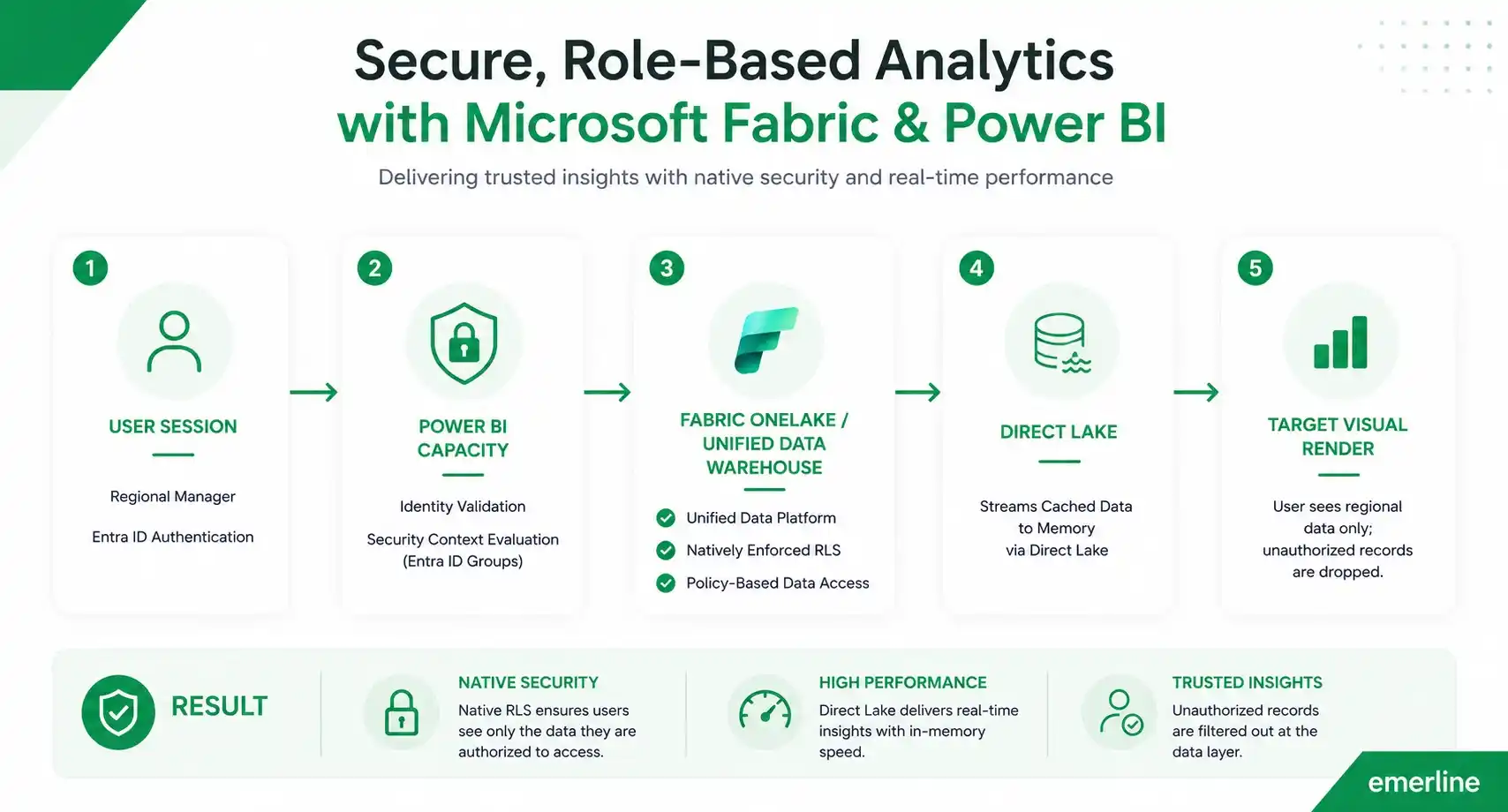
The vendor's engineers should know how to build data architectures that leverage dynamic security contexts - such as mapping Azure Entra ID Security Groups or utilizing the USERPRINCIPALNAME() function. This setup allows a single dashboard to automatically filter its visual results based on the active user's identity, completely eliminating the security risk and maintenance overhead of creating separate report files for different access levels.
Technical Vendor Evaluation Checklist
Before partnering with an external provider for your data transformation initiatives, technical leaders should audit the candidate's engineering posture against these five metrics:
- Modeling Strategy Mastery: Can the vendor demonstrate how they refactor legacy flat-file databases into star-schema dimensional models to maximize engine compression?
- Resource Sizing Competency: Does the team possess certified experience in capacity planning, ensuring they can accurately size your workspace requirements without triggering capacity throttling or unexpected billing spikes?
- Advanced Security Design: Can the provider build unified security models where row-level restrictions and column-level masking rules are inherited downstream across all analytical layers without breaking performance modes?
- Incremental Lifecycle Setup: Are they proficient in configuring incremental refresh policies, ensuring the system only scans rows that have actively changed rather than re-reading entire historical databases?
- Post-Deployment Support: Does the vendor offer structured Power BI managed services to handle ongoing governance, license tracking, and regular dashboard optimizations as your organization scales?
To understand how your core operational infrastructure, database registries, and financial data pipelines should be aligned to support an enterprise-grade analytics rollout, read our strategic guide on connecting Power BI with enterprise ERP systems.
Frequently Asked Questions
Why should we hire a specialized Power BI partner instead of using our internal generalist developers?
Rebuilding an enterprise data architecture requires highly specialized database tuning and modeling skills that generalist application developers rarely possess. A dedicated Power BI implementation partner brings deep, focused experience in star-schema database optimization, high-performance DAX programming, and secure hybrid gateway networking, ensuring your analytics platform is built to be fast, stable, and completely secure from day one.
How do we verify that a vendor actually has enterprise-grade experience?
Look past high-level project slides and ask the vendor's technical leads to describe their approach to performance diagnostics and query optimization. An experienced team will immediately focus on backend mechanics, such as query folding percentages, memory footprint metrics, and unified security filtering architectures, rather than simply discussing dashboard layouts or visual chart designs.
What role does Microsoft Fabric competency play when selecting a partner?
In the modern data environment, Power BI is deeply integrated with the broader Microsoft Fabric ecosystem. Choosing a partner with proven Fabric capabilities ensures that your analytics architecture can smoothly transition to unified cloud storage architectures (OneLake) and zero-copy data streaming (Direct Lake mode) when your data volumes scale, protecting your software investments from early technology obsolescence.
Expert Analytics and Infrastructure Support
Transitioning to an automated, enterprise-grade business intelligence platform requires a technology partner with deep cloud-native experience, database modeling mastery, and advanced security certifications. As a certified Microsoft Solutions Partner, Emerline specializes in modernizing legacy reporting silos, building secure hybrid data integrations, and deploying high-performance analytical environments tailored to your industry's exact compliance constraints.
Comparison: Generalist Agency vs. Enterprise Power BI Partner
| Evaluation Metric | Generalist Development Agency | Enterprise Power BI Partner (Emerline) |
| Data Modeling | Flat tables, ODS replication, high redundancy | Optimized Star Schema (Fact & Dimension tables) |
| Performance Focus | Visual formatting and cosmetic design | VertiPaq engine compression and DAX profiling |
| Data Architecture | Direct import of raw, unfiltered source data | Multi-tier architecture (Lakehouse/Medallion) |
| Scalability | High risk of report timeouts under heavy loads | Low-latency execution via optimized query paths |
Contact our Enterprise Data and Analytics Engineers to arrange a comprehensive evaluation of your analytics strategy, optimize your data infrastructure, and deploy secure, low-latency workflows across your ecosystem.
Published on Apr 1, 2026