How To Choose an AI Consulting Company for Enterprise AI Strategy
Table of contents
- Quick answer
- Key takeaways
- What Does an AI Consulting Partner Actually Do?
- What Should an Enterprise AI Strategy Include?
- Business objectives come first
- AI readiness
- Use-case discovery and prioritization
- Data
- Technology selection
- Architecture and integration
- Governance and security
- Organization and operating model
- AI strategy and AI roadmap
- Business value and KPIs
- How To Evaluate an AI Consulting Company
- Evaluation criteria and evidence to request
- Use a simple scoring system
- Questions to ask before signing
- Five practical tests that reveal more than a sales deck
- Ask for a genuinely comparable project
- Ask to see how the methodology works in practice
- Ask what happens when a PoC does not validate the idea
- Ask who takes responsibility after strategy
- Ask how success will be measured before discussing technology
- Red flags and common mistakes
- Use cases are proposed without examining the data behind them
- The engagement stops at recommendations or a PoC
- Governance is scheduled for later
- No one can explain what success means
- The proposed scope tries to solve everything at once
- What Should an AI Consulting Proposal Include — And What Affects Cost?
- What deliverables should be defined?
- Common commercial models
- What affects the cost of AI consulting?
- Where consulting ends and implementation begins
- Why Choose Emerline for Enterprise AI Consulting?
- Frequently Asked Questions About Choosing an AI Consulting Company
- What does an AI consulting company do?
- How do I choose an AI consulting partner?
- How do I know whether my company is ready for AI?
- Should an AI consulting partner also provide development services?
- How long does an AI consulting engagement take?
- How much does AI consulting cost?
- Final Checklist: Choosing an AI Consulting Partner
For many enterprises, AI planning starts with several questions at once: where AI can create meaningful business value, which use cases are realistic with the data and systems already in place, what the architecture needs to support, and how security, governance, and cost should shape the decision. Add pressure to move beyond isolated pilots, and the task becomes one of setting priorities: what is worth pursuing, what needs more groundwork, and where investment should come first.
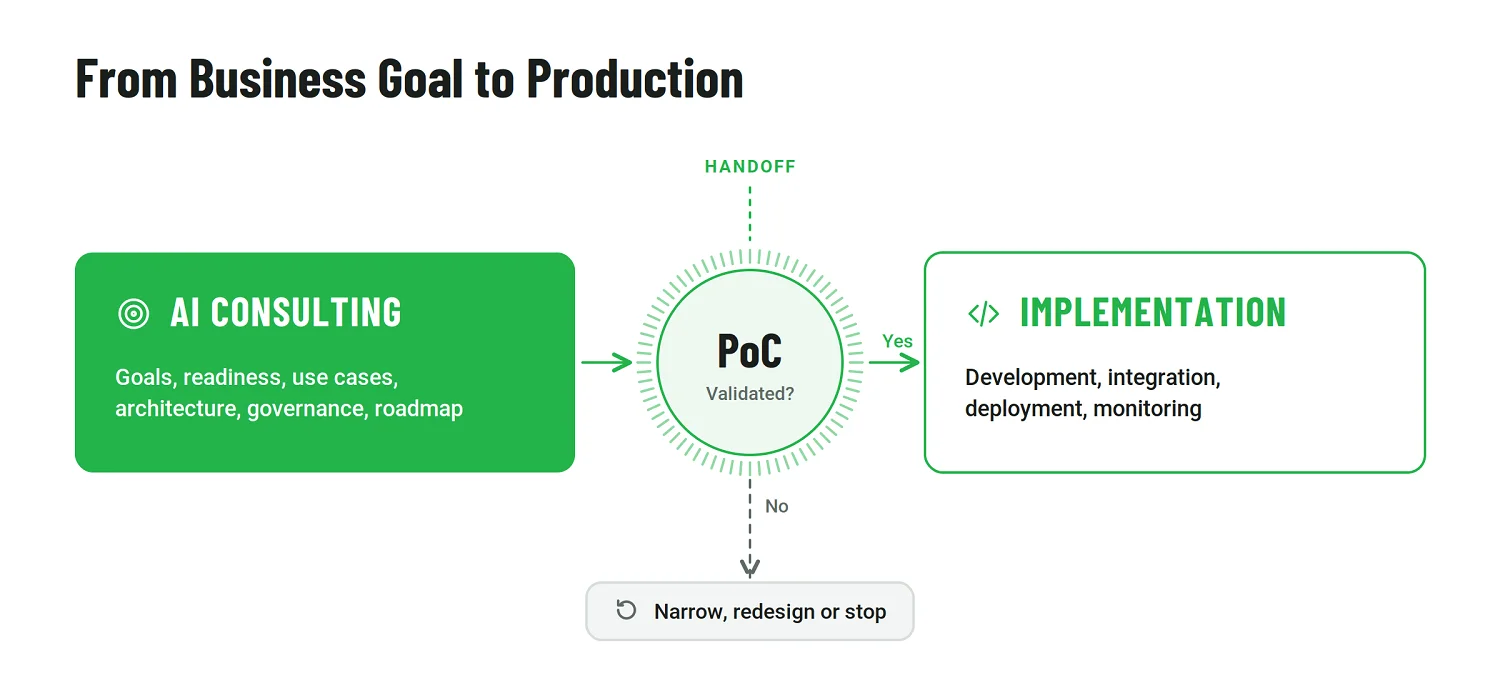
A capable AI consulting partner helps turn those questions into a workable sequence, going from assessing the business goals to production. That process brings business and technical considerations together early enough to test feasibility, uncover data or integration constraints, and shape a roadmap around the realities of the enterprise environment.
For buyers, the challenge is to distinguish between firms that can advise on AI in broad terms and those that can connect strategy with data, architecture, governance, engineering, and production delivery. This guide focuses on the evidence that helps make that distinction.
Quick answer
When choosing an AI consulting company, look for evidence that the team can connect business priorities with technical feasibility and implementation. Review its experience with AI readiness, use-case prioritization, data and architecture, security and governance, technology selection, PoC development, and production delivery. Comparable projects, a clear methodology, concrete deliverables, and a defined delivery team are more useful than broad claims about AI expertise.
Key takeaways
- Start with the business problem and the outcome you want AI to improve.
- Check whether the partner can assess data, systems, architecture, security, and organizational readiness before recommending a solution.
- Ask how they prioritize use cases and what evidence they use to judge feasibility, value, and risk.
- Expect a roadmap with clear implementation steps, investment priorities, and measurable outcomes, not just a strategy presentation.
What Does an AI Consulting Partner Actually Do?
In an enterprise setting, AI consulting lies between business planning and engineering. The work usually starts with business priorities and a review of existing initiatives, then proceeds into readiness, use-case selection, data and architecture decisions, governance, and an implementation roadmap. The goal is to provide the organization with enough technical and commercial clarity to decide what is worth building, what needs preparation first, and how the chosen initiatives can reach production.
The exact scope depends on the company’s background. Some teams need a focused readiness assessment; others already have a backlog of AI ideas and need help deciding which ones deserve investment. Consulting is necessary when data is spread across systems, several business units pursue different initiatives, technology choices are still open, or promising proofs of concept have stalled before production. In those situations, the value of AI consulting services is often in bringing business, data, architecture, security, and delivery decisions into the same conversation.
The difference between AI consulting and AI development is clear: consulting focuses on the decisions before and around implementation, clarifying which problem is worth solving, whether the necessary data and capabilities exist, what approach fits the enterprise environment, what risks need to be managed, and how the work should be sequenced. Development, on the other hand, turns those decisions into working software through model and API integration, AI application development, retrieval-augmented generation (RAG) pipelines, machine learning systems, testing, deployment, monitoring, and optimization.
The boundary is rarely absolute. Architecture constraints discovered during implementation can change the original plan. An early PoC may show that a promising use case needs different data, tighter scope, or a different technical approach. For that reason, enterprises often benefit from a partner that can stay involved beyond the strategy phase, or, when consulting and development are handled by different providers, from a clearly defined handoff between the two teams.
What Should an Enterprise AI Strategy Include?
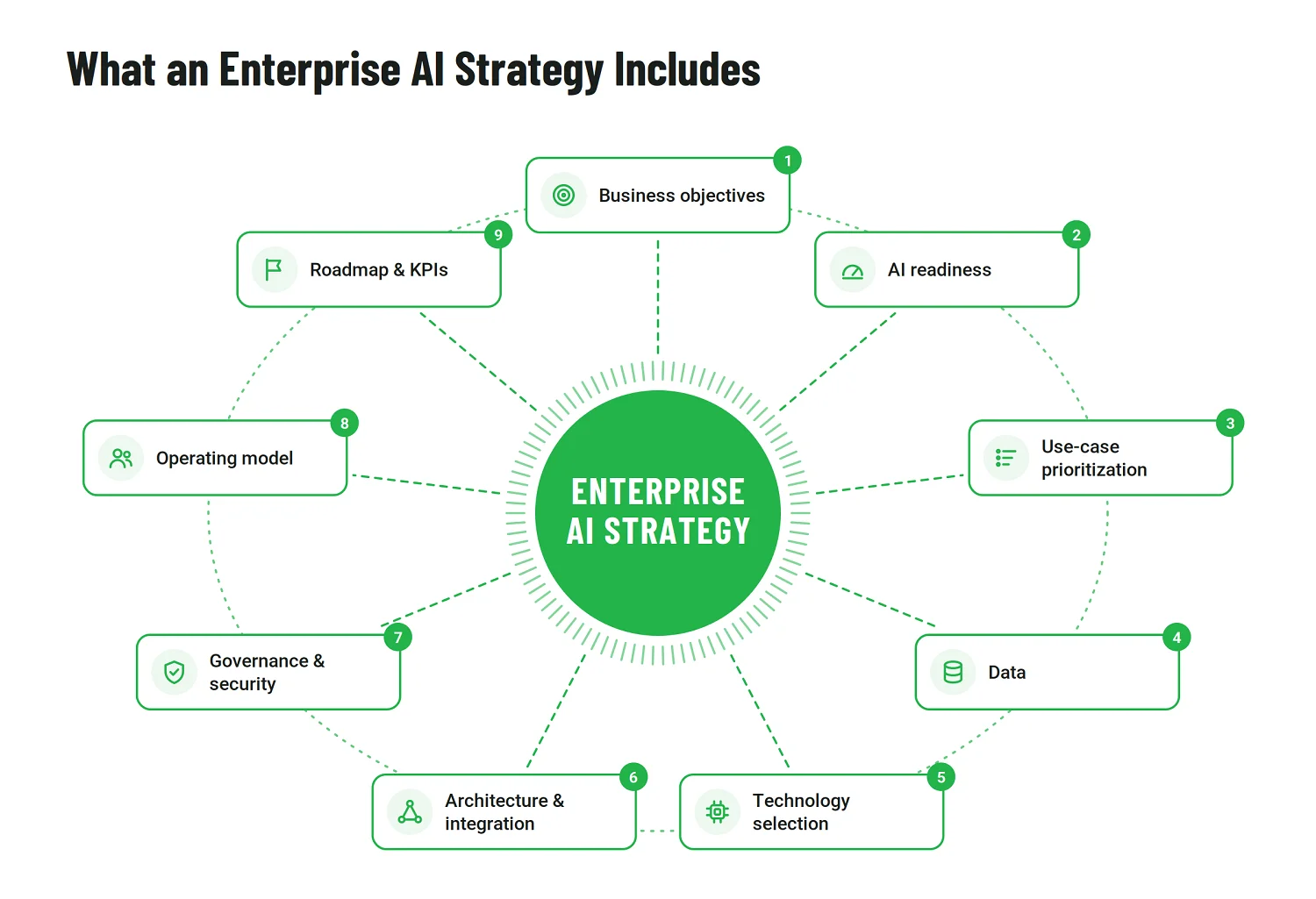
An enterprise AI strategy aims to do more than identify promising AI applications. It should give the organization a realistic view of what is worth pursuing, what the existing environment can support, where foundational work is still needed, and how individual initiatives fit into a broader plan.
That means looking at business priorities alongside data, technology, architecture, governance, skills, and delivery. These areas are closely connected. A use case with obvious business value may depend on data that is difficult to access. A technically feasible solution may introduce security or compliance concerns. A successful proof of concept may still require substantial integration work before it can operate reliably in production. Bringing those dependencies into the strategy early makes investment decisions easier to defend and implementation easier to plan.
Business objectives come first
A strategy needs a clear reason for using AI in the first place. The starting point might be reducing operating costs, shortening processing times, improving forecasting, helping employees access information more efficiently, improving customer experience, or creating an AI-enabled product.
Those objectives give the organization a basis for deciding which ideas deserve further work. They also create a reference point for later decisions about data, technology, architecture, and measurement. Without that connection, an AI program can easily become a collection of technically interesting initiatives competing for the same budget.
AI readiness
Before committing to particular use cases, the organization needs an honest picture of its starting position.
AI readiness covers much more than infrastructure. It includes data quality and accessibility, application architecture, API availability, security controls, governance, internal skills, leadership support, and the maturity of the business processes where AI will be introduced.
A structured AI readiness assessment can help separate initiatives that are ready for validation from those that first require work on data, architecture, governance, or internal capabilities.
A simple maturity model can make this easier to discuss across business and technology teams:
|
Stage |
What it may look like |
|
Not ready |
Significant gaps in data, technology, or governance limit practical AI adoption |
|
Exploring |
Teams are experimenting with AI, but approaches are still largely ad hoc. |
|
Pilot-ready |
Selected use cases have enough business support, data, and technical capability to be tested. |
|
Production-ready |
Architecture, governance, delivery processes, and ownership are in place for production use. |
|
AI-driven |
AI development, deployment, governance, and improvement have become repeatable capabilities. |
Readiness can also vary by initiative. An organization may have everything it needs for a predictive analytics project while lacking the clean, permission-aware knowledge sources required for a retrieval-augmented generation application.
Use-case discovery and prioritization
Most enterprises can identify dozens of places where AI might be applied. The real strategic work is deciding which of those opportunities deserve investment.
It is necessary to consider each use case from several angles: expected business impact, data availability, technical feasibility, implementation effort, cost, risk, and time to value. Scalability also matters if the organization expects the initiative to expand beyond an initial team or business unit.
This often changes the vision of apparently simple ideas. An internal knowledge assistant, for example, may seem straightforward at first. Its success may depend on document quality, access permissions, retrieval accuracy, source freshness, integration with existing systems, and a reliable way to evaluate responses. All of that affects whether the use case is a sensible early investment.
Prioritization should produce a manageable portfolio of initiatives instead of an indiscriminate list of AI opportunities.
Data
Enterprise AI depends heavily on what data is available and how that data can be used.
In practice, relevant information is often spread across ERP and CRM systems, databases, documents, data warehouses, SaaS products, internal applications, and APIs. These sources may differ substantially in quality, structure, ownership, and accessibility.
A sound strategy should establish the sources required for each use case, ownership, access control, and whether the information is reliable enough for the intended purpose.
The requirements will differ by solution type. Generative AI may depend on document ingestion, knowledge repositories, permissions, retrieval, and source freshness. Predictive AI may require historical data preparation, feature engineering, and model-training pipelines. Either way, the data work belongs inside the AI strategy because it can materially change the feasibility, cost, and timing of the initiative.
Technology selection
Once the use case and its constraints are cleared, technology choices become much easier to evaluate.
Different approaches serve different purposes, and enterprise solutions often combine several of them:
|
Approach |
Typical use |
Main considerations |
|
Large language models |
Language, summarization, conversational interfaces, content and knowledge workflows |
Accuracy, latency, cost, context requirements, data handling, deployment options |
|
Retrieval-augmented generation |
Grounding model responses in enterprise knowledge |
Document ingestion, permissions, retrieval quality, source freshness, evaluation |
|
Machine learning |
Prediction, classification, recommendations |
Historical data, model performance, retraining, monitoring |
|
AI agents |
Multi-step workflows involving tools, APIs, or business systems |
Permissions, action boundaries, reliability, observability, human oversight |
|
Custom models |
Specialized data or performance requirements |
Development effort, operating cost, maintenance, available alternatives |
|
Commercial AI platforms |
Managed capabilities that can accelerate implementation |
Pricing, data handling, portability, vendor dependency, long-term fit |
The choice should reflect business requirements, available data, security constraints, expected performance, cost, and the surrounding enterprise architecture.
Architecture and integration
Enterprise AI rarely operates as an isolated system. Production solutions typically need to interact with existing applications, APIs, identity providers, data platforms, monitoring tools, and business workflows.
That makes architecture an early strategic concern. The organization needs to understand data movement through the solution, access to the models, orchestration issues, how applications will communicate, and how scalability, observability, and failure handling will be managed.
It is also worth considering how much flexibility the architecture needs to preserve. Model providers, frameworks, and data sources can change quickly, so tightly coupling a solution to one technology may create avoidable constraints later.
Where AI needs to connect deeply with existing systems, AI integration becomes part of the design itself rather than a technical task left for the end of the project.
Governance and security
Governance becomes much easier to manage when it is designed alongside the solution rather than added after deployment.
The strategy needs to establish who can use AI, which data the system may access, what actions it is allowed to perform, and how outputs will be reviewed. Depending on the use case, this can involve access control, privacy, sensitive information, model risk, prompt security, auditability, human oversight, output validation, and third-party AI providers.
Agentic systems require particular attention because they may trigger actions in connected enterprise applications. Permissions, approval points, monitoring, and fallback mechanisms therefore become part of the solution design, not only governance documentation.
Organization and operating model
An enterprise AI strategy also has to clarify who will own the work.
That includes the roles responsible for business decisions, technical delivery, architecture, security, governance, and ongoing operation. The organization should understand which capabilities already exist internally, where skills need to be developed, and where external support may be required.
Clear ownership becomes increasingly important as more departments begin experimenting with AI. Without shared responsibilities and decision-making processes, separate initiatives can drift toward duplicated technology, inconsistent controls, and competing priorities.
AI strategy and AI roadmap
The strategy defines the direction: the business objectives, priority use cases, capabilities, technology principles, governance requirements, and expected outcomes.
The roadmap turns those decisions into a practical sequence of work. It identifies dependencies, establishes what needs to happen first, and shows how the organization can move from preparation and validation through production and broader adoption.
For one company, the first step may be improving data access. Another may be ready to validate two or three use cases immediately. Some will need architecture or security work before a production deployment is realistic.
That is why the roadmap should reflect the organization's actual starting point rather than follow a generic 3-, 6-, or 12-month transformation template.
Business value and KPIs
A strategy also needs to define what success will look like before implementation begins.
The right measures depend on the use case, but they usually fall into several groups:
- Financial: revenue impact, cost reduction, savings, payback.
- Operational: processing time, time saved, automation levels, error reduction.
- Adoption: active users, usage, task completion.
- AI quality: accuracy, relevance, retrieval performance, hallucination rate.
It is necessary to consider technical and business performance together. A system can achieve good model-level metrics and still fail to deliver enough value to justify its cost.
That cost also changes as usage grows. Model inference, data processing, external APIs, infrastructure, monitoring, and human review can all affect the economics of a production AI system, so they belong in the business case from the beginning.
By the end of the strategy phase, the organization should understand which AI initiatives are worth pursuing, what each one depends on, how they fit the existing technology environment, and how their value will be measured.
How To Evaluate an AI Consulting Company
By the time an enterprise starts comparing AI consulting companies, most providers will show an impressive technology stack, a selection of AI projects, and a polished methodology deck. Those materials are useful, but they do not tell you enough on their own. The stronger test is whether the company can show how it has worked through the same kinds of constraints your organization is likely to face: fragmented data, legacy systems, security requirements, multiple stakeholders, integration complexity, and the move from PoC to production.
That makes the evaluation process largely an evidence exercise. Instead of asking whether a provider “does enterprise AI,” look at what it can substantiate.
Evaluation criteria and evidence to request
The criteria below cover the areas that are most useful when comparing AI consulting companies. They do not all need equal weight; a regulated organization working with sensitive data, for example, may place much more emphasis on governance, architecture, and integration than on experience with a particular framework.
|
Evaluation area |
What to validate |
Valuable evidence |
|
Enterprise AI experience |
Work in complex environments with multiple systems, stakeholders, and operational constraints |
Comparable case studies, client references, project examples |
|
Business understanding |
Ability to translate business problems into realistic AI opportunities |
Discovery approach, workshop outputs, sample deliverables |
|
Use-case prioritization |
A clear way to compare opportunities by value, feasibility, risk, and effort |
Prioritization framework, assessment examples |
|
AI readiness and data expertise |
Experience assessing data quality, availability, access, infrastructure, and organizational readiness |
Readiness assessment examples, data architecture work |
|
Architecture and integration |
Ability to design solutions that fit existing enterprise systems |
Architecture diagrams, integration examples, production cases |
|
Technology selection |
A reasoned approach to models, platforms, and tooling |
Selection criteria, trade-off analysis, examples involving different vendors |
|
Security and governance |
Experience with privacy, access control, compliance, AI risk, and oversight |
Governance frameworks, security approach, relevant project examples |
|
Engineering and production delivery |
Ability to move beyond prototypes into maintainable systems |
Production references, deployment approach, monitoring and evaluation practices |
|
Delivery team |
Clarity about who will actually do the work |
Named roles, relevant experience, team composition |
|
Commercial transparency |
Clear scope, assumptions, dependencies, deliverables, and pricing boundaries |
Proposal, statement of work, delivery plan |
|
References |
Experience that can be independently validated |
Reference calls, client contacts, comparable engagements |
A large portfolio is less useful than a smaller number of genuinely comparable examples. The closer the evidence is to your own environment, the easier it is to judge whether the provider has dealt with similar data, integration, regulatory, or operating constraints.
Use a simple scoring system
If you are comparing several providers, a simple 1–5 score can make the evaluation more consistent. Rate each criterion based on the evidence the company can provide, not its marketing claims.
1 means there is little or no relevant evidence; 3 indicates credible examples and a defined approach; 5 means the provider can demonstrate directly comparable experience, deliverables, or references.
The criteria do not need equal weight. For an initiative involving sensitive data and legacy systems, for example, architecture, integration, and governance may matter more than experience with a particular AI framework. Use the overall score as a comparison aid rather than as a substitute for reviewing individual strengths, gaps, and open questions.
Questions to ask before signing
The best questions force the provider to explain how it works, not simply what services it offers.
- Strategy: How do you identify and prioritize AI use cases? How do you connect them to business objectives?
- Data: How do you assess data readiness? What happens if the data needed for a priority use case is incomplete or difficult to access?
- Technology: How do you choose models and platforms? How do you avoid unnecessary vendor lock-in?
- Architecture: How will the solution fit our existing applications, APIs, identity systems, and data platforms?
- Security and governance: How do you handle sensitive enterprise data, access control, human oversight, and third-party AI providers?
- Delivery: What happens after the strategy phase? Can the same team support PoC development, integration, deployment, and optimization?
- Measurement: How will success be defined before implementation starts?
- Commercial scope: What is included in the engagement, and which activities would be priced separately later?
Five practical tests that reveal more than a sales deck
Some checks are especially useful because they are difficult to answer convincingly without real delivery experience.
Ask for a genuinely comparable project
Do not stop at “Have you built an AI assistant?” Ask for a project with similar data complexity, integration requirements, regulatory pressure, or business-process constraints. Then dig into what the team actually delivered, how the solution was evaluated, and what happened after the initial implementation.
Ask to see how the methodology works in practice
A methodology becomes meaningful when the provider can explain what happens at each stage: discovery, readiness assessment, use-case prioritization, architecture, validation, and implementation. Ask what the outputs look like and which decisions the client is expected to make along the way.
Ask what happens when a PoC does not validate the idea
Not every promising AI use case deserves to reach production. A mature consulting process should allow an initiative to be narrowed, redesigned, or stopped when the data, economics, technical performance, or business case do not hold up. How a company handles that conversation can tell you a great deal about its independence and decision-making discipline.
Ask who takes responsibility after strategy
If the consulting team stops after producing recommendations, establish exactly how those recommendations will be handed over. If the company also provides engineering, ask whether the same people remain involved through architecture, development, integration, deployment, and optimization. Either model can work; unclear ownership is where problems usually begin.
Ask how success will be measured before discussing technology
The provider should be able to talk about business and technical measures before recommending a model or platform. If success is still undefined when the technology decision is being made, the project is already being shaped in the wrong order.
Red flags and common mistakes
A few patterns deserve closer scrutiny during evaluation.
Use cases are proposed without examining the data behind them
A compelling business idea can become expensive very quickly if the required information is incomplete, inaccessible, poorly governed, or spread across systems.
The engagement stops at recommendations or a PoC
A strategy should show how priority initiatives can move into validation and implementation, while a successful PoC still needs a credible path to production. That path may involve architecture, integration, security, monitoring, ownership, evaluation, and operational processes that are not part of the initial prototype.
Governance is scheduled for later
Security, privacy, responsible AI, access controls, and human oversight can affect the architecture itself. Deferring them until after the solution has been designed usually creates avoidable rework.
No one can explain what success means
Without a measurement framework, it becomes difficult to decide whether a PoC should move forward, whether a production system is creating value, or whether continued investment is justified.
The proposed scope tries to solve everything at once
A long list of AI opportunities can look ambitious in a strategy presentation, but launching too many initiatives simultaneously makes prioritization, governance, and resource allocation harder.
There is also a common buyer-side mistake: applying the same checklist to every engagement. The criteria should reflect the project. If the initiative involves sensitive data and several legacy systems, evidence of integration, security, and enterprise architecture experience may tell you much more than the provider’s familiarity with a particular AI framework.
Whether you use scoring or a qualitative comparison, do not rely on a single overall result. Review the evidence, gaps, and open questions behind each criterion before making a decision. By the end of the process, you should be able to explain why a company is credible for your enterprise environment, who will do the work, what the engagement will produce, and how the recommendations can move into implementation.
What Should an AI Consulting Proposal Include — And What Affects Cost?
A proposal is where broad consulting promises should become concrete. Before signing, an enterprise should be able to see what will be assessed, what decisions the engagement is expected to support, what the consulting team will deliver, and which activities sit outside the agreed scope.
For an AI consulting engagement, the proposal will usually cover the current-state assessment, business objectives, use cases, AI readiness, data, target architecture, governance, roadmap, KPIs, team structure, timeline, pricing, assumptions, and next steps.
The level of detail matters. Terms such as AI strategy, discovery, or readiness assessment can describe very different amounts of work from one provider to another. The proposal should make the expected outputs visible enough that the client knows what it will actually have at the end of the engagement.
What deliverables should be defined?
Deliverables will vary with the scope, but the list can include:
- A current-state or AI readiness assessment
- A prioritized set of use cases
- Findings on data availability and readiness
- Technology and architecture recommendations
- Governance and security requirements
- An implementation roadmap
- Business and technical KPIs
- PoC recommendations or validation criteria
- Documented assumptions, dependencies, and next steps.
The proposal should also identify who is responsible for each part of the work and where client participation is required. Workshops, access to subject-matter experts, technical documentation, data samples, or architecture reviews can all affect delivery if they are assumed but not available.
A strategy becomes difficult to act on when its recommendations are not detailed enough to guide validation, architecture, or implementation.
Common commercial models
There is no single commercial model that fits every AI consulting project. The structure usually depends on how well the problem and scope are understood at the outset.
|
Model |
When it tends to fit |
|
Fixed-scope assessment |
A readiness review, strategy exercise, or other engagement with clearly defined boundaries and deliverables |
|
Time and materials |
Discovery work where the scope is expected to evolve as new information emerges |
|
Consulting + PoC |
Situations where strategic recommendations need technical validation before a larger investment is made |
|
Strategy + implementation |
Programs where the same partner continues from consulting into development, integration, and deployment |
The commercial model should reflect the uncertainty in the work. A narrowly defined readiness assessment can often be scoped more precisely than an enterprise-wide discovery involving several business units, systems, and potential use cases.
What affects the cost of AI consulting?
The specification does not provide universal price ranges, and that is appropriate: the effort can vary substantially between engagements. The main cost drivers include scope, the number of business units involved, data complexity, the number of use cases being assessed, the amount of workshop and stakeholder work required, architecture depth, PoC requirements, the regulatory environment, and the consulting team involved.
Two projects described as “enterprise AI strategy” can therefore have very different budgets. One may involve a focused review of several known use cases. Another may require interviews across departments, data assessment, architecture work, governance design, vendor evaluation, and technical validation.
This is why comparing proposals only by total price can be misleading. The more useful comparison is what each provider includes, what it assumes, and what work will still be required afterward.
Where consulting ends and implementation begins
The boundary should be explicit before the engagement starts.
Consulting may include assessment, prioritization, architecture, roadmap development, governance planning, business-case work, and definition of a PoC. Implementation may then involve software development, model and API integration, data pipelines, infrastructure, testing, deployment, monitoring, and ongoing optimization.
Some engagements deliberately combine both. Others stop after strategy and hand the work to an internal engineering team or another provider. Neither setup is inherently problematic, but the transition needs to be planned.
In practical terms, the proposal should clarify the boundaries: Does the quoted price include technical validation? Which implementation activities are included or excluded? Who turns the target architecture into a production design? What happens after the roadmap is approved?
The fee for strategy work should therefore be distinguished from the cost of implementation unless the proposal explicitly combines the two.
For an enterprise buyer, a well-written proposal should make the commercial and delivery boundaries easy to understand before work begins. That clarity becomes especially valuable once strategy starts generating follow-on activities in data, architecture, integration, governance, or development.
Why Choose Emerline for Enterprise AI Consulting?
Emerline combines AI consulting with hands-on engineering, which makes it possible to carry the same initiative from early discovery through technical validation and into production. The work can cover use-case exploration, AI readiness, data and solution architecture, governance, PoC or MVP development, enterprise integration, and deployment.
That continuity matters when strategic decisions depend on implementation realities. Architecture, data access, model performance, security, and integration can all change what is feasible once a concept is tested. Emerline brings consulting and engineering into the same delivery process rather than treating the strategy document as the end product.
Need an enterprise AI strategy that can move into production? Talk to Emerline’s AI consulting team.
Frequently Asked Questions About Choosing an AI Consulting Company
What does an AI consulting company do?
An AI consulting company helps organizations decide where AI can create value and what will be required to implement it. Depending on the engagement, that can include readiness assessment, use-case discovery, strategy, architecture, technology selection, governance, roadmapping, PoC planning, and implementation support.
How do I choose an AI consulting partner?
Look for relevant enterprise experience, a clear approach to use-case prioritization, strong data and architecture capabilities, security and governance expertise, and evidence that the team can support production delivery. Comparable projects and client references are more useful than broad claims about AI expertise.
How do I know whether my company is ready for AI?
Readiness depends on the intended use case. Data quality and accessibility, application architecture, security, skills, processes, governance, and integration capabilities all affect what can be implemented successfully. A readiness assessment helps identify which initiatives can move forward and which require preparation first.
Should an AI consulting partner also provide development services?
Not necessarily. Organizations with established AI engineering teams may only need outside support for strategy, architecture, or specialized expertise. Where internal delivery capacity is limited, having consulting and engineering available through the same partner can simplify the transition from strategy to implementation.
How long does an AI consulting engagement take?
The timeline depends on the scope. A focused readiness assessment or use-case prioritization exercise may require considerably less time than an enterprise-wide strategy involving multiple business units, data sources, architecture decisions, and governance requirements. The proposal should define the expected timeline, deliverables, dependencies, and decision points before the engagement begins.
How much does AI consulting cost?
The cost depends on the scope, organizational complexity, number of use cases, data and architecture work involved, team composition, and whether technical validation or implementation planning is included. Proposals are therefore more meaningful when compared by scope and deliverables, not price alone.
Final Checklist: Choosing an AI Consulting Partner
Before making a decision, you should be able to answer five questions:
- Can the team turn our business priorities into realistic AI use cases?
- Can it assess our data, technology, security, and organizational readiness?
- Can it design solutions that fit our existing enterprise environment?
- Is there a credible path from strategy and validation into production?
- Can the expected business value be defined and measured?
A strong consulting engagement should leave the organization with clear priorities, realistic implementation requirements, and enough evidence to decide where AI investment makes sense. That is ultimately more valuable than a long list of possible AI projects or a strategy deck with no clear next step.
Published on Oct 8, 2026