Fitness App Development in 2026: The Ultimate Guide to Building a Market Leader
Table of contents
- Strategic key takeaways
- Global Market Analytics
- Why "one app for all" no longer works
- Regional portraits: what is your user actually thinking?
- Tech Pillars for 2026
- 1. Agentic AI: the coach that actually acts
- 2. On-device computer vision: form and privacy
- 3. Nutrigenomics: from calorie counting to body chemistry
- Technical Architecture
- A. The frontend strategy
- B. Backend and data
- C. AI orchestration
- Investment Snapshot: Budgeting for Utility vs. Intelligence
- Understanding the split: utility vs. intelligence
- Hidden costs to plan for
- Retention: Defeating the 30-Day Churn
- Strategic Recommendations from Emerline
- How Emerline Can Help
You download a new fitness app on Monday, full of resolve. By Thursday it's just another icon nagging you with a notification you swipe away without reading. That cycle is exactly what the 2026 health-tech market has stopped tolerating. Users don't want a tracker anymore. They want something that behaves like it actually knows them.
For a business, that changes the whole game plan. Chasing sign-up numbers used to be enough; now the products that win are the ones building something closer to a relationship than a utility. Good UX alone won't get you there either — in a market this saturated, you need the app to anticipate what the user needs before they open it. That's the shift this guide is about: from passive tracking to predictive, almost invisible support.
Strategic key takeaways
- Simple trackers are a commodity now. Long-term retention comes from the app disappearing into someone's daily rhythm rather than demanding attention.
- Skip the basic chatbot framing. What's actually moving the needle is agentic AI — systems that adjust a plan on their own once they detect fatigue or poor sleep, without waiting to be asked.
- Running computer vision on the device itself, rather than in the cloud, does two things at once: it removes lag and it gives users a reason to trust you with a camera pointed at their living room.
- Flat subscriptions are hitting a ceiling. The next revenue layer is the app noticing a gap — low iron, poor recovery — and suggesting the product that solves it at the exact right moment.
- How much you should spend depends less on your feature list than on which region and user you're building for first. More on that in the Investment Snapshot below.
Explore Emerline's fitness app development services to see how we've taken fitness concepts like these from idea to shipped product.
Global Market Analytics
Building for a global audience means understanding that "fitness" isn't the same idea everywhere.
Why "one app for all" no longer works
Entering the global market in 2026 takes more than translating your interface into five languages. What actually gets someone off the couch in New York looks nothing like what gets someone off the couch in Berlin or Mexico City — and if your product doesn't reflect that, you'll feel it in retention numbers before you feel it anywhere else.
Here's how priorities shift by region, and where the ROI tends to be hiding:
| Region | User Demand | Technical Stack | Business Model / ROI |
| North America | Bio-hacking and longevity, biological age management, high personalization | CGM (glucose) integration, blood marker analysis, advanced wearable sync | Premium subscriptions ($30+), personalized supplement upsell, paid human-AI coaching |
| Europe | Digital sovereignty, ethical and transparent AI, mental well-being | On-device AI (local data), EU AI Act compliance, "incognito" fitness modes | Privacy-as-a-service model, trust-based freemium, B2B eco-brand partnerships |
| LATAM | Social status & mobility, fitness as currency, high-intensity gamification | Fintech wallet integration, move-to-earn mechanics, mobile acquiring/payments | Micro-transactions for challenges, activity-based cashback, insurance provider partnerships |
| Asia (APAC) | Smart city ecosystems, corporate loyalty, discipline & community | Hardware-sync (park equipment), office wellness zones, AR group quests | B2B2C corporate contracts, real estate/developer bundles, smart infrastructure fees |
Regional portraits: what is your user actually thinking?
North American users treat fitness like an engineering problem. Every rep is justified by a number somewhere, and the products that win turn workouts into a personal "age-hacking" plan built entirely on sensor data.
European users are more skeptical of where their data actually goes. The brands that do well here have made data protection part of the pitch itself, not a line buried in the terms of service — control over one's own information is the selling point.
In Latin America, activity has turned into a kind of currency, riding the same wave as the digital wallet boom. A logged run isn't just a number on a screen; it can translate into a real discount or a better rate from a financial partner.
In Asia, the app works best as a key rather than a destination — something that plugs into park equipment, office wellness programs, and whatever else makes up daily city life, rather than asking the user to come to it.
One practical note: localize the reward system, not just the copy. Leaderboards and personal-best bragging rights work well in the US. In Asia and Latin America, team-based models — where the group benefits from individual effort — tend to perform noticeably better.
Tech Pillars for 2026
Regional insight tells you what to build. The next question is how — and in 2026, the gap between the leaders and everyone else isn't a longer feature list. It's how deeply the product is woven into someone's biology and daily habits.
Three technologies do most of that work right now.
1. Agentic AI: the coach that actually acts
Static workout plans and basic chatbots don't cut it anymore. What we're building instead are agentic systems — software that doesn't just offer advice, it makes the call.
Say an Oura ring or a Whoop strap shows a recovery score under 40%. A good agent doesn't wait for the user to ask what to do about it. It swaps the planned heavy lifting session for mobility work and suggests a magnesium-rich breakfast, pulled straight from a delivery API.
The payoff for the business is a lighter cognitive load on the user. The app stops being something they check and starts being something that quietly runs in the background on their behalf.
This kind of real-time biometric response is a simplified, consumer-facing version of what we engineer for elite teams — see our deep dive into sports injury prevention software for how sensor fusion and Edge computing work at the professional level.
2. On-device computer vision: form and privacy
Speed and privacy have quietly become the same requirement.
Using MediaPipe or CoreML, we track over 33 skeletal points in real time — and critically, all of it happens on the device. The moment that video leaves for a cloud server, two things go wrong at once: latency creeps in, and user trust drops. Correcting a squat instantly, right there on the phone screen, is what makes the experience feel like a trainer is actually in the room.
For the engineering cost behind these CV models — data labeling, Edge AI deployment, the full AI SDLC — see our detailed cost breakdown.
3. Nutrigenomics: from calorie counting to body chemistry
Logging protein and carbs manually is fading out in favor of something more precise: managing the body at a molecular level.
Connecting to lab APIs like InsideTracker gives the app visibility into actual deficiencies, not guesses. Instead of telling someone to "eat more vegetables," it can read a current chemical profile and suggest a specific meal to bring cortisol down or restore iron levels — right now, not as a generic tip.
All three of these pillars point at one goal: making the health journey feel natural enough that the user never has reason to opt out of it.
Technical Architecture
None of this matters if the architecture underneath can't hold up. A market leader needs an engine that can process biometric data at scale without operational costs spiraling as it grows.
Here's the stack we'd recommend to get there.
A. The frontend strategy
For 85% of fitness use cases, Flutter or React Native is still the right call — one codebase, faster time to market, and a good enough native feel for almost everything you'll need. We reserve fully native Swift or Kotlin for the specialized cases: heavy background sensor polling, or graphics work that genuinely needs Metal or Vulkan.
If you're not building something that requires Formula-1-level graphics, a cross-platform shell gets you to market roughly twice as fast without a real hit to polish.
B. Backend and data
Fitness apps produce a lot of data, but not all of it needs to move at the same speed.
We build the API layer in Go or Node.js with GraphQL, so the app only pulls the specific fields it needs instead of over-fetching — which keeps both server costs and load times down. On the storage side, we don't run everything through one database: PostgreSQL handles user data, Redis powers real-time leaderboards, and InfluxDB is built specifically for the constant stream of time-series biometric data.
Rather than one large, slow warehouse, this is closer to a set of specialized counters, each built for a different kind of request — so the app doesn't stutter when thousands of users are hitting the leaderboard at once.
C. AI orchestration
Fitness intelligence only works if it's fast. We serve lightweight, quantized models through FastAPI in Python, which keeps the AI sharp without draining the user's battery or requiring a large server footprint.
That's what makes the "invisible" part possible — sleep data gets processed and a morning workout gets adjusted in milliseconds, not seconds. It's the difference between an AI that feels sluggish and one that feels like it already knows what you need.
We offer strategic technology consultations if you're weighing these architectural decisions or just want a second opinion on a roadmap you already have.
Investment Snapshot: Budgeting for Utility vs. Intelligence
Building a market leader today means aiming past a basic MVP toward what we'd call a MAP — a Minimum Awesome Product. Functionality alone won't get you through the first 30 days; you need enough "wow" early on to keep people around.
Most founders start from one of two points:
A Core Utility MVP gives you a solid logging-and-tracking foundation without a heavy AI investment upfront. It's the right call if you want to validate retention before committing real money to machine learning.
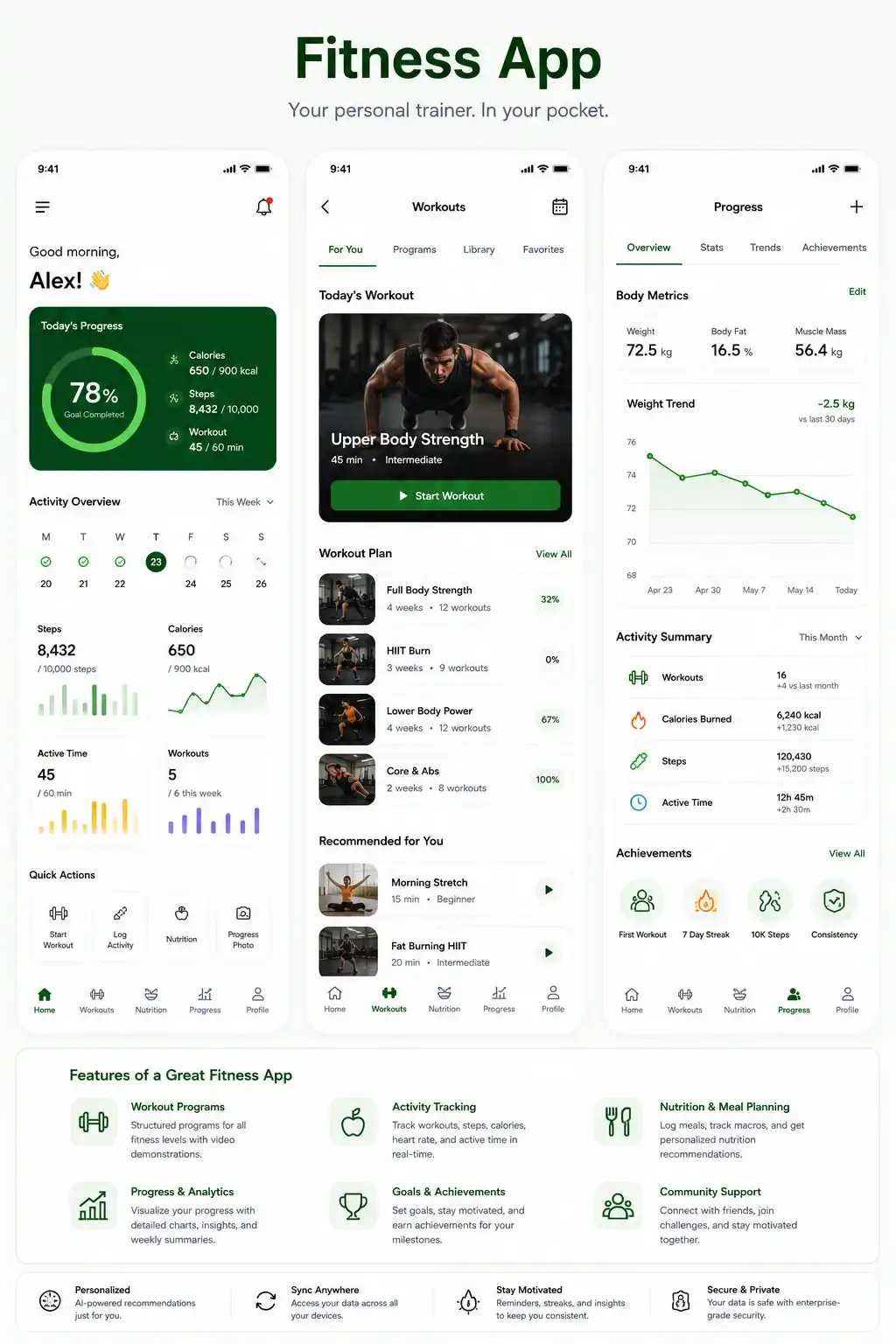
AI-Enhanced or Full-Scale builds add adaptive coaching, on-device computer vision, and agentic decision-making on top. This is where most of the 2026 market leaders are actually competing.
The jump between the two tiers is real money, mostly driven by AI training, compliance audits, and native development for anything camera-based.
Regional context matters here too. North American users tend to reward AI-driven personalization enough to justify the higher tier from day one. European users respond just as strongly to a clear, honest privacy story, which can often be delivered within a Core Utility budget if the local-only processing is communicated well. In LATAM and APAC, a leaner Core Utility build with strong social and gamification features frequently outperforms a heavier AI build — community, not personalization depth, is what keeps people coming back there.
Understanding the split: utility vs. intelligence
A Core Utility MVP is about being a reliable tool — logging a workout, tracking a run, nothing more. It's a solid choice for founders who already have an audience and want to give them a home without taking on much technical risk. Test your retention mechanics here first: if people won't log a workout manually, an AI layer probably won't save the experience.
An AI-enhanced MVP is where the app starts making suggestions instead of just recording history. In 2026, this is close to table stakes if you're entering a crowded category like HIIT or yoga — without it, you're competing against much bigger marketing budgets with nothing to differentiate you.
Full-scale builds are for the three pillars covered above: a real moat, built on custom-trained models and movement analysis competitors can't easily copy.
Hidden costs to plan for
Four categories tend to eat into margins quietly: wearable API licensing, AI compute or token costs that scale with engagement, annual compliance audits (GDPR, HIPAA, EU AI Act), and cloud infrastructure that has to grow with your user base. We go through exact 2026 pricing ranges for each of these in the cost guide's operational breakdown — worth a read before you lock in an OpEx model.
Compliance spend, in particular, has become more than a legal checkbox. Users are wary of where biometric data ends up, and a visible EU AI Act or HIPAA audit trail is turning into an actual trust signal that shows up in retention.
Retention: Defeating the 30-Day Churn
Push notifications alone stopped working a while ago. Surviving that first month means the app has to act more like a partner than a reminder service.
A few mechanisms do most of the heavy lifting:
Predictive intervention watches for a drop in engagement — say, 20% — and steps in before the user disappears, with something like an adjusted workout or a well-timed reward rather than a generic "come back!" push.
Micro-communities of 5 to 8 people, built around a shared goal, tend to beat massive anonymous leaderboards. Small groups create real accountability; large ones let people hide.
Behavioral rewards give consistency an actual payoff — whether that's move-to-earn mechanics or unlocking something the user actually wants, effort needs to convert into something tangible.
The reasoning is straightforward: retaining someone through a well-timed AI nudge costs a fraction of acquiring a new user through paid channels, and a small squad turns the app into something closer to a social commitment than a chore you can quietly abandon.
Strategic Recommendations from Emerline
Prioritize interoperability. Your app should function as the control center for someone's entire wearable stack rather than competing with Oura or Apple Watch directly — aggregate the data into one health score instead of asking users to check five apps.
Design for the invisible UX. The best fitness app is the one you don't have to feed information into. Push as much as possible onto background sensors, since manual logging is still the single biggest cause of churn.
Treat bio-privacy as a selling point. In 2026, data security isn't just compliance — it's a feature high-value users will pay for. If your processing genuinely happens on-device, say so clearly and often.
Budget in stages. Don't fund the full-scale build on day one. Launch with a Core Utility MVP to prove retention, add the AI-Enhanced layer once you have real usage data to train against, and save Full-Scale investment — agentic AI, on-device CV, global compliance — for when you're defending a market position rather than searching for one. It's also, practically speaking, the most efficient way to fund Tier B ambitions with Tier A revenue.
How Emerline Can Help
Emerline specializes in transforming complex fitness visions into scalable, high-performance digital products — fitness being one of the fastest-growing segments within the broader wellness app landscape. With over 15 years of experience in AI-powered SDLC and IoT integration, we provide:
- Technical feasibility audits — validating your AI and computer vision models before you commit to full-scale development.
- End-to-end development — from initial discovery through global scaling and ongoing maintenance.
- Compliance engineering — meeting GDPR, HIPAA, and EU AI Act standards in a way that actually builds user trust, not just satisfies an audit.
Get a technical feasibility audit for your AI fitness vision today.
Updated on Jul 28, 2026