How to Automate Vendor Payments in Manufacturing and Streamline Supply Chain Finance
Table of contents
- The Manual Payout Cycle as a Production Bottleneck
- The real security risk
- Core Benefits of Automated Vendor Payments
- High-yield dynamic discounting
- Seamless global scalability
- Precision working capital management
- The Financial Baseline of Manual versus Automated Payouts
- Choosing the Core Platform: What Tool to Use?
- UiPath
- SAP Build Process Automation
- Microsoft Power Platform
- Automation Anywhere
- WorkFusion
- SS&C Blue Prism
- Our Step-by-Step Implementation Roadmap
- Step 1: Vendor master data clean-up
- Step 2: Payment rail selection
- Step 3: Deep ERP-to-bank integration
- Step 4: Approval workflow digitization
- Step 5: Advanced security layering
- Step 6: Vendor self-service onboarding
- Step 7: Automated reconciliation
- Common Mistakes of Automating Vendor Payments Without a Partner
- Industrial Payment Trends Involving Real-Time Rails and Smart Contracts
- The rise of autonomous financial agents
- Global ISO 20022 migration and instant clearing
- Smart contract pay-on-receipt workflows
- Proactive virtual card origniation
- Real-World Case Studies of Manufacturing Payment Efficiency
- 1. Automotive parts supplier clears supply chain bottlenecks
- 2. Aerospace components manufacturer eliminates payout disputes
- 3. Global industrial machinery provider defeats vendor fraud
- Strategic Engineering Support from Emerline
On a manufacturing floor, downtime is the ultimate nightmare. Most plant managers spend their time obsessing over preventive machine maintenance or raw material shortages. Yet, a massive vulnerability often hides right inside the finance department because slow and clunky vendor payments freeze supply chains.
When you are managing a sprawling industrial network, you are not just dealing with a few bills. You are juggling raw material suppliers, specialized logistics partners, and massive utility vendors. Relying on manual payout processes introduces a layer of friction that triggers delayed shipments, strained supplier relationships, and sudden material holds at the worst possible moments.
Transitioning to intelligent supply chain finance automation removes this heavy administrative drag. By modernizing your payout workflows, your plant can completely eliminate late-payment penalties, capture early-bird incentives, and achieve a 90% faster payment reconciliation cycle.
The Manual Payout Cycle as a Production Bottleneck
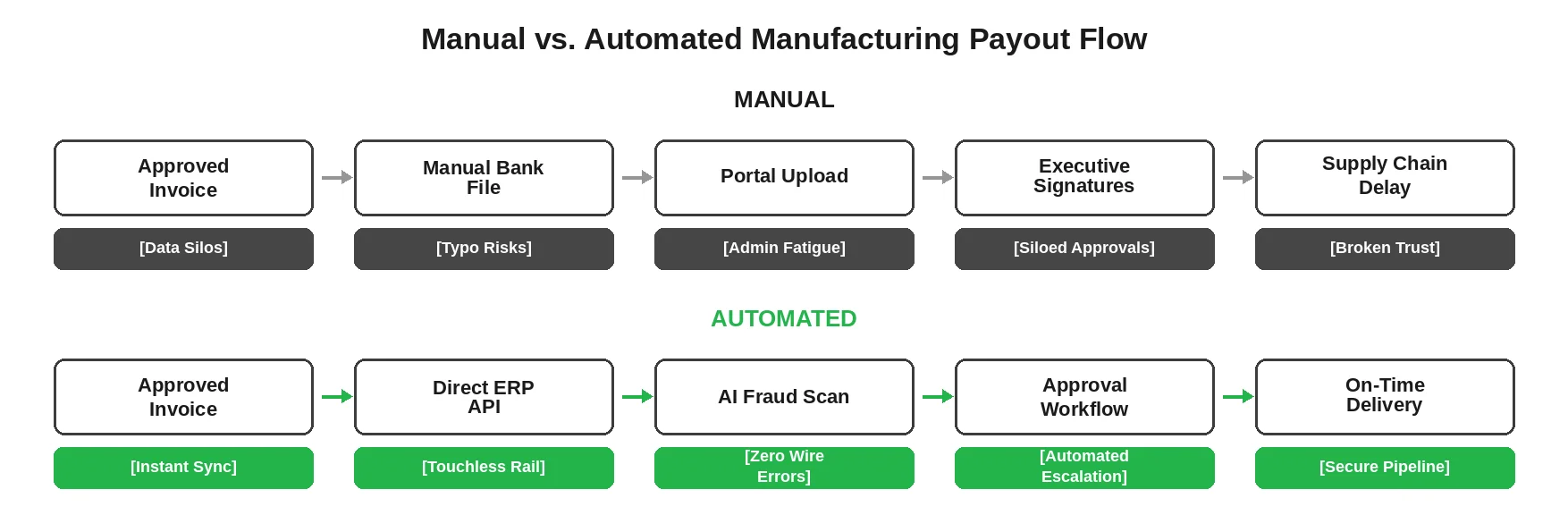
The traditional manufacturing payment flow depends entirely on human handoffs. It is slow, kills production momentum, and leaves the business wide open to simple human errors.

1. Invoice approval – The finance team hunts down data across disconnected inventory and procurement systems just to flag an invoice as ready.
2. Bank file creation – A clerk aggregates the weekly payout data to generate a bulky text file (like an ABA or CSV) from your ERP.
3. Manual portal upload – Someone logs into individual corporate banking portals to upload that file, which frequently crashes due to minor formatting errors.
4. The exec signature chase – Transactions sit in a banking queue waiting for authorization, often stalling for days because directors are traveling or tied up on the factory floor.
5. Manual reconciliation – Days later, accountants review bank statements line by line to check off vendor ledger accounts one by one.
The real security risk
This "human-in-the-middle" model is exactly what hackers look for. Without automated verification layers, sophisticated Business Email Compromise (BEC) fraud and altered banking details can easily slip through tired manual approval loops.
Core Benefits of Automated Vendor Payments
Setting up a proper ERP payment integration for manufacturing turns your back office into a lean efficiency hub. The actual business case boils down to three core benefits.
High-yield dynamic discounting
Automated platforms monitor your real-time liquidity to spot early-payment opportunities. The system automatically schedules early payouts to secure supplier price cuts, slicing 1% to 3% off your total Cost of Goods Sold without hurting your operating cash.
Seamless global scalability
Automated systems connect directly to localized, low-cost international clearings like SEPA, ACH, and SWIFT. This lets you pay overseas raw material suppliers in their local currencies while bypassing expensive intermediary bank fees.
Precision working capital management
Automation lets finance leaders decide exactly when cash leaves the business. You can precisely time your payment batches to preserve cash reserves during heavy manufacturing cycles while guaranteeing your vendors get paid exactly when they expect it.
Emerline advice: Capturing early-payment discounts looks great on your ledger, but never automate payments based blindly on invoice data alone. In manufacturing, you must tie your payout triggers directly to your warehouse quality-control metrics. If a batch of raw steel arrives damaged or short, your automation layer must freeze the payment file before it hits the bank rail. True efficiency comes from syncing your outbound cash flows with physical inventory verification, not just digital paperwork.
The Financial Baseline of Manual versus Automated Payouts
Moving to automated vendor payouts delivers clear, undeniable advantages that directly impact your plant's bottom line.
| Performance Metric | Manual Payout Operation | Automated Payouts (Standard) |
| Data Extraction Error Rate | 4% – 8% (Triggers payment rejection) | < 0.5% (API-verified routing) |
| Time Spent on Bank Portals | 10 – 15 Hours per week | < 30 Minutes (Touchless execution) |
| Vendor Payment Inquiries | High (Constant calls regarding status) | Near Zero (Automated tracking emails) |
| FX Fees on Global Sourcing | High standard retail bank spreads | Optimized wholesale institutional FX rates |
Let's look at what this actually costs a mid-market manufacturing facility handling 2,500 vendor payments per month.
A manual back office spends roughly $45,000 monthly fixing payment exceptions, managing bank file errors, and resolving vendor payment disputes.
Transitioning to automated processing slashes that operational spend to under $6,000. This shift instantly saves your business $39,000 per month in administrative overhead while eliminating the supply chain risks caused by sudden late-payment production holds.
Choosing the Core Platform: What Tool to Use?
To handle high-volume industrial operations, you need a software platform that acts as a secure, intelligent bridge between your invoice workflows and your global corporate bank accounts.
UiPath
A powerhouse for automating complex, end-to-end payment workflows. It features certified SAP integrations to seamlessly bridge the gap between your manufacturing execution systems and banking interfaces.
SAP Build Process Automation
If your organization runs SAP S/4HANA Finance, this is your go-to option. It enables deep ERP payment integration for manufacturing without breaking your core IT architecture.
Microsoft Power Platform
An excellent, agile option for extending financial workflows into your existing Microsoft environment. It allows operational leads to securely track and approve large material vendor payouts directly from Outlook or Teams.
Automation Anywhere
This cloud-native solution uses AI agents to read, validate, and authorize complex batch payments. It is particularly good at identifying invoice anomalies and matching payouts against partial inventory deliveries.
WorkFusion
Built specifically for document-heavy, highly regulated ecosystems. It combines RPA and intelligent document processing to automate international vendor payouts while keeping compliance checks airtight.
SS&C Blue Prism
A rock-solid choice for tying together old legacy software. It automates repetitive transactional tasks across old custom inventory programs, external customs databases, and modern banking portals.
Unsure which platform fits your architecture? We will handle your manufacturing payment automation from start to finish – from tool selection to full deployment. Talk to our experts today.
Our Step-by-Step Implementation Roadmap
Forcing new software onto poorly mapped financial processes will only disrupt your operations. We protect your supply chain by executing a deliberate, phased deployment strategy.
Step 1: Vendor master data clean-up
Before deploying any software, our engineers audit your vendor database. We standardize bank routing information, international SWIFT codes, and tax IDs to prevent transaction rejections down the line.
Step 2: Payment rail selection
We help you choose the best financial rails for your operation. Our team configures the platform to route transactions through optimal paths, balancing API-based corporate banking connections, virtual cards, and localized clearing hubs.
Step 3: Deep ERP-to-bank integration
We establish secure, automated communication channels between your accounting core and your banking partners. Our integration specialists set up direct API hooks or secure host-to-host frameworks, such as SAP Multi-Bank Connectivity.
Step 4: Approval workflow digitization
We build intelligent approval hierarchies based on your internal risk tolerances. The system automatically routes low-risk utility bills through touchless paths while escalating large raw-material payments to executive leads based on custom thresholds.
Step 5: Advanced security layering
We safeguard your cash flow by deploying multi-factor authentication and AI-driven fraud screening. The system cross-references payout requests against historical data, instantly blocking altered vendor bank details or unauthorized batch files.
Step 6: Vendor self-service onboarding
We configure dedicated self-service supplier portals. Your vendors manage their own banking preferences, upload updated tax documentation, and track real-time payment statuses without emailing your accounting team.
Step 7: Automated reconciliation
We close the loop by enabling real-time bank statement syncing. The platform reads outbound bank clearings and automatically matches them with open general ledger accounts, instantly updating your financial balance sheets.
Common Mistakes of Automating Vendor Payments Without a Partner
Many manufacturing facilities attempt to manage payment automation updates internally. Without an experienced integration partner like Emerline, these projects frequently hit severe roadblocks that disrupt outbound cash flows and halt production.
- Hardcoding custom bank connections
Internal IT teams often write rigid, custom code scripts to link the ERP directly to a single bank's API rail. When the bank updates its security protocols or API schemas, the integration breaks instantly, halting all vendor payouts and delaying material shipments.
- Failing to sync payments with inventory controls
Deploying a standalone payout tool without connecting it to your warehouse logistics creates major financial errors. The system may execute full automated payouts for invoices that only received partial material deliveries, which drains your working capital and weakens your dispute position.
- Mismanaging the supplier onboarding phase
Forcing vendors to adopt a complicated, poorly documented payment portal always backfires. Suppliers will avoid the tool entirely and continue emailing unstructured payment requests to individual buyers, destroying your touchless payment goals.
Emerline advice: Avoid building unique file conversion tools for every separate corporate bank account. Implement global financial messaging standards, such as ISO 20022, right from the start. This approach ensures your outbound payment files seamlessly interact with any global banking system, keeping your IT infrastructure lean, scalable, and ready for real-time rails.
Industrial Payment Trends Involving Real-Time Rails and Smart Contracts
The manufacturing payment landscape is moving away from basic electronic routing and toward fully autonomous finance networks. Modern facilities are bridging physical supply chain milestones with instant, data-rich digital banking channels.
The rise of autonomous financial agents
Simple automated routing has given way to agentic AI workflows. Advanced platforms deploy intelligent agents that run silently in the background, read internal procurement policies, and handle payment exceptions independently. Rather than merely flagging data mismatches for human review, these systems cross-reference open inventory databases, communicate autonomously with vendor portals to resolve short-pays, and only loop in human teams for highly unique edge cases.
Global ISO 20022 migration and instant clearing
Corporate banking has fully embraced the rich-data ISO 20022 messaging standard. This framework allows massive amounts of metadata—including full purchase order itemizations and quality control reports—to travel directly inside the outbound payment file. Simultaneously, expanded real-time transaction limits on networks like FedNow and RTP allow manufacturers to instantly clear high-value supplier payouts up to $10 million, ensuring immediate parts delivery without settlement lag.
Smart contract pay-on-receipt workflows
Forward-thinking operations are connecting SAP S/4HANA Finance directly to their physical shop floors. The moment raw components or materials pass through warehouse RFID scanners, a secure smart contract automatically runs a 3-way match against the digital purchase order and delivery note. If the quality metrics clear, the system triggers an immediate bank payout via API with zero human intervention, completely removing the traditional invoice approval cycle.
Proactive virtual card origniation
Corporate card utilization has evolved from basic expense tracking into a strategic tool for high-volume manufacturing suppliers. AP platforms now instantly issue single-use virtual cards directly inside procurement workflows for specialized or urgent SaaS and utility payouts. These cards lock spending to a specific vendor and amount, deliver instant cash rebates back to the business, and automate downstream ledger entries without manual intervention.
Real-World Case Studies of Manufacturing Payment Efficiency
1. Automotive parts supplier clears supply chain bottlenecks
A major automotive tier-1 supplier faced constant delivery holds because their manual, multi-bank international wire transfers took days to clear, stalling critical raw material shipments. They integrated an automated corporate banking API platform directly into their SAP backend, allowing them to route payments dynamically through local clearing networks. This shift slashed transaction cycle times from 5 days to under 30 minutes and saved over $100,000 annually in foreign exchange fees.
2. Aerospace components manufacturer eliminates payout disputes
An aerospace supplier handling thousands of complex partial shipments struggled with constant ledger errors and endless arguments with vendors over short-pays. By deploying an intelligent payment orchestration tool backed by automated 3-way matching and real-time inventory verification, they managed to connect shop-floor receipt data directly to outbound bank files. This achieved a 92% touchless payment execution rate, allowing them to scale vendor volumes without adding a single administrative hire.
3. Global industrial machinery provider defeats vendor fraud
A heavy machinery manufacturer with a massive, decentralized supplier network suffered from slow executive manual approval chains and a rising risk of vendor identity scams. We helped them integrate an AI-driven payment orchestration hub featuring multi-factor bank authentication and automated fraud screening. The system now automatically flags unexpected vendor bank detail changes and duplicate billing attempts, completely eliminating manual errors and blocking two major payment fraud attempts during the pilot phase alone.
Strategic Engineering Support from Emerline
Automating vendor payments is, at its core, a complex integration challenge. To make it work, you need a tight, unyielding connection between your physical shop floor logistics, your central ERP backend, and your global banking networks.
At Emerline, we help manufacturing enterprises design, build, and deploy robust payment automation layers under one roof. Whether you need to orchestrate SAP Multi-Bank Connectivity, deploy autonomous financial AI agents to screen for payment fraud, or link custom inventory databases directly with real-time banking rails, our engineers ensure your technology framework delivers clear, measurable ROI.
We offer a free consultation to evaluate your current financial tech stack and identify your biggest operational leaks. Our enterprise architects will recommend the ideal automation platform and outline a phased deployment roadmap for your business.
Published on Jul 13, 2026