Best Cloud Migration Companies in 2026: How To Choose the Right Partner
Table of contents
- Key takeaways
- Cloud Migration Vendor Selection Methodology
- Cloud platform expertise
- Migration scope
- Architecture and modernization depth
- Security and compliance maturity
- Evidence from case studies and client outcomes
- Post-migration support and FinOps
- Quick Comparison: Top Cloud Migration Providers
- Top Cloud Migration Companies: Detailed Overview
- Emerline
- N-iX
- Adastra
- Future Processing
- Blackthorn Vision
- ELEKS
- eSparkBiz
- Intellias
- Simform
- Rackspace Technology
- Deloitte
- Accenture
- How to Choose the Right Cloud Migration Company
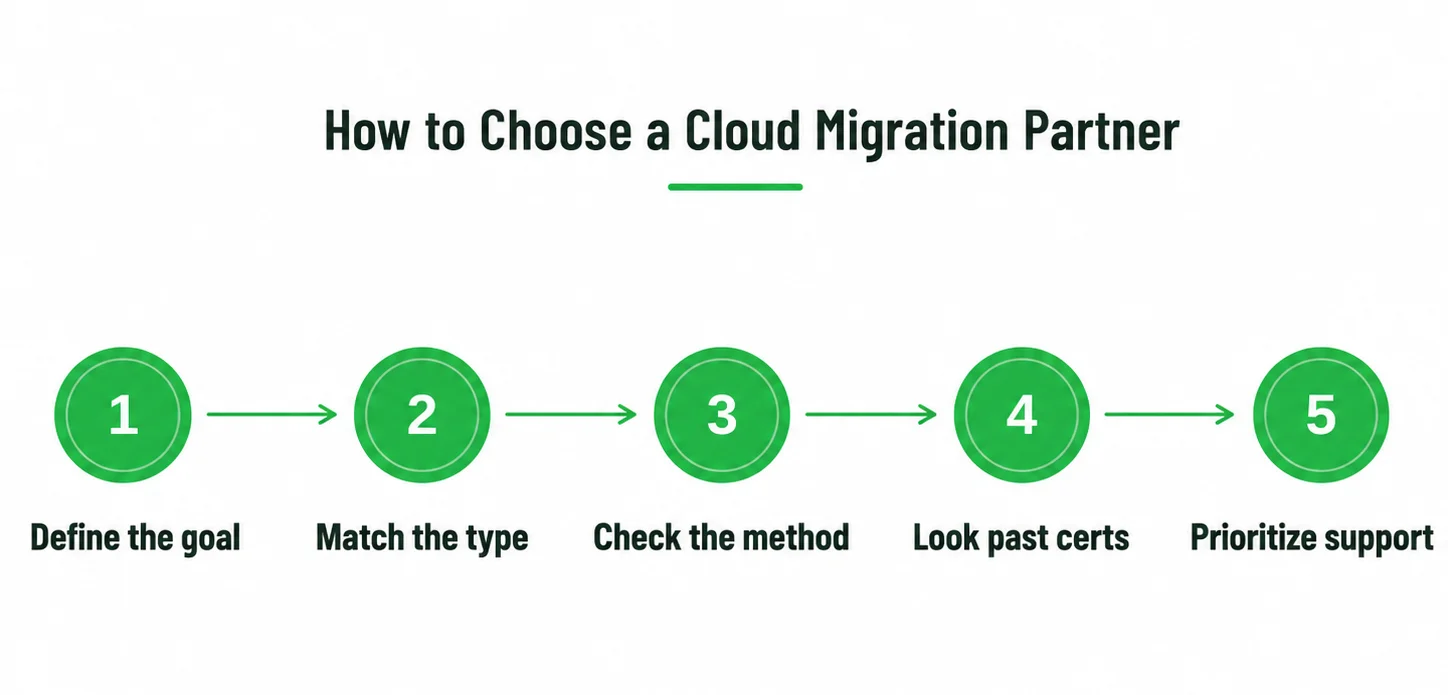
- Step 1. Define your migration goal before evaluating vendors
- Step 2. Match the provider to the type of migration you need
- Step 3. Evaluate the provider’s methodology, not just its promises
- Step 4. Look beyond certifications and cloud partnerships
- Step 5. Prioritize post-migration support from the beginning
- Which Cloud Migration Partner Best Fits Your Organization’s Needs?
- For startups evolving beyond MVP infrastructure
- For mid-sized businesses, modernizing legacy applications
- For data-heavy organizations and analytics-driven environments
- For enterprises managing complex transformation programs
- For companies requiring managed cloud operations after migration
- For hybrid and multi-cloud migration environments
- For ERP and business-critical system migration
- For SaaS companies, improving scalability and reliability
- For organizations struggling with cloud costs after migration
- For organizations preparing infrastructure for AI and analytics initiatives
- Cloud Migration Vendor Red Flags
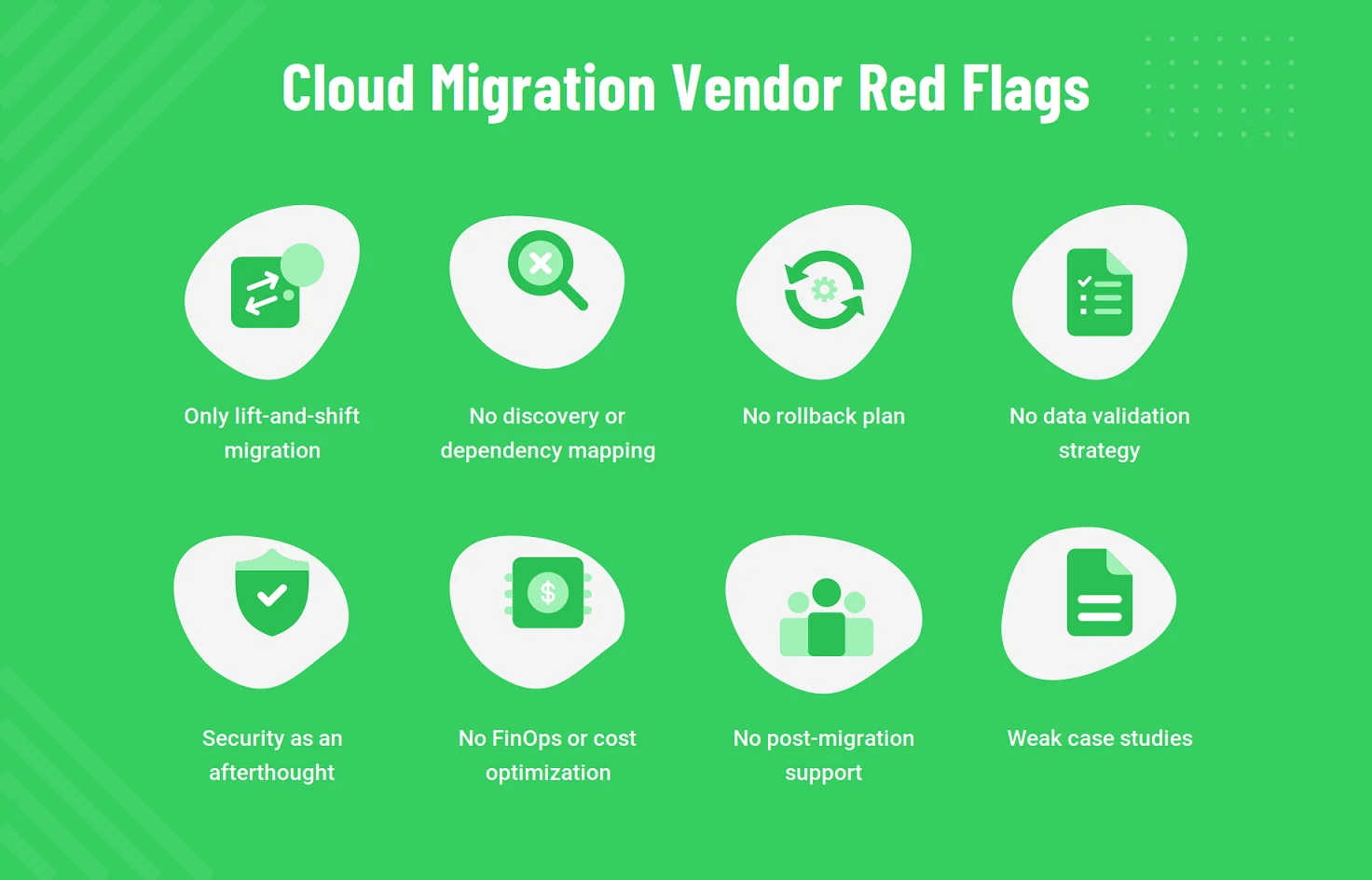
- The vendor only talks about lift-and-shift migration
- No discovery or dependency mapping phase
- No rollback plan
- No data validation strategy
- Security is treated as an afterthought
- No FinOps or cost optimization plan
- No post-migration support
- Weak case studies
- Cloud Migration Trends to Consider
- AI-ready cloud infrastructure
- FinOps from the start
- Hybrid and multi-cloud governance
- Security-by-design migration
- Application modernization instead of pure lift-and-shift
- Data platform modernization
- Questions to Ask Before Hiring a Cloud Migration Company
- Conclusion
Cloud migration is no longer a purely technical infrastructure project. It reshapes how applications are built, integrated, secured, deployed, and scaled across the enterprise. For modern businesses, the cloud has become the foundation for digital products, AI adoption, operational resilience, and long-term growth.
As migration complexity increases, organizations demand much more from technology partners than just basic workload transfers. They require deep expertise in modernization, cloud-native architecture, Kubernetes, DevOps, security, compliance, and sustainable operations. Simultaneously, every migration path presents distinct challenges, ranging from hybrid environments and legacy decomposition to multi-cloud governance and phased modernization strategies.
Therefore, selecting the right partner for cloud migration involves more than simply verifying certifications. Organizations must assess architectural expertise, modernization capabilities, operational maturity, and strategic alignment. This guide outlines the qualities that distinguish leading cloud migration providers and key evaluation criteria for organizations embarking on their transformation journey.
Key takeaways
- Cloud migration today is about modernization, not just infrastructure moves. Success requires focus on application architecture, DevOps, security, governance, observability, and operational scalability.
- Top cloud migration companies excel in different transformation scenarios. Some specialize in enterprise governance and multi-cloud, while others are experts in SaaS modernization, data platforms, cloud-native engineering, or managed operations.
- Choosing a migration partner involves evaluating methods, the depth of modernization, and operational maturity. Certifications alone are insufficient; teams must assess discovery, rollback, security, FinOps, and provide post-migration support.
- Cloud migration strategy now depends on AI readiness, FinOps, hybrid infrastructure, and data modernization. Organizations prioritize scalable analytics, cloud-native design, automation, and lasting governance from the start.
Cloud Migration Vendor Selection Methodology
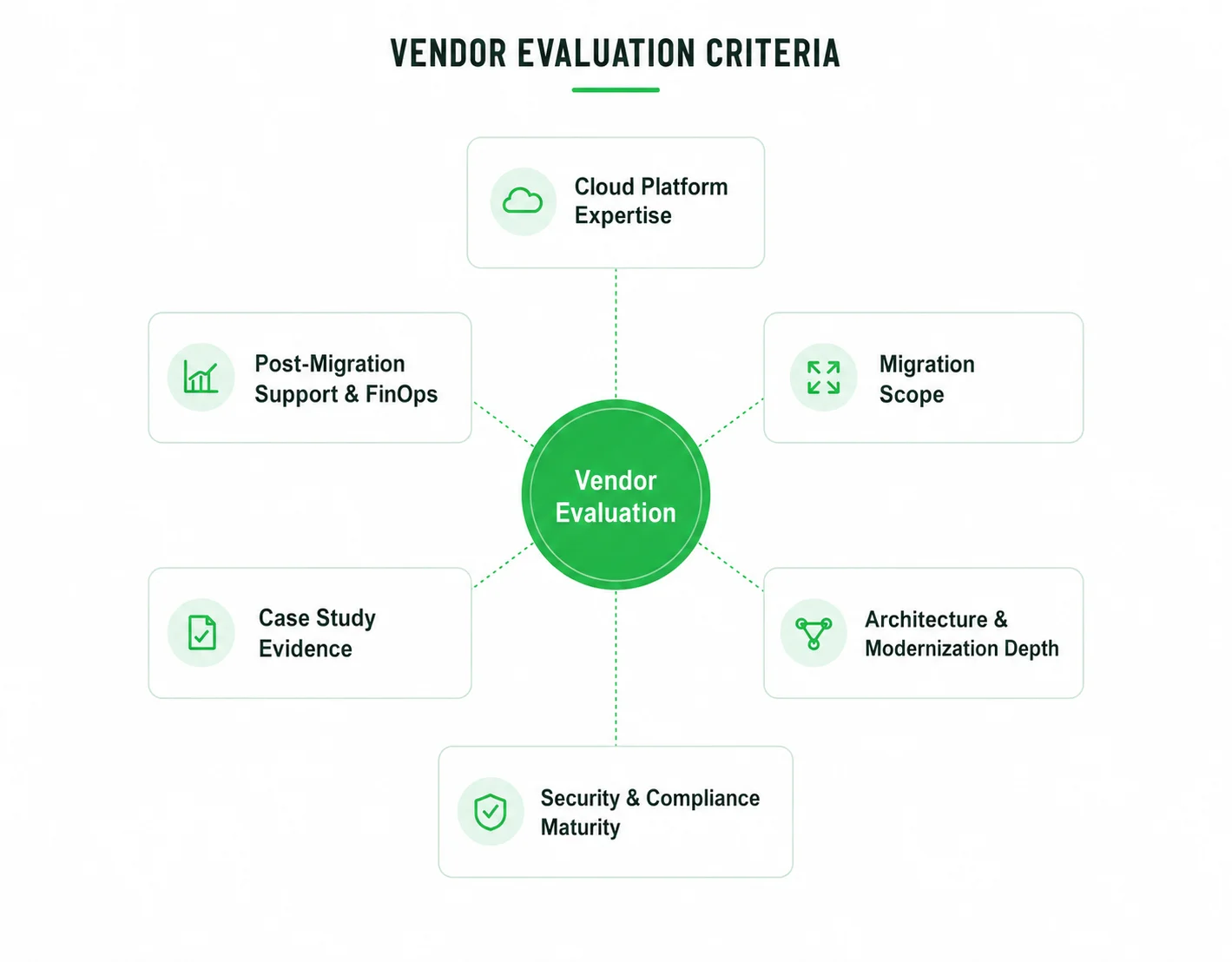
Selecting a cloud migration partner means evaluating more than technical expertise. The ideal provider must grasp infrastructure strategy, application modernization, security, business continuity, and ongoing optimization. We assessed vendors on migration depth, architecture skills, compliance readiness, and post-transition support. Our goal was to highlight strengths relevant to different business priorities and transformation needs, rather than rank vendors.
Cloud platform expertise
Expertise in different cloud platforms is essential. We evaluated each vendor’s skills in AWS, Azure, Google Cloud, hybrid, and multi-cloud settings. Few migrations fit one scenario. Some require full cloud-native adoption; others demand hybrid integration or workload portability. Strong platform expertise cuts risk and improves flexibility.
Migration scope
Cloud migration projects differ in complexity. Some involve moving infrastructure; others require refactoring, migrating databases, containerizing, replatforming, or full transformation. We assessed the breadth of scenarios vendors handle along with their ability to manage both small and large projects. A broad scope reflects mature engineering and adaptability.
Architecture and modernization depth
Lifting systems to the cloud without architectural improvement retains old limits. We assessed how thoroughly companies pursue modernization in the following areas: microservices, Kubernetes, serverless, DevOps, API redesign, and cloud-native engineering. This matters, because businesses expect cloud migration to boost scalability, resilience, speed, and efficiency — not just change hosting.
Security and compliance maturity
Cloud transformation introduces new security, governance, and regulatory challenges that threaten continuity. We examined provider approaches for identity, encryption, access, monitoring, compliance, disaster recovery, and risk. We focused on experience in regulated industries, such as finance, healthcare, and SaaS. Strong maturity remains crucial for firms with sensitive data or compliance demands.
Evidence from case studies and client outcomes
Without proof, technical claims matter less. We reviewed public case studies, client reviews, outcomes, and examples of long-term relationships. We focused on projects that demonstrated reduced costs, improved performance, faster deployment, or successful legacy modernization. Real-world evidence distinguishes marketing from true capability.
Post-migration support and FinOps
Cloud migration continues after deployment. Ongoing optimization, governance, observability, and cost control are vital in production. We evaluated whether vendors provide support services: monitoring, optimization, tuning, management, and FinOps. Poorly governed clouds can quickly lead to inefficiencies and unrestrained costs, even after a successful migration.
Quick Comparison: Top Cloud Migration Providers
This comparison spotlights vendors with diverse technical strengths, delivery models, and specialties. Some target enterprise modernization and regulated sectors. Others suit SaaS, cloud-native, or infrastructure-heavy needs. It guides businesses to partners who fit their priorities, not to rankings.
|
Company |
Location |
Hourly rate |
Clutch rating |
Core strengths |
Delivery model |
|
Miami, FL, USA, with additional global locations |
$50-$99/hr |
Application migration, cloud migration, replatforming, refactoring, legacy modernization, software migration consulting |
Dedicated teams, project-based delivery, consulting, long-term engineering partnership |
||
|
Plantation, FL, USA London, UK |
$50-$99/hr |
AWS, Azure, Google Cloud, cloud migration, cloud strategy, DevOps, CloudOps, legacy tech migration |
Dedicated development teams, managed delivery, consulting, enterprise engineering teams |
||
|
Toronto, Canada, with international presence |
Undisclosed |
Cloud migration, application migration, data migration, AWS, Azure, Google Cloud, analytics modernization |
Consulting, project delivery, data and cloud transformation teams |
||
|
Gliwice, Poland |
$50-$99/hr |
Cloud migration, cloud modernization, data storage management, performance and cost monitoring, software development, cybersecurity |
Product teams, software delivery teams, consulting, cloud modernization support |
||
|
Lviv, Ukraine, and Wroclaw, Poland |
$40/hr |
Application modernization, cloud application migration, .NET development, scalability, performance optimization, cost efficiency |
Custom software teams, project-based delivery, modernization teams |
||
|
Toronto, Canada, with an international presence |
$50-$99/hr |
Cloud migration, data migration, application migration, infrastructure migration, DevOps, AWS, Azure, Google Cloud |
Dedicated teams, enterprise delivery, cloud consulting, software engineering teams |
||
|
eSparkBiz |
India, Global |
$12-$25/hr |
Cloud-based product engineering, API and backend systems, DevOps support |
Dedicated teams, project-based delivery, long-term development partnerships |
|
|
Chicago, IL, USA, with global presence |
$50-$99/hr |
Hybrid cloud, native cloud migration, data migration, infrastructure modernization, cloud resource provisioning, monitoring and logging |
Product engineering teams, cloud infrastructure teams, consulting, long-term delivery |
||
|
Orlando, FL, USA, with global delivery presence |
$25-$49/hr |
Cloud migration, hybrid cloud architecture, cloud-native transformation, product engineering, cloud modernization, data, AI, platform innovation |
Co-engineering teams, product engineering teams, cloud modernization teams |
||
|
San Antonio, TX, USA, with global presence |
Custom pricing |
Cloud migration, cloud adoption, workload migration, managed cloud, hybrid and multi-cloud operations |
Managed services, cloud consulting, migration planning, ongoing CloudOps |
||
|
London, UK, with global presence |
Custom enterprise pricing |
Cloud transformation, cloud strategy, enterprise architecture, migration planning, public cloud transformation, governance |
Enterprise consulting, transformation programs, systems integration, strategic advisory |
||
|
Dublin, Ireland, with global presence |
Custom enterprise pricing |
N/A |
Cloud strategy, migration, modernization, infrastructure, applications, data, operations, automation, industrialized delivery |
Enterprise consulting, managed services, transformation programs, ecosystem orchestration |
Note: Companies in this comparison were selected using public data, market presence, case studies, client feedback, and editorial analysis. This is informational and not a definitive ranking. Businesses should conduct independent evaluation and technical due diligence before choosing a partner.
Top Cloud Migration Companies: Detailed Overview
Cloud migration projects rarely fail because of the technology itself. Issues often arise from mismatched expectations, a weak modernization strategy, poor architectural planning, or partnering with a provider whose strengths don't align with the business need. Some firms focus on enterprise transformation, others on software modernization, while other vendors excel at infrastructure operations, data ecosystems, or cloud-native engineering.
The profiles below help businesses pragmatically evaluate cloud migration companies. Rather than simply providing generic “top vendor” claims, each overview highlights the company’s best applications, standout capabilities, project fit, and factors to consider before committing to one.
Emerline
Best for: Cloud migration paired with software modernization and long-term engineering support.
Overview
Emerline treats cloud migration as part of broader technology evolution, not just an infrastructure task. The company is ideal for organizations migrating legacy applications, modernizing SaaS platforms, or rebuilding systems needing greater scalability, maintainability, and resilience after migration.
Cloud migration capabilities:
- Legacy application migration
- Cloud migration consulting
- Replatforming and refactoring
- Application modernization
- Data migration
- On-premise to cloud transition
- DevOps and QA support
- Ongoing post-migration engineering
Key strengths:
Emerline offers migration services and full-cycle software engineering. This makes it valuable to businesses that need architectural modernization, custom development, integrations, testing, and operational support during migration. Its delivery model supports long-term product evolution rather than isolated migrations.
Best-fit projects:
- Legacy system modernization
- SaaS platform migration and optimization
- Migration of custom-built business applications
- Re-architecting monolithic systems for cloud environments
- Cloud migration requiring active engineering support after launch
What to consider
Emerline is most valuable when migration includes modernization or application engineering. Organizations that only need infrastructure relocation may favor a provider focused on managed cloud operations.
Our take
Emerline is a strong fit for companies that want cloud migration to improve product architecture, engineering quality, and long-term operational flexibility rather than simply relocate workloads.
N-iX
Best for: Enterprise cloud modernization and large-scale multi-cloud initiatives.
Overview
N-iX operates at the intersection of cloud engineering, modernization, and enterprise transformation. The company supports organizations needing structured cloud adoption, large migrations, DevOps integration, and modernization of aging technology.
Cloud migration capabilities:
- Multi-cloud migration
- AWS, Azure, and Google Cloud services
- DevOps and CloudOps
- Infrastructure modernization
- Cloud readiness assessments
- Migration strategy development
- Legacy platform transformation
Key strengths:
N-iX brings engineering scale and cross-platform expertise to complex migrations. Its experience across enterprise cloud ecosystems suits organizations managing distributed infrastructure, multiple environments, or extended modernization roadmaps.
Best-fit projects:
- Enterprise-wide cloud transformation
- Hybrid and multi-cloud adoption
- Large infrastructure modernization initiatives
- Migration programs requiring DevOps integration
- Long-term cloud optimization engagements
What to consider
The company aligns best with mid-market and enterprise digital transformation. Businesses pursuing smaller migrations may find its scale larger than needed.
Our take
N-iX stands out as a mature engineering partner for organizations navigating complex cloud modernization across multiple systems and environments.
Adastra
Best for: Cloud migration connected to analytics, data infrastructure, and enterprise intelligence.
Overview
Adastra frames cloud migration within the context of data and digital transformation. Its services are ideal for organizations that are modernizing their analytics, enterprise data platforms, and governance-sensitive workloads as they adopt the cloud.
Cloud migration capabilities:
- Data platform migration
- Cloud transformation strategy
- Analytics modernization
- Data warehouse migration
- Compliance-focused cloud migration
- Cloud cost optimization
- AWS, Azure, and Google Cloud support
Key strengths:
Adastra excels where cloud migration and data transformation intersect. The company’s strengths include analytics modernization, governance-heavy environments, and cloud ecosystems that support AI and business intelligence.
Best-fit projects:
- Data warehouse modernization
- Analytics platform migration
- Enterprise reporting infrastructure transformation
- AI-ready cloud environment preparation
- Migration of governance-sensitive workloads
What to consider
Organizations focused primarily on application engineering or product modernization may want to compare Adastra with software-development-led cloud providers.
Our take
Adastra is particularly compelling for enterprises where cloud migration is fundamentally tied to data strategy, analytics modernization, and operational intelligence.
Future Processing
Best for: Businesses seeking cloud modernization within a long-term cloud strategy consulting and software delivery partnership.
Overview
Future Processing combines cloud migration expertise with consulting and software engineering. The company supports migration planning, infrastructure assessment, implementation, testing, and ongoing optimization as part of a continued technology partnership.
Cloud migration capabilities:
- Infrastructure assessment
- Migration planning
- Cloud modernization
- Performance monitoring
- Testing and validation
- Cloud optimization
- Advisory and consulting services
Key strengths:
The company’s strength is combining technical execution with long-term support. Future Processing is best for businesses seeking a collaborative partner that will support modernization well beyond migration.
Best-fit projects:
- Cloud readiness and infrastructure assessment
- Mid-sized modernization programs
- Migration combined with software support
- Long-term optimization initiatives
- Migration programs requiring ongoing testing and validation
What to consider
Future Processing delivers the most value when cloud migration is part of a broader consulting or software modernization engagement.
Our take
Future Processing is a practical option for organizations seeking continuity across migration, modernization, and long-term software delivery.
Blackthorn Vision
Best for: Custom application migration and performance-focused modernization projects.
Overview
Blackthorn Vision specializes in migrating custom-built applications and software modernization. Its services suit companies seeking greater scalability, cleaner architecture, and improved operational efficiency during cloud transition.
Cloud migration capabilities:
- Cloud application migration
- Containerization
- Kubernetes modernization
- Application performance optimization
- Cloud-native development support
- Business analysis and engineering
Key strengths:
The company offers strong engineering for application-level modernization. It is effective for projects that need architectural cleanup, performance tuning, or the cloud-native adaptation of legacy systems.
Best-fit projects:
- .NET modernization initiatives
- Migration of custom enterprise software
- Application performance improvement
- Cloud-native transformation projects
- Legacy application refactoring
What to consider
Businesses seeking enterprise-wide transformation across multiple units may need a larger consulting or integration partner.
Our take
Blackthorn Vision is well-suited for organizations that prioritize application engineering quality and deep modernization during cloud migration.
ELEKS
Best for: Enterprise cloud migration supported by deep software engineering expertise.
Overview
ELEKS combines cloud migration services with enterprise software engineering and modernization capabilities. The company supports organizations that are migrating applications, workloads, data systems, and infrastructure while improving delivery pipelines and operational agility.
Cloud migration capabilities:
- Application migration
- Data migration
- Infrastructure modernization
- DevOps integration
- Workload migration
- Cloud-native modernization
- AWS, Azure, and Google Cloud support
Key strengths:
ELEKS brings strong enterprise engineering maturity to technically demanding migration initiatives. Its ability to combine modernization, DevOps, and cloud transformation into a single engagement model makes it particularly valuable for engineering-intensive programs.
Best-fit projects:
- Enterprise software modernization
- Cloud-native application migration
- DevOps-enabled cloud transformation
- Workload and infrastructure migration
- Large-scale digital product modernization
What to consider
The company is best aligned with substantial transformation initiatives rather than narrowly scoped migration tasks.
Our take
ELEKS is a strong option for enterprises requiring serious engineering depth alongside cloud migration execution.
eSparkBiz
Best for: Cloud application development and migration aligned with future AI model deployment needs.
Overview
eSparkBiz delivers application development and cloud-oriented engineering for organizations building or upgrading digital products. The company supports full-cycle development needs, system modernization, and migration of existing applications into cloud environments.
Cloud migration capabilities:
- Cloud Consulting Services
- Cloud Managed Services
- Cloud Cost Optimization
- Microservices Development
- DevOps Outsourcing Services
- Cloud Strategy Consulting
- Azure Consulting
Key strengths:
eSparkBiz covers AI-enabled cloud modernization and end-to-end engineering rather than isolated migration tasks. This supports teams combining development delivery with system restructuring, along with ongoing product evolution after migration.
Best-fit projects:
- Migration of custom business applications
- SaaS development and scaling
- Legacy system modernization
- Backend upgrades for existing platforms
- Long-term engineering partnerships
What to consider
It is better suited for product and application engineering than complex enterprise governance or multi-region cloud programs.
Our take
eSparkBiz works well when migration is closely tied to application rebuilding and ongoing product development.
Intellias
Best for: Hybrid cloud transformation and infrastructure-intensive migration programs.
Overview
Intellias focuses on technically complex cloud initiatives involving infrastructure modernization, hybrid environments, data platforms, and cloud-native transformation. Its services are particularly relevant for enterprises moving away from legacy infrastructure toward modern distributed architectures.
Cloud migration capabilities:
- Hybrid cloud migration
- Cloud-native transformation
- Data warehouse migration
- Infrastructure modernization
- Monitoring and logging implementation
- Security configuration
- Migration testing and validation
Key strengths:
The company demonstrates strong expertise in cloud infrastructure engineering, observability, and migration reliability. Intellias is particularly effective in projects where minimizing downtime, monitoring, and maintaining operational continuity are critical.
Best-fit projects:
- Hybrid cloud migration
- Enterprise infrastructure modernization
- Data lake and warehouse migration
- Cloud-native transformation programs
- Migration projects with advanced monitoring requirements
What to consider
Smaller businesses pursuing relatively simple infrastructure migration may find more focused providers easier to engage operationally.
Our take
Intellias is highly relevant for enterprises managing technically demanding infrastructure and hybrid cloud ecosystems.
Simform
Best for: SaaS companies and digital product businesses modernizing for cloud-native growth.
Overview
Simform approaches cloud migration through a product-engineering lens. The company works extensively with SaaS providers, ISVs, and platform-driven businesses looking to modernize architecture, strengthen DevOps maturity, and improve scalability during cloud transition.
Cloud migration capabilities:
- Cloud modernization
- Hybrid cloud architecture
- Product infrastructure migration
- Cloud-native engineering
- DevOps integration
- Platform modernization
- Data engineering support
Key strengths:
Simform is particularly strong in product-focused cloud transformation, where scalability, deployment velocity, and engineering agility are central business priorities.
Best-fit projects:
- SaaS platform migration
- Cloud-native product modernization
- Hybrid cloud transformation
- DevOps-focused cloud initiatives
- Product scalability improvement programs
What to consider
Organizations with highly regulated enterprise environments may also want to compare Simform with larger enterprise consulting providers.
Our take
Simform is an excellent fit for product-led businesses treating cloud migration as part of broader platform evolution.
Rackspace Technology
Best for: Organizations seeking both cloud migration and long-term managed cloud operations.
Overview
Rackspace Technology combines cloud migration services with ongoing cloud management and operational support. The company is particularly suitable for businesses aiming to reduce internal infrastructure management responsibilities after migration.
Cloud migration capabilities:
- Workload migration
- Cloud adoption services
- Managed cloud operations
- Hybrid and multi-cloud support
- Migration assessment and planning
- Infrastructure monitoring and optimization
Key strengths:
Rackspace stands out through its operational support capabilities. Businesses can centralize migration, infrastructure management, monitoring, and optimization under a single provider relationship.
Best-fit projects:
- Managed cloud migration
- Hybrid cloud operations
- Long-term infrastructure support
- Workload relocation initiatives
- Post-migration operational management
What to consider
Companies requiring substantial custom application redevelopment may need additional software engineering support beyond managed infrastructure services.
Our take
Rackspace Technology is particularly attractive to organizations that prioritize operational stability and ongoing cloud management after migration.
Deloitte
Best for: Governance-heavy enterprise cloud transformation programs.
Overview
Deloitte approaches cloud migration as part of enterprise-wide operational and organizational transformation. The company supports large enterprises managing regulatory complexity, stakeholder alignment, governance redesign, and multi-year modernization initiatives.
Cloud migration capabilities:
- Enterprise cloud strategy
- Governance planning
- Public cloud migration
- Operating model redesign
- Systems integration
- Compliance-focused transformation
- Enterprise architecture consulting
Key strengths:
Deloitte combines business consulting, governance expertise, and technology transformation capabilities at enterprise scale. The company is particularly effective in highly regulated industries or complex multi-stakeholder environments.
Best-fit projects:
- Enterprise cloud transformation
- Governance and compliance modernization
- Multi-division migration programs
- Industry-regulated cloud adoption
- Business-led operating model redesign
What to consider
Smaller organizations focused mainly on technical migration execution may find Deloitte broader and more consulting-heavy than necessary.
Our take
Deloitte is a strong match for enterprises treating cloud migration as part of a larger organizational transformation initiative.
Accenture
Best for: Global-scale cloud reinvention and multi-year modernization programs.
Overview
Accenture delivers cloud migration services within large-scale transformation and operational reinvention initiatives. Its capabilities span applications, infrastructure, operations, data ecosystems, and enterprise architecture across global organizations.
Cloud migration capabilities:
- Enterprise cloud migration
- Application modernization
- Infrastructure transformation
- Cloud automation
- Data migration
- Operating model transformation
- Managed cloud operations
Key strengths:
Accenture brings exceptional delivery scale, automation maturity, and enterprise transformation experience. Its industrialized migration methodologies and global delivery capabilities make it particularly relevant for multinational organizations managing extensive modernization programs.
Best-fit projects:
- Global cloud transformation
- Enterprise application modernization
- Large-scale infrastructure migration
- Multi-year digital transformation initiatives
- Cloud migration for highly complex organizations
What to consider
For smaller businesses or tightly scoped projects, Accenture’s scale and operational structure may exceed practical requirements.
Our take
Accenture is a strong fit for enterprises pursuing cloud migration as part of broad operational, technological, and organizational reinvention.
How to Choose the Right Cloud Migration Company
Choosing a cloud migration partner is more than a procurement decision. If your provider collaborates closely with your teams, they help modernize your architecture, reduce friction, improve resilience, and prepare your business for growth. If there is poor alignment, the partner can introduce complexity, hidden costs, security gaps, and technical debt.
Many migration companies look similar at first. Most claim expertise in AWS, Azure, or Google Cloud, and promise seamless migration and minimal downtime. What truly separates strong partners is their approach to architecture, modernization, risk, governance, and post-migration support.
The steps below can help narrow the field and identify providers that align with your technical environment, business priorities, and transformation goals.
Step 1. Define your migration goal before evaluating vendors
Before comparing providers, clarify what your organization is actually trying to achieve through migration.
Different companies aim to reduce infrastructure maintenance, modernize legacy systems, improve scalability, support AI, enable faster releases, or consolidate environments. These objectives require varied approaches.
A migration partner that excels at infrastructure relocation may not be the right fit for application modernization or cloud-native transformation.
Start by identifying:
- The business problem driving migration
- Which systems are involved
- What “success” looks like after migration
- Whether the project includes modernization, not just relocation
- Operational, compliance, or performance constraints
Without this clarity, distinguishing between generic vendors and those truly aligned with your goals is difficult.
Step 2. Match the provider to the type of migration you need
Cloud migration projects vary in technical depth and business complexity.
Some migrations are straightforward lift-and-shift initiatives. Others require deep application refactoring, ERP modernization, multi-cloud orchestration, DevOps transformation, or data platform redesign.
Choose a provider that fits your workload, not just your cloud platform.
For example:
- Managed cloud providers are often strongest for infrastructure-focused migration and ongoing operations.
- Software engineering firms may be better for application modernization and product transformation.
- Enterprise consultancies are typically more suitable for governance-heavy, multi-stakeholder transformation programs.
- Data-focused vendors are stronger when analytics, AI, or large-scale data migration are central to the initiative.
A mismatched provider leads to gaps, escalation, or architectural compromise.
Step 3. Evaluate the provider’s methodology, not just its promises
Migration vendors often promote certifications and cloud partnerships. These matter, but methodology matters more.
A reliable migration partner should be able to clearly explain how the migration will be assessed, executed, validated, and stabilized after launch. Ask them to walk you through a recent migration end to end — the trade-offs they made and what they would do differently.
Ask whether the provider covers:
- Infrastructure and application assessment
- Cloud readiness analysis
- Migration roadmap creation
- Dependency mapping
- Security and compliance evaluation
- Rollback planning
- Testing and validation procedures
- Downtime minimization strategies
- Post-migration optimization
- Monitoring and operational support
Strong providers explain process, risk, and governance. Weak ones rely on generic marketing language.
Step 4. Look beyond certifications and cloud partnerships
Cloud certifications and official partnerships are useful signals, but you should not decide based on those alone.
A company may hold advanced certifications while still lacking practical experience with your industry, architecture type, operational model, or migration scenario.
The more important question is whether the provider has previously solved problems similar to yours.
Evaluate:
- Real migration case studies
- Modernization examples
- Experience with comparable workloads
- Regulatory or compliance familiarity
- The architectural complexity handled previously
- Post-migration outcomes, not just migration completion
The strongest cloud migration companies combine platform expertise with delivery maturity, engineering discipline, and practical business understanding.
Step 5. Prioritize post-migration support from the beginning
Migration isn’t the finish line. In many cases, real operational challenges arise after moving to the cloud.
Cloud environments need ongoing monitoring, optimization, governance, security, cost management, and performance tuning. Without ownership, organizations face rising costs, reliability issues, or fragmented infrastructure after migration.
Ask providers:
- Who supports the environment after go-live
- Whether managed services are available
- How incidents and escalations are handled
- What optimization processes exist already
- Whether FinOps practices are included
- How performance and cloud spend are monitored over time
Long-term operational support separates successful migrations from expensive relocations.
The best cloud migration company is not the largest, the cheapest, or the most certified. The best fit has the technical skills, delivery model, and operational approach that match your business needs.
A strong migration improves more than infrastructure. Done well, it creates a foundation for scalability, efficiency, resilience, and innovation.
Which Cloud Migration Partner Best Fits Your Organization’s Needs?
Selecting a cloud migration company isn’t about picking the absolute best. Focus on those who align with your infrastructure, delivery model, compliance requirements, capabilities, and technology roadmap.
A vendor that excels in enterprise governance and multi-year transformation programs may be unnecessarily complex for a fast-growing SaaS company. At the same time, a lightweight engineering partner optimized for rapid delivery may not be the right choice for a multinational organization navigating strict compliance, stakeholder-heavy decision-making, and hybrid infrastructure at scale.
The following examples map business scenarios to the types of migration partners most likely to meet those goals.
For startups evolving beyond MVP infrastructure
Recommended companies: Emerline, Simform
Early-stage startups rarely migrate just to move infrastructure. More often, they need to rebuild unstable MVP environments into resilient, production-ready platforms for rapid user growth, continuous releases, and new features.
In these cases, cloud migration is closely tied to product engineering, architecture redesign, DevOps maturity, and operational scalability.
Choose this type of provider if your company needs:
- Cloud migration combined with product development
- Scalable SaaS infrastructure
- CI/CD automation and DevOps enablement
- Database and application modernization
- Flexible engineering capacity
- Budget-conscious delivery models
Best choice:
Emerline is particularly well-suited for startups combining cloud migration with ongoing software evolution, platform modernization, or custom engineering initiatives. Simform is also a strong contender for product-led companies pursuing cloud-native architecture and long-term co-engineering collaboration.
For mid-sized businesses, modernizing legacy applications
Recommended companies: Emerline, ELEKS, Blackthorn Vision, N-iX
Many mid-sized organizations migrate to the cloud because legacy applications are difficult to maintain, extend, or integrate. Simply moving workloads rarely solves underlying limits.
Modernization often requires refactoring, API redesign, database restructuring, and architectural changes with migration.
Choose this partner category if you require:
- Legacy system assessment
- Application re-platforming or refactoring
- Migration with minimal operational disruption
- Modernization of custom-built software
- Integration with newer platforms and services
- Long-term engineering support after migration
Best choice:
Emerline is a strong option when migration and application modernization need to happen under a unified engineering strategy. ELEKS and N-iX are particularly effective for larger-scale modernization initiatives, while Blackthorn Vision offers a practical approach for custom software transformation projects.
For data-heavy organizations and analytics-driven environments
Recommended companies: Adastra, Intellias, Accenture, Emerline
When migration involves large data volumes, analytics, warehouses, lakes, or critical databases, the challenge goes beyond infrastructure.
These migrations involve data mapping, validation, governance, pipeline redesign, and analytics modernization.
Choose this type of partner if your project includes:
- Data warehouse migration
- Analytics platform modernization
- Database migration and validation
- Data lake transformation
- AI- or BI-ready cloud infrastructure
- Secure handling of sensitive datasets
- Governance and compliance controls
Best choice:
Adastra stands out for its migration projects that are closely tied to data modernization and analytics transformation. Intellias is well-suited for technically demanding infrastructure and data platform initiatives. Emerline becomes especially relevant when migration intersects with application modernization or custom software engineering.
For enterprises managing complex transformation programs
Recommended companies: Accenture, Deloitte, N-iX, ELEKS
Enterprise cloud transformation often involves far more than technical execution. Large organizations frequently require governance design, operating model restructuring, compliance coordination, vendor management, stakeholder alignment, and multi-phase migration planning across numerous business units.
These programs typically require both strategic consulting and disciplined execution.
Choose this category of partner if you need:
- Enterprise cloud strategy development
- Large-scale migration roadmaps
- Governance and compliance planning
- Hybrid or multi-cloud transformation
- Stakeholder and vendor coordination
- Enterprise program management
- Industry-specific transformation expertise
Best choice:
Accenture and Deloitte are particularly strong for multi-year enterprise transformation programs involving organizational and operational change. N-iX and ELEKS are attractive alternatives when engineering execution and deep modernization are prioritized alongside cloud migration delivery.
For companies requiring managed cloud operations after migration
Recommended companies: Rackspace Technology, Accenture, Deloitte, N-iX
For many organizations, migration is only the beginning. Once workloads move to the cloud, businesses still need ongoing operational oversight, including monitoring, incident response, infrastructure optimization, security management, backup strategies, and cost governance.
Some companies prefer to outsource these responsibilities rather than build large in-house cloud operations teams.
Choose this type of provider if you require:
- Managed cloud operations
- Infrastructure monitoring and maintenance
- Post-migration optimization
- Incident response support
- Cloud cost management
- Hybrid or multi-cloud operations
- Reduced internal operational overhead
Best choice:
Rackspace Technology is especially strong for organizations seeking both migration services and ongoing managed cloud operations. Accenture and Deloitte are better aligned with enterprise managed services programs, while N-iX works well when managed operations need to coexist with continuous engineering delivery.
For hybrid and multi-cloud migration environments
Recommended companies: Rackspace Technology, Intellias, N-iX, Accenture
Hybrid and multi-cloud strategies introduce additional architectural complexity compared to single-provider migrations. Organizations may need to maintain some workloads on-premises, distribute services across multiple public clouds, comply with regional data residency rules, or avoid vendor lock-in.
These projects require thoughtful workload placement, interoperability planning, and cross-environment governance.
Choose this category of partner if your migration includes:
- Hybrid cloud architecture
- Multi-cloud infrastructure strategy
- Cloud-to-cloud migration
- Workload distribution planning
- Private/public cloud integration
- Cross-platform governance
- Distributed monitoring and security management
Best choice:
Rackspace Technology is a strong fit for managed hybrid and multi-cloud operations. Intellias is a practical option for technically focused hybrid migration initiatives. N-iX and Accenture are better suited for broader enterprise-scale multi-cloud transformation programs.
For ERP and business-critical system migration
Recommended companies: Emerline, Deloitte, Accenture, ELEKS, N-iX
Migrating ERP platforms and business-critical systems requires an exceptionally cautious approach. These environments often support finance, procurement, HR, reporting, logistics, customer operations, and other foundational business functions.
A poorly executed migration can disrupt core operations, create data inconsistencies, or introduce costly downtime.
Choose this type of provider if your project involves:
- ERP-related cloud migration
- Migration of mission-critical systems
- Integration dependency mapping
- Data cleansing and validation
- Rollback and contingency planning
- Performance and load testing
- User acceptance testing
- Post-go-live stabilization support
Best choice:
Emerline is particularly strong when ERP migration overlaps with custom integrations, modernization, or broader software transformation. Deloitte and Accenture are better suited for enterprise ERP transformation at scale, while ELEKS and N-iX are effective for engineering-intensive migration initiatives.
For SaaS companies, improving scalability and reliability
Recommended companies: Emerline, Simform, ELEKS, N-iX
SaaS businesses frequently modernize cloud infrastructure to improve scalability, reduce downtime, accelerate release cycles, and prepare platforms for future product expansion.
In these environments, cloud migration is tightly connected to engineering maturity and long-term product performance.
Choose this type of provider if you need:
- Scalable cloud architecture
- Application modernization
- DevOps and CI/CD enablement
- Containerization and orchestration
- Observability and monitoring
- Database optimization
- Cloud cost efficiency
- Product engineering support
Best choice:
Emerline is a strong fit for SaaS businesses, combining migration with long-term product development. Simform is especially relevant for cloud-native product modernization, while ELEKS and N-iX are effective for larger engineering ecosystems and more technically demanding SaaS platforms.
For organizations struggling with cloud costs after migration
Recommended companies: Rackspace Technology, Future Processing, N-iX, Accenture, Deloitte
Cloud adoption does not automatically reduce operational expenses. Many organizations discover rising infrastructure costs after migration due to oversized environments, inefficient workload allocation, limited visibility, or the absence of mature FinOps practices.
Optimization often becomes a second transformation phase.
Choose this category of provider if you need:
- Cloud cost analysis
- Workload right-sizing
- Infrastructure optimization
- Monitoring and observability
- FinOps implementation
- Governance improvements
- Performance tuning
- Continuous operational optimization
Best choice:
Rackspace Technology is particularly strong for operational optimization and managed cloud cost control. Future Processing is relevant for modernization projects focused on efficiency improvements. N-iX, Accenture, and Deloitte are better suited for enterprise-scale governance and optimization initiatives.
For organizations preparing infrastructure for AI and analytics initiatives
Recommended companies: Adastra, Accenture, Intellias, Emerline, Simform
AI and advanced analytics programs depend heavily on modern cloud foundations. Before AI initiatives can succeed, organizations pursuing machine learning, predictive analytics, or large-scale BI initiatives often need scalable storage, reliable pipelines, secure environments, and well-integrated application ecosystems.
In these cases, the migration strategy should be shaped around future analytical capabilities, not just current infrastructure limitations.
Choose this type of provider if your organization requires:
- Data platform modernization
- AI- or ML-ready cloud infrastructure
- Analytics migration
- Data lake or warehouse transformation
- Secure data pipelines
- Scalable compute environments
- Integration between applications and analytics systems
Best choice:
Adastra is particularly strong for analytics-centered cloud transformation. Accenture is well suited for enterprise AI modernization initiatives at scale. Emerline and Simform are compelling options when AI-ready infrastructure must be closely integrated with application modernization and product engineering efforts.
Cloud Migration Vendor Red Flags
Most migration failures are predictable. The signals show up early — in how a vendor scopes the work, talks about risk, and plans for what happens after go-live.
These red flags often hide behind appealing language like "fast delivery," "simplified implementation," or "cost-efficient migration," while actually pointing to gaps in architecture, governance, operational readiness, or support.
Spotting these issues early helps businesses avoid unstable environments, rising costs, security risks, and costly post-migration fixes.
The vendor only talks about lift-and-shift migration
Lift-and-shift migration has its place. Sometimes, moving workloads with minimal architectural changes is the fastest way to leave outdated infrastructure behind.
Problems arise when lift-and-shift is presented as the default solution to every migration challenge.
A vendor focused solely on relocation may overlook architectural constraints, technical debt, inefficient workloads, or outdated dependencies, thereby reproducing old issues in the cloud rather than resolving them.
A strong migration partner should evaluate whether applications actually benefit from refactoring, replatforming, containerization, or broader modernization, not simply moving servers from one location to another.
No discovery or dependency mapping phase
Migration projects depend on knowing how systems interact before any changes are made.
Applications, databases, APIs, authentication, reporting tools, integrations, and background services often have hidden dependencies from years of growth. Without thorough discovery, migrations become unpredictable.
Skipping this phase creates major risks, such as:
- Broken integrations
- Application downtime
- Data inconsistencies
- Failed workloads
- Operational disruption after cutover
If a vendor proposes to start migration execution without collaborating with clients on a structured discovery process, it often signals a tactical approach rather than a disciplined transformation strategy.
No rollback plan
Every migration project needs a contingency path.
Even well-tested migrations can fail due to misconfiguration, network issues, integration errors, bottlenecks, or incompatibility. Without rollback, businesses must troubleshoot live, as systems remain unstable.
A rollback plan is not a sign of pessimism. It is a sign of operational maturity.
Reliable migration providers define:
- Rollback conditions
- Recovery procedures
- Backup validation
- Failover mechanisms
- Restoration timelines
- Decision-making responsibilities during incidents
If rollback planning is vague or absent entirely, the project may not be adequately prepared for operational risk.
No data validation strategy
Migration involves more than data transfer; it requires ensuring completeness, accuracy, synchronization, and usability after transition.
Without structured validation, organizations may find missing records, corrupted relationships, duplicates, or reporting errors after going live.
This becomes especially dangerous in environments involving:
- ERP systems
- Financial platforms
- Healthcare data
- Analytics environments
- Compliance-sensitive workloads
- Customer-facing systems
A mature migration process includes data reconciliation, integrity checks, validation, and controlled verification before production cutover.
Security is treated as an afterthought
Security should shape the migration architecture from the very beginning, not be treated as a final checklist item before launch.
Some providers focus on infrastructure but postpone identity management, access control, encryption, monitoring, compliance, and threat detection until later.
This creates avoidable exposure, especially in regulated industries or distributed cloud environments.
A strong migration strategy should address:
- IAM architecture
- Least-privilege access
- Encryption policies
- Logging and monitoring
- Compliance controls
- Network segmentation
- Vulnerability management
- Incident response readiness
If security conversations happen only after migration execution starts, the project may already be carrying unnecessary operational risk.
No FinOps or cost optimization plan
Many organizations move to the cloud expecting lower costs but end up with higher bills due to oversized infrastructure, idle resources, complexity, and poor workload management.
Cloud environments require active financial governance.
Be wary if a migration provider never discusses:
- Resource optimization
- Usage monitoring
- Workload right-sizing
- Reserved instance strategies
- Cloud spend visibility
- Scaling policies
- FinOps governance
If these items are skipped, cost efficiency is probably not built into the migration approach.
Cloud migration without financial planning often results in uncontrolled spending and less scalability.
No post-migration support
Migration is not complete at go-live.
The first weeks after cutover often reveal performance issues, monitoring gaps, sync failures, user friction, scaling problems, or unexpected costs.
Without post-migration support, internal teams may be left managing stabilization alone, while still adapting to a completely new environment.
Reliable providers typically include:
- Stabilization periods
- Monitoring support
- Incident response
- Optimization cycles
- Operational tuning
- Knowledge transfer
- Ongoing managed services if required
The warning sign is a vendor whose responsibility ends at cutover rather than carrying through stabilization.
Weak case studies
Case studies should demonstrate more than technical buzzwords and platform logos.
Weak case studies avoid specifics. They describe "successful cloud transformation" but never explain what was done. For example:
- What systems were migrated
- What business problem was solved
- How complexity was handled
- Which risks were mitigated
- What measurable outcomes were achieved
This lack of detail makes it hard to judge whether the vendor has relevant project experience.
Strong providers can clearly explain:
- Architectural challenges
- Migration scope
- Modernization depth
- Compliance considerations
- Operational outcomes
- Scalability improvements
- Performance gains
- Cost optimization results
Detailed case studies are among the clearest signs of delivery maturity.
Cloud Migration Trends to Consider
Cloud migration today differs from previous, infrastructure-focused years. Organizations are now migrating toward modernization, automation, resilience, AI, and long-term strategy.
As cloud environments become increasingly central to business operations, companies are placing greater emphasis on governance, architectural quality, financial controls, and intelligent infrastructure design.
The trends below are shaping how businesses evaluate cloud migration initiatives and select long-term technology partners.
AI-ready cloud infrastructure
AI initiatives are becoming a major driver behind cloud modernization decisions.
Modern analytics, machine learning, generative AI, and intelligent automation workloads require infrastructure capable of supporting large-scale processing, distributed compute environments, scalable storage, and real-time data access.
Cloud migration is now planned around future AI needs, not just current infrastructure limits.
Organizations now evaluate whether cloud environments can support:
- AI model training and inference
- Real-time analytics
- High-volume data pipelines
- GPU-enabled workloads
- Scalable compute orchestration
- AI-ready data architecture
Migration providers who understand both infrastructure and AI-readiness are now much more valuable.
FinOps from the start
Cloud cost optimization is no longer treated as a post-migration cleanup exercise.
Organizations are increasingly embedding FinOps practices directly into migration planning, architecture decisions, and operational governance from day one. The goal is to prevent uncontrolled spending before it happens, rather than react after costs escalate.
Modern migration strategies now consider:
- Workload efficiency
- Automated scaling policies
- Resource lifecycle management
- Cloud spend visibility
- Forecasting and budgeting
- Governance controls
- Performance-to-cost balance
This shift shows that cloud scalability, without financial discipline, quickly becomes unsustainable.
Hybrid and multi-cloud governance
Many businesses no longer rely on a single cloud provider.
Regulatory requirements, data residency rules, resilience strategies, acquisition-driven infrastructure complexity, and vendor diversification goals all contribute to hybrid and multi-cloud adoption.
This creates a new challenge: consistent governance across distributed environments.
Organizations increasingly need:
- Unified monitoring
- Centralized identity management
- Cross-cloud security policies
- Workload governance
- Compliance visibility
- Standardized operational controls
Migration providers now need expertise not only in cloud deployment, but also in managing interoperability and governance across multiple infrastructure ecosystems.
Security-by-design migration
Security is shifting from a reactive control layer to a foundational architectural principle.
Rather than applying security policies after migration, organizations are integrating security decisions directly into infrastructure planning, workload segmentation, IAM strategy, observability, and deployment automation.
This approach reduces operational exposure while improving compliance readiness and incident response maturity.
Modern migration programs increasingly include:
- Zero-trust architecture principles
- Automated compliance enforcement
- Infrastructure-as-code security controls
- Identity-centric access management
- Continuous monitoring
- Threat detection integration
- Secure DevOps pipelines
Security-by-design is becoming especially important for organizations operating in finance, healthcare, E-commerce, and other highly regulated sectors.
Application modernization instead of pure lift-and-shift
Businesses are becoming more selective about what should actually be migrated unchanged.
While lift-and-shift migration remains useful in certain cases, many organizations now recognize that relocating outdated applications without modernization often preserves inefficiencies, technical debt, and operational limitations.
As a result, migration projects increasingly include:
- Application refactoring
- Replatforming
- API modernization
- Containerization
- Microservices adoption
- Cloud-native redesign
The focus is shifting from infrastructure relocation to long-term operational improvement and architectural flexibility.
Data platform modernization
Cloud migration is increasingly connected to broader data transformation initiatives.
Organizations that are modernizing cloud environments are often simultaneously redesigning analytics infrastructure, migrating warehouses to lakehouse architectures, enabling real-time reporting, or preparing environments for AI-driven decision-making.
This means migration strategy now frequently includes:
- Data warehouse modernization
- Lakehouse adoption
- Real-time analytics pipelines
- Scalable storage architecture
- AI-ready data environments
- Data governance modernization
- Integration between operational systems and analytics platforms
For many companies, the real business value of cloud migration now comes less from infrastructure relocation and more from the ability to build modern, intelligent, data-driven operational ecosystems.
Questions to Ask Before Hiring a Cloud Migration Company
Selecting a cloud migration partner requires more than technical expertise; it means understanding the provider’s approach to risk, architecture, continuity, and optimization. The right questions clarify whether a vendor has a structured migration methodology or just offers generic services.
These discussions also show how well a provider understands your business, not just your infrastructure. A strong migration company should clearly explain its decisions, identify trade-offs, and connect migration choices to scalability, resilience, governance, and efficiency.
Before committing to a provider, ensure that both your team and the provider can jointly answer the following questions:
- What migration strategy do you recommend for our workloads: rehost, replatform, repurchase, refactor, retire, or retain?
- How will you assess our current infrastructure and application dependencies?
- What cloud platform do you recommend and why?
- How will you minimize downtime?
- What is your rollback plan?
- How will you validate data integrity?
- How do you handle security, IAM, encryption, and compliance?
- Do you have experience in our industry?
- What happens after go-live?
- How do you approach cloud cost optimization?
- Will you document the new environment and train our internal team?
- Can you show relevant case studies with measurable outcomes?
Conclusion
Cloud migration today is no longer just about moving infrastructure. It drives business transformation and affects architecture, resilience, security, data, costs, and long-term scalability.
The right migration partner does more than move workloads. They help modernize, reduce friction, boost reliability, and build a future-ready cloud environment.
No single cloud migration company fits every need. The choice depends on your infrastructure, goals, compliance, internal maturity, and operational needs. Startups modernizing SaaS need different partners than enterprises managing their multi-cloud across many business units.
Successful cloud migrations start with clarity. Define your goals, understand limitations, and evaluate providers on their ability to support your long-term operations.
The companies in this guide have strengths in engineering, modernization, services, transformation, data, and product development. Choose a partner whose delivery, technical skills, and strategy align with your business needs — and not just sales promises.
Published on Jun 11, 2026