AI in Retail: Practical Use Cases, Real-World Examples, and Business Value
Table of contents
- Key takeaways
- Where AI Delivers Value in Retail
- Customer experience and commerce
- Merchandising, pricing, and marketing
- Inventory, supply chain, and fulfillment
- Store operations and workforce
- Back-office and enterprise operations
- Which AI Approaches Fit Different Retail Problems?
- How to Prioritize Retail AI Use Cases
- From AI Pilot to Production: What Retailers Need to Get Right
- Costs, Risks, and ROI of AI in Retail
- Understanding the total cost of AI
- Managing AI-related risks
- Measuring the return on AI investment
- What Agentic AI Changes for Retailers
- Putting AI to Work in Retail
- Frequently Asked Questions About AI in Retail
- What is AI in retail?
- What are the most common AI use cases in retail?
- How is generative AI used in retail?
- How can retailers choose which processes to automate with AI?
A retailer can accurately predict a demand surge and still run out of stock if the forecast never reaches the replenishment team. An inventory system may show that a product is available, even though customers can't find it on the shelf. These everyday situations illustrate a persistent retail challenge: businesses collect enormous amounts of data, but turning it into timely, actionable decisions remains difficult.
Artificial intelligence is helping retailers close that gap. Predictive models improve demand planning and pricing decisions, computer vision provides better visibility into store operations, and generative AI supports everything from product discovery to customer service. AI agents take things further by connecting information with actions across business systems. Each technology serves a different purpose, and its value depends on how well it fits existing processes.
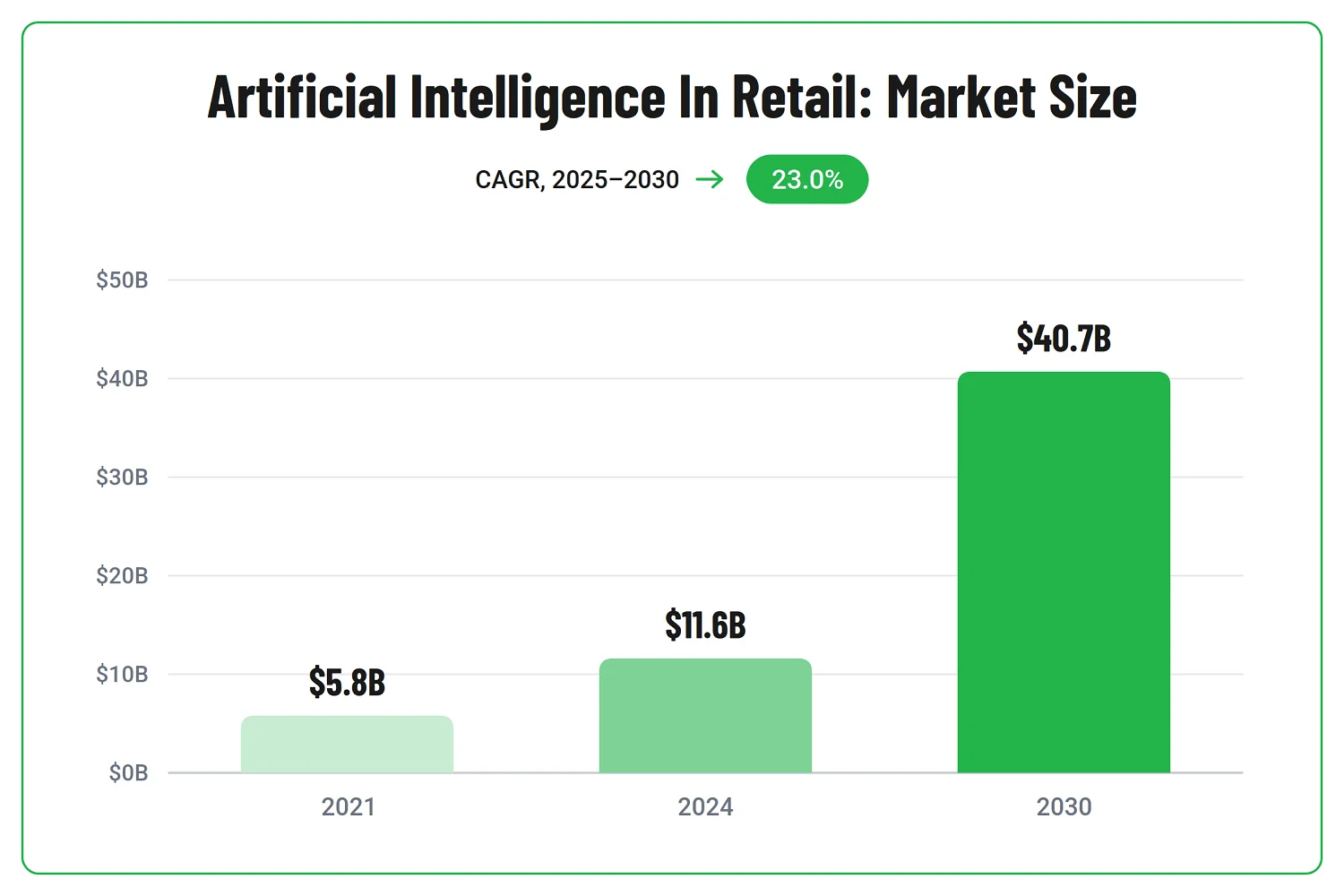
Retail investment in these technologies continues to grow. According to Grand View Research, the global AI in retail market was valued at $11.61 billion in 2024 and is projected to reach $40.74 billion by 2030, with a compound annual growth rate of 23% from 2025 to 2030. A 2025 National Retail Federation survey of 56 AI leaders at U.S. retailers also found that 39% expected AI to account for more than 10% of their technology budgets within three years.
For retail businesses considering AI adoption, the central question is which applications can deliver measurable results and what it takes to implement them successfully.
Key takeaways
- AI creates value across retail operations. Demand forecasting, inventory optimization, personalized shopping, and customer support are among the practical applications retailers can explore.
- Different problems require different AI approaches. Predictive models support forecasting and pricing, generative AI handles conversational tasks and content, while computer vision helps monitor physical stores.
- Successful adoption starts with business priorities. Retailers should focus on measurable outcomes, reliable data, and the ability to integrate AI into existing workflows.
- Greater automation demands stronger controls. As AI agents begin executing business tasks, clear permissions, monitoring, and human oversight become essential.
Where AI Delivers Value in Retail
AI is finding its way into nearly every part of retail, from the moment a customer starts searching for a product to the decisions that determine when and where that product becomes available. The applications vary considerably, and so do their business objectives. A recommendation engine might aim to increase conversion rates, while a demand forecasting system helps reduce stockouts and excess inventory.
The table below highlights the main areas where retailers are putting AI to work:
|
Retail area |
What AI can improve |
|
Customer experience |
Search, recommendations, shopping assistants, customer service |
|
Merchandising and marketing |
Assortments, pricing, promotions, segmentation, content |
|
Inventory and supply chain |
Demand forecasting, replenishment, allocation, fulfillment |
|
Stores and workforce |
Shelf availability, loss prevention, scheduling, associate support |
|
Back office |
Document processing, supplier workflows, internal knowledge |
Customer experience and commerce
Imagine a shopper looking for a lightweight waterproof jacket for a spring trip to Scotland. They may have no particular brand or product in mind, which makes a conventional keyword search less useful. AI-powered search helps interpret the intent behind such requests, while recommendation engines draw on browsing behavior, purchase history, and product attributes to suggest relevant options.
Other tools make product discovery more intuitive. Visual search allows customers to find similar items using photographs, while virtual try-on solutions help them assess how clothing, accessories, or cosmetics might look before placing an order.
Generative AI adds a conversational element to the shopping experience. Instead of navigating multiple product pages, customers can ask an assistant to compare specifications, explain differences between products, or clarify delivery and return conditions. For these interactions to be useful, the assistant needs access to accurate product information, current availability, and retailer-specific policies.
Customer service offers another practical application. According to a Google Cloud case study, Best Buy increased call containment by more than 50% through AI-powered self-service. This means more customer inquiries could be handled without transferring callers to a human representative. The company also reported fewer transfers and faster issue resolution.
Merchandising, pricing, and marketing
Choosing the right product assortment involves more than identifying popular items. Retailers need to account for local preferences, seasonal demand, shelf space, and profitability. Even a successful promotion can hurt margins if discounts are too aggressive or demand has been overestimated.
Machine-learning models help merchandising teams evaluate these factors together. By analyzing historical sales, competitor prices, promotions, and regional purchasing patterns, they support decisions about which products to stock, when to adjust prices, and where markdowns may be necessary.
Marketing teams benefit from a different set of capabilities. Predictive analytics helps identify promising customer segments and determine which offers are more likely to generate a response. Generative AI, meanwhile, speeds up the preparation of product descriptions, campaign materials, and localized content. This is particularly useful for retailers managing large catalogs or running campaigns across several markets.
These applications become more useful when they connect with everyday merchandising processes. Microsoft's retail AI offerings, for example, cover assortment planning, pricing, promotions, and inventory management, with AI agents supporting selected workflows. A pricing recommendation can then become part of a merchandising team's regular decision-making process rather than remaining an isolated analytical result.
Inventory, supply chain, and fulfillment
Inventory planning requires retailers to balance two costly outcomes: running out of products customers want and holding more stock than they can sell. Demand forecasting helps address both, particularly when purchasing decisions must be made weeks or months before products reach stores.
AI forecasting models analyze historical sales alongside factors that influence demand, including price changes, promotional campaigns, weather, local events, and product lifecycles. Retailers can use the resulting forecasts to plan replenishment, distribute stock between locations, and adjust safety-stock levels.
German E-commerce retailer OTTO provides a practical example. Using AI-based time-series forecasting, the company improved forecast accuracy by up to 30%, according to Google Cloud. Its approach accounts for changing demand patterns and helps teams make more informed inventory decisions, particularly for products with unpredictable sales behavior.
Forecasting also becomes more valuable when retailers can respond quickly to what the models reveal. Suppose one store is running low on a popular product while another has more stock than it needs. An AI-enabled inventory system could identify the imbalance and recommend transferring stock before the shortage affects sales.
Walmart has taken this approach further through its self-healing inventory systems. The retailer describes using real-time AI and automation to detect inventory imbalances, redirect products between locations, and reduce waste. Such applications show how forecasting, inventory visibility, and automated execution can work together across a large retail network.
Store operations and workforce
A store's inventory records don't always reflect what customers find on the shelves. Products may be misplaced, left in storage areas, or displayed with incorrect price labels. Identifying these issues through manual checks takes time, particularly across large store networks.
Computer vision helps retailers monitor actual store conditions using cameras and image analysis. Depending on the system, it can detect empty shelf spaces, misplaced products, pricing discrepancies, planogram violations, and unusual checkout activity. Store teams can use these insights to address issues before they lead to missed sales or customer complaints.
Simbe offers an example of this technology in practice. Its platform combines computer vision, sensors, and autonomous inventory robots to monitor shelf conditions and product availability. According to a Google Cloud case study, retailers using Simbe's solutions have achieved over 98% on-shelf availability and more than 2% annual sales lift. These are provider-reported results, but they illustrate the potential value of improving visibility into store conditions.
AI also helps employees handle everyday tasks. In-store assistants can provide quick access to product specifications, inventory information, and company policies, reducing the time spent searching through separate systems. Workforce planning tools can use expected foot traffic and workload patterns to help managers schedule employees more effectively.
Back-office and enterprise operations
Behind every retail transaction is a considerable amount of administrative work. Finance teams process invoices, procurement departments coordinate with suppliers, and employees regularly search for information scattered across internal systems and documents.
AI helps streamline these activities. Solutions built with generative AI and retrieval-augmented generation (RAG) allow employees to retrieve information from approved internal sources using natural-language questions. Document AI tools extract and organize data from invoices, purchase orders, and supplier documents, reducing the need for manual entry. Other models can flag unusual transactions or inconsistencies that require attention.
Consider a supplier notifying a retailer that an upcoming shipment will be delayed. Resolving the issue may require checking an ERP system, reviewing inventory at different locations, identifying affected orders, and contacting the purchasing team. An AI agent could gather this information across connected systems, prepare alternative actions, and escalate decisions that require employee approval.
This kind of coordination is especially valuable in retail environments where employees work across multiple applications. With the necessary integrations and access controls in place, AI can help teams manage routine exceptions faster and spend less time transferring information between systems.
Which AI Approaches Fit Different Retail Problems?
Choosing an AI approach starts with understanding the task, the available data, and the expected outcome. Forecasting demand from sales records requires different capabilities than interpreting a product image or processing a customer request. The distinction also affects implementation costs, infrastructure requirements, and how much human oversight a solution needs.
|
AI approach |
What it does best |
Key considerations |
|
Machine learning and predictive AI |
Identifies patterns in data to estimate future outcomes or classify information |
Requires representative data and regular performance monitoring |
|
Generative AI and LLMs |
Understands and generates language, processes unstructured information, and supports natural-language interactions |
Needs reliable information sources and safeguards against inaccurate outputs |
|
Computer vision |
Extracts information from images and video to recognize objects, conditions, or activities |
Depends on image quality, deployment conditions, and privacy requirements |
|
AI agents |
Coordinates multi-step tasks, interacts with software tools, and executes authorized actions |
Requires clearly defined permissions, error handling, and audit trails |
These categories are closely related, but they aren't interchangeable. Computer vision often relies on machine learning, while AI agents describe a way of coordinating models, tools, and business rules rather than a separate type of model.
A product return illustrates how several approaches might work together. Computer vision could help assess a photo of a damaged item, an LLM could interpret the customer's request, and an agent could retrieve the order details and prepare a return. Business rules would determine whether the request qualifies for automatic processing.
Understanding these distinctions helps retailers select technologies based on what a process actually requires, without adding unnecessary complexity.
How to Prioritize Retail AI Use Cases
Retail teams may identify dozens of opportunities for AI, but pursuing too many at once can stretch budgets and resources without producing meaningful results. A sensible starting point is to identify processes where delays, errors, or repetitive work create measurable costs, then assess whether those processes are ready for automation.
The following framework helps retailers screen potential projects before committing to a pilot.
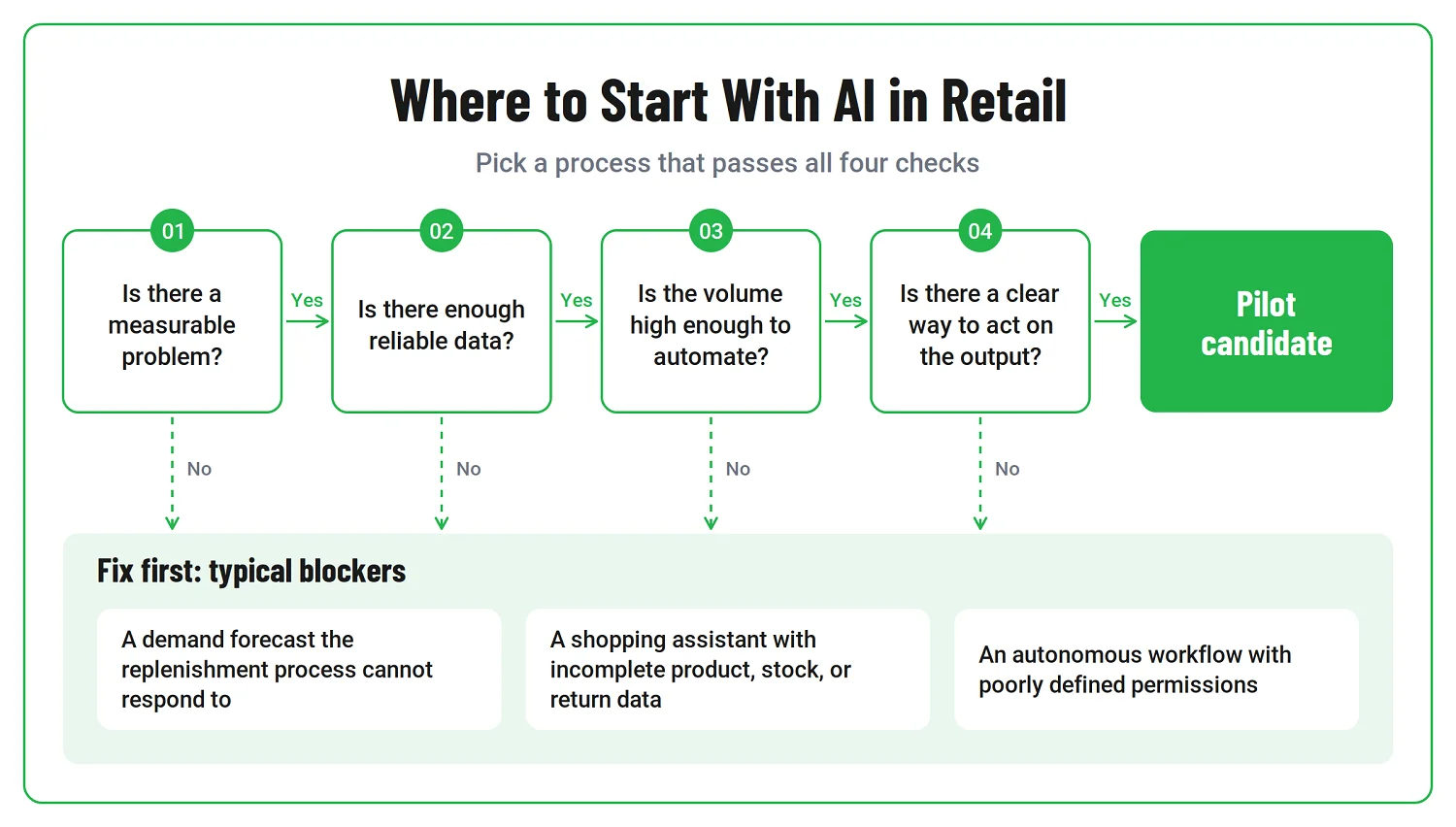
A process that fails one of these checks may still be worth pursuing later. The immediate priority is to address whatever prevents the solution from working in practice, whether that's incomplete data, an inefficient workflow, or unclear responsibilities.
For projects that pass, the next step is to compare their potential impact with the effort required to implement them. Each pilot should have a clearly defined scope, an accountable process owner, and measurable success criteria. Depending on the application, those metrics might include fewer inventory shortages, shorter customer-service resolution times, or reduced manual processing.
This approach gives retailers a practical basis for deciding which initiatives to pursue first and which require further preparation.
From AI Pilot to Production: What Retailers Need to Get Right
An AI solution may perform well in a controlled pilot and still struggle when introduced into daily retail operations. A model tested on a carefully prepared dataset must eventually handle changing product catalogs, delayed inventory updates, unexpected demand fluctuations, and information coming from multiple systems. Preparing for these conditions is an essential part of moving beyond experimentation.
Consider a demand forecasting tool initially tested in a single region. Expanding it across a retail network may reveal differences in how stores record returns, stock transfers, or promotional sales. These inconsistencies can affect the model's predictions, even if it performed accurately during testing. Before scaling, retailers need reliable data pipelines, consistent data definitions, and mechanisms for detecting missing or outdated information.
Integration presents another challenge. AI-generated insights must reach employees through the applications they already use, whether that's an ERP system, an inventory management platform, or an internal dashboard. Engineers also need to account for situations where connected systems become unavailable or return conflicting information. Clear fallback procedures help employees continue working when automated recommendations cannot be trusted.
A gradual rollout makes these challenges easier to manage. Retailers can introduce a solution to selected stores, product categories, or departments, evaluate its performance under actual operating conditions, and resolve issues before expanding its reach. Monitoring should cover both technical indicators, such as processing delays and model accuracy, and operational metrics, such as stock availability or fulfillment performance.
Long-term reliability also depends on clearly assigned responsibilities. Retail teams need a way to report inaccurate results, while technical teams must maintain integrations, investigate performance changes, and update models as business conditions evolve. Establishing these processes early helps turn a promising pilot into a dependable part of retail operations.
Costs, Risks, and ROI of AI in Retail
Before scaling an AI solution, retailers need to understand what it will cost to operate, which risks could undermine its performance, and whether the expected benefits justify the investment. A successful pilot provides useful evidence, but a sound business case must account for ongoing expenses and results under real operating conditions.
Understanding the total cost of AI
The choice of AI technology directly affects implementation and operating expenses. For many forecasting, scoring, and optimization tasks, statistical methods or conventional machine-learning models can deliver the required performance without the computational demands of more complex neural architectures.
Beyond model development, retailers also need to budget for data preparation, integration, computing infrastructure, monitoring, maintenance, and technical support. These expenses can vary significantly depending on the solution's complexity and how frequently it is used.
For generative AI applications, inference costs deserve particular attention. An assistant handling thousands of customer inquiries daily may incur substantial expenses if every interaction requires a large language model. Caching frequently requested information, using smaller models for straightforward tasks, or routing only complex queries to more capable models can help control spending while maintaining service quality.
Calculating total cost of ownership (TCO) gives retailers a more realistic basis for evaluating an AI investment, particularly when comparing solutions with different licensing, infrastructure, and maintenance requirements.
Managing AI-related risks
The consequences of an AI error depend on where the system operates and what it is allowed to do. An assistant providing an incorrect product description may frustrate a customer, while a system that applies unauthorized discounts or modifies purchase orders could cause direct financial losses.
Generative AI applications require particular attention to unreliable outputs. Connecting models to approved information sources, validating sensitive responses, and providing escalation options can reduce the likelihood of customers or employees receiving incorrect information. Retailers must also protect personal and commercially sensitive data processed by these systems.
AI agents introduce additional concerns when they execute transactions or modify business records. Approval requirements, spending limits, and audit trails help organizations retain control over consequential actions while automating lower-risk tasks.
Retailers are increasingly formalizing these safeguards. In a 2025 National Retail Federation survey of 56 AI leaders at U.S. retailers, 86% reported having AI governance policies, while 93% planned to develop or continue developing them over the following year.
Measuring the return on AI investment
Return on investment (ROI) assessment should begin with a measurable baseline and a clear understanding of how the proposed solution affects business performance. Depending on the application, retailers might track changes in inventory holding costs, lost sales from stockouts, customer-service expenses, or employee hours spent on repetitive tasks.
The distinction between operational improvements and financial returns matters. Saving employees time, for example, doesn't automatically translate into lower costs. The benefit becomes measurable when that time allows teams to handle more work, avoid additional hiring, or improve service without increasing resources.
Comparing results against pre-implementation performance or a suitable control group helps retailers determine whether observed improvements are attributable to AI. The financial assessment should then weigh those incremental benefits against development and ongoing operating expenses.
This gives decision-makers a stronger basis for determining whether to expand an AI initiative, refine its scope, or reconsider further investment.
What Agentic AI Changes for Retailers
Retail operations involve countless tasks that require several decisions before an issue is resolved. A forecasting system might identify an upcoming shortage, for example, but employees still need to evaluate the options, coordinate a response, and check whether the problem has been addressed. Agentic AI offers the possibility to handle more of these steps within a single workflow.
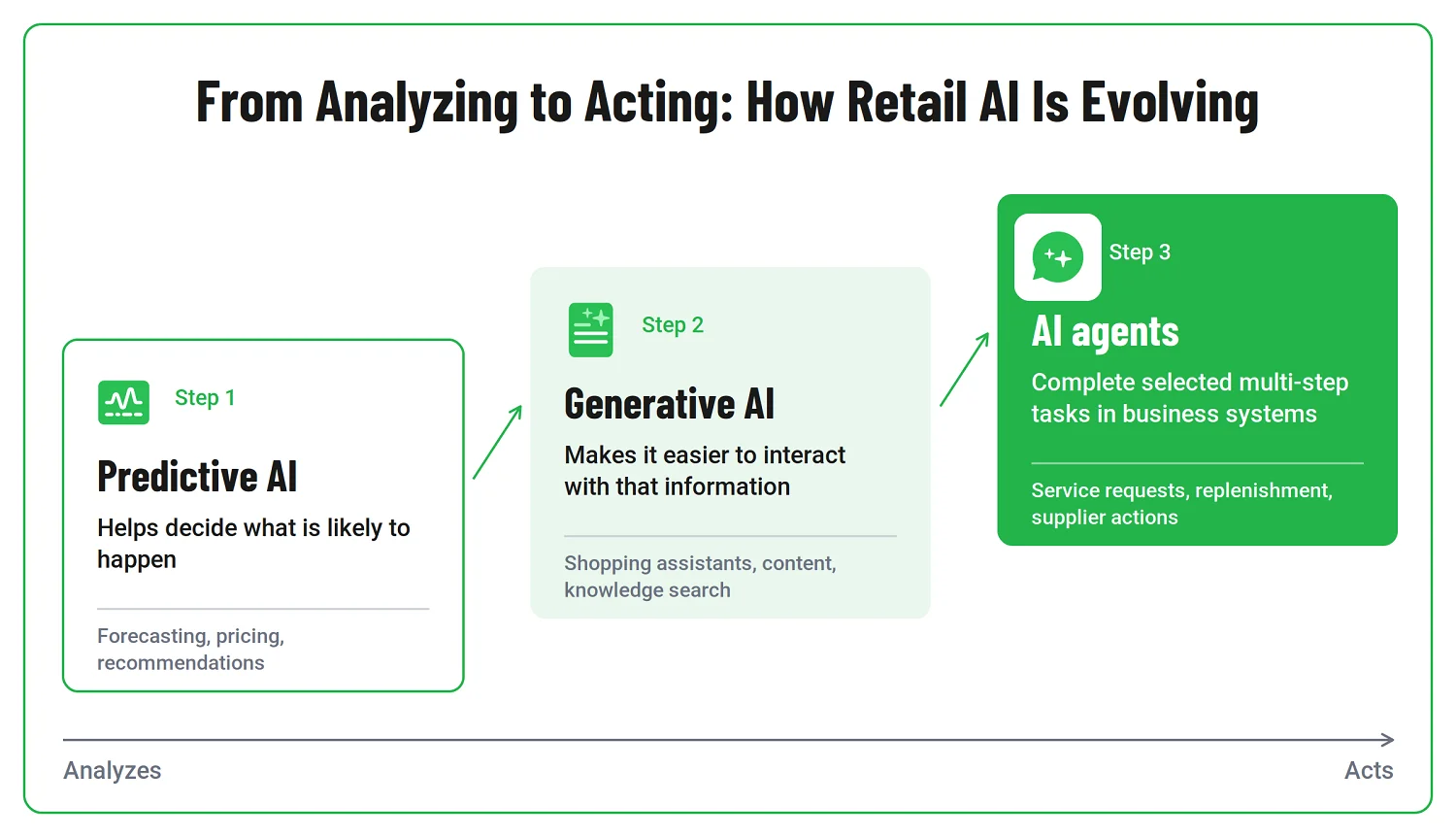
The shift could change how retailers organize routine work. Consider an online order that cannot be fulfilled as promised. An AI agent could investigate alternative fulfillment options, prepare an adjustment, and communicate the proposed solution to the customer. If the situation falls outside established procedures, the agent could pass the case to an employee with the relevant information already collected.
For retailers, this also changes how automation success should be measured. The number of queries answered or recommendations generated tells only part of the story. More meaningful indicators include how quickly issues are resolved, how often employees need to intervene, and whether completed actions require subsequent corrections.
As agentic systems mature, their value will increasingly depend on their ability to handle complete business processes reliably. Retailers that identify suitable workflows and establish clear expectations for their outcomes will be better positioned to benefit from this next stage of AI adoption.
Putting AI to Work in Retail
The growing range of retail AI applications gives businesses plenty of opportunities to experiment. The greater challenge is turning promising pilots into solutions that perform reliably in daily operations.
For retailers planning their next AI initiative, this starts with selecting a well-defined use case, identifying the necessary data and system integrations, and establishing measurable success criteria. Testing the solution on a limited scale under real operating conditions helps determine whether it's ready for a wider rollout.
Considering AI for your retail business? Contact us and we will help you evaluate technical requirements, identify implementation challenges, and develop a practical plan for bringing AI into your operations.
Frequently Asked Questions About AI in Retail
What is AI in retail?
AI in retail refers to the use of artificial intelligence to analyze data, improve decisions, and automate business processes. Retailers apply these technologies to areas such as customer service, inventory management, pricing, and store operations.
What are the most common AI use cases in retail?
Common applications include personalized product recommendations, intelligent search, customer-service automation, demand forecasting, inventory optimization, dynamic pricing, fraud detection, and shelf monitoring. The most relevant use cases depend on a retailer's business model, operational challenges, and available data.
How is generative AI used in retail?
Generative AI helps retailers create product content, power conversational shopping assistants, handle customer inquiries, and provide employees with access to internal knowledge. Combined with retrieval-augmented generation, it can retrieve relevant information from company-approved sources to support more accurate, context-aware responses.
How can retailers choose which processes to automate with AI?
Retailers should begin with a specific operational problem and assess how frequently it occurs, what it costs the business, and whether sufficient data is available. A small-scale pilot with measurable success criteria can help determine whether automation is practical and financially worthwhile before a broader rollout.
Published on Oct 15, 2026