Gambling ERP Development for US Operators: Architecture, Compliance, and Costs
Table of contents
- What Is a Gambling ERP?
- What a Gambling ERP Helps Operators Achieve
- ERP vs. PAM, Sportsbook, RGS, and Casino Management Systems
- Sportsbook vs. iCasino vs. Land-Based Casino ERP Requirements
- Gambling-Specific Capabilities Around the ERP Core
- Multi-jurisdiction reporting and tax logic
- Player liabilities and safeguarded funds
- Tribal-state compact calculations
- Multi-entity consolidation
- Promotional wagers and effective-dated rules
- Chargebacks and prior-period adjustments
- BSA/AML integration
- Systems a Gambling ERP Usually Integrates With
- Gambling ERP Reference Architecture
- Example Gambling ERP Scenarios
- Multi-state sportsbook
- iCasino
- Land-based casino
- Cloud vs. On-Premises vs. Hybrid
- When Custom Gambling ERP Development Makes Sense
- Extend Existing ERP vs. Composable vs. Custom
- When you probably don’t need a fully custom ERP
- Gambling ERP Development Process
- Stage 1: Map the business and regulatory scope
- Stage 2: Establish system ownership
- Stage 3: Design the financial integration and reconciliation model
- Stage 4: Separate configurable rules from core logic
- Stage 5: Plan migration around open financial positions
- Stage 6: Test the books, not just the features
- Stage 7: Test failure, recovery, and peak conditions
- Stage 8: Define the regulatory review boundary
- Stage 9: Roll out in controlled stages
- Security, Auditability, and Regulatory Considerations
- Gambling ERP Development Cost and Timeline
- What drives gambling ERP cost?
- Pre-Development Checklist
- How Emerline Can Help With Gambling ERP Development
- Frequently Asked Questions
- Is a gambling ERP the same as a PAM?
- Can an operator use SAP, Oracle, NetSuite, or Microsoft Dynamics instead of custom gambling ERP software?
- Does a gambling ERP need GLI certification?
- Should every wager or casino game round be posted to the ERP?
- Can one ERP support sportsbook, iCasino, and land-based casino operations?
- How much does gambling ERP development cost?
- How long does gambling ERP implementation take?
- Does a gambling ERP have to run in the cloud?
- Closing remarks
Gambling operators have an unusual financial back office. Revenue may originate in a sportsbook, online casino, or physical property, while player funds, payment settlements, taxes, provider fees, bonuses, and regulatory obligations are recorded across different systems. Finance still has to translate all of that activity into books that reconcile, close on time, and stand up to audit.
That is where a gambling enterprise resource planning (ERP) fits. It gives the finance organization a controlled corporate view of the business without trying to replace the platforms that actually run betting, gaming, player accounts, or casino operations.
For some operators, that means extending an established ERP with gambling-specific integrations and financial logic. Others need a more substantial custom back-office layer because of transaction volumes, jurisdictional rules, or the number of gaming systems involved. This guide covers both approaches, focusing on architecture, reconciliation, compliance, implementation choices, and the cost of building an ERP environment that works for a regulated US gambling business.
What Is a Gambling ERP?
A gambling ERP is the financial and administrative backbone that connects gaming activity with corporate accounting and back-office processes. You may also see terms such as gaming ERP, casino ERP, or sportsbook ERP, depending on the operator. Still, the basic role is similar: turning activity generated elsewhere in the business into controlled financial records, liabilities, settlements, tax obligations, and management reporting.
It should not replace a player account management system, sportsbook platform, remote gaming server, or casino management system. Those platforms run gaming operations. The ERP handles their financial consequences and connects them with the company’s wider finance processes.
A gambling ERP typically supports:
- Accounting and financial consolidation
- Gaming revenue reconciliation
- Player liability accounting
- Payment and bank reconciliation
- Gaming tax accounting
- Regulatory reporting
- Procurement and accounts payable
- Management reporting
For operators deciding whether to extend an existing platform or build additional functionality, ERP development can cover anything from custom modules and integrations to a broader financial back-office implementation.
What a Gambling ERP Helps Operators Achieve
The business case for a gambling ERP is usually less about adding another enterprise system and more about reducing the amount of financial work that happens outside controlled processes.
A well-designed environment can improve several areas at once:
- Faster financial close. Automated feeds and reconciliation reduce the amount of spreadsheet work finance teams need before they can trust period-end figures.
- Less manual reconciliation. Gaming activity, player balances, processor settlements, bank movements, and accounting records can be compared systematically instead of through separate exports.
- Stronger audit and reporting readiness. Finance teams can preserve the evidence behind balances, adjustments, tax calculations, and regulatory outputs without reconstructing it after the fact.
- More reliable player liability accounting. The ERP can maintain and reconcile the financial liability associated with player funds while the PAM remains responsible for individual player balances.
- Less manual compliance work. Versioned tax and reporting logic can reduce recurring spreadsheet calculations and make changes easier to control.
- A financial architecture that can grow with the operator. New jurisdictions, entities, payment providers, or gaming products can be added without redesigning the entire accounting environment each time.
For a single-product operator, some of these requirements may be handled around an existing ERP with relatively limited customization. As the number of jurisdictions, gaming channels, and integrations grows, the value of a more deliberate gambling-specific financial architecture usually becomes easier to see.
ERP vs. PAM, Sportsbook, RGS, and Casino Management Systems
A gambling operator usually relies on several systems that see the same money from different angles. A player account management (PAM) platform knows what belongs to an individual player. A sportsbook platform knows what happened to a wager. A remote gaming server (RGS) or game provider records casino game activity. A casino management system handles much of what happens on a physical gaming floor.
The ERP has a different job. It takes the financial consequences of those activities into the corporate books: revenue, liabilities, settlements, taxes, payables, and the figures finance needs for close, consolidation, and reporting.
That distinction is easier to see when responsibilities are separated explicitly:
|
System |
What it should own |
What the ERP needs from it |
|
PAM |
Player accounts, wallet balances, deposits, withdrawals, bonuses, and player-level balance movements |
Aggregate player liabilities, financial movements, and reconciliation data |
|
Sportsbook platform |
Bets, odds, settlements, voids, refunds, open wagers, and wagering history |
Settled financial results, open-liability information, fees, adjustments, and traceable posting data |
|
RGS/game provider |
Game rounds, results, stakes, wins, jackpots, and provider-level gaming activity |
Settled gaming revenue, provider obligations, jackpot or progressive balances where applicable, and reconciliation data |
|
Casino management system |
Gaming-floor activity such as slots, tables, player tracking, device data, and property-level gaming operations |
Revenue and liability data required for accounting, property reporting, reconciliation, and consolidation |
|
ERP |
General ledger, accounts payable, procurement, financial close, consolidation, tax liabilities, and corporate reporting |
Controlled financial inputs from the operational systems above |
The key issue is system ownership. Operational platforms should remain the authoritative source for player, wagering, and gaming activity, while the ERP records the financial effects of that activity, including revenue, liabilities, settlements, taxes, and other accounting entries. Finance should still be able to trace those records back to the underlying source data without duplicating operational functionality inside the ERP.
Sportsbook vs. iCasino vs. Land-Based Casino ERP Requirements
The financial model changes depending on how gambling revenue is generated. A sportsbook, an iCasino, and a land-based casino may ultimately report into the same corporate accounts, but they create different liabilities, reconciliation needs, tax rules, and operational data.
That difference matters when designing a gambling ERP or deciding which parts of an existing ERP need to be extended.
| Sportsbook | iCasino | Land-based casino | Multi-channel/hybrid | |
|
Revenue mechanics |
Wagers accepted and settled; gaming revenue recognized from settled wagering activity |
Gaming revenue generated from settled game activity across providers and aggregators |
Slots, table games, and property operations |
Revenue consolidated across channels, properties, and entities |
|
Distinctive financial balances |
Open and unsettled wager liabilities |
Jackpot and progressive liabilities; provider payables |
Chips and ticket-in/ticket-out (TITO) liabilities; marker receivables; cage and vault cash; gaming assets |
Combination of channel-specific balances and intercompany positions |
|
Main reconciliation sources |
Wagering ledger, PAM, payment service provider (PSP), bank, and general ledger (GL) |
Provider statements, PAM, PSP, bank, and GL |
Cage, count room, device meters, and GL |
Cross-channel, cross-property, and intercompany reconciliation |
|
Tax considerations |
State-specific wagering taxes and treatment of promotions |
Game-specific tax rules and provider economics |
Gaming taxes alongside non-gaming property revenue |
Multiple vertical and jurisdiction-specific rules |
|
Asset-accounting impact |
Limited |
Limited |
Significant |
Depends on the property and channel mix |
For a sportsbook, timing is one of the main accounting complications. A bet may be accepted today but remain unsettled for weeks or months. Futures markets make that especially visible: the operator may already hold player funds while the final revenue outcome is still unknown. Financial reconciliation, therefore, has to distinguish settled activity from open wagering liabilities.
An iCasino has a different set of counterparties and settlement rules. Finance may need to reconcile gaming activity against provider or aggregator statements, account for revenue-sharing arrangements, and track jackpot or progressive obligations. The ERP does not need to reproduce every game round, but the financial records must still tie back to the underlying gaming activity.
Land-based casinos introduce physical value, cash handling, and property assets. Chips and TITO tickets represent liabilities until redeemed, while casino markers are receivables. Cage and vault balances have to reconcile with property-level systems and count-room activity. Slot machines and other gaming equipment also make fixed-asset accounting more significant than it is for a digital-only operator.
Multi-channel operators combine several of these requirements in one financial environment. A business running both sportsbook and casino products, for example, may need different reconciliation and tax logic for each vertical while still producing consolidated reporting at entity or group level.
Tribal operations add another layer rather than forming a separate operating model. A tribal operator may run a land-based property, sportsbook, digital casino, or a combination of them. Compact-specific calculations, revenue-sharing obligations, or reporting requirements then sit on top of the financial model for the underlying operation.
Gambling-Specific Capabilities Around the ERP Core
A gambling financial back office has to support requirements that conventional ERP platforms were not designed around. That does not mean every gambling-specific function belongs inside the ERP.
A useful way to divide responsibilities is:
|
Layer |
Main responsibility |
|
Operational gaming systems |
Player balances, wagers, game rounds, gaming-floor activity, AML case management, and other transaction-level operational records |
|
Integration and reconciliation layer |
Data mapping, reconciliation, jurisdiction-specific calculations, adjustments, settlement logic, and audit traceability |
|
ERP core |
General ledger, liabilities, payables, consolidation, financial close, tax accounting, and management reporting |
The exact split will vary by operator, but keeping those boundaries clear prevents the ERP from becoming a second PAM, sportsbook platform, casino management system, or compliance application.
Multi-jurisdiction reporting and tax logic
Operators working across several states or jurisdictions need more than separate report templates. The underlying financial facts may be the same, while the way revenue, promotions, deductions, fees, or liabilities are calculated and reported can differ considerably.
A more durable architecture keeps those facts separate from jurisdiction-specific rules. Settled gaming revenue, promotional activity, fees, player liabilities, and payment adjustments can feed calculation and reporting logic that is versioned by jurisdiction and effective date.
Infrastructure requirements can vary as well. Nevada, for example, revised provisions related to hosting centers and cloud computing for certain gaming-related systems in March 2026, including changes affecting Regulation 5.242 and the state’s hosting-center definition. The Nevada Gaming Commission disposition documents those changes.
This does not mean the whole ERP necessarily falls within a regulated gaming-system boundary. It does mean the wider back-office architecture needs enough flexibility to meet jurisdiction-specific hosting, access, security, and evidence requirements while still supporting centralized finance.
Player liabilities and safeguarded funds
The ERP should hold a reliable accounting representation of what the operator owes players, but it should not become the master player wallet.
The authoritative individual balance normally remains in the PAM. Finance may instead maintain an aggregate player-liability balance or subledger in the ERP and reconcile it against the PAM. Where a jurisdiction requires reserves or another mechanism for protecting player funds, that liability also needs to be reconciled against the relevant protected-funds arrangement.
This gives finance a defensible balance-sheet position without duplicating player-account functionality in the ERP.
Tribal-state compact calculations
Tribal gaming can introduce financial rules that do not fit neatly into a conventional tax configuration. A compact may define its own revenue base, deductions, rates, recipients, or effective periods.
The important issue is often not the arithmetic but the definition behind it. A calculation should therefore remain traceable to the compact and rule version that produced it rather than being treated as another static percentage in a tax table.
Indian Affairs maintains the federal record of Tribal-State gaming compacts and their approval status. For operators subject to these agreements, compact-specific logic may sit alongside state tax and regulatory rules within the wider finance architecture.
Multi-entity consolidation
This is one area where established ERP products are already strong. Mature platforms such as SAP, Oracle, Microsoft Dynamics, and NetSuite provide proven capabilities for legal entities, charts of accounts, intercompany transactions, consolidation, and financial close.
Rebuilding those functions solely because the business operates in gambling usually adds cost without solving a new problem.
For many operators, the more practical model is to keep the established ERP core and add gambling-specific reconciliation, reporting, tax, and integration logic around it. This distinction will also matter later when we compare extending an existing ERP with composable and fully custom approaches.
Promotional wagers and effective-dated rules
Promotional wagering shows why gambling tax logic needs effective dates.
Colorado, for example, progressively restricted deductions related to free bets under HB22-1402, and HB25-1311 removed the deduction beginning July 1, 2026.
A system that stores only a current “promo deduction” value cannot reproduce what applied to an earlier reporting period. Rates, thresholds, caps, and effective dates therefore need to be versioned where possible, with changes to the underlying calculation logic going through normal engineering, testing, and approval controls.
Chargebacks and prior-period adjustments
Chargebacks can arrive after a reporting period has already closed. That creates a different problem from correcting an ordinary current-period transaction.
The original accounting and filing should remain visible. The back office then needs to record what changed, why it changed, and how the correction was handled — whether through an amended filing, a later-period adjustment, a reversal, or another permitted process.
For audit purposes, the history matters as much as the final number. A reviewer should be able to follow the original entry, the subsequent event, the authorization, and the resulting adjustment without reconstructing the sequence manually.
BSA/AML integration
Bank Secrecy Act and anti-money laundering (BSA/AML) controls are another good example of why system boundaries matter.
The ERP is generally not where sanctions screening, behavioral monitoring, or AML case management should take place. Those functions belong in specialized compliance systems. The finance environment still depends on the same underlying transaction data and needs reliable reconciliation with those systems.
FinCEN’s casino guidance makes clear that sports betting and mobile gaming offered through a covered casino form part of the casino’s products and services for AML purposes. It also addresses aggregation of cash transactions when determining reporting obligations.
The financial back office therefore needs to exchange accurate, traceable data with AML systems without trying to reproduce their compliance logic inside the ERP.
Systems a Gambling ERP Usually Integrates With
A gambling ERP sits inside a wider operating environment. Finance depends on data from gaming, payments, compliance, customer, and corporate systems, so integration design has a direct effect on reconciliation, reporting, and financial close.
|
System group |
Typical integrations |
Why they matter |
|
Gaming operations |
PAM, sportsbook platforms, RGS/game aggregators, casino management systems |
Provide wagering, gaming, player-liability, provider-settlement, and property-level financial data |
|
Payments and banking |
PSPs, payment gateways, banks |
Connect deposits, withdrawals, fees, reserves, chargebacks, settlements, and actual cash movements |
|
Compliance and jurisdiction |
KYC/AML platforms, geolocation services, tax and regulatory systems |
Supply compliance status, jurisdiction evidence, tax inputs, and data required for regulated reporting |
|
Data and analytics |
BI platforms, data warehouses, event stores |
Preserve transaction-level detail and support reconciliation, analytics, audit, and management reporting |
|
Customer systems |
CRM, loyalty, and promotional platforms |
Connect campaigns, bonuses, customer programs, and their financial impact |
|
Corporate back office |
Procurement, HR, payroll, and other enterprise systems |
Bring suppliers, workforce, payroll, and operating costs into corporate finance and consolidation |
Some integrations deserve more attention than others. Payments are a good example: the PAM records what happened to the player account, the processor records settlements and fees, and the bank confirms the cash movement. Those views need to reconcile even though they originate in different systems.
Gaming integrations create a similar challenge. A sportsbook, RGS, or casino management system remains the source of operational detail, while finance needs reliable revenue, liability, settlement, and adjustment data for accounting.
For operators connecting a mix of gaming and enterprise platforms, software integration may cover API design, data exchange, orchestration, and the reconciliation logic needed between those systems.
Gambling ERP Reference Architecture
The difficult part of gambling ERP integration is rarely moving data from one system to another. It is deciding what reaches the ERP, at what level of detail, and how finance proves that the result is complete and correct.
A sportsbook, PAM, RGS, payment platform, or casino system may generate millions of operational events. Posting each event as an individual journal entry adds volume to the general ledger without giving finance much additional value. It can also make financial close harder.
A more practical pattern is to separate detailed operational data from financial posting:
Operational systems → integration and reconciliation layer → summarized accounting entries → ERP.
The transaction-level detail remains available in an event store or data platform, while the ERP receives controlled postings at an accounting level appropriate to the business — for example, by day, entity, product, market, or jurisdiction.
This is where the architecture from the diagram below fits:
- Source systems
Sportsbook, PAM, RGS/game providers, and payment systems generate the underlying activity.
- Integration and reconciliation layer
Events are validated, transformed, reconciled, and aggregated into accounting-ready batches.
- ERP/general ledger
The ERP receives summarized postings for the financial close, payables, consolidation, tax accounting, and management reporting.
- Event store/data platform
Detailed records remain available for investigation, audit evidence, reporting, and reconstruction of the accounting result.
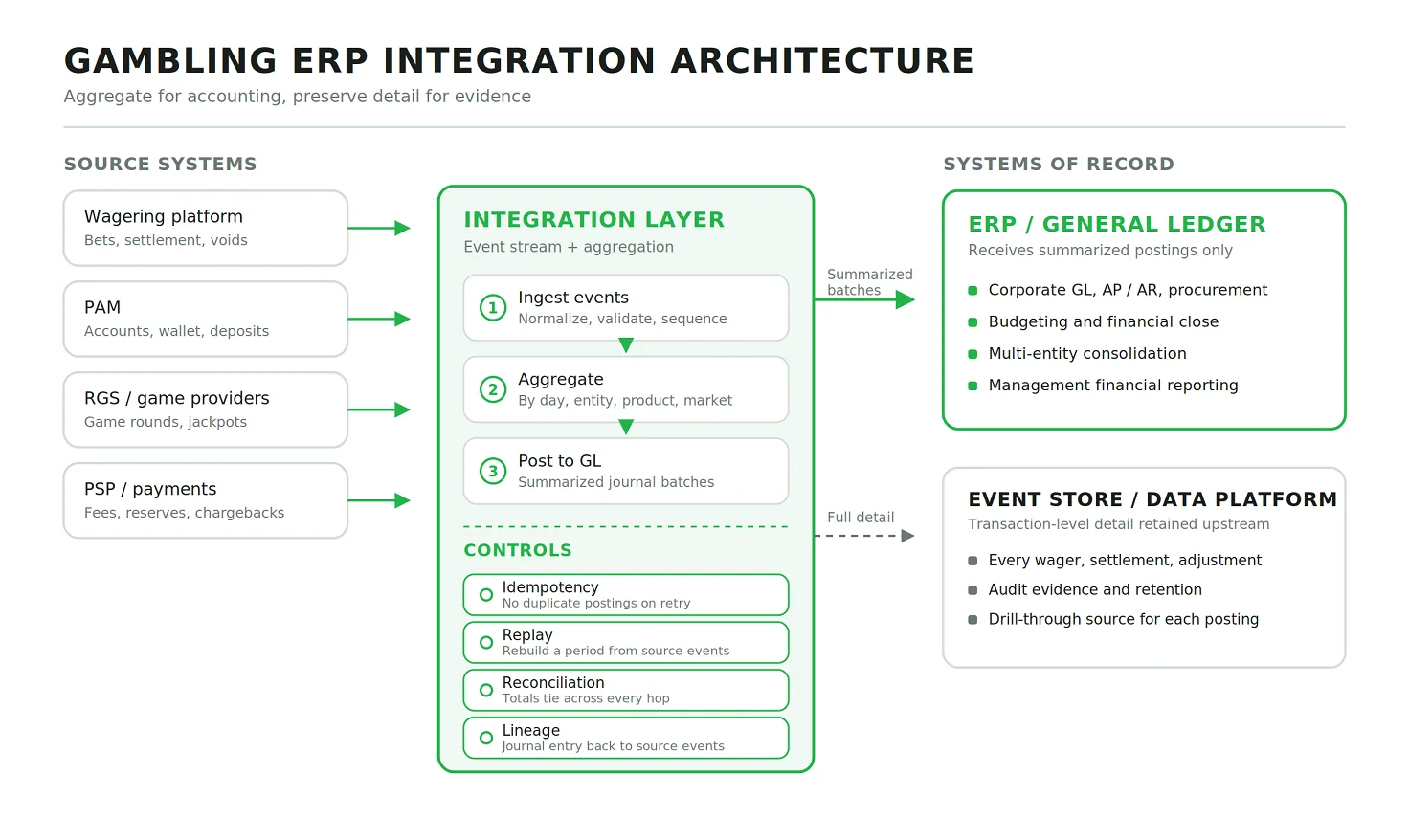
Four controls are especially important in the integration layer:
- Idempotency prevents a retried event or message from creating the same financial posting twice.
- Replay allows a period or batch to be rebuilt from authoritative source events when a calculation needs to be rerun.
- Automated reconciliation compares the totals produced by operational systems, the transformation layer, the ERP, payment processors, and banks.
- Lineage links a summarized journal entry back to the source events and transformation rules that produced it.
Payment reconciliation is a good example of why those controls matter. The PAM may show the deposit requested by the player. The PSP has its own settlement amount, fees, failures, reserves, and chargebacks. The bank records the cash that actually arrived.
Those numbers will not always match automatically. A three-way reconciliation between the player system, payment provider, and bank makes the differences visible before they turn into unexplained month-end balances.
Migration needs the same discipline. Open futures bets or other long-dated wagers cannot disappear simply because the original transaction occurred before the new ERP went live. Their unsettled liabilities need to move into the new environment in a way that still reconciles to the operational system after cutover.
The architecture therefore needs to preserve two things at the same time: accounting-level information that finance can use for close and reporting, and transaction-level evidence that explains how those figures were produced. Keeping those layers connected allows the ERP to remain a financial system of record without turning it into a second gaming platform.
Data engineering can support the pipelines, transformation logic, reconciliation datasets, and data stores required to maintain that connection across operational and financial systems.
Example Gambling ERP Scenarios
The following scenarios illustrate how gambling ERP requirements change across different operating models. They are representative examples based on common industry patterns and do not describe specific Emerline client projects.
Multi-state sportsbook
Challenge:
A sportsbook operating across several US states has to reconcile wagering activity, player balances, payments, taxes, and corporate accounting while preserving the rules that apply in each jurisdiction. Some wagers settle quickly, while futures and other long-dated bets may remain open for weeks or months. Deposits, withdrawals, bonuses, refunds, processor fees, and tax obligations also follow different financial paths.
Architecture:
The sportsbook platform and PAM remain responsible for wagering and player-account activity. PSPs and banks provide the settlement and cash view, while the reconciliation layer connects those sources with the ERP and applies the relevant entity, product, and jurisdiction context.
How data flows:
Sportsbook + PAM + PSP → reconciliation and rules layer → ERP
Settled wagering activity is converted into accounting-ready postings, while open bets continue to be reflected in liability calculations. Player balances are reconciled against the corresponding financial liability, processor settlements are matched with bank movements, and state-specific tax logic uses the appropriate revenue, deduction, and promotional data for the reporting period.
Business impact:
Finance gets a more controlled close and reconciliation process, while the architecture can accommodate additional states, products, or payment providers without requiring the corporate accounting core to be redesigned each time.
iCasino
Challenge:
An iCasino has to reconcile gaming activity across game providers or aggregators, player accounts, payments, and provider settlements. Finance may also need to account for revenue-sharing arrangements, jackpot or progressive liabilities, bonuses, and gaming taxes, often across several jurisdictions or brands.
Architecture:
The RGS or game provider remains the source of detailed gaming activity, while the PAM holds player balances and account movements. PSPs provide settlement data. A reconciliation layer brings those sources together, calculates provider and financial obligations, and passes accounting-ready results to the ERP.
How data flows:
RGS / game providers → PAM + PSP data → reconciliation layer → ERP
Gaming activity is compared with provider statements and player-account data before financial postings are created. Provider fees and revenue shares are separated from player liabilities, while bonuses, jackpot obligations, and tax calculations remain tied to the correct reporting period and jurisdiction.
Business impact:
Finance can reconcile gaming revenue, provider obligations, player liabilities, and payments within a consistent financial model. New providers or casino content can then be introduced without changing the underlying corporate accounting structure.
Land-based casino
Challenge
A land-based casino adds physical cash, gaming instruments, receivables, and property-level operations to the financial picture. Finance may need to account for cage and vault balances, TITO tickets, casino markers, gaming devices, payroll, procurement, and other operating expenses alongside gaming revenue.
Architecture
The casino management system remains responsible for gaming-floor activity. Cage, TITO, marker, and device data feed the finance layer, where balances and exceptions are reconciled before the relevant accounting entries reach the ERP. Corporate functions such as payroll and procurement also feed the same financial environment.
How data flows:
Casino management system → cage / TITO / marker activity → finance and reconciliation layer → ERP
Unredeemed TITO tickets remain liabilities, while casino markers create receivables. Cage and vault balances are reconciled with operational records and physical cash, and gaming results are combined with payroll, procurement, and other property-level costs for reporting and consolidation.
Business impact:
Finance can bring gaming activity and property-level operating costs into the same accounting structure while preserving the detail needed for reconciliation. For multi-property operators, the same model can support property-level reporting alongside consolidation across casinos, digital products, and other business units.
Cloud vs. On-Premises vs. Hybrid
Deployment is another architectural decision that affects a gambling ERP long after go-live. The right model depends on the operator’s regulatory footprint, existing infrastructure, security requirements, internal IT resources, and the systems the ERP needs to connect with.
|
Model |
Advantages |
Considerations |
|
Cloud |
Easier scaling, managed infrastructure, faster provisioning and rollout |
Data residency, regulatory requirements, vendor dependency, connectivity, and ongoing cloud consumption costs |
|
On-premises |
Greater control over infrastructure, data location, and selected configurations |
Higher infrastructure and maintenance burden, slower scaling, upgrades, disaster recovery, and greater dependence on internal IT resources |
|
Hybrid |
Flexibility to place workloads according to regulatory, operational, or technical requirements |
More integration points, additional monitoring and security coordination, and greater operational complexity |
Each deployment model comes with a different balance of control, scalability, and operational responsibility. Cloud infrastructure can simplify provisioning and make it easier to scale selected workloads, while on-premises environments may remain appropriate where existing systems, data-location requirements, or operational constraints make direct infrastructure control important. A hybrid model can combine both approaches, although it also introduces more integration, security, and monitoring complexity.
There is no single deployment model that is preferable for every gambling ERP environment. The decision should reflect the operator’s regulatory obligations, data location, connected systems, resilience requirements, internal IT capabilities, and long-term cost model. In practice, different components may require different deployment choices rather than one infrastructure strategy for the entire back office.
When Custom Gambling ERP Development Makes Sense
Custom development becomes worth considering when the financial model has outgrown what a standard ERP can reasonably support through configuration and conventional integrations.
That point usually arrives because of complexity rather than company size alone. A large operator with relatively straightforward finance processes may be well served by an established ERP, while a smaller multi-jurisdiction business can struggle if tax logic, gaming integrations, and reconciliation workflows depend heavily on spreadsheets or manual intervention.
Custom development or substantial ERP extension becomes worth considering when several of the following conditions apply:
- The business operates across multiple jurisdictions. Different tax bases, reporting formats, promotional rules, effective dates, and regulatory requirements can make a single generic configuration difficult to maintain.
- Gaming tax logic is unusually complex. This may include jurisdiction-specific deductions, revenue definitions, compact calculations, or rules that change over time.
- The operator has many gaming and payment integrations. PAMs, sportsbook platforms, game providers, PSPs, banks, and regulatory systems may all contribute data that finance needs to reconcile.
- Reconciliation is still heavily manual. Repeated spreadsheet work, unexplained settlement differences, or long month-end investigations are signs that a dedicated reconciliation layer may provide more value than another manual control.
- Revenue-sharing models are business-specific. Provider agreements, affiliate arrangements, tribal compacts, jackpots, or other settlement structures may require logic that does not fit neatly into standard ERP workflows.
- Transaction volumes are high. Large volumes of bets, game rounds, payments, adjustments, and settlements increase the importance of aggregation, automated reconciliation, and reliable data lineage.
- The operator is adding new gaming products or channels. A sportsbook expanding into iCasino, or a land-based group launching digital products, may need a financial architecture that can accommodate more than one operating model.
- The existing ERP has become a constraint. Excessive manual workarounds, difficult integrations, rigid reporting, or repeated custom patches can indicate that the surrounding architecture needs to be redesigned.
In many of these cases, “custom ERP” does not mean rebuilding general ledger, procurement, consolidation, and every other finance capability from scratch. More often, the custom work sits around an established financial core: integration services, reconciliation, tax logic, regulatory reporting, financial subledgers, or modules that reflect how the gambling business actually operates.
That is why ERP development for gambling operators may involve extending an existing platform just as often as building a new financial system.
Extend Existing ERP vs. Composable vs. Custom
The familiar build-versus-buy question is too narrow for gambling ERP projects. In practice, operators usually have several options: extend the financial platform they already use, move to a standard cloud ERP, build a composable architecture around an established financial core, or develop a highly customized ERP environment.
These approaches are not completely mutually exclusive. A cloud ERP, for example, can also become the financial core of a composable architecture. The comparison is still useful because it shows where most of the implementation effort and ownership will be.
|
Approach |
Best fit |
Main advantage |
Main consideration |
|
Extend an existing ERP |
Operator already has a mature SAP, Oracle, Microsoft Dynamics, NetSuite, or similar environment |
Preserves established accounting, consolidation, procurement, and reporting processes |
Gambling-specific integrations, reconciliation, tax, and reporting logic still need to be developed |
|
Adopt a standard cloud ERP |
Finance is fragmented across legacy tools or the operator needs a more consistent financial core |
Faster route to standardized corporate finance and easier infrastructure scaling |
Standard ERP functionality will not remove the need for gaming and payment integrations |
|
Composable architecture |
Multi-brand, multi-product, or multi-jurisdiction operator with a complex integration landscape |
Keeps the financial core stable while gambling-specific services can evolve independently |
More interfaces and services mean greater integration, monitoring, and operational complexity |
|
Fully custom ERP |
Highly specialized financial model that cannot be supported reasonably through an existing platform |
Maximum control over workflows, data model, and domain logic |
Highest development cost, longest delivery path, and the greatest long-term ownership burden |
For many established operators, extending the existing ERP is the most practical starting point. If the current platform already handles the general ledger, payables, procurement, consolidation, and corporate reporting reliably, custom development can focus on the areas that are specific to gambling: gaming and payment integrations, reconciliation, player-liability accounting, jurisdiction-specific calculations, regulatory reporting, and specialist financial workflows.
A composable architecture becomes more useful as the number of jurisdictions, brands, products, and integrations grows because gambling-specific services can evolve without forcing every change into the ERP core. An established platform can often be extended through ERP customization, while a fully custom ERP is easier to justify only when the financial model itself cannot reasonably be supported by an existing solution. Even then, the decision to rebuild mature finance functions should be made deliberately rather than becoming a side effect of a broader customization project.
When you probably don’t need a fully custom ERP
A fully custom ERP can be difficult to justify when an established platform already handles the company’s core finance processes well. Replacing a functioning general ledger, payables, procurement, consolidation, and reporting environment may add cost, migration effort, and operational risk without addressing the actual gap.
If the main limitations are gaming-system integrations, reconciliation, player-liability accounting, jurisdiction-specific tax logic, or regulatory reporting, those capabilities can often be developed around the existing ERP. This allows the operator to preserve mature finance functionality while concentrating custom development on the parts of the business that are genuinely specific to gambling.
A broader replacement becomes more relevant when the limitations extend beyond those surrounding layers and affect the underlying architecture, scalability, data model, integration capabilities, or finance processes themselves.
Gambling ERP Development Process
A gambling ERP project should begin with the operating model, not with a shortlist of products. Before choosing platforms or designing integrations, the team needs to understand which jurisdictions, legal entities, gaming products, financial obligations, and regulatory boundaries the new environment has to support.
Stage 1: Map the business and regulatory scope
Start by documenting the jurisdictions, legal entities, licenses, gaming verticals, payment flows, reporting obligations, tax regimes, and Tribal-State compact requirements in scope.
The aim is to replace a broad requirement such as “support multi-state operations” with something that can actually guide architecture and development. The matrix should show where requirements differ and which rules are shared.
Stage 2: Establish system ownership
For every important financial or operational object, identify the authoritative system.
Which platform owns the wager? Where is the player wallet maintained? Which system owns a provider settlement, payment transaction, tax calculation, or journal entry?
This work may seem basic, but unclear ownership creates expensive problems later. Two systems begin calculating the same value differently, reconciliation turns into exception management, and teams lose confidence in which number should be trusted.
Stage 3: Design the financial integration and reconciliation model
Once ownership is clear, define how operational activity becomes accounting data.
This includes posting frequency, aggregation levels, accounting dimensions, reconciliation checkpoints, idempotency, replay behavior, exception handling, and lineage back to the original events.
The architecture should also specify where detailed gaming data is retained and how finance can drill from a summarized ERP balance to the evidence behind it. This is the stage where the reference architecture discussed earlier becomes an implementation design rather than a diagram.
Stage 4: Separate configurable rules from core logic
Tax rates, thresholds, reporting mappings, effective dates, and similar parameters change more frequently than the underlying accounting model.
Where the calculation itself remains stable, these values should be configurable and versioned. A change that alters the meaning of the calculation — for example, a new definition of taxable gaming revenue — should go through controlled development, testing, and approval instead of being hidden inside a configuration change.
This distinction reduces the amount of engineering required for routine regulatory maintenance without removing governance from material changes.
Stage 5: Plan migration around open financial positions
Migration cannot focus only on master data and historical general-ledger balances.
The cutover may also need to preserve open wagers, outstanding player liabilities, unsettled PSP transactions, provider obligations, jackpot or progressive balances, casino markers, TITO liabilities, and other positions whose financial lifecycle continues after the migration date.
Those balances need a reconciliation plan before cutover. Otherwise, the new system can start technically “clean” while finance immediately inherits unexplained differences.
Stage 6: Test the books, not just the features
User acceptance testing can confirm that a workflow behaves correctly. Finance needs another level of proof: does the new environment close correctly?
A parallel close is one of the most valuable tests in a gambling ERP implementation. The new and existing processes run against the same period so the team can compare postings, liabilities, tax calculations, reconciliations, and financial statements.
Timing differences, missing mappings, rounding errors, and incomplete event flows often become visible here long before they would appear in ordinary functional testing.
Stage 7: Test failure, recovery, and peak conditions
High transaction volumes matter, particularly around major sporting events or busy casino periods, but load testing is only part of the picture.
The project should also test failed integrations, duplicate messages, recovery and replay, privileged access, audit logging, data retention, backup and disaster recovery, and what happens when an upstream provider becomes temporarily unavailable.
The goal is to know how the financial process behaves when something goes wrong, not merely when every dependency is available.
Stage 8: Define the regulatory review boundary
Technical standards and certification requirements should be scoped at the component level.
Gaming Laboratories International lists GLI-19 for Interactive Gaming Systems and GLI-33 for Event Wagering Systems, while also noting that individual jurisdictions set their own standards and may use GLI requirements as a starting point.
That is why a blanket statement such as “the ERP requires GLI certification” is too broad. The team needs to determine which components fall within the regulated gaming-system boundary in each jurisdiction and what review, testing, or approval applies to them.
Stage 9: Roll out in controlled stages
A multi-jurisdiction or multi-entity program does not have to move everything at once.
Rollout can be phased by jurisdiction, legal entity, property, product, or another boundary that gives the team a meaningful reconciliation checkpoint. Each stage provides a chance to validate accounting results, integrations, reporting, and operational support before the next part of the business moves onto the new architecture.
A staged approach is particularly valuable when the project changes both financial processes and the systems feeding them. It gives finance and engineering time to correct real production issues without exposing the entire organization to the same cutover risk at once.
Security, Auditability, and Regulatory Considerations
In a gambling financial environment, security and auditability are closely tied to the integrity of the books. A change to a tax rule, a manual journal adjustment, or a failed integration may eventually affect financial statements or regulatory reporting. The system therefore needs to preserve not only the final number, but also the history behind it.
Several controls should be designed into the architecture from the start:
- Segregation of duties. The person who changes a tax rule, accounting mapping, or other sensitive configuration should not automatically be able to approve the same change. Privileged access should be limited and reviewed.
- Traceable change history. Material changes should record who made them, when they became effective, what changed, and how the change was authorized. Historical rules and reporting logic should remain reproducible after a new version goes live.
- Audit evidence and data lineage. Finance should be able to move from a reported figure or journal entry back to the reconciliation batch, source records, and transformation logic behind it. Where applicable, logs and evidence may also need tamper-evident controls and defined retention periods.
- Controlled recovery. Backups and disaster recovery are only part of the requirement. The operator also needs to know what happens to in-flight transactions, reconciliation batches, and financial postings after an integration failure or recovery event.
- Access and environment controls. Production access, administrative actions, API credentials, deployment rights, and sensitive financial data need appropriate authentication, authorization, monitoring, and change-control procedures.
Regulatory scope should be assessed component by component. Gaming Laboratories International (GLI) publishes separate standards for interactive gaming systems and event wagering systems — GLI-19 and GLI-33 respectively — and the standards themselves operate alongside requirements set by individual jurisdictions. An ERP component does not therefore become subject to gaming-system testing simply because it exchanges data with a sportsbook or iCasino platform; the actual role of that component and the applicable jurisdiction matter.
The same boundary principle applies to compliance systems. Anti-money laundering monitoring and case management generally belong in specialist platforms rather than inside the ERP. The financial back office still needs accurate transaction records, reconciliation, and retained evidence because those records may support wider compliance processes. FinCEN’s casino guidance, for example, places significant emphasis on internal controls, recordkeeping, and aggregation of reportable currency transactions.
Resilience also belongs in this discussion. Recovery point objective (RPO) and recovery time objective (RTO) targets, backup testing, monitoring, access management, and incident procedures should reflect the financial importance of each component. A system that can resume processing after an outage but cannot explain whether a batch was partially posted, replayed, or duplicated has recovered technically without necessarily recovering financially.
For that reason, security and auditability should be treated as part of the accounting and integration design rather than as controls added shortly before production.
Gambling ERP Development Cost and Timeline
The cost of gambling ERP development depends much more on the scope of the financial environment than on the label “ERP.” Extending an established financial platform for a single-state sportsbook is fundamentally different from building a back office across several jurisdictions, gaming products, legal entities, and payment ecosystems.
The ranges below should therefore be read as planning guidance rather than market benchmarks.
These are Emerline's indicative planning ranges for projects with the scopes described below, not universal industry averages.
|
Project profile |
Example scope |
Approximate timeline |
Indicative planning range |
|
Single-state sportsbook with an existing ERP |
Extend the current ERP; integrate sportsbook, PAM, and PSP data; create accounting mappings, reconciliation workflows, and basic state tax reporting |
4-7 months |
$150,000 - $300,000 |
|
Multi-state online gambling back office |
Multiple jurisdictions; player-liability accounting; payment reconciliation; versioned tax rules; regulatory reporting; audit trails; several gaming and payment integrations. |
8-14 months |
$300,000 - $700,000 |
|
Multi-channel/multi-entity environment |
Sportsbook, iCasino, and/or land-based operations; several entities; consolidation; complex reconciliation; substantial migration; multiple regulatory and reporting models. |
12-24+ months |
$700,000 - $1,500,000 |
The range within each category can still be wide. Two operators with the same number of states may have very different implementation efforts if one has clean APIs and a well-maintained ERP while the other relies on legacy integrations, manual reconciliations, and inconsistent historical data.
What drives gambling ERP cost?
Several factors have the greatest effect on both budget and timeline:
- Number and complexity of integrations. Connecting one PAM and one payment provider is very different from coordinating several gaming platforms, PSPs, banks, data systems, and regulatory interfaces. The amount of reconciliation logic required between them matters just as much as the number of connections.
- Jurisdictions and regulatory logic. Additional states or Tribal-State compact requirements can introduce different tax bases, deductions, effective dates, filing formats, and approval processes.
- Transaction volumes. Higher wagering, gaming, and payment volumes affect data architecture, aggregation strategy, reconciliation performance, storage, monitoring, and testing requirements.
- Migration complexity. Historical data is only part of the work. Open wagers, player liabilities, provider balances, unsettled payments, jackpots, TITO liabilities, markers, and other positions may have to cross the cutover boundary without breaking reconciliation.
- Reporting requirements. Management reporting, regulatory outputs, jurisdiction-specific filings, audit evidence, and drill-through requirements can add substantial work even when the accounting core itself remains relatively standard.
- Condition of the existing ERP. Keeping a stable, well-integrated financial platform usually creates a different scope from modernizing an aging ERP or replacing the financial core at the same time as gambling-specific functionality is introduced.
Reconciliation complexity deserves particular attention because it is easy to underestimate during early budgeting. If finance currently spends significant time comparing sportsbook or casino data with PAM balances, PSP settlements, bank records, tax calculations, and ERP postings, automating that work may require substantial rules, exception handling, and data engineering even when the final ERP posting looks simple.
The architecture decision therefore has a direct effect on cost. Retaining an existing ERP and adding gambling-specific services around it may limit the amount of standard finance functionality that needs to be rebuilt. Replacing the ERP at the same time introduces migration, finance-process redesign, testing, training, and cutover work in addition to the gambling-specific scope.
Operators should also clarify what an early estimate includes. Microsoft, SAP, Oracle, cloud, or other software licensing; third-party gaming or payment vendors; infrastructure consumption; independent laboratory testing; regulatory fees; and hardware may need to be budgeted separately depending on the project and commercial model.
A credible gambling ERP cost estimate should therefore come after discovery, when the team understands the systems involved, jurisdictions, open financial positions, transaction volumes, reconciliation requirements, reporting scope, and the condition of the current ERP.
Pre-Development Checklist
By the time an operator reaches vendor selection or detailed ERP configuration, several architectural decisions should already be clear. If they are not, discovery usually has more value than starting development immediately.
Before committing to the implementation approach, check that the team can answer the following questions:
- Is system ownership clear? Is there an agreed source of truth for wagers, player balances, payments, provider settlements, tax calculations, and accounting entries?
- Is the posting model defined? Does the ERP receive accounting-level postings with traceability to source activity, rather than becoming another store for raw gaming transactions?
- Can the main balances reconcile automatically? Finance should be able to compare gaming activity, PAM balances, PSP settlements, bank movements, and ERP postings without rebuilding the process in spreadsheets every month.
- Are jurisdiction-specific rules versioned? Tax rates, deductions, thresholds, effective dates, compact requirements, and reporting mappings should be tied to the period in which they apply.
- Does the accounting model cover the operator’s actual liabilities and receivables? Depending on the business, that may include open wagers, player funds, progressive jackpots, TITO liabilities, casino markers, provider balances, or cage cash.
- Can corrections happen without rewriting history? Chargebacks, late settlements, and prior-period adjustments should leave the original accounting and filing trail intact.
- Are regulatory and technical boundaries documented? The team should know which components are subject to gaming-system requirements and what that means for hosting, security, audit logging, access, retention, and recovery.
- Does migration include open positions? Moving historical data is not enough if outstanding wagers, player liabilities, unsettled payments, provider balances, or other obligations cross the cutover date.
- Is failure recovery part of the design? Duplicate events, unavailable providers, partial postings, replay, and reconciliation after recovery need defined behavior.
- Will finance run a parallel close before cutover? The new environment should prove that balances, taxes, reconciliations, and financial statements tie before it becomes the production system.
If several answers are still uncertain, the next step is usually architecture work rather than ERP configuration.
How Emerline Can Help With Gambling ERP Development
A gambling operator does not always need to replace its existing ERP. If the financial core already handles general ledger, payables, procurement, consolidation, and corporate reporting well, the real gap may be in the gambling-specific layers around it.
Emerline can support both new implementations and existing-platform extensions, focusing on the parts that standard ERP functionality often does not cover.
- Architecture, modernization, and deployment. Discovery, ERP modernization, extensions, and cloud or hybrid architecture based on the operator’s current systems, jurisdictions, and operational constraints.
- Gaming integrations and reconciliation. PAM, sportsbook, RGS, payment, and other system integrations, together with reconciliation-layer development and data migration.
- Gambling-specific finance. Custom financial modules, player-liability accounting, provider settlements, and other domain-specific workflows that sit around the ERP core.
- Regulatory, tax, and reporting logic. Jurisdiction-specific calculations, effective-dated rules, reporting workflows, and traceable outputs for finance and regulatory teams.
Emerline’s ERP development and software integration capabilities can be applied to either a new back-office environment or an existing financial platform that needs additional gambling-specific functionality.
In many cases, the more practical route is to preserve the ERP that already works and add the integration, reconciliation, reporting, and regulatory components it lacks. That keeps development focused on the areas that are actually specific to gambling instead of rebuilding established finance functionality.
Frequently Asked Questions
Is a gambling ERP the same as a PAM?
No. A PAM manages player-facing functions such as accounts, wallets, deposits, withdrawals, and player balances. The ERP handles corporate finance: the general ledger, liabilities, payables, consolidation, financial close, and reporting.
They need to exchange data, but they should not compete for ownership of the same processes.
Can an operator use SAP, Oracle, NetSuite, or Microsoft Dynamics instead of custom gambling ERP software?
Yes. For many operators, an established ERP is the right financial core.
Custom development is usually needed around the parts conventional ERP products do not handle natively: gaming-system integrations, reconciliation, player-liability accounting, jurisdiction-specific tax logic, regulatory reporting, or specialized financial workflows.
A fully custom ERP becomes more relevant when the limitations extend beyond those surrounding layers and affect the financial architecture itself.
Does a gambling ERP need GLI certification?
Not automatically.
Gaming Laboratories International standards apply to particular types of regulated gaming systems, while individual jurisdictions determine their own technical and approval requirements. Whether an ERP component falls within that scope depends on what the component does, how it interacts with regulated gaming systems, and where it is deployed.
The review boundary should therefore be established during architecture and compliance planning rather than assumed for the entire ERP environment.
Should every wager or casino game round be posted to the ERP?
Usually not. The ERP needs reliable accounting information, but it does not need to become a second wagering ledger or game-event store.
Detailed activity can remain in the operational and data systems designed to handle it, while finance receives controlled accounting postings with enough lineage to investigate balances, reconciliation differences, and audit questions.
Can one ERP support sportsbook, iCasino, and land-based casino operations?
Yes, but the financial model has to account for the differences between them.
A sportsbook may have open-wager liabilities; an iCasino may have provider settlements and progressive liabilities; a land-based casino introduces cage cash, TITO liabilities, markers, and physical assets. A shared ERP can consolidate those businesses, while channel-specific logic remains in the appropriate operational or financial services around it.
How much does gambling ERP development cost?
There is no standard price. Emerline’s indicative planning ranges in this article start at approximately $150,000–$300,000 for a relatively focused single-state sportsbook extension and can exceed $700,000–$1,500,000 for multi-channel, multi-entity environments.
The largest variables are usually integrations, jurisdictions, reconciliation complexity, transaction volumes, migration, regulatory logic, reporting requirements, and the condition of the existing ERP.
How long does gambling ERP implementation take?
A focused extension around an existing ERP may take several months, while a multi-jurisdiction or multi-channel program can run for a year or longer.
The timeline depends heavily on discovery, integration complexity, migration of open financial positions, testing, regulatory review, and whether the financial core itself is being replaced.
Does a gambling ERP have to run in the cloud?
No. Cloud, on-premises, and hybrid deployment can all be appropriate.
The decision should reflect regulatory requirements, data location, connected systems, resilience needs, security controls, scalability, and the operator’s existing infrastructure rather than following a cloud-first rule by default.
Closing remarks
Gambling ERP development is less about creating an accounting system specifically for betting or casino operations and more about building the right financial structure around those businesses.
The starting point is usually to establish what the existing ERP already does well, where gaming-specific requirements begin, and which systems should remain authoritative for operational activity. From there, operators can decide whether they need targeted extensions, a composable financial architecture, broader ERP modernization, or a more substantial custom implementation.
For US operators, that decision becomes more important as jurisdictions, payment providers, gaming products, and legal entities are added. Reconciliation, player liabilities, tax logic, regulatory reporting, and auditability need to scale without turning the financial core into another gaming platform.
A well-designed gambling or casino ERP environment should therefore solve the financial problems the business actually has — while leaving proven systems in place where replacing them would add complexity rather than value.
Updated on Sep 23, 2026