What Is MVC Architecture and Why Is It the Undisputed Standard in Modern Web Development?
Table of contents
- The Core MVC Concept: the Three Interlocking Pillars
- Model: the data and business logic engine
- View: the presentation layer
- Controller: the orchestration boundary
- The Standard Request Flow in MVC Architecture
- The Unrivaled Advantages: Why MVC Is Mandatory for Enterprise Systems
- Rigid separation of concerns
- Superior testability and quality assurance (QA)
- Flexibility, maintainability, and reusability
- MVC in Modern PHP Frameworks
- Conclusion: MVC as the Enterprise Blueprint
Modern web platforms operate with frequent releases, broad integration points, and distributed team ownership. In these conditions, architecture acts as a control for managing changes and ensuring predictable delivery.
The Model-View-Controller (MVC) pattern remains a default baseline across mainstream web frameworks, including PHP ecosystems such as Laravel and Symfony, as it formalizes responsibility boundaries. MVC architecture enforces separating business logic from the user interface, which preserves consistent domain behavior as products and teams scale.
This article defines MVC, explains its standard request lifecycle, and shows why it remains the default for enterprise delivery. It also connects those principles to how Laravel and Symfony use an MVC-like structure. The focus is on service layer design, dependency injection (DI), and anti-patterns that reduce code clarity.
The Core MVC Concept: the Three Interlocking Pillars
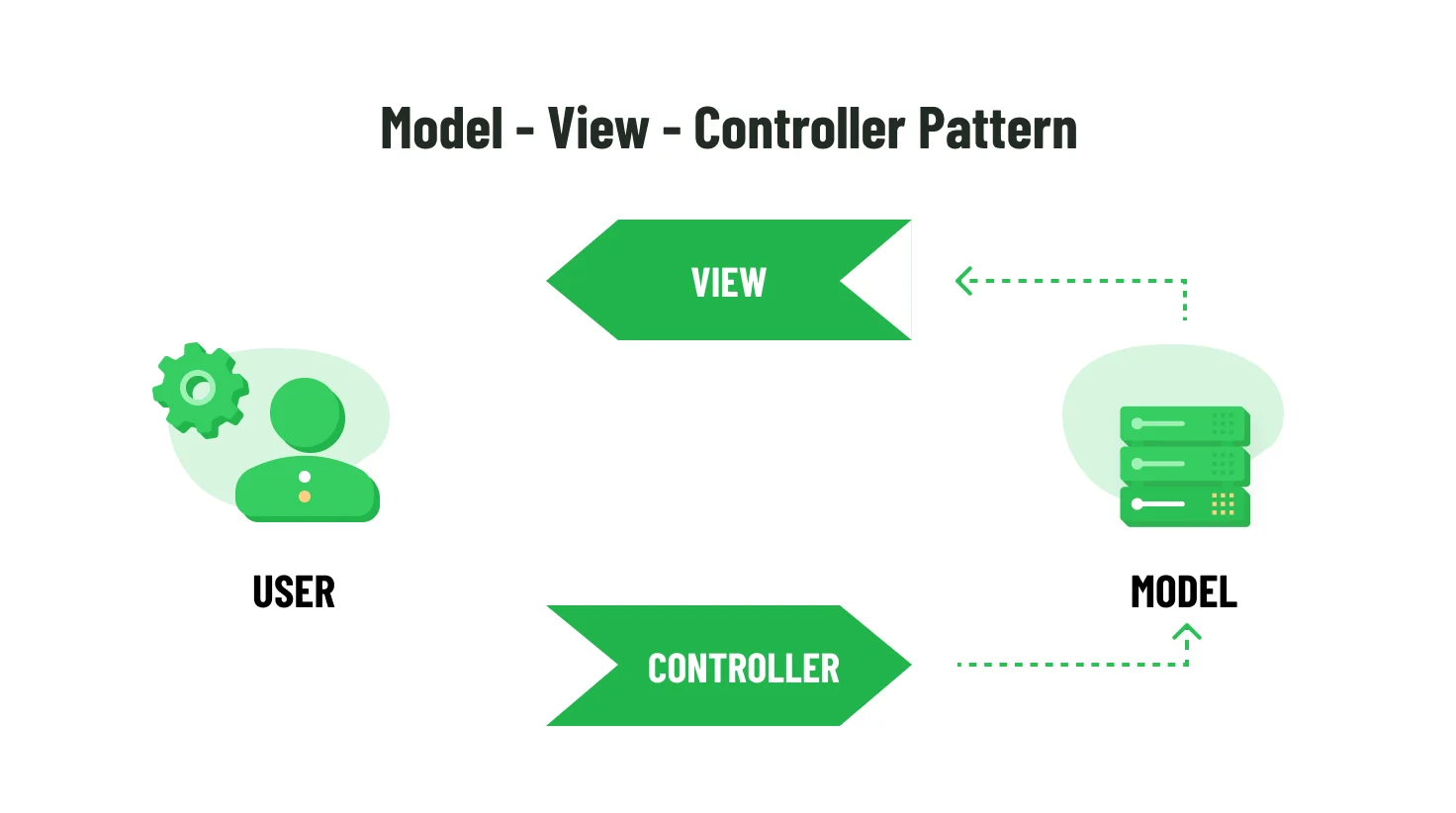
MVC breaks an application into three connected but independent components. This separation of concerns (SoC) clarifies ownership boundaries. It also helps teams predict the impact of changes, which keeps MVC stable as the project grows.
The diagram below summarizes responsibility boundaries across Model, View, and Controller, as well as the typical request-response interaction between them.
The following sections define each layer as an enforceable responsibility boundary and outline the constraints that prevent Controllers and Views from absorbing domain logic over time.
Model: the data and business logic engine
The Model encapsulates domain state and the rules that govern it. It handles data storage, retrieval, modification, and validation, and coordinates with the persistence layer, which includes databases, external APIs, and files. It also defines how data can be changed and maintains the application’s state.
In mature codebases, the Model is rarely limited to “ORM objects” alone. It is typically implemented as a domain layer with persistence adapters, for example, Eloquent ORM models in Laravel or Doctrine Entities and Repositories in Symfony, augmented by dedicated Service classes that implement business workflows and follow the service layer pattern. The Model remains agnostic about the View and Controller and surfaces outcomes through structured results and state-change notifications rather than markup.
View: the presentation layer
The View owns representation, not decisions. Its role is to render prepared data into a response contract, such as HTML for a browser or JSON/XML for an API consumer.
A View may include conditional presentation logic, but business logic is outside the scope of the View, as domain rules must remain consistent across all delivery channels. Operationally, the View layer is treated as an I/O-free layer. It does not execute database queries, call external services, or decide how domain entities transition between states. In Laravel, Views are commonly implemented with Blade templates, while Symfony typically uses Twig templates.
Controller: the orchestration boundary
The Controller is the entry point for user intent. It receives an HTTP request and validates request data. Then, it delegates execution to the Model or service layer, and selects the appropriate View to generate the response.
Well-designed Controllers remain thin. They manage request flow and coordination, rather than business outcomes, and centralized request-level concerns, such as validation and authorization, without embedding domain-specific rules. In PHP frameworks, this is typically implemented as Controller classes mapped to Routes, often as Resource Controllers in Laravel or via routing Attributes in Symfony.
With responsibilities defined by layer, the next step is to trace how a request moves through the Controller, Model/service layer, and View in a typical MVC lifecycle.
The Standard Request Flow in MVC Architecture
The sequence below remains consistent across most MVC-like frameworks, even when middleware, authorization, and caching are introduced. That consistency improves production traceability and makes the execution path easier to review, test, and operate.
- User input. A client initiates a request, for example, GET /products/5.
- Routing. The framework maps the URL and HTTP method to a Controller action.
- Request pipeline. Cross-cutting controls such as authentication, authorization, rate limiting, and logging are typically applied via middleware before the request reaches business logic.
- Controller. The Controller validates input and orchestrates the use case without embedding domain rules.
- Model/service layer. The Controller delegates to the Model or service layer to execute the required use case (for example, retrieving a product by identifier).
- Logic execution. The domain layer applies business rules, interacts with persistence, and returns a structured result.
- View selection. The Controller selects the View (or a serializer), and passes prepared data to it.
- Response. The View renders HTML or produces a structured payload, and the framework returns it to the client.
This flow is the practical reason MVC scales in enterprise environments: responsibilities remain explicit, and the impact of change can be assessed and tested at the appropriate layer.
The Unrivaled Advantages: Why MVC Is Mandatory for Enterprise Systems
Enterprise organizations rarely miss objectives because they cannot deliver functionality. They underperform when the cost of change loses predictability, and the delivery model becomes difficult to govern. This is particularly visible in modernization programs. According to the IDC Asia/Pacific IT and Business Services Sourcing survey, 77% of surveyed enterprises reported that application modernization is a “top” or “very high” priority, indicating a sustained focus on refactoring rather than isolated infrastructure work. CAST’s 2025 technical debt research estimates that paying off global technical debt would require 61 billion workdays of software development time, which makes unmanaged coupling a measurable business risk.
MVC can’t guarantee success. But it does reduce a major risk by making responsibility boundaries clear. The next sections highlight why MVC works at scale: strong separation of concerns (SoC), good testability for QA, and long-term maintainability through decoupling.
Rigid separation of concerns
SoC prevents presentation code from absorbing domain rules, thereby reducing unintended side effects during changes.
- Change containment. When UI logic and business outcomes are intertwined, even small updates produce non-obvious regressions.
- Parallel development. Back-end engineers can evolve the Model and service layer code while front-end teams iterate on the View, which supports time-to-market without compromising correctness.
- Code clarity. Clear boundaries eliminate practices such as embedding SQL queries directly within HTML templates.
Superior testability and quality assurance (QA)
MVC supports safer change because each layer can be validated at the appropriate level, thereby reducing brittle end-to-end coverage while maintaining clear accountability.
- Model isolation. Domain rules can be validated with unit tests without a web server, templates, or HTTP clients.
- Controller testing. Request handling and orchestration can be verified via functional tests that simulate HTTP requests.
- Independent QA. Since business logic is not embedded in the View, UI changes do not automatically force a full re-validation of financial, operational, or compliance logic.
Flexibility, maintainability, and reusability
Decoupling creates options because each concern has a stable home, even as requirements and integrations evolve.
- Decoupling for evolution. If you change the persistence technology, most changes are isolated to the Model and repository adapters, while Controllers and Views remain largely untouched.
- API readiness. The same Model and service layer can power both an HTML experience and a mobile client. For API endpoints, the View may be a serializer rather than a template, but the separation still holds.
- Operational extensibility. Caching, async processing, and integration adapters can be introduced without rewriting presentation logic.
These benefits depend on keeping layer boundaries intact. The usual failure is gradual: Controllers take on business logic, Models lose power as rules spread into glue code, and templates start to contain domain decisions. This creates inconsistent behavior across channels.
When these boundary violations are avoided, MVC delivers what enterprise teams require: governable change, testing aligned with architecture, and long-term evolution that remains financially defensible.
MVC in Modern PHP Frameworks
Modern PHP frameworks apply MVC as an operational baseline rather than a purely structural pattern. This approach is commonly described as MVC-plus or an MVC-like structure, where MVC is supported by a DI Container, standardized routing, middleware pipelines, and enforceable conventions for validation and authorization.
The table below maps the classic MVC components to typical implementation choices in Laravel and Symfony, highlighting the architectural emphasis that most teams formalize in their production codebases.
| Component | Laravel (Examples) | Symfony (Examples) |
Architectural note |
| Model | Eloquent ORM (Model classes) complemented by services that implement business workflows through a service layer approach. | Doctrine with Entities and Repositories, complemented by dedicated services managed by the DI Container. | Often aligns with Domain-Driven Design (DDD) when responsibility boundaries are explicit and consistently enforced. |
| View | Blade templating engine (files ending in .blade.php). | Twig templating engine (files ending in .html.twig). | Presentation-only layer. Business logic remains out of scope. |
| Controller | Controller classes such as ProductController and Resource Controllers mapped to routes. | Controller classes, commonly configured via routing Attributes. | Coordination layer that delegates execution to the Model and service layer. |
Across both ecosystems, the mechanics remain consistent even when conventions differ. Controllers delegate execution to services registered in the DI Container, repositories isolate persistence decisions, and Views remain a final rendering step. When these boundaries are enforced through code review and CI pipelines, MVC becomes a repeatable delivery model with predictable change impact and test scope.
Architecture and language go hand in hand. To see how different stacks impact MVC efficiency, check out our comparison of PHP vs. Python to find the best fit for your project’s goals.
Conclusion: MVC as the Enterprise Blueprint
The MVC architecture remains the undisputed standard as it addresses complexity by decomposing systems into manageable, independent parts with enforceable responsibility boundaries. Implemented through frameworks such as Laravel and Symfony, and strengthened by practices like the service layer and dependency injection, MVC maintains stable domain behavior while delivery channels evolve. The outcome is a PHP application that is structurally positioned to remain highly scalable, maintainable, and reliable over a long roadmap and a non-trivial risk profile.
Updated on Jun 9, 2026