Cost to Develop a Wealth Management Platform in the U.S. in 2026
Table of contents
- How Emerline can help
- Budget Comparison Matrix by Platform Type
- Development Phases and CAPEX Allocation
- The Wealth-AI Bridge: Investing in the Cognitive Backend
- The Maintenance Gap: Hidden Scaling Costs
- Legacy Debt Recovery: The Cost of Integrating with the Past
- Margin Compression Risks
- Hidden infrastructure: foundational platform work
- The sandwich effect: growth without margin
- Data indigestion: scaling fails at the data layer
- The AI enthusiasm trap: OpEx inflation without a payback model
- Competitive Edge: Capabilities That Win in the U.S. Market
- Rapid Answers for 2026 Budgeting Decisions
- Emerline’s Strategic Advice: Build Modular, Scale on Demand
- Stage 1: lean start
- Stage 2: AI integration and hyper-personalization
- Stage 3: scaling and tokenization
- Why this path is economically attractive
- Conclusion: 2026 Budget Checklist
Nowadays, a wealth management platform is no longer just a dashboard with static charts. It is evolving into the unified client brain: a governed operating layer that consolidates portfolio positions, client preferences, servicing history, suitability constraints, and entitlements into a single, auditable source of truth that both advisors and clients can rely on.
Client expectations continue to rise. Personalization is the baseline expectation, AI is moving from pilots into day-to-day servicing, and private markets are becoming a standard part of the allocation conversation, as highlighted in MSCI’s “Wealth Trends 2026” report. At the product level, this shifts effort from UI polish to data fidelity, access control, and workflow reliability.
Oliver Wyman’s 2026 wealth management outlook points in a similar direction, including the growing relevance of tokenized cash and broader digital-asset infrastructure. The budgeting challenge is that the cost curve is shaped primarily by integration surface area, data governance, and control design, not by UI complexity.
This article outlines typical development costs for U.S. wealth management platforms in 2026, from an MVP to an enterprise-scale solution, along with the specific technical drivers that shape total cost of ownership (TCO).
Key takeaways
- Integration surface area drives cost: budgets scale with custodian/aggregator connectivity, legacy remediation, and workflow orchestration more than with UI scope.
- Governed semantic layer: AI personalization depends on a unified, permissioned semantic layer with lineage and auditability to eliminate fragmentation.
- Generative AI (GenAI) requires controlled workflows: costs are concentrated in entitlements, audit trails, monitoring and evaluation, and human-in-the-loop controls, not in the chat interface.
- Compliance by design is non-negotiable: know your customer and anti-money-laundering (KYC/AML), recordkeeping, and evidence-ready controls must be built into workflows early, or they inflate cost later.
- TCO matters as much as build cost: cloud/API fees, inference spend, and regulatory reporting maintenance are first-order budget inputs post-launch.
How Emerline can help
Emerline supports wealthtech and fintech teams with end-to-end delivery of U.S.-market-ready wealth platforms, including product scoping, architecture, secure integrations, and compliance-oriented engineering as part of our fintech practice.
Budget Comparison Matrix by Platform Type
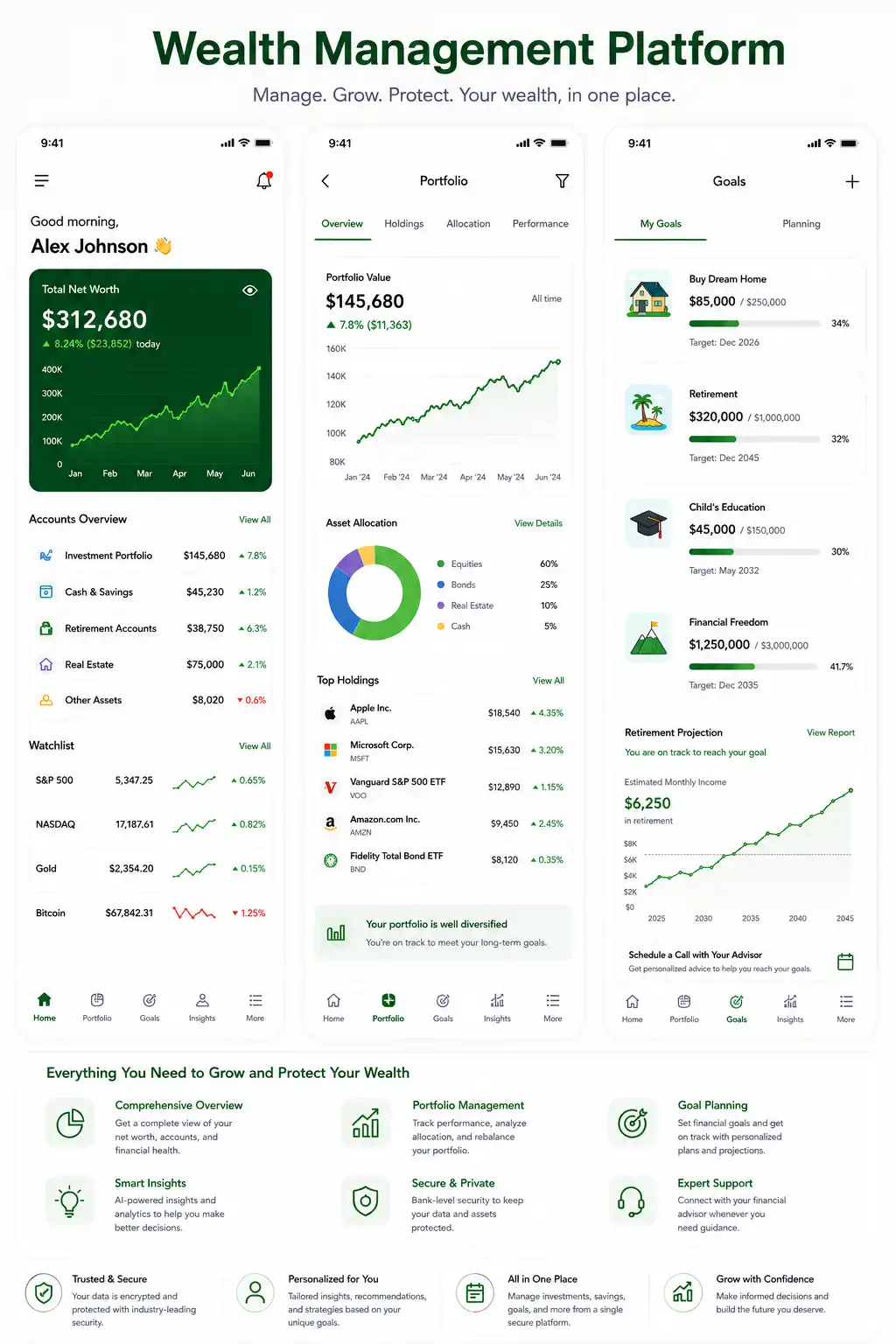
In the U.S. market, wealth management platform budgets typically fall into three delivery tiers. What drives the spread is not visual complexity, but the depth of integrations, analytics maturity, and compliance-grade controls embedded into the product.
| Platform type | Indicative budget (U.S. market) | Typical timeline | Primary focus |
| Basic MVP | $40,000–$100,000 | 3–4 months | Core portfolio view, authentication, and simple transaction flows |
| Mid-scale platform | $100,000–$300,000 | 4–8 months | Analytics, custodian integrations, and KYC/AML enablement |
| Enterprise solution | $300,000–$500,000+ | 9–18 months | AI agents, asset tokenization, and advanced compliance capabilities |
Budget increases are usually triggered by the transition from basic portfolio experiences to compliance-grade operations and third-party connectivity. Mid-scale scope is dominated by custodians and KYC/AML, whereas enterprise scope extends to AI-controlled decision layers, tokenization workflows, and audit-ready controls. The following sections explain the underlying cost drivers.
Development Phases and CAPEX Allocation
After the budget tiers, the next practical question is how that investment is typically distributed across delivery. For wealth platforms, cost is concentrated in the work that turns a product concept into a production-grade, regulated system, namely architecture decisions, core back-end implementation, and compliance setup. The breakdown below outlines the main CAPEX (capital expenditure) phases and the cost ranges most companies should plan for when building for the U.S. market today.
- Initial discovery and planning. Teams usually allocate 10 to 15% of the budget to discovery and planning. The goal is to lock in scope, confirm architectural direction, and remove uncertainty before engineering scales. This is also the point where integration sequencing is defined to avoid late-stage surprises that expand effort.
- UI/UX design. Investment here typically falls in the $15,000 to $50,000+ range. The work centers on analytics-led experiences that feel credible and easy to operate. It covers dashboard interaction patterns, workflow clarity, and personalization logic aligned across client, advisor, and operations roles.
- Core back-end development. This is usually the primary cost center, accounting for up to 65% of the total budget, with a common baseline of $50,000 to $100,000+. The backend carries the operational burden of the platform, including secure data services, permissions, integration-heavy execution, and reliability foundations. As the integration surface grows and workflows become more regulated, back-end scope expands accordingly.
- Regulatory and legal setup. Budgets for U.S.-market readiness often start from $50,000 upfront. Compliance must be operationalized, not documented, so this stream typically includes audit trails, control evidence foundations, and the legal groundwork required to support regulated execution. It also sets expectations for how the platform will prove compliance over time.
In most builds, the estimate increases once regulated workflows and audit-grade controls are treated as product requirements from day one. Those requirements expand scope early, so the most accurate estimates start with integration mapping and a compliance-first architecture.
The Wealth-AI Bridge: Investing in the Cognitive Backend
In advanced builds, AI-related scope can account for 30% to 40% of wealth platform development cost, as intelligence must be engineered into governed workflows rather than added as a UI feature. Below are three practical investment levels teams typically use to scope the cognitive layer.
- The navigator. Budgeting typically starts at $20,000–$40,000 when the goal is to embed large language model (LLM) capabilities for tasks such as summarizing market research and personalizing outbound communications. This tier is best suited for insight consumption and content augmentation, with human decision-making kept firmly in the loop.
- The analyst. A typical range of $50,000 to $90,000 supports predictive models that inform portfolio rebalancing based on macroeconomic signals and historical patterns. Here, the value comes from decision support that is measurable, repeatable, and integrated into portfolio workflows.
- The autopilot. Starting at $150,000+, this tier covers fully autonomous AI agents that can execute trades within predefined risk profiles. The cost reflects the guardrails, monitoring, and control evidence required for compliant and operationally safe autonomy.
A useful scoping lens is the level of agency granted to AI, from insight augmentation to decision support and ultimately execution. With greater agency, budgets are increasingly driven by governance and operational controls, not by the model layer, influencing both initial build cost and long-term TCO.
The Maintenance Gap: Hidden Scaling Costs
Initial estimates often capture build effort well, yet still miss the costs that appear once the platform runs continuously at scale. The maintenance gap describes recurring expenses that grow with integration depth, AI consumption, and ongoing compliance obligations, and that can materially influence TCO.
- Data egress and API fees. When portfolio and account data is refreshed at higher frequency, egress and aggregator usage move from incidental charges to a steady operating line item. For Plaid and Yodlee-style integrations, costs often start from $1,000 per month and grow with the number of connected institutions and the volume of refresh operations.
- AI inference costs. AI spend does not end at implementation. Ongoing inference introduces variable cost through token consumption or GPU-hours, and it tends to increase with higher request volumes, longer context windows, and more granular personalization.
- Regulatory reporting automation. Automated reporting for SEC and FINRA requires maintenance to remain aligned with current expectations. Annual updates to reporting software and workflows are commonly budgeted at $10,000–$20,000 per year.
The most reliable budgeting approach is to treat these as first-order TCO inputs from the start. When early cost monitoring is in place, teams can manage integration frequency, AI consumption, and reporting automation with far fewer surprises.
Legacy Debt Recovery: The Cost of Integrating with the Past
For established firms, especially registered investment advisers (RIAs), a major budget driver is not new feature development but legacy debt recovery. The core challenge is taming fragmented historical data and connecting modern digital experiences to systems that were never designed for today’s integration and security expectations.
- Data cleaning and normalization. When data lives in multiple formats and storage systems, the platform cannot rely on it without normalization. Budgeting $15,000 to $40,000 is typical for consolidating sources such as Excel files and older SQL servers into consistent, reusable datasets that support automation and analytics.
- Middleware development. Modern frontends rarely integrate cleanly with legacy cores without a translation layer. Building middleware to mediate between data models, orchestrate workflows, and avoid brittle point-to-point dependencies commonly starts from $30,000, with scope increasing as the number of legacy interfaces grows.
- API standardization. Standardizing data feeds to meet FAPI (financial-grade API) security profiles is commonly budgeted at $10,000 to $25,000. This work reduces integration risk by enforcing consistent authorization, token handling, and security controls across the ecosystem.
When legacy remediation is planned upfront, it improves estimate accuracy and prevents integration work from silently consuming the budget later in the program.
Margin Compression Risks
In the U.S. wealthtech market, margin rarely disappears because teams misprice a feature list. It declines in predictable cost traps that compound across delivery, operations, and compliance. The patterns below are the most common budget leak zones that can turn a viable roadmap into a long-running capital sink.
Hidden infrastructure: foundational platform work
Problem. Founders and product teams optimize for visible functionality, while the majority of engineering time is absorbed by foundational capabilities such as security controls, entitlement models, audit logging, integration plumbing, data quality, environments, and deployment automation. This aligns with DevEx research indicating that developers lose significant time to non-coding work due to organizational inefficiencies.
Financial risk. Every additional quarter spent building undifferentiated infrastructure delays learning, slows market capture, and increases the probability that a competitor accumulates distribution and data advantages first.
Emerline recommendation. Use certified modules, proven white-label components, and reference architectures for baseline capabilities wherever differentiation is low, then reserve custom engineering for domain-specific workflows, data intelligence, and experience layers that actually change outcomes.
The sandwich effect: growth without margin
Problem. Currently, revenue growth does not automatically translate into profit growth. Delivery and run costs can rise faster than the customer base due to higher specialized labor costs, deeper compliance scope, and stricter operational expectations, reinforced by ongoing supervisory pressure, as reflected in the SEC’s published 2026 examination priorities.
Financial risk. If the organization absorbs higher operating costs without adjusting pricing, packaging, or service levels, gross margin compresses and cash flow becomes structurally constrained.
Emerline recommendation. Establish cost-to-serve (CTS) analytics early, map platform consumption to unit-economics KPIs, and reframe service tiers around true delivery cost. This helps teams surface structurally unprofitable segments and eliminate loss-making patterns before they harden into scale-time margin drag.
Data indigestion: scaling fails at the data layer
Problem. Fragmented data and a growing integration surface area limit scalability. If aggregation still runs through manual reconciliation or spreadsheet-centric processes, teams regularly consume dozens of expert hours per month on data correction and validation, leaving the intelligence layer unstable.
Financial risk. Manual processing cost, delayed reporting, and data-quality defects degrade investor confidence, slow decision-making, and create downstream rework in analytics, compliance evidence, and client communications.
Emerline recommendation. Move to automated API-based aggregation and cloud platformization, enforce data contracts, and build a governed semantic layer that becomes the single interface for portfolio, client, and operational context.
The AI enthusiasm trap: OpEx inflation without a payback model
Problem. AI adoption can improve productivity, but it also introduces cost surfaces that scale aggressively, including inference spend, monitoring, evaluation, model governance, and control evidence. At the macro level, AI infrastructure investment is projected to exceed $500 billion in 2026, shaping pricing and capacity dynamics across the ecosystem.
Financial risk. Organizations fund experimentation without a defensible operating model, then inherit recurring AI costs that outpace the value delivered. In regulated contexts, unmanaged AI also increases supervisory and recordkeeping exposure.
Emerline recommendation. Embed AI into governed workflows with explicit entitlements, logging, and measurable outcomes. Prioritize use cases that eliminate expensive manual operations, such as compliance support and reporting workflows, rather than feature-first experimentation.
Competitive Edge: Capabilities That Win in the U.S. Market
Today, defensible advantage in U.S. wealthtech is created less by feature breadth and more by how efficiently the platform can onboard, operate, and evolve under cost and regulatory pressure. The strongest roadmaps focus on three capability clusters that compound over time.
- Cloud-agnostic architecture. Cloud-agnostic does not mean multi-cloud complexity by default. It means standardizing on Kubernetes and portable infrastructure practices, so the platform can migrate between AWS and Azure when unit economics justify it. Over time, this can materially reduce TCO: FinOps programs commonly target 10–20% savings when waste is actively controlled, with higher outcomes in some organizations.
- Instant onboarding. In wealth, onboarding is a conversion funnel and a compliance workflow at the same time. Pairing biometrics (with liveness checks) and OCR-based document capture can reduce onboarding from days to minutes for low-risk customers. [verify] In one Emerline engagement, this cut account-opening time from three weeks to under five days and reduced NIGO-driven rejections from 30% to under 3% (case study). The impact is typically measured in funded-account conversion and reduced operational load, with outcomes driven by risk policy, exception rates, and how much of KYC is automated versus routed to manual review.
- Fractional assets and social investing. Gen Z expects fractional access and community context, which shifts “fractional” and “social” from UI features into investment primitives with suitability guardrails, supervision, and audit-ready records. The operational angle matters because FINRA fractional share reporting enhancements are scheduled to take effect on Feb. 23, 2026, raising the bar on precision and downstream reporting consistency.
Together, these capability clusters demand stronger upfront engineering discipline, but they reduce long-run operating cost and compliance overhead, which are two of the largest contributors to wealth platform TCO in the U.S.
Rapid Answers for 2026 Budgeting Decisions
Prior to a build commitment, teams require decision-grade signals: what is reusable, what must be engineered, and which areas drive spend. The estimates below represent indicative planning baselines for U.S. wealth platforms, shaped by common regulated delivery patterns; actual cost varies with integrations, compliance scope, and nonfunctional demands, including security, performance and auditability.
- Can low-code (for example, Microsoft Power Platform) reduce development cost?
For internal operations and back-office workflows, including case handling, approvals, internal portals and automation, yes. In these domains, low-code can reduce delivery effort for the relevant modules by up to about 40%, primarily by accelerating user interface and workflow assembly under controlled governance.
For U.S. client-facing wealth applications in 2026, low-code is rarely a fit: differentiation depends on a highly tuned user experience, while security expectations often require deeper customization of authorization, session controls and identity integrations. As a result, custom engineering is the default for external channels.
- How much of the budget does compliance actually consume?
A pragmatic planning range is 15% to 25% of the build budget once you account for legal readiness and technical controls such as know your customer and anti-money-laundering (KYC/AML) workflows, Service Organization Control 2 (SOC 2)-aligned control design, entitlements and audit logging.
Resilience expectations add cost as well: evidence-ready testing and operational preparedness are increasingly treated as first-class requirements, which can translate into up to $30,000 in additional spend for resilience-focused assessments and remediation when scope expands.
- In 2026, what is more efficient — an in-house U.S. team or an outsourcing model?
Fully loaded U.S. delivery remains expensive, particularly once you factor in taxes, benefits, and retention overhead. For planning purposes, one engineer can land in the $150,000 to $250,000 a year range, depending on seniority and total-compensation structure.
A partner-led delivery model, often via established Eastern European teams, can reduce engineering spend by about 2.5 to 3 times, frequently reflected in blended rates of $40 to $80 an hour versus $120 to $220 an hour in the U.S., while preserving tier-1 architecture quality when engineering standards and delivery governance are enforced.
- What operating expenses (OpEx) should we plan for after launch?
Budget 15% to 20% of the original build cost per year for maintenance and evolution: support, security patches, dependency upgrades, compliance-led change and reliability work. Monthly cloud spend is commonly $500 to $10,000 or more, driven by availability requirements, traffic patterns, data retention, observability footprint and integration throughput, not just assets under management (AUM).
- How does AI change monthly platform costs?
Nowadays, an “AI tax” often becomes a visible line item in OpEx. With active agentic usage, inference, including tokens or GPU-hours, plus evaluation, monitoring, and human review can add $5,000 to $15,000 per month, driven by volume, context length and routing decisions. To manage spend, implement an LLM gateway to select the most economical model that satisfies a defined quality threshold, and apply guardrails that prevent runaway prompts and excessive context.
Emerline’s Strategic Advice: Build Modular, Scale on Demand
Emerline’s recommendation is to avoid building the entire platform in a single release on top of a monolithic architecture. In 2026, a modular, cloud-agnostic architecture is the more resilient option since it allows you to stage investment, keep the roadmap adaptable, and respond quickly when market requirements shift.
Stage 1: lean start
Budget baseline: $80,000 to $120,000.
Focus: Establish a reliable core engine and baseline analytics first. These components become the execution layer for portfolio logic and the measurement layer for early product performance.
Goal: Launch an MVP that validates the value proposition and supports onboarding the first assets under management with a product that can operate credibly in production conditions.
Technology stack: Containerize early with Kubernetes, ensuring the platform can run across AWS, Azure, and GCP. This reduces vendor lock-in and preserves architectural flexibility as your security and compliance profile matures.
Stage 2: AI integration and hyper-personalization
Focus: Introduce AI agents and predictive analytics once you have enough data volume and behavioral signals to justify automation and measure impact.
Investment baseline: $20,000 to $90,000 for navigator- or analyst-level AI modules, depending on how much decision support and workflow automation you want to operationalize.
Value: Retention tends to improve when the platform can deliver deeper, differentiated insights that older systems do not consistently surface.
Stage 3: scaling and tokenization
Focus: Expand the product surface by adding modules for alternative and tokenized assets, including real-world assets (RWA) without destabilizing the core.
Optimization: Implement FinOps practices to manage cost discipline at scale, including carbon footprint considerations and real-time optimization of AI inference spend as usage grows.
Result: This is the point where a narrowly positioned product can mature into a full-scale wealth management ecosystem built for enterprise-grade extensibility and governance.
Why this path is economically attractive
- Lower total cost of ownership: You invest in the modules and capacity that generate value now, rather than funding functionality and infrastructure before they have a revenue case.
- Technology flexibility: You can keep a stable backend on AWS and use GCP selectively for AI-heavy analytics, then route workloads to the environment that is more cost-effective for that workload profile.
- Security and compliance: Controls can scale in step with platform complexity, allowing you to introduce security information and event management (SIEM) and tools such as Microsoft Sentinel as regulatory expectations and operational risk increase.
Conclusion: 2026 Budget Checklist
If you need a clear starting point for 2026 planning, align scope to the maturity level you intend to deliver and operate. The tiers below summarize typical budget ranges for U.S. wealth management platforms. They are planning baselines, not a fixed quote, and they should be adjusted for your integration landscape, compliance perimeter and the nonfunctional requirements that define production readiness.
- Minimum entry point, informational MVP: $30,000 to $50,000.
This tier is designed for validation. It usually covers a small number of core journeys, a controlled data presentation layer, and a foundation that supports iteration without structural rework. The emphasis is clarity and speed, with enough engineering discipline to avoid turning early delivery into throwaway work.
- Standard platform for registered investment advisers and small to midsize firms: $100,000 to $200,000.
At this level, the platform becomes operational. It typically includes production workflows, stable integrations, and the operational capabilities required to run reliably, such as monitoring, hardened access control, and audit-ready logging. This tier is also where governance matters more than it did in an MVP, as release management and change control become recurring needs.
- Full-scale ecosystem with AI capabilities: $350,000 and up.
This is the right tier when advanced analytics, personalization, and AI-driven automation are part of the primary value proposition. Budgets here reflect broader modular coverage and the additional engineering required for evaluation, monitoring, and cost governance. The operating model needs to be mature enough to keep outcomes consistent as volume, data complexity, and regulatory expectations increase.
Disclaimer: The information provided in this article is for informational and educational purposes only. It does not constitute financial, legal, or investment advice. Development costs and timelines are estimates based on market trends as of 2026 and may vary depending on specific project requirements, geographic location, and technological complexity. Emerline recommends consulting with specialized legal and compliance experts regarding SEC, FINRA, and state-level regulations prior to platform deployment.
Updated on May 31, 2026