EdTech Trends 2026–2030: A Roadmap for Digital Transformation
Table of contents
Key Metrics for EdTech Product Owners
- Growth Dynamics: The Global EdTech Landscape
- Market Valuation & Velocity
- Key EdTech Market Projections
Regional Pressures & Regulatory Mandates
- North America: The Hub of AI-Driven Infrastructure
Asia-Pacific: The Mobile-First Growth Engine
Europe: Ethical AI and Trust-as-a-Service
- Performance & Impact: The "Outcome" Economy
Hard Metrics
The Foundation: Standardizing the Adaptability Stack
- 2026: The Transformation Peak and the Era of "Agentic AI"
- 1. The Shift to Agentic AI (Multi-Agent Swarms)
- 2. Predictive Analytics & Retention
- 3. Economic Pivot: From Content Libraries to the "Outcome" Economy
- 4. Immersive XR Standards & Biometric Competency
- Legacy EdTech vs. Modern EdTech (2026+)
Redefining the Human Element & Key Bottlenecks- А. Redefining the Teacher's Role: From "Source" to "Mentor"
- B. Ethical Frameworks & "Black Box" Accountability
- C. Neuroeducation: The Bridge to 2030
- D. Sustainable EdTech: The Rise of "Green Learning"
- 2027–2030 Horizon: Knowledge Ecosystems
- 2027–2028: Cognitive Analytics & The Neuroeducation Breakthrough
- 2029: The Skill-Centric Labor Market & "Just-in-Time" Hiring
- 2030: Lifelong Learning Nodes & The Neuro-Interface Standard
- Challenges for EdTech 2026–2030
- 1. Cognitive Dependency: Protecting Human Agency
- 2. AI Ethics: Solving the "Black Box" Crisis
- 3. The Digital Divide: Closing the Infrastructure Gap
- 4. Cultural Resistance: The Teacher-in-the-Loop Model
- 5. Data Security: Protecting the "Digital Silhouette"
- Table: EdTech Risks vs. Strategic Solutions (2026–2030)
Frequently Asked Questions
1. What is the core difference between Generative AI and Agentic AI in EdTech?
2. How do modern EdTech platforms control soaring AI compute costs?
3. What are xAPI and LRS, and why are they mandatory for 2026 platforms?
4. How does Agentic AI empower teachers instead of replacing them?
5. What does the EU AI Act require from educational software developers?
- Strategic Summary
The world of education is shifting from a "one-size-fits-all" content model to a framework of intelligent accompaniment. In 2026, experimental AI tools evolved from a "nice-to-have" feature into a mandatory baseline for any educational platform.
This evolution isn't just about adding new gadgets; it’s a fundamental change in how we capture and support the learner's journey. To thrive in the 2026–2030 era, organizations must build their educational technology solutions at the intersection of parallel realities: rigid regional data compliance and mobile-first user adoption.
Key Metrics for EdTech Product Owners
- From Content to Outcomes: Platform value is no longer measured by the size of a video library, but by the speed and accuracy of skill acquisition (Skills Intelligence).
- Compliance as a Feature: Under strict frameworks like the EU AI Act and U.S. executive orders, AI systems must provide complete audit transparency (Explainable AI).
- Data Interoperability: Autonomous AI agents are only as smart as the data they ingest. Transitioning to xAPI standards and Learning Record Stores (LRS) is now the market baseline.
Growth Dynamics: The Global EdTech Landscape
The global EdTech and Smart Classroom market has entered a phase of structural transformation. Digital infrastructure is no longer an alternative; it is the core of the $10 trillion global education economy.
Market Valuation & Velocity
The financial landscape of EdTech is defined by a heavy shift toward cloud ecosystem models and high-value AI integrations:
- Market Size: According to Fortune Business Insights, the global EdTech market is projected to reach $380 billion in 2026, on a trajectory to exceed $600 billion by 2032 (CAGR of 13–17%).
- E-Learning Segment: The global e-learning segment alone has reached $260 billion and is poised to hit $480 billion by 2033.
- Cloud Infrastructure: The cloud segment holds 57% of the total EdTech market share as institutions rapidly abandon legacy, on-premise servers.
- AI Velocity: According to Mordor Intelligence, AI in education is projected to skyrocket from $6.3 billion to over $35 billion by 2030, reflecting a CAGR of over 40% in this specific sub-sector.
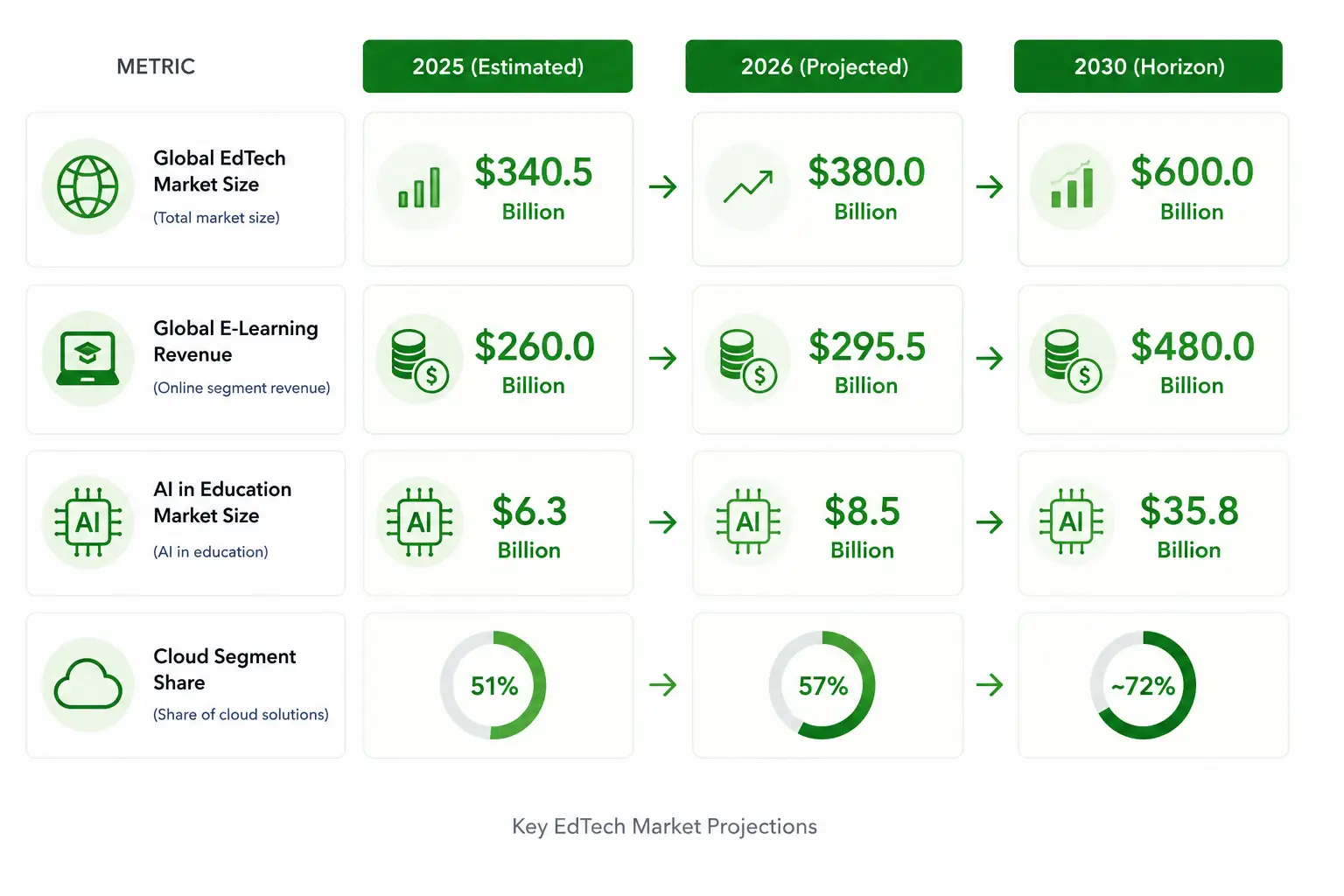
Key EdTech Market Projections
| Metric | 2025 (Estimated) | 2026 (Projected) | 2030 (Horizon) |
| Global EdTech Market Size | ~$340.5 Billion | ~$380 Billion | $600 Billion+ |
| Global E-Learning Revenue | $260 Billion | $295.5 Billion | $480 Billion |
| AI in Education Market Size | $6.3 Billion | $8.5 Billion | $35.8 Billion |
| Cloud Segment Share | 51% | 57% | ~72% |
Regional Pressures & Regulatory Mandates
While digital transformation is global, specific regions are driving the majority of the market's value and innovation in 2026.
- North America: Remains the largest market with a 36% global share in 2026. Growth here is driven by the rapid adoption of AI tutors and federal mandates for "responsible AI integration." (Coherent Market Insights, MarketsandMarkets)
- Asia-Pacific: The fastest-growing region with a projected 28% share in 2026. India and Southeast Asia are leading this charge, fueled by mobile-first learning initiatives and massive government investments in digital textbooks (Fortune Business Insights).
- Europe: A mature and stable market, estimated at over €111 billion in 2025, with a focus on ethical AI codes and student data sovereignty as competitive advantages.
North America: The Hub of AI-Driven Infrastructure
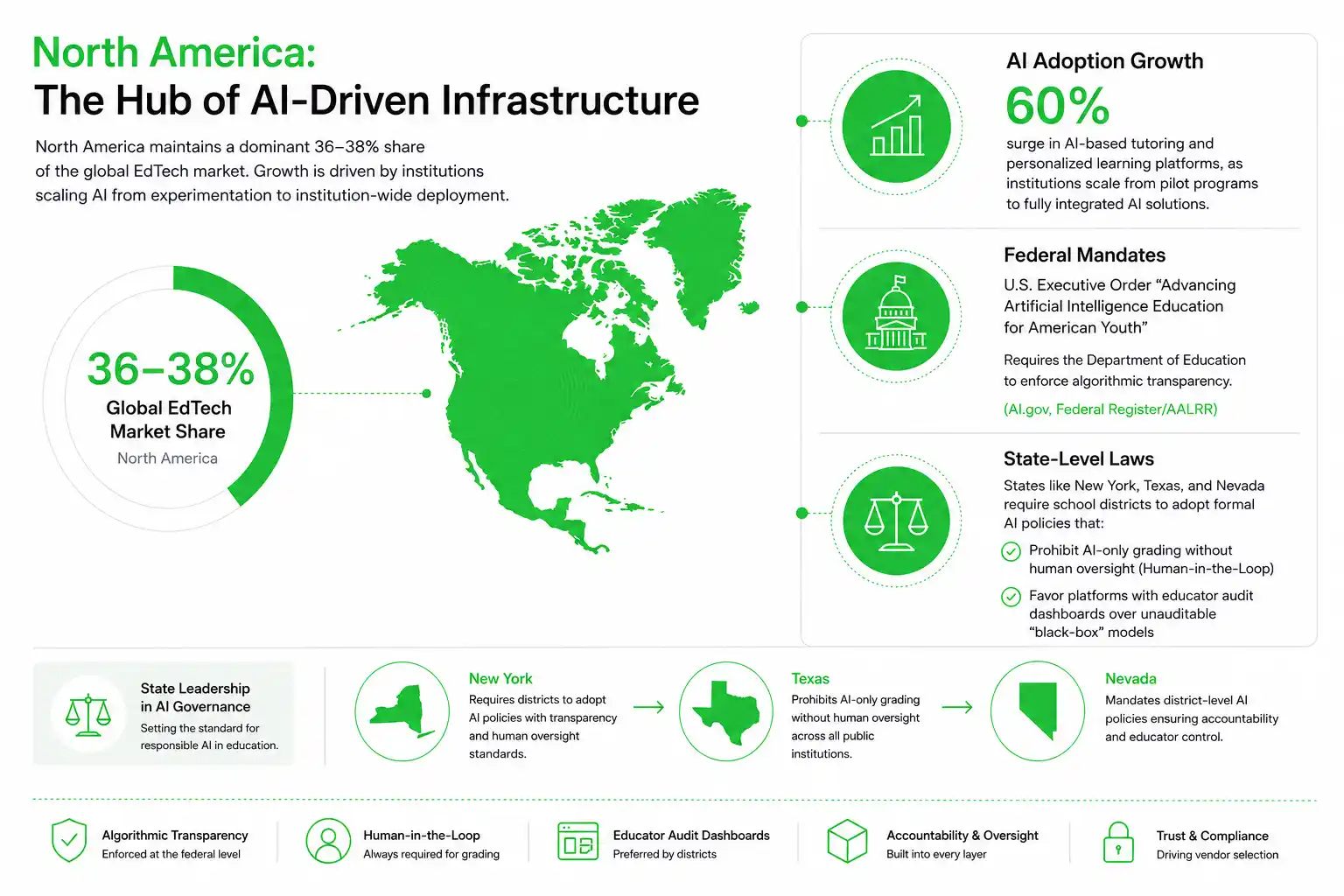
North America continues to command a 36–38% global share of the EdTech market. Growth here is propelled by institutions transitioning from pilot projects to core AI tutoring infrastructure.
- AI Adoption Growth: The regional growth is propelled by a 60% surge in AI-based tutoring and personalized learning platforms, as institutions transition from pilot programs to core AI infrastructure.
- Federal Mandates: A pivotal driver is the U.S. Executive Order “Advancing Artificial Intelligence Education for American Youth”, which requires the Department of Education to enforce algorithmic transparency (AI.gov, Federal Register/AALRR).
- State-Level Laws: States like New York, Texas, and Nevada require school districts to adopt formal AI policies that explicitly prohibit AI-only grading without human oversight (Human-in-the-Loop). Software vendors using un-auditable "black-box" models are losing ground to platforms offering robust educator audit dashboards (Center for Democracy & Technology).
Success in the North American market in 2026 depends on Compliance-as-a-Feature. It is no longer enough for an AI tutor to be effective; it must demonstrate adherence to federal Responsible AI frameworks. Companies that integrate "Transparency Dashboards" for educators, allowing them to audit AI decisions, are outperforming those with "black-box" models.
Asia-Pacific: The Mobile-First Growth Engine
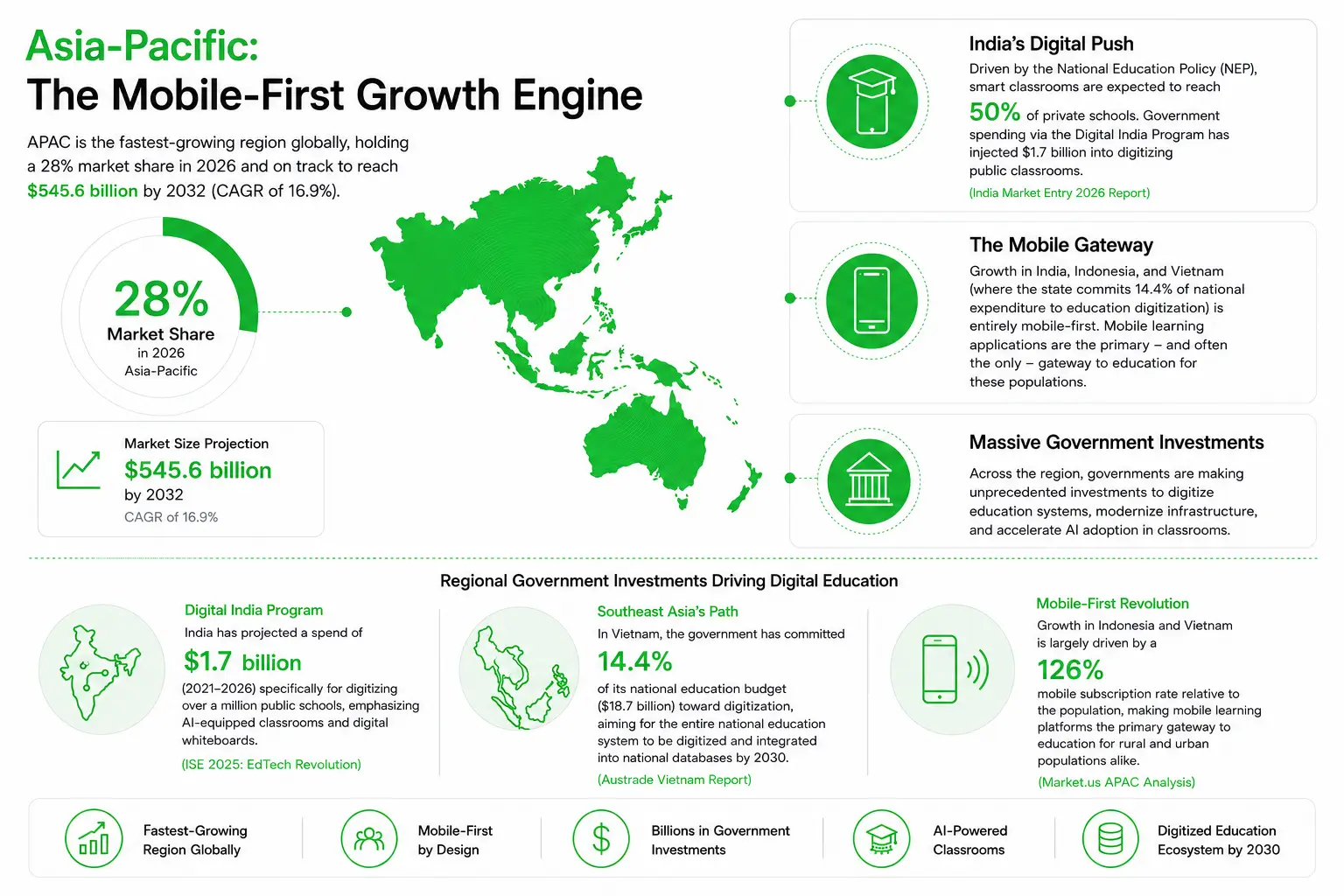
APAC is the fastest-growing region globally, holding a 28% market share in 2026 and on track to reach $545,6 billion by 2032 (CAGR of 16.9%).
- India’s Digital Push: Driven by the National Education Policy (NEP), smart classrooms are expected to reach 50% of private schools. Government spending via the Digital India Program has injected $1.7 billion into digitizing public classrooms. (India Market Entry 2026 Report).
- The Mobile Gateway: Growth in India, Indonesia, and Vietnam (where the state commits 14.4% of national expenditure to education digitization) is entirely mobile-first. Mobile learning applications are the primary - and often only - gateway to education for these populations.
Massive Government Investments:
- Digital India Program: India has projected a spend of $1.7 billion (2021–2026) specifically for digitizing over a million public schools, emphasizing AI-equipped classrooms and digital whiteboards (ISE 2025: EdTech Revolution).
- Southeast Asia’s Path: In Vietnam, the government has committed 14.4% of national expenditure ($18.7 billion) to education, aiming for the entire national education system to be digitized and integrated into national databases by 2030 (Austrade Vietnam Report).
- Mobile-First Revolution: Growth in Indonesia, Vietnam, and India is largely driven by a 126% mobile subscription rate relative to the population, making mobile learning platforms the primary gateway to education for rural and urban populations alike (Market.us APAC Analysis).
In 2026, the APAC market is no longer just "emerging" - it is the first-launch market for global innovators. Success here requires a "Phygital" strategy (Physical + Digital), where affordable mobile solutions bridge the gap between rural classrooms and high-end AI-driven content.
Europe: Ethical AI and Trust-as-a-Service
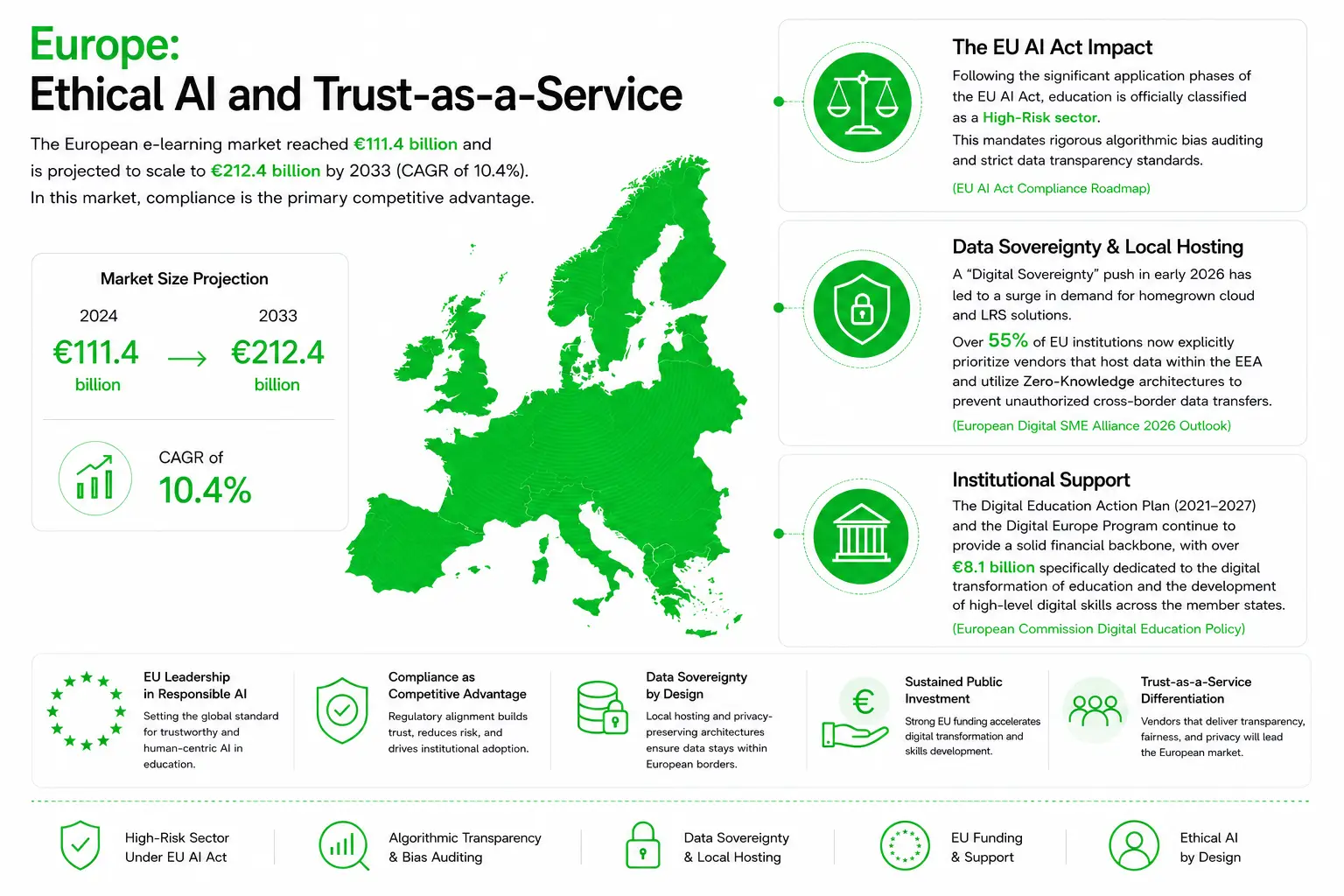
The European e-learning market reached €111.4 billion and is projected to scale to €212.4 billion by 2033 (CAGR of 10.4%). In this market, compliance is the primary competitive advantage.
- The EU AI Act Impact: Following the significant application phases of the EU AI Act (opens in a new tab), education is officially classified as a High-Risk sector. This mandates rigorous algorithmic bias auditing and strict data transparency standards (EU AI Act Compliance Roadmap).
- Data Sovereignty & Local Hosting: A "Digital Sovereignty" push in early 2026 has led to a surge in demand for homegrown cloud and LRS solutions. Over 55% of EU institutions now explicitly prioritize vendors that host data within the EEA and utilize Zero-Knowledge architectures to prevent unauthorized cross-border data transfers (European DIGITAL SME Alliance 2026 Outlook).
- Institutional Support: The Digital Education Action Plan (2021-2027) and the Digital Europe Program continue to provide a solid financial backbone, with over €8.1 billion specifically dedicated to the digital transformation of education and the development of high-level digital skills across the member states (European Commission Digital Education Policy).
In 2026, the European market is not just buying "software"; it is buying "Trust-as-a-Service." For companies looking to enter or scale within Europe, demonstrating adherence to Sovereign Cloud standards and Algorithm Transparency are the most effective sales arguments for winning government and enterprise contracts.
Performance & Impact: The "Outcome" Economy
In 2026, market value has permanently shifted from passive content libraries to measurable outcomes. Educational platforms are no longer judged by the size of their database, but by their processing efficiency. For developers and investors, the highest ROI is found in Adaptive Architecture - modular systems that evolve without disrupting institutional governance.
Hard Metrics
- Completion & Mastery: AI-powered personalization has officially boosted course completion rates by 70%, far outperforming traditional methods. This is driven by adaptive learning paths that reduce cognitive friction and keep students in the "Flow State".
- Academic Achievement: University-level exam scores have risen by an average of 10–15% in programs utilizing adaptive AI tutors and intelligent assessment tools.
- The Retention Dividend: Predictive analytics identify at-risk students 3 to 4 weeks before they drop out. This proactive safety net has successfully reduced student churn by 15%, protecting millions in tuition revenue for university administrations and corporate training centers.
- Operational Efficiency: Automating administrative tasks (grading, attendance tracking, and lesson deployment) has reduced teacher workloads by nearly 40%. In the U.S. alone, this saves educators up to 3 million hours per week, allowing them to redirect energy toward high-impact mentorship.
The 2026 market data sends a clear signal: the era of "digitizing textbooks" is over. We have entered the era of Skills Intelligence. For developers and investors, the highest ROI is now found in Adaptive Architecture - modular systems that can evolve with new technologies without disrupting academic integrity or institutional governance.
The Foundation: Standardizing the Adaptability Stack
To understand the transformation peak of 2026, we must look at how the technological baseline stabilized over the preceding months. The industry has moved past the "hype" phase of Generative AI, successfully integrating it as a standardized layer across legacy ecosystems.
- Mass Classroom Adoption: Approximately 60% of educators across the U.S. and Europe utilize AI as a daily co-pilot, shifting from basic lesson generation to real-time, rubric-based automated grading.
- The Voice Revolution: High-quality AI language tutors capable of fluid, natural dialogue with near-zero latency have bridged the gap between learning a language and living it, providing 24/7 contextual conversation partners.
- Deep Hybridization of Learning Spaces: The barrier between live interaction and independent study has vanished. Modern formats seamlessly blend live streaming sessions with synchronous collaboration inside cloud-based AI editors, where students and AI co-create projects in real time.
The true breakthrough here isn't the standalone AI engines, but the strict interoperability of these tools. When building modern EdTech products, your development team must focus on creating unified data environments. The AI tutor, the video delivery framework, and the cloud-native editor must communicate seamlessly. This creates a friction-free, compliant digital trail of student progress that makes proactive, agentic interventions possible.
2026: The Transformation Peak and the Era of "Agentic AI"
Educational technology has permanently evolved from a passive directory of isolated digital tools into an active, contextual learning partner. Software no longer sits idle, relying entirely on explicit user prompts; it proactively interprets a student’s cognitive friction and behavioral patterns in real time. This marks the definitive transition from software you simply operate to an intelligent partner that accompanies you throughout your learning lifecycle.
1. The Shift to Agentic AI (Multi-Agent Swarms)
The defining structural breakthrough of 2026 is the rapid obsolescence of static, single-prompt chatbots in favor of fully autonomous Agentic AI. While first-generation generative tools were strictly reactive, modern educational software possesses true educational agency. It operates without continuous human supervision, executing complex, multi-step workflows to guide learners toward objective skill acquisition.
- How it works (Adaptive Middleware): This layer acts as the orchestrator of the educational ecosystem. Positioned securely between raw educational assets and the frontend client interface, it reads high-frequency interaction data via xAPI data pipelines. It continuously monitors microscopic behavioral signals - such as reading velocity variations, quiz option hesitation, multi-step formula failures, or erratic system navigation.
- The Multi-Agent Swarm Framework: Rather than overloading a single, massive foundational LLM with raw prompts, modern EdTech backends split tasks across lightweight, specialized agent swarms. An Assessment Agent continuously evaluates concept retention, a Pedagogical Agent alters content delivery style on the fly, and a Triage Agent flags immediate alerts for human intervention.
- Real-World Application: Instead of triggering a generic "Incorrect Answer" screen when a student struggles with an engineering math formula, the system analyzes the exact point of friction: "I noticed you have spent over four minutes reviewing the thermodynamic variable and have failed the quiz matrix twice. Let's step back from the theoretical text. Instead, let's solve an interactive sandbox simulation based on your recorded professional preference - renewable energy systems - to clarify the underlying variable balance."
- The Product Impact: By actively eliminating the "frustration wall" that historically causes users to abandon digital courses, this proactive personalization has been empirically proven to increase user engagement rates by up to 60%.
2. Predictive Analytics & Retention
For universities, enterprise corporate training networks, and subscription-based EdTech platforms, student churn represents the single greatest threat to financial sustainability and customer lifetime value (LTV). In 2026, user metrics have evolved from historical reporting into a predictive safety net.
- Early Warning Systems: By passing high-frequency interaction telemetry - such as keyboard input delays, shifts in systemic login rhythms, and response degradation patterns- through predictive machine learning models, platforms identify at-risk learners 3 to 4 weeks before they make the conscious decision to drop out.
- The Retention Dividend: These early, algorithmic warning signals trigger automated, low-friction micro-interventions. The system can issue targeted cognitive scaffolding sessions or escalate the case to an institutional counselor's dashboard. Moving from historical analysis to automated, predictive retention modeling has successfully reduced student dropout rates by an average of 15%, saving enterprise operations and academic networks millions in unearned tuition and lost recurring revenue.
3. Economic Pivot: From Content Libraries to the "Outcome" Economy
For over a decade, the digital education marketplace operated under the assumption that "Content is King," resulting in massive budget allocations toward expanding video catalogs and digitizing static text. In 2026, that paradigm has been completely inverted. Content has been thoroughly commoditized by generative pipelines; the true market differentiator is now Orchestration Efficiency.
- The Core Logic: Value is no longer generated by how many thousands of hours of video a platform hosts, but by how accurately and rapidly its software layer drives a user to verified skill mastery.
- Market Funding Dynamics: The global AI in Education market has surged past the $12.5 billion milestone in 2026, on a clear trajectory to exceed $53 billion by 2030 (SkyQuest, Precedence Research, 2026). Institutional venture capital has ceased funding standalone content plays, shifting heavily toward modular, interoperable middleware architectures that demonstrate clear, automated outcome generation.
- Performance Metrics: In pilot university programs, this outcome-based approach has:
- 70% Boost in overall course completion rates compared to linear video learning.
- 10–15% Average Increase in objective university-level examination scores.
- 25% Reduction in total time-to-mastery for complex corporate and technical skills.
4. Immersive XR Standards & Biometric Competency
In 2026, Virtual (VR) and Augmented Reality (AR) have left gaming novelties behind, cementing their position as mandatory infrastructure for high-stakes vocational, aerospace, and medical training pipelines.
- High-Stakes Spatial Simulations: The baseline metric for technical skill verification is now "learning by doing" inside photorealistic, spatial computing spaces. Platforms leverage immersive virtual sandbox environments where a professional can safely fail a hundred times to guarantee they execute flawlessly in real-world, high-risk scenarios.
- Hardware Inflow & Spatial Metrics: Global institutional spending on XR educational frameworks has reached $12.6 billion. Modern enterprise EdTech applications do not just track basic controller clicks; they ingest real-time eye-tracking paths, spatial hand positioning, and situational reaction latency. This data is converted directly into tamper-proof, blockchain-verified competency logs, matching the growing demand for frictionless micro-credentials.
Your Agentic AI orchestration layer is fundamentally limited by the structure, latency, and velocity of the data it ingests. Building a truly proactive system requires abandoning disconnected SQL logging tables. Startups and enterprise platforms must implement a unified Learning Record Store (LRS) conforming to strict xAPI (Experience API) standards.
By capturing every micro-interaction (such as video pause intervals, simulation object manipulation, and tool-use latency) as an interoperable data blob, you give your multi-agent swarms the high-fidelity, real-time data visibility they need to dynamically adapt curricula without causing client-side processing lags.
Legacy EdTech vs. Modern EdTech (2026+)
To visualize how drastically the landscape has changed, the following table compares the legacy models of the early 2020s with the new 2026 standards:
| Feature | Legacy EdTech (Pre-2025) | Modern EdTech (2026+) |
| Interaction Model | Reactive: Student asks, AI answers. | Agentic: AI senses friction and initiates help. |
| Content Strategy | Static Libraries: Success measured by volume. | Adaptive Middleware: Success measured by outcomes. |
| Retention Strategy | Historical: Analyzing why students already left. | Predictive: Intervening weeks before a student quits. |
| Learning Format | Isolated: Video, PDF, and Quiz are separate. | Immersive: Unified XR and AI-orchestrated tasks. |
| Key Metric | Consumption: Hours spent in the platform. | Mastery: Speed and accuracy of skill acquisition. |
| Infrastructure | Data Silos: Fragments of student behavior. | Interoperable (LRS): A unified, real-time data stream. |
Redefining the Human Element & Key Bottlenecks
As AI agents take over 80% of routine educational labor, automating grading, administrative tracking, and foundational tutoring, the "human" side of education is undergoing a profound identity shift. In 2026, we aren't seeing the end of the teacher; we are seeing the birth of the high-impact educator.
А. Redefining the Teacher's Role: From "Source" to "Mentor"
Historically, teachers were the primary "source" of information. In 2026, information is a commodity, and the teacher has evolved into an Experience Designer and Emotional Mentor.
- Mentorship over Lectures: With AI handling the "what" and the "how-to," educators focus on the "why." They guide students through the complex landscapes of ethics, social responsibility, and cross-disciplinary application.
- Fostering Human-Centric Skills: The value of a human teacher is now measured by their ability to cultivate skills where AI still struggles: empathy, nuanced negotiation, and high-level critical thinking. * Curating the Journey: Teachers now act as curators of the AI’s suggestions, ensuring that the technology aligns with the student’s long-term career aspirations and personal well-being, rather than just optimizing for short-term test scores.
B. Ethical Frameworks & "Black Box" Accountability
As AI takes the wheel in curriculum design and student evaluation, the industry is facing a crisis of Explainability. If an AI decides a student isn't ready for a promotion or a degree, "the algorithm said so" is no longer an acceptable answer in 2026.
- The Transparency Mandate: Winning platforms are moving away from "Black Box" models. They are implementing Transparent AI (XAI — Explainable AI), which provides a clear, human-readable logic trail for every recommendation, grade, and intervention.
- Algorithmic Bias Auditing: U.S. and EU regulations now require educational platforms to undergo regular bias audits. Organizations must prove that their AI agents aren't inadvertently penalizing students based on socio-economic background, dialect, or neurodivergent learning patterns.
- The Human-in-the-Loop Standard: In 2026, high-stakes decisions (like final certifications or disciplinary actions) require a "Human-in-the-loop" (HITL) protocol. AI provides the data-driven evidence, but a human educator makes the final moral and professional judgment.
C. Neuroeducation: The Bridge to 2030
A third, emerging element of the human transformation involves the psychological management of the learning environment.
- Social-Emotional Guardians: Educators are now responsible for managing "Tech-Fatigue" - knowing when to pull students out of the digital ecosystem for "unplugged" collaborative sessions to prevent burnout.
- Collaborative Intelligence: Teachers are now instructing students on Prompt Engineering and AI Ethics, teaching the next generation how to treat AI as a powerful co-processor rather than an infallible oracle.
D. Sustainable EdTech: The Rise of "Green Learning"
In 2026, the carbon footprint of AI is a primary procurement factor.
- Green Coding: Using energy-efficient Small Language Models (SLMs) reduces the carbon cost per student by up to 40%.
- ESG Integration: Enterprises now prioritize providers who demonstrate "Sustainable Intelligence" and carbon-neutral hosting.
If you are building an EdTech platform, don't just build for the student - build a "Teacher Command Center." The most successful products in 2026 are those that give educators a high-level "god-view" of the AI’s logic, allowing them to override or refine the AI's path based on their human intuition and professional experience.
2027–2030 Horizon: Knowledge Ecosystems
By the end of the decade, the concept of a "school" or a "platform" will have dissolved into a Global Metaverse of Skills. Education will no longer be a discrete phase of life; it will become a permanent, background process deeply integrated with the human brain, the global labor market, and our digital identities.
2027–2028: Cognitive Analytics & The Neuroeducation Breakthrough
We are moving beyond behavioral data (tracking what a student clicks) to neurological data (tracking what a student feels and thinks). The focus has shifted to managing Cognitive Load to ensure the brain is always operating at its biological peak.
- Flow State as a Service: Through the mass integration of non-invasive EEG (electroencephalogram) headbands and high-precision eye-tracking, systems can now detect the exact moment a student enters or leaves the "Flow State."
- The 80/20 Engagement Rule: To prevent burnout and boredom, AI dynamically adjusts the difficulty of tasks to maintain a perfect 80/20 Success-to-Challenge ratio. This maximizes dopamine-driven engagement, keeping learners in the "zone" for up to 3x longer than traditional methods.
- Brain-Computer Interface (BCI) Pilots: Early adopters are beginning to use BCI to "download" foundational knowledge in high-intensity environments, though this remains primarily in the medical and aerospace sectors.
2029: The Skill-Centric Labor Market & "Just-in-Time" Hiring
In 2029, the friction between education and employment finally disappears. Learning platforms have evolved into Real-Time Labor Exchanges.
- The Digital Performance Footprint: Resumes and LinkedIn profiles have been replaced by a student’s "Digital Performance Footprint." This is a living record of every problem solved, every line of code written, and every leadership decision made in a simulation.
- Employer Reservation: Large U.S. enterprises now "reserve" students while they are still in the learning phase. Using Blockchain-verified credentials, employers can lock in talent based on real-time data, often sponsoring the remainder of a student's education in exchange for a guaranteed contract.
- Smart Contracts for Skills: Payments and career advancements are automatically triggered via smart contracts the moment a specific "Skill Node" is mastered and verified by the platform’s AI.
2030: Lifelong Learning Nodes & The Neuro-Interface Standard
By 2030, education has become a seamless, lifelong utility, much like electricity or the internet. We have reached the era of the "Lifelong Learning Node."
- Neuro-Mediated Education: Wearable neuro-interfaces are now as common as smartwatches. They monitor concentration levels, sleep quality, and even nutritional needs, suggesting the perfect time of day for a learner to tackle a new language or a complex engineering problem.
- The Death of the "One-Time" Degree: The university degree has been completely replaced by a Dynamic Skill Passport. This passport is updated daily, showing a person's current proficiency in a world where technology moves too fast for traditional four-year cycles.
- Global Talent Liquidity: A learner in a rural village can prove their mastery of quantum computing to a company in Silicon Valley through a verified 3D simulation, with the AI handling all cultural, linguistic, and technical translation in real-time.
Challenges for EdTech 2026–2030
As we move toward a sentient educational ecosystem, the industry faces a set of "bottleneck" challenges. Successfully navigating these obstacles is what will separate market leaders from short-lived experiments.
1. Cognitive Dependency: Protecting Human Agency
The rise of Proactive (Agentic) AI creates a risk of "intellectual atrophy." If an AI agent predicts every struggle and provides an immediate solution, the learner's ability to engage in productive struggle diminishes.
The Problem: Over-reliance on AI can erode critical thinking, long-term memory retention, and the ability to solve problems without digital assistance.
The Strategy: Developers are implementing "Struggle-Based Learning" protocols. These systems detect when a student is stuck but intentionally withhold the answer, instead providing "Socratic prompts" to force the brain to build its own neural pathways.
2. AI Ethics: Solving the "Black Box" Crisis
In 2026, transparency is no longer optional. As AI takes over high-stakes grading and career recommendations, the industry is facing a crisis of accountability.
Systemic Bias: Algorithms trained on historical datasets can inadvertently penalize students based on socio-economic background, regional dialects, or neurodivergent behavior.
The Strategy: Leading platforms are adopting Explainable AI (XAI). This technology provides a human-readable logic trail for every AI decision, allowing educators and students to audit the reasoning behind a grade or a suggested learning path.
3. The Digital Divide: Closing the Infrastructure Gap
The 2030 vision of neuro-interfaces and XR depends on high-speed 5G/6G connectivity and modern hardware, which are not globally guaranteed.
Two-Tier Learning: There is a growing risk of a "technological caste system," where elite students use immersive metaverses while one-third of the global population remains stuck with static 2D content or no digital access at all.
The Strategy: Strategic investment is shifting toward Edge AI and Offline-first architectures. By processing AI models locally on the device, platforms can deliver high-quality adaptive learning even in regions with intermittent connectivity.
4. Cultural Resistance: The Teacher-in-the-Loop Model
Technology often evolves faster than institutional policy or human habits. Fear of job displacement and "automation anxiety" among educators can lead to low adoption rates.
The Training Paradox: While $180B is spent on EdTech, a significant portion is wasted because tools are designed to replace teachers rather than empower them.
The Strategy: Successful products are pivoting to "Teacher Command Centers." These dashboards give educators a "God-view" of the AI’s logic, allowing them to override AI decisions and focus their human energy on emotional support and social-emotional learning (SEL).
5. Data Security: Protecting the "Digital Silhouette"
With the integration of neuro-interfaces, platforms are now collecting the most intimate data imaginable: brainwave patterns, focus levels, and emotional responses.
Hyper-Profiling: This "digital silhouette" is highly valuable to third parties but poses a massive privacy risk. A leak of cognitive data is far more damaging than a leaked email address.
The Strategy: The new gold standard is Zero-Knowledge Architecture and Self-Sovereign Identity (SSI). Using blockchain, students own their cognitive data, granting temporary, encrypted access to platforms only when necessary for the learning process.
Table: EdTech Risks vs. Strategic Solutions (2026–2030)
| Challenge | Impact on Business | Strategic Response |
| Cognitive Dependency | Decline in learning quality. | Socratic AI: Intentional "Struggle Points." |
| Algorithmic Bias | Legal and reputational risk. | XAI Audits: Human-readable logic trails. |
| Digital Divide | Limited global market reach. | Edge AI: Local processing & low-latency modes. |
| Teacher Resistance | High churn & low adoption. | Co-pilot Design: Focus on teacher empowerment. |
| Data Privacy | Regulatory fines & loss of trust. | Blockchain SSI: Decentralized data ownership. |
Frequently Asked Questions
1. What is the core difference between Generative AI and Agentic AI in EdTech?
Generative AI acts as a reactive assistant - it answers user prompts but relies entirely on continuous human direction and input. Agentic AI is proactive; it operates autonomously within preset guardrails, breaks complex learning objectives down into independent phases, manages localized data memory, and dynamically alters its instructional methods over long-term learning cycles without needing manual prompts.
2. How do modern EdTech platforms control soaring AI compute costs?
Enterprise platforms minimize token costs and compute bills by utilizing specialized, open-source model swarms on the backend and offloading routine processing to local client-side devices. Running narrow, low-parameter models (SLMs) for dedicated micro-tasks - such as grading, scheduling, or rendering hints - yields much higher cost efficiency than routing every student interaction through a monolithic public LLM API.
3. What are xAPI and LRS, and why are they mandatory for 2026 platforms?
xAPI (Experience API) is an advanced data standard that captures any learner interaction (such as reading velocity, video pause intervals, or object manipulation inside an XR sandbox) as a structured statement. A Learning Record Store (LRS) is the high-frequency database that centralizes these streams in real time. Without this interoperable architecture, Agentic AI swarms lack the granular behavioral visibility required to execute proactive interventions.
4. How does Agentic AI empower teachers instead of replacing them?
AI automates high-volume, repetitive administrative labor - such as grading standardized tests, parsing baseline vocabulary mechanics, and analyzing attendance degradation logs - saving educators up to 40% of their weekly workloads. Modern platforms funnel these insights into an integrated "Teacher Command Center," allowing human educators to focus entirely on high-impact, empathetic mentorship and social-emotional learning (SEL).
5. What does the EU AI Act require from educational software developers?
Under the EU AI Act, the education and vocational training sector is officially classified as a High-Risk domain. This requires EdTech providers to establish strict quality management workflows, embed automated event logging, provide transparent data documentation to institutional buyers, and ensure accessible "Human-in-the-Loop" (HITL) override protocols to prevent un-auditable algorithmic bias.
Strategic Summary
Your success and market valuation in 2026 depend on three non-negotiable architectural pillars:
- Absolute Data Sovereignty: Utilize Self-Sovereign Identity (SSI) and zero-knowledge cryptographic frameworks to eliminate compliance liabilities and return data ownership to the learner.
- AI-Native Atomic Content: Break course material into structured, microscopic semantic units (Knowledge Graphs) so generative AI engines can instantly assemble and remix custom micro-learning modules on the fly.
- Outcome-Driven Time-to-Competency: Shift your core system KPIs from "time spent on platform" to skills mastered, closing individual knowledge gaps up to 3x faster than linear learning paths.
To succeed in 2026, you must prioritize Data Interoperability. Your Agentic AI is only as smart as the data it receives. Implement Learning Record Stores (LRS) and xAPI standards today to ensure your AI agents have the real-time data they need to be truly proactive.
Disclaimer & Limitation of Liability: The market projections, regulatory updates, and financial metrics presented in this article are based on 2026 industry evaluations and analytical forecasts for informational purposes only. They do not constitute formal technical, legal, or financial advice. Emerline assumes no liability or responsibility for any business decisions, implementation strategies, or third-party compliance outcomes resulting from the use of the information provided in this guide.
Updated on May 27, 2026