How to Develop a Workout App with a Personalized Training Plan
Table of contents
- Quick Answer: The Engineering Core of a Personalized Workout App
- Key takeaways for product leaders
- What Is a Personalized Workout App?
- The evolution of digital fitness platforms
- Ecosystem Matrix: Traditional Coaching vs. AI Personalization
- How Does a Personalized Workout App Work?
- The ingestion-to-adaptation pipeline
- 1. Ingestion of core user inputs
- 2. The algorithmic processing layer
- 3. Dynamic output compilation
- Key Features of a Modern Personal Training App: MVP vs. Advanced
- Feature phasing framework
- Implementing AI and Advanced Personalization
- AI personal coach
- Computer vision and form correction
- Predictive fatigue and progression modeling
- Enterprise Technology Stack for Fitness Applications
- Custom Software Development Lifecycle for Fitness Apps
- Phase 1: Product discovery and requirements gathering
- Phase 2: User-centric UX/UI design
- Phase 3: Lean MVP development sprint
- Phase 4: AI Integration and wearable syncing
- Phase 5: Testing, validation, and deployment
- Full-Stack Fitness App Architecture
- How Much Does It Cost to Develop a Fitness App?
- Standard industry estimates
- Core Operational Challenges & Mitigation Strategies
- 1. Generating safe and accurate recommendations
- 2. High user attrition rates (The motivation wall)
- 3. Data privacy and healthcare compliance
- App Monetization Strategies
- How to Choose a Fitness App Development Company
- Why Choose Emerline as Your Software Product Development Partner
- Frequently Asked Questions
- How long does it take to build a personalized workout app?
- How does AI personalize training plans?
- What features should every fitness app have?
- Can I develop a fitness app comparable to Fitbod or Freeletics?
The global fitness market has underwent a definitive structural shift. Consumers no longer find value in static, non-adaptive exercise catalogs or generic, one-size-fits-all training routines. In an era dominated by hyper-personalized digital experiences, users expect their fitness platforms to function as dynamic, digital personal trainers that understand their unique physiological profiles, track real-time biometrics, and adapt dynamically to their physical progress.
For startup founders, gym chains, and wellness enterprises, building a modern fitness application is no longer a simple mobile layout task; it is an exercise in data engineering, algorithmic personalization, and cross-platform integration. Success requires establishing a robust backend architecture, building secure wearable data pipelines, and implementing machine learning recommendation engines.
This comprehensive guide outlines the end-to-end product development framework, core features, technology stacks, and implementation costs required to develop a market-leading, personalized workout application.
Quick Answer: The Engineering Core of a Personalized Workout App
Developing a personalized workout app requires combining modern cross-platform mobile frameworks with an intelligent backend recommendation engine. The application must ingest user telemetry (profile metrics, onboarding data, and real-time wearable biometrics) and process it through a specialized algorithmic engine.
Rather than querying static database tables, the system dynamically compiles personalized, adaptive training plans on the fly. As users log activity or skip sessions, the machine learning models automatically recalibrate the difficulty, rest intervals, and exercises to match current performance levels.
Key takeaways for product leaders
- Personalization is the core product: Static content libraries are obsolete. Modern user retention depends entirely on adaptive, data-driven personalization.
- Architecture over features: A scalable fitness app relies on a decoupled, microservices-based backend that can handle continuous data updates from wearables without latency.
- AI is no longer optional: Advanced features like real-time form tracking via computer vision and predictive progression modeling define market-leading platforms (e.g., Fitbod or Freeletics).
- Wearables are the primary data source: Seamless integration with Apple HealthKit, Google Health Connect, and specialized sport watches is critical to capture real-time biometrics.
- Compliance must be planned early: Storing user physiological metrics and health data requires strict adherence to global privacy laws like GDPR, HIPAA, and local data protection regulations.
What Is a Personalized Workout App?
To build a competitive fitness platform, product managers must understand the technological leap from legacy apps to modern, adaptive systems.
The evolution of digital fitness platforms
| Architectural Vector | Traditional Fitness App | Adaptive Personalized Training App |
| Data Model Storage | Static database structures containing rigid, predefined workout plans. | Dynamic, graph-based relational structures that generate plans on the fly. |
| User Onboarding | Basic name and gender inputs; zero validation. | Comprehensive physiological, environmental, and behavioral assessment. |
| Program Execution | Sequential exercises with no response to user performance. | Real-time adjustability of sets, reps, and load based on feedback. |
| Wearable Syncing | Post-workout manual sync or data-isolated logs. | Real-time biometric streaming (heart rate zones, recovery metrics). |
| Retention Strategy | Standard push alerts and generic motivation messages. | Behavioral-triggered, personalized gamification and adaptive goals. |
Ecosystem Matrix: Traditional Coaching vs. AI Personalization
To understand where your application will fit in the commercial market, it is vital to contrast how an automated, adaptive app delivers value compared to human trainers and legacy fitness apps:
|
Feature Dimension |
Traditional Workout App (e.g., Nike Training Club) | Human Personal Trainer (1-on-1 Gym Coaching) | AI Fitness Coach (e.g., Fitbod, Freeletics) |
| Cost Profile | Low (often free or low-tier monthly subscriptions). | High (significant per-hour or monthly retainer fees). | Medium (scalable SaaS subscription tier models). |
| Scalability | High (static videos distributed globally with low overhead). | Ultra-low (constrained by human working hours). | Infinite (serverless cloud execution scales to millions of users). |
| Data Processing | Static (user selects a pre-made track manually). | Subjective (trainer notes data manually between sessions). | Continuous & Algorithmic (processes live wearable biometrics and performance logs). |
| Adaptability | None (the workout remains identical regardless of fatigue). | Delayed (adjusted during subsequent meetings or text threads). | Instantaneous (re-calculates sets and rest windows between exercise sets). |
How Does a Personalized Workout App Work?
An enterprise-grade fitness app functions as a continuous feedback loop. It processes incoming user data to continuously refine and optimize training outputs.
The ingestion-to-adaptation pipeline
1. Ingestion of core user inputs
The platform collects data across several key points:
- Demographic metrics: Age, gender, height, and body weight.
- Physiological parameters: Resting heart rate, target fitness level, injuries, and joint constraints.
- Environmental context: Available equipment (commercial gym, home workout, zero equipment), target location, and available time per session.
- Behavioral preferences: Preferred training styles (strength, cardio, HIIT, mobility) and target weekly frequency.
2. The algorithmic processing layer
The application’s backend processes this data through custom-trained machine learning algorithms. For instance, regression models analyze historical user performance to calculate the user’s theoretical $1\text{RM}$ (one-rep maximum) and estimate physical progression. Simultaneously, collaborative filtering models compare user profiles to suggest highly engaging exercises matching historical preferences.
3. Dynamic output compilation
Rather than serving static PDF structures, the app generates custom, sequence-controlled workouts on the fly. The system dynamically adjusts the target weights, sets, repetitions, and rest intervals for each session based on the user's logged performance during previous exercises.
Key Features of a Modern Personal Training App: MVP vs. Advanced
When scoping your initial product development lifecycle, separating your features into a core Minimum Viable Product (MVP) phase and a downstream advanced expansion track keeps development budgets controlled and accelerates time-to-market.
Feature phasing framework
| Product Module | Must-Have MVP Features | Advanced Engineering Features |
| Onboarding |
|
|
| Workout Engine |
|
|
| AI Capabilities |
|
|
| Integrations |
|
|
| Analytics & UI |
|
|
Implementing AI and Advanced Personalization
To position your platform against top-tier competitors, product teams should integrate advanced artificial intelligence capabilities:

AI personal coach
Implement conversational AI coaches powered by customized Large Language Models (LLMs). This module provides users with real-time text or voice feedback, answers complex nutritional questions, explains specific execution mechanics, and automatically adjusts plan structures based on conversational inputs (e.g., "I have lower back pain today, adapt my legs workout").
Computer vision and form correction
For elite applications, build on-device computer vision models using frameworks like Google MediaPipe or Apple's Vision framework. The app accesses the user's front-facing camera during exercises to map anatomical joint coordinates in real time, validating their posture and delivering immediate audio-visual feedback on posture alignment and range of motion.
Predictive fatigue and progression modeling
Use machine learning to analyze user telemetry over time. By evaluating trends in heart rate variability, workout frequency, and reported ratings of perceived exertion, the app can predict cumulative physical fatigue and adjust the upcoming week's training intensity down to prevent overtraining injuries.
Enterprise Technology Stack for Fitness Applications
Building a cross-platform mobile app with high performance and heavy backend calculations requires a modern, scalable technology stack:
| Technology Category | Selected Stack Elements | Primary Purpose inside App Lifecycle |
| Mobile Client | React Native, Flutter, Swift, Kotlin | Cross-platform UI efficiency or high-performance native rendering. |
| Backend Services | Node.js, Python (Django, FastAPI) | Managing light transactional routing or running heavy ML pipelines. |
| Primary Databases | PostgreSQL, MongoDB, Redis | Relational storage for user profiles, NoSQL logs, and lightning-fast caching. |
| AI / Machine Learning | TensorFlow, PyTorch, Scikit-learn | Training recommendation models and building computer vision posture models. |
| Cloud Infrastructure | AWS, Microsoft Azure, Google Cloud | Secure serverless execution, load balancing, and reliable global storage. |
| Wearable Frameworks | Apple HealthKit, Google Health Connect | Consolidating native mobile OS biometric data streams. |
| Product Analytics | Firebase, Mixpanel, Segment | Tracking user interaction telemetry to optimize retention funnels. |
Custom Software Development Lifecycle for Fitness Apps
A successful product rollout must move sequentially through five defined engineering phases to minimize risks and manage budgets:
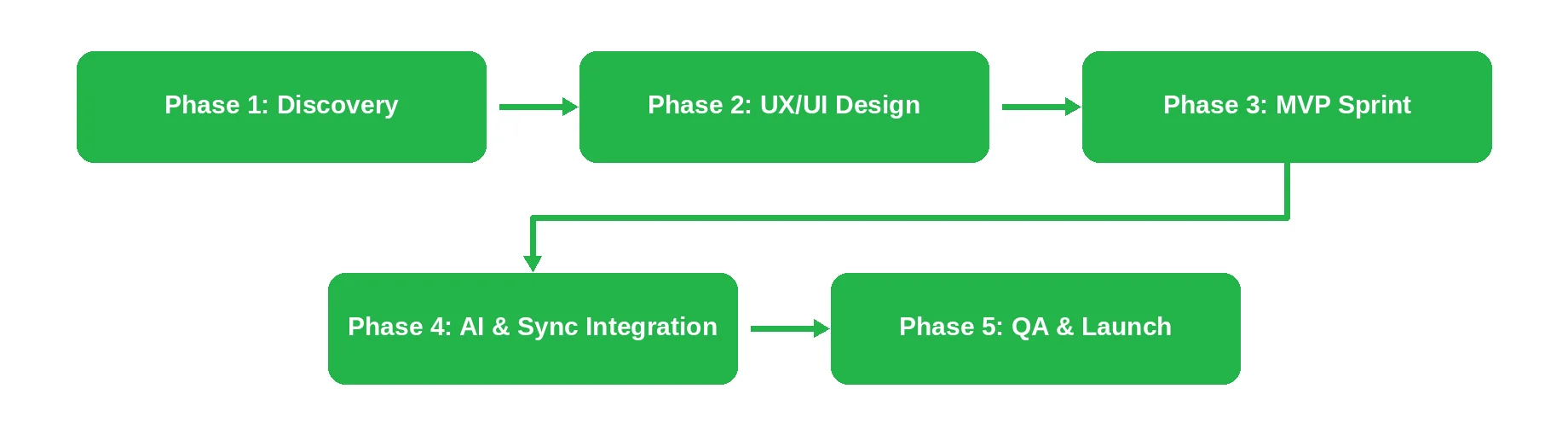
Phase 1: Product discovery and requirements gathering
This initial phase aligns target business goals with technical constraints. Focus on defining your precise target audience (e.g., strength athletes vs. post-injury rehabilitation), researching competitor monetization loops, designing the initial system architecture, and scoping a lean MVP backlog.
Phase 2: User-centric UX/UI design
The UI of a training application must be highly intuitive, high-contrast, and optimized for physically active users. Workflows should include simple, fast-loading interfaces for log entries, logical onboarding questionnaires, and accessible dashboards that present complex metrics simply.
Phase 3: Lean MVP development sprint
Avoid building every planned feature at once. Focus your initial development cycles on stabilizing core functionalities: simple profile creation, onboarding, access to a curated exercise database, manual tracking logs, and a standard SQL workout generator.
Phase 4: AI Integration and wearable syncing
Once the core database is stable, integrate the advanced automation layers. Connect your custom-built machine learning recommendation models, establish secure Apple HealthKit and Google Health Connect data syncing, and configure your cloud background pipelines to process biometric updates.
Phase 5: Testing, validation, and deployment
Before deploying to the Apple App Store and Google Play Store, execute thorough quality-assurance testing. Conduct device compatibility checks across different screen layouts, run stress-tests on your backend to handle concurrent database queries, and verify that all biometric data remains strictly encrypted in transit and at rest.
Full-Stack Fitness App Architecture
To ensure your application can handle millions of active data events without crashing, the architecture must decouple transaction logging from data analysis:
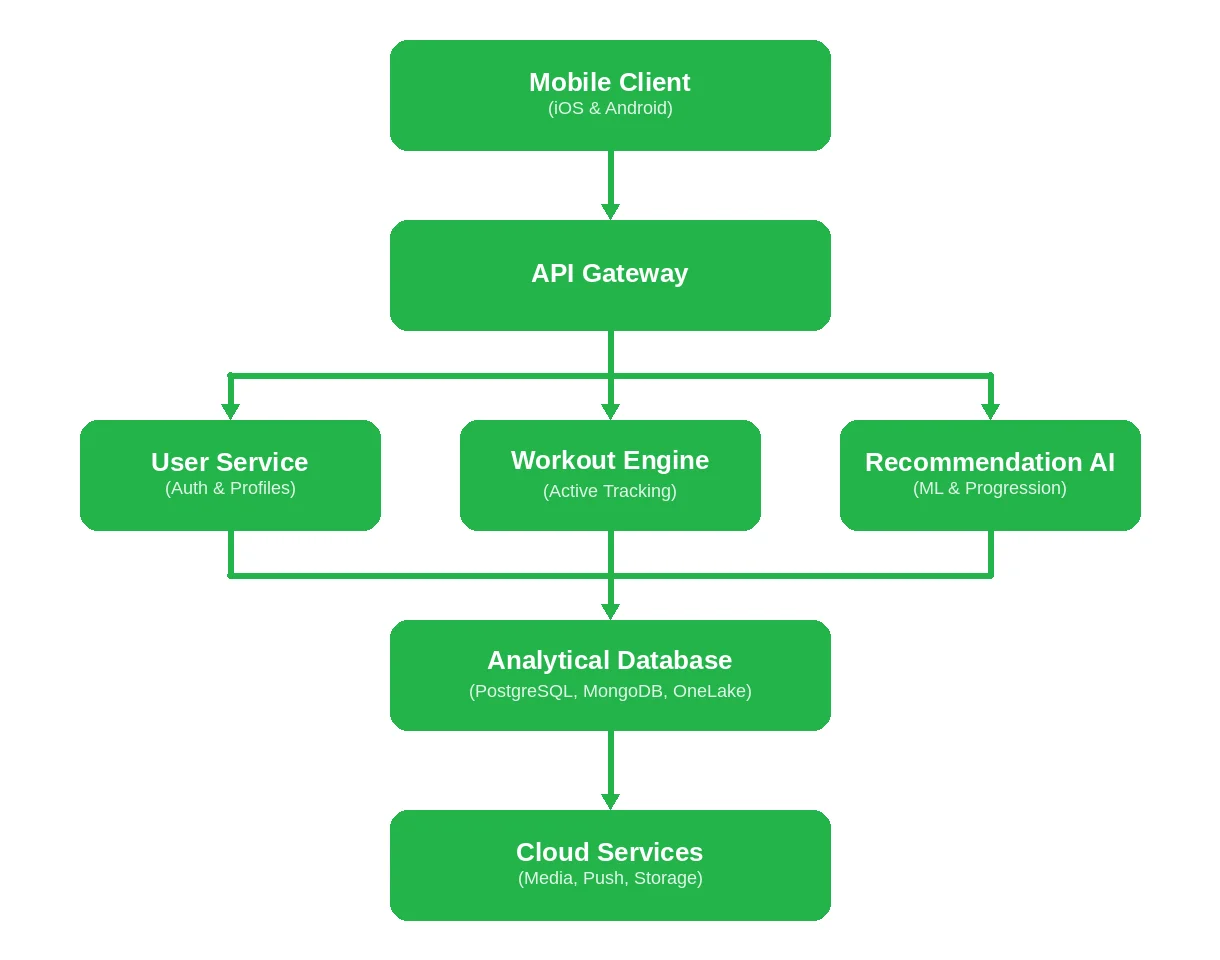
By isolating your primary transactional database from your analytical data warehouse, you can ensure that heavy machine learning calculations and custom report generation never slow down active tracking sessions for users mid-workout.
How Much Does It Cost to Develop a Fitness App?
The financial and time commitments required to deploy a personalized fitness application vary based on the complexity of your technology stack, selected platforms, and automation requirements.
Standard industry estimates
| Product Scope Class | Development Timeline | Estimated Cost Range | Key Structural Components Delivered |
| Basic Workout Tracker | 3–5 Months | $30,000 – $60,000 | Static exercise database, basic user profiles, manual log tracking, and standard charts. |
| Personalized Training App | 6–9 Months | $80,000 – $150,000 | Custom onboarding questionnaires, adaptive workout generator, HealthKit/Google Fit syncing, and database integrations. |
| AI-Powered Fitness Platform | 9–18 Months | $150,000+ | Real-time computer vision posture correction, LLM-driven virtual coach, advanced telemetry analysis, and enterprise scale. |
Core Operational Challenges & Mitigation Strategies
Building a high-growth fitness app requires navigating specific technical and operational challenges:
1. Generating safe and accurate recommendations
- The risk: An unvalidated algorithm might suggest excessively heavy weights or complex, high-risk exercises to a beginner, resulting in serious joint injuries.
- The solution: Establish strict boundary controls within your recommendation models. Ensure all machine learning engines are verified and calibrated by certified physical therapists and professional trainers. Enforce maximum safety caps on progression jumps.
2. High user attrition rates (The motivation wall)
- The risk: Most users download a fitness application with initial enthusiasm, only to abandon it within the first three weeks as daily habits prove hard to sustain.
- The solution: Prioritize cognitive engagement. Integrate smart progress visualizations that highlight micro-achievements, build social workout sharing functionalities, and trigger personalized push notifications timed around their historical workout patterns.
3. Data privacy and healthcare compliance
- The risk: Storing users' physical metrics, biometric histories, and personal health logs exposes your organization to severe security leaks and compliance fines under GDPR and HIPAA.
- The solution: Encrypt all user biometric data both in transit and at rest using standard security protocols. Anonymize database rows, isolate personally identifiable information (PII) from health metrics, and implement secure OAuth 2.0 authentication systems.
App Monetization Strategies
To ensure long-term profitability, product leaders must match their application's target audience with the right pricing model:
- The subscription model (SaaS): The most predictable, high-value revenue model. Users pay recurring weekly, monthly, or annual fees to access advanced personalization plans, continuous AI coaching, and premium training metrics.
- The freemium approach: Deliver broad access to your standard exercise library, manual tracking logs, and pre-packaged plans for free. Lock the advanced, adaptive AI workout engines, wearable biometric analysis, and custom scheduling behind a premium paywall.
- Corporate wellness and enterprise SaaS: License your platform directly to large corporations, health insurance providers, or commercial gym chains. These organizations buy bulk seats to provide the app as a wellness benefit for employees or members, giving you a highly stable, B2B revenue stream.
How to Choose a Fitness App Development Company
Transforming an unmanaged digital product idea into a secure, globally scalable application requires an engineering partner that combines deep mobile development expertise with advanced backend and machine learning capabilities. When evaluating potential vendors, use this structural assessment framework:
- Verify cloud and API infrastructure mastery: Ensure the vendor's engineering leads can showcase real-world case studies detailing high-concurrency database configurations and seamless web API structures.
- Audit health ecosystem integration experience: Candidate companies must demonstrate native familiarity with Apple HealthKit APIs, Google Health Connect protocols, and OAuth 2.0 background synchronization layers.
- Review Agile and CI/CD release automation: A high-quality partner implements strict automated testing, continuous linting, and sandboxed mobile deployments to protect code quality across development cycles.
- Validate product thinking capabilities: Avoid simple coding houses that build to rigid specifications without commercial analysis. Select a partner that actively audits your MVP roadmap, questions design vulnerabilities, and protects your launch timeline.
Why Choose Emerline as Your Software Product Development Partner
Transitioning a raw product concept into a secure, scalable, and market-ready personalized fitness platform requires an engineering partner with deep capabilities across mobile design, custom artificial intelligence, and cloud backend systems.
Building a successful digital product demands more than simply generating code to specification; it requires aligning your entire technology stack to support business growth, protect operational margins, and scale under user load. Minor architectural omissions or weak data configurations during early development can result in technical debt, performance bottlenecks, and eventual system failures.
As an established technology partner with deep capabilities across the enterprise cloud and custom engineering ecosystem, Emerline helps mid-market businesses, venture-backed startups, and global enterprises convert complex digital product ideas into reliable, high-performance software. We focus on optimizing your underlying system architecture, ensuring your product supports rapid business growth while completely removing the burden of technical debt from your core platforms.
Our elite product engineering and dedicated teams collaborate directly with your product owners, security officers, and technology leads to build scalable cloud-native architectures, modernize legacy applications, and implement advanced technologies (such as AI and machine learning) tailored to your exact operational goals.
The right software product development company becomes a strategic technology partner, helping you construct an unshakeable analytical and system foundation that drives permanent growth.
Contact our enterprise software architects today to schedule a comprehensive Software Product Architecture Assessment, identify potential optimization opportunities, and establish a secure, automated source of product truth.
Frequently Asked Questions
- How much does it cost to develop a custom fitness app?
The cost of developing a fitness app typically ranges between $30,000 and $150,000+, depending on project complexity, selected platforms, wearable integrations, and the depth of your AI personalization. Simple trackers require less initial investment, while advanced, AI-driven platforms with real-time pose tracking require larger budgets.
How long does it take to build a personalized workout app?
A basic MVP with standard tracking, profiles, and manual logs can be completed in 3 to 6 months. A fully-featured personalized training app with biometric syncing and adaptive plans typically takes 6 to 9 months, while complex AI platforms require 9 to 18 months of development.
How does AI personalize training plans?
AI analyzes user telemetry—including demographic profiles, onboarding questionnaire data, fitness levels, historic performance logs, and real-time biometric inputs. Machine learning models use these values to predict muscle recovery states, automatically adjust target sets, reps, and weights, and schedule upcoming workouts.
What features should every fitness app have?
Every successful platform requires interactive onboarding questionnaires, a detailed, high-definition exercise database, an intuitive tracking interface, wearable device integrations (HealthKit/Google Connect), progress visualization dashboards, and smart retention engines.
Can I develop a fitness app comparable to Fitbod or Freeletics?
Yes. Building a platform of that caliber requires establishing a microservices-based backend, designing intuitive mobile interfaces, training custom regression and recommendation models, and collaborating with certified fitness experts to validate your progression algorithms.
Published on Jul 31, 2026