Setting up a Center of Excellence for Enterprise Power BI Governance
Table of contents
- Key takeaways
- Defining the Center of Excellence Architecture
- Emerline operational advice: preventing the spread of untrusted dashboards
- Automating Tenant Monitoring and Security Audits
- Emerline FinOps advice: recovering wasted infrastructure budgets
- Center of Excellence Deployment Checklist
- Comparison of Analytics Operational States
- Frequently Asked Questions
- Enterprise Platform and Analytics Support
When a large organization scales its business intelligence operations, it often hits a predictable tipping point. Initially, giving business units the freedom to build their own reports accelerates data democracy. However, without centralized control, this self-service model quickly deteriorates into operational chaos.
Different departments begin building disconnected reports, leading to situations where the finance team, the marketing department, and regional operations present completely conflicting definitions of core metrics like "monthly active revenue."
At the same time, unmanaged workspaces proliferate, sensitive datasets are shared via unencrypted web links, and expensive capacity limits are exhausted by redundant, unoptimized data refreshes.
For Chief Data Officers (CDOs) and Chief Information Officers (CIOs), stopping this data fragmentation requires more than just stricter software permissions. It requires establishing a structured Center of Excellence (CoE).
A Power BI CoE is a dedicated cross-functional governing body that balances data accessibility with strict corporate compliance. This technical guide outlines how to build a CoE framework, audit tenant-wide report consumption, optimize software licensing, and prevent unvalidated dashboards from corrupting your enterprise source of truth.
Key takeaways
- Eliminating reporting chaos: Establishing a single, authoritative gateway for certifying corporate datasets and standardized data metrics.
- Tenant-wide consumption auditing: Leveraging automated activity logs to track exactly who is viewing, exporting, or modifying sensitive data assets.
- Capacity and license optimization: Recovering wasted infrastructure spend by automatically reclaiming unutilized premium licenses and optimizing compute capacities.
- Structured self-service frameworks: Providing clear deployment pathways that allow business units to innovate without bypassing IT data perimeters.
Defining the Center of Excellence Architecture
A successful Center of Excellence does not act as an IT bottleneck that blocks data requests. Instead, it operates as a governance hub that defines data standards, automates compliance verification, and trains decentralized business analysts to build models safely.
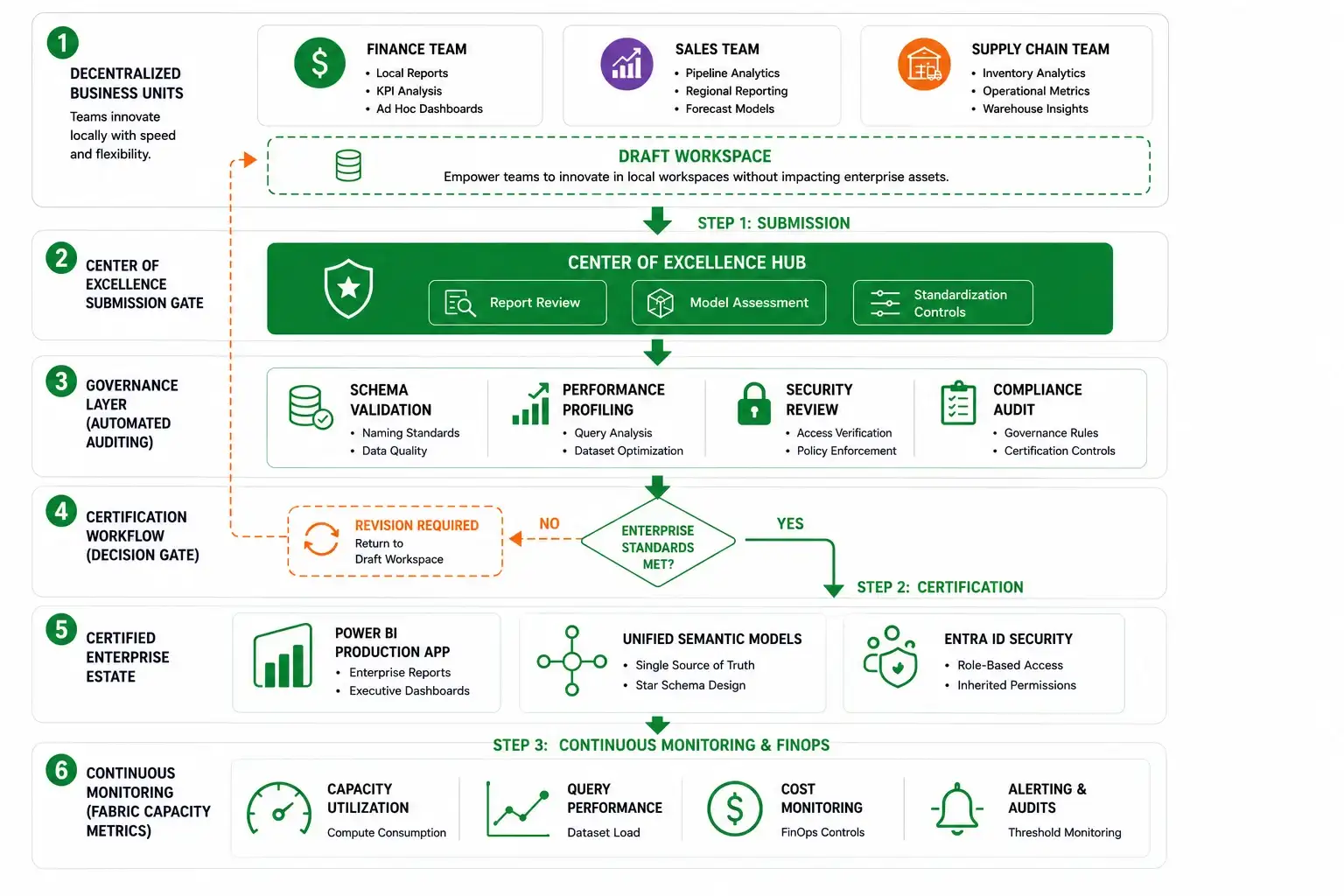
The CoE splits your reporting environment into distinct, managed zones. Business analysts retain full freedom to experiment, connect to sandbox databases, and sketch prototype visuals inside isolated Development Workspaces.
However, a report cannot be published to the corporate app portal or shared with executive leadership until it passes the CoE’s validation checklist. The model must be refactored into a clean star schema, measures must be checked for computation efficiency, and data connections must be routed through secure enterprise gateways, ensuring that only verified data guides corporate decisions.
Emerline operational advice: preventing the spread of untrusted dashboards
The most common failure pattern in enterprise business intelligence is the rise of the "shadow semantic model." When an internal department needs a report quickly, a local analyst might pull an un-vetted flat file into Power BI Desktop, write custom calculations on the fly, and share the raw file with colleagues. Within weeks, executive decisions are being made based on a report that has never been audited, uses un-validated business rules, and exposes sensitive company logic in a flat file format.
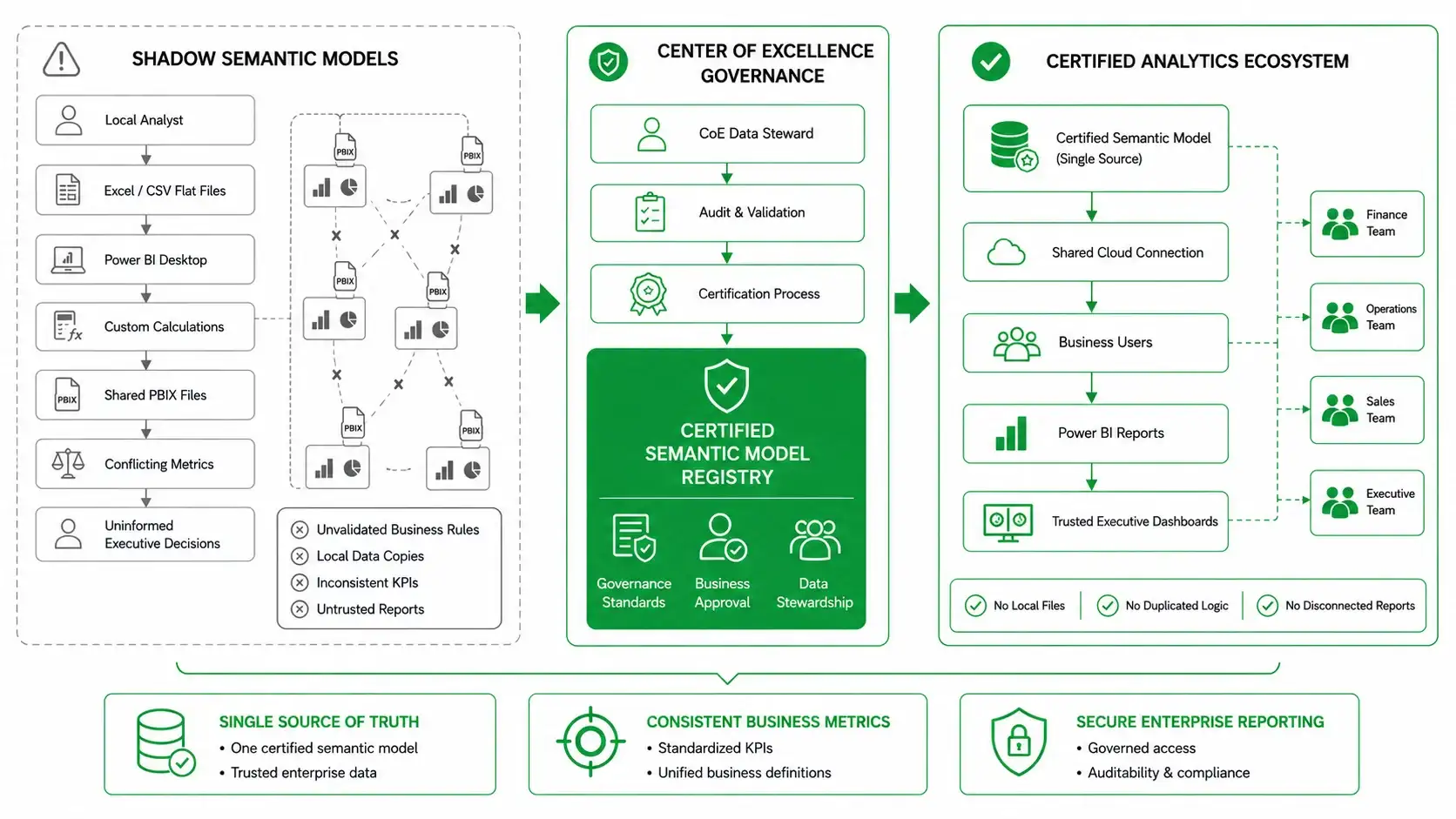
To stop this architectural decay, your CoE must enforce Microsoft’s Dataset Certification framework.
Train your infrastructure groups to utilize explicit endorsement flags inside the cloud tenant. Mark audited, master data sources as Certified—a restriction that should be locked exclusively to your CoE data stewards. Business users are then instructed to build local reports by connecting directly to these certified semantic models via shared cloud connections, completely eliminating the need for employees to extract raw data locally or invent their own conflicting metrics.
To review how your core operational infrastructure and database structures should be aligned for modern cloud platforms without generating unnecessary computing overhead, explore our strategic guide on the fundamentals of the Microsoft enterprise ecosystem.
Automating Tenant Monitoring and Security Audits
You cannot govern an enterprise data estate that you cannot see. As user adoption scales to thousands of active seats, your CoE must deploy automated monitoring pipelines to protect your perimeters from data leaks and tracking failures.
The foundation of this visibility relies on harvesting the Power BI Activity Log via the native REST APIs. By configuring an automated pipeline inside Azure Data Factory, the CoE can extract daily user activity logs and store them inside a protected cloud ledger table.
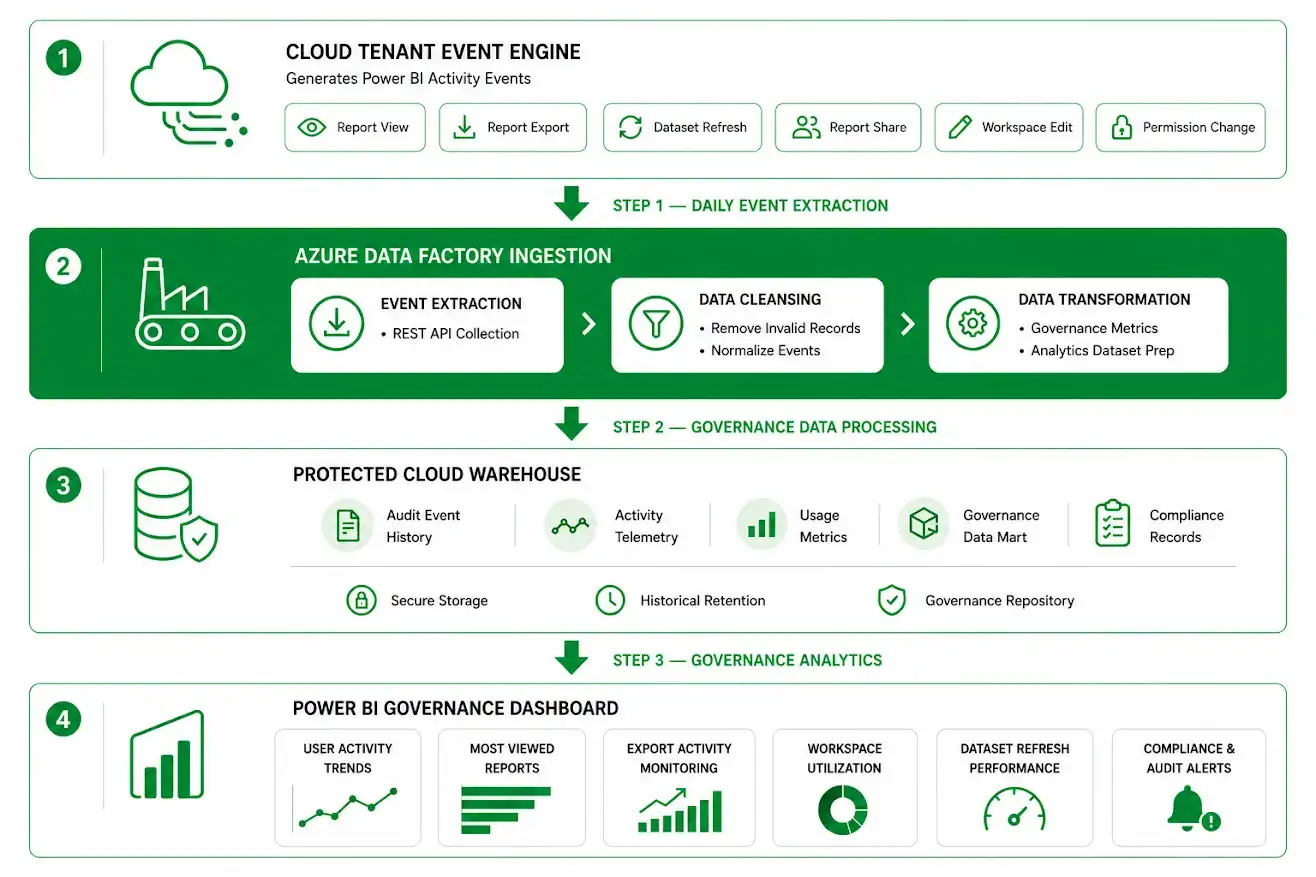
This governance dashboard allows security teams to monitor data movements in real time. The CoE can run automated compliance audits to flag high-risk anomalies, such as an employee attempting to export a massive customer database table to a local CSV file, or a workspace manager changing a report's sharing permissions to allow external web viewing.
Maintaining this level of end-to-end trace visibility ensures your data estate complies perfectly with rigid international privacy standards and internal risk-mitigation frameworks.
Emerline FinOps advice: recovering wasted infrastructure budgets
High-volume analytical environments frequently accumulate significant financial waste due to unmanaged software deployments. Without strict oversight, organizations continuously purchase expensive Power BI Pro or Premium licenses for users who only check a dashboard once a quarter, while unoptimized report models consume excessive cloud compute power.
To keep your operations sustainable, integrate proactive infrastructure profiling directly into your CoE workflows by leveraging professional Power BI consulting services.
By analyzing tenant-wide usage telemetry, your platform administrators can identify inactive accounts, automate the reclamation of unused user licenses, and track down unoptimized, long-running queries that are driving up your cloud capacity bills. Cleaning these unoptimized processes slashes overall background resource consumption and stabilizes your monthly IT budget.
To deeply understand how continuous code-level refactoring, performance profiling, and strategic data life cycles prevent systemic waste across your digital assets, explore our comprehensive guide to the operational benefits of managed cloud computing.
Center of Excellence Deployment Checklist
Before launching a formalized Center of Excellence framework across your global business units, your technical leadership should validate the following parameters:
- Workspace lifecycle policy: Are your cloud workspaces segregated into explicit development, testing, and production tiers with automated deployment pipelines?
- Endorsement flag restrictions: Is the permission to mark data models as Certified strictly limited to approved data stewards within your CoE?
- Gateway cluster redundancy: Are your data connections routed through high-availability gateway clusters to ensure secure, load-balanced hybrid network performance?
- Automated license reclaim: Have you established an automated workflow to notify administrators and reclaim user licenses if an account remains inactive for more than 45 days?
- Capacity alerting systems: Is your capacity management app configured with proactive alerts to notify the CoE team if background processing usage spikes near maximum limits?
Comparison of Analytics Operational States
| Operational Vector | Unmanaged Self-Service Chaos | Governed Center of Excellence Model |
| Data Definition | Conflicting definitions of metrics across teams | Unified, certified semantic models used company-wide |
| Security Controls | Fragmented, un-audited workspace permissions | Centralized Entra ID authentication and dynamic RLS |
| Infrastructure Costs |
Unmonitored capacity spikes and license waste |
Proactive FinOps tuning and automated license recovery |
| Compliance Posture | Blind spots regarding data exports and transfers | Traceable activity logging with automated audit trails |
Frequently Asked Questions
Will establishing a Center of Excellence frustrate our business analysts and slow down innovation?
No. When engineered correctly, a CoE actually accelerates business velocity. By providing analysts with pre-cleaned, optimized, and certified data models, the CoE eliminates the time-consuming tasks of data extraction, cleansing, and validation. Business teams can focus 100% of their energy on building creative visual analytics and discovering data insights, while the governance layer runs automatically behind the scenes.
How do we handle legacy reports built before the CoE framework was established?
Legacy reports are managed through a structured Migration and Grandfathering pipeline. The CoE inventories all active reports and prioritizes them based on business criticality and user traffic. Critical executive reports are fast-tracked into the validation lifecycle to be refactored and certified, while low-traffic, non-compliant reports are assigned a clear decommissioning date, giving teams ample time to move their workflows to approved cloud assets.
What is the ideal staffing composition for a Power BI Center of Excellence?
An enterprise-grade CoE is a cross-functional team that combines technical engineering with business leadership. The core structure typically includes a Platform Architect to oversee cloud capacity health and gateway infrastructure, a Data Governor to enforce data compliance and model certification standards, and Business Champions—senior analysts embedded directly within departments like finance or HR to act as localized coaches, ensuring data standards are respected across all teams.
Enterprise Platform and Analytics Support
Establishing an automated, highly secure Center of Excellence requires an experienced technology partner with deep expertise in big data architecture, tenant administration, and end-to-end security compliance. As a certified Microsoft Solutions Partner, Emerline works directly with enterprise IT groups to eliminate reporting chaos, optimize cloud infrastructure expenditures, and build resilient data governance frameworks designed for strict regulatory environments.
Contact our enterprise systems and governance engineers today to arrange a comprehensive evaluation of your business intelligence environment, map your governance milestones, and build a secure, scalable data estate.
Disclaimer
The governance strategies, frameworks, and Center of Excellence (CoE) architectural methodologies outlined in this article are provided for general informational and educational purposes only. Corporate data environments, security compliance standards, and cloud deployment boundaries (including tenant administration controls within Microsoft Power BI and Microsoft Fabric) vary significantly based on industry regulations, organizational size, and specific corporate risk profiles.
While we endeavor to present accurate and up-to-date governance best practices, Emerline makes no representations or warranties of any kind, express or implied, about the completeness, absolute security, or cross-industry suitability of these blueprints. Any implementation of the security matrices, data access lifecycles, or tenant policies described herein is executed strictly at your own risk.
In no event will Emerline be liable for any unauthorized data exposure, regulatory non-compliance issues, administrative operational disruptions, or loss of technical control inside your enterprise environments resulting from the adoption of these strategies. Organizations must validate all tenant administration changes and access group configurations against their internal IT security protocols and compliance mandates prior to deployment.
Published on Jun 8, 2026