Offshore Development Center (ODC): The Complete Guide (2026)
Table of contents
- Quick Answer: What Is an Offshore Development Center?
- Key Takeaways
- The Basics of Offshore Development Center (ODC)
- What’s the difference between outsourcing and offshoring?
- ODC vs. Dedicated Development Team vs. Staff Augmentation
- Orthodox ODC Models
- Key Challenges of Opening an ODC on Your Own
- Key Offshore Development Center Benefits
- When Is an Offshore Development Center the Right Choice?
- How to set up an offshore development center
- Step 1: Define Your Goals and Requirements
- Step 2: Understand Whether ODC Will Work for You
- Step 3: Select a Country to Set up an ODC
- Regional Deep-Dive: Central and Eastern Europe
- Step 4: Choose the Right ODC Partner
- Step 5: Get Involved in the Team Setup Process
- Hire Emerline as Your ODC Partner
Frequently Asked Questions
What is the primary definition of an Offshore Development Center?
How does an ODC differ from traditional software outsourcing?
What are the main benefits of using a Build-Operate-Transfer (BOT) model?
Is an ODC secure enough to handle sensitive corporate IP?
How long does it take to set up an operational ODC?
Recent reports highlight the increasing difficulty in finding qualified specialists, making scaling a business a challenge. Hiring new talent, setting up infrastructure in a new office, and other expansion-related tasks require significant investment. In these circumstances, establishing an offshore development center in cooperation with a reliable service provider can be a game-changer.
This approach is gaining traction, as the global offshore custom software development market is projected to experience substantial growth. The market is expected to reach a staggering $283,457.5 million by 2030, with a compound annual growth rate (CAGR) of 10.13%.
If you're looking to expand your business and tap into global talent pools, setting up an offshore development center is a strategic move. Our complete guide provides a roadmap for navigating the process and maximizing the benefits of this approach. Learn how to establish a successful offshore development center and unlock new opportunities for your business.
Quick Answer: What Is an Offshore Development Center?
An Offshore Development Center (ODC) is a dedicated remote software development office located abroad that functions as an extension of a company’s in-house IT department.
Unlike short-term project outsourcing, an ODC provides an enterprise with a dedicated team, infrastructure, and operations aligned entirely with the parent company’s corporate culture, security policies, and long-term product roadmaps, while significantly optimizing operational and scaling costs.
Key Takeaways
- Strategic alignment over transactional hiring: An ODC behaves like an internal business unit, ensuring developers adopt your corporate guidelines, long-term vision, and software engineering standards.
- Substantial cost optimization: Partnering with an offshore service provider can reduce total infrastructure, recruitment, and administrative overhead by 40% to 70% compared to local hiring.
- Access to niche talent pools: Relocating scaling efforts to mature regional tech hubs opens instant access to specialized expertise in high-demand domains like artificial intelligence, cloud architecture, and cybersecurity.
- The "Follow-the-Sun" operational model: Leveraging geographic and time zone differences enables continuous development and deployment pipelines, accelerating overall time-to-market.
- Choosing the right model dictates risk: Selecting between Build-Operate-Transfer (BOT) and Managed ODC models allows businesses to align their operational risk with their long-term corporate ownership strategies.
The Basics of Offshore Development Center (ODC)
An Offshore Development Center (ODC) stands for an office located abroad with tech expertise ready to scale the development of software products at reduced costs. Offshore development centers are typically set up in countries with a rich pool of tech talent, favorable business conditions, and reasonable price-quality combinations.
What’s the difference between outsourcing and offshoring?
The main difference between outsourcing and ODC is ODC’s offshore location. But it’s not the only difference. While specific outsourcing engagement models are quite similar to ODC, there’s a slight difference: ODC operates like a separate unit of people, infrastructure, and operations dedicated to one client. This dedication fosters deeper integration and alignment with the parent company's goals.
ODC vs. Dedicated Development Team vs. Staff Augmentation
To choose the optimal model for your technology expansion, you must understand how an ODC compares to alternative remote engagement strategies:
| Engagement Model | Team Dedication | Core Infrastructure Ownership | Operational Duration | Best Suited For |
| Staff Augmentation | Partially embedded inside internal teams. | Maintained completely by the client. | Short-term (weeks to months). | Filling immediate, tactical skill gaps for an existing internal project. |
| Dedicated Team | 100% focused on the client's projects. | Provided by the vendor's existing facilities. | Medium-term (6 to 24 months). | Building a specific product or scaling an established core module. |
| Offshore Development Center (ODC) | 100% integrated into corporate culture. | Dedicated physical office space and security. | Long-term (multi-year permanent unit). | Establishing a scalable, permanent extension of your internal IT division. |
Orthodox ODC Models
There are two orthodox ODC models that are typically employed but adapted to clients’ needs by offshore software development companies. They include:
- BOT (Build-Operate-Transfer): Customers hire a service provider to set up the ODC, and the service provider covers all the initial funding, hiring, and physical infrastructure costs. The service provider operates the center to meet the client's operational metrics, and after a predetermined period, transfers complete ownership of the center (including assets, contracts, and IP) to the customer.
- Managed ODC: This model also requires the supplier's responsibility for infrastructure establishment and administrative tasks. With this model, the client gets a remote ODC operated continuously by the services provider, allowing the parent company to focus entirely on software delivery while the partner manages local compliance, facilities, and HR operations.
Explore how you can leverage these custom engagement models at Emerline.
Key Challenges of Opening an ODC on Your Own
The setup of an offshore development center you are not familiar with requires significant effort. Below are several areas you need to consider if you decide to set up an offshore development center by yourself:
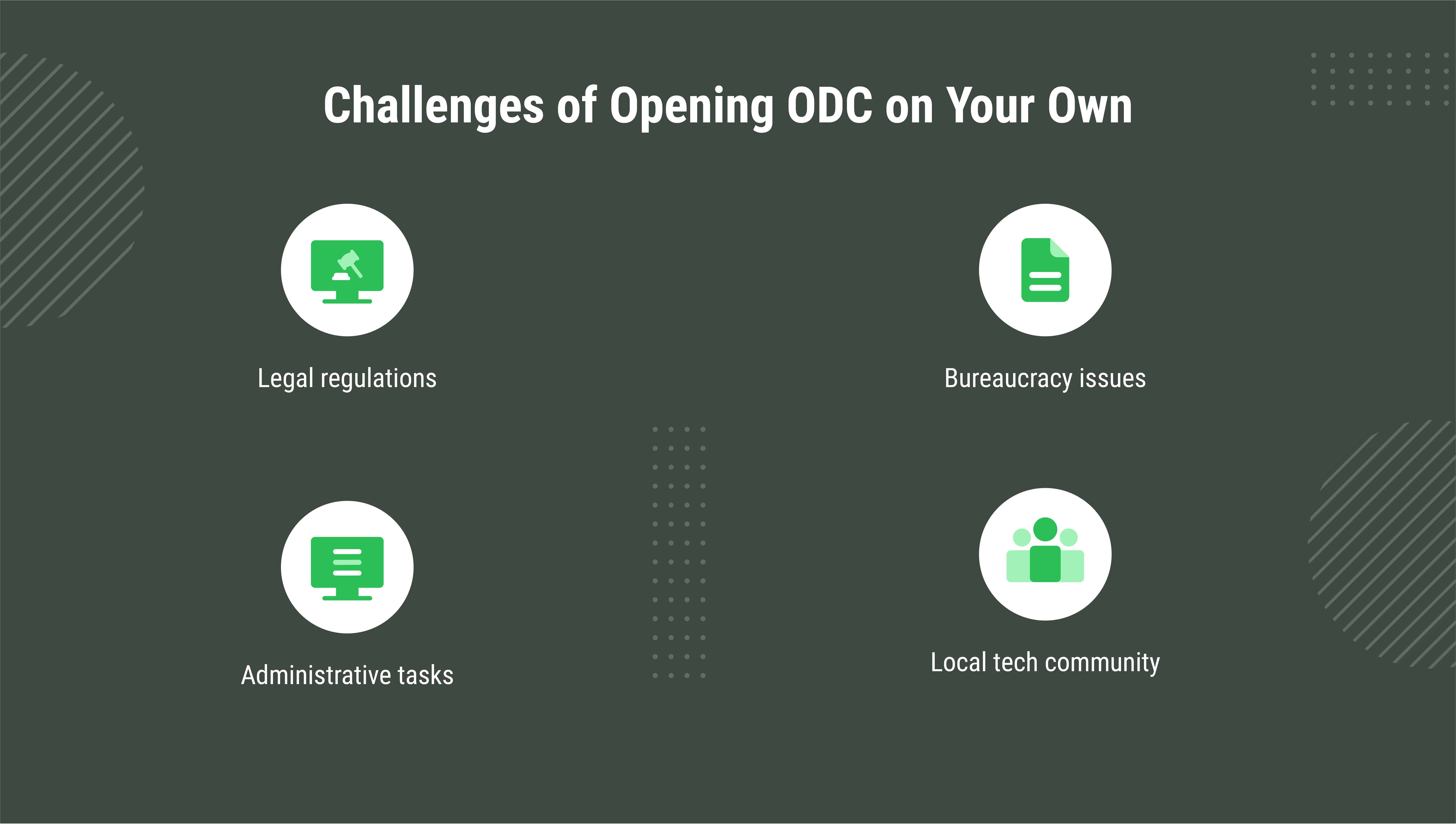
- Complex Legal Regulations: You need to be fully aware of or delve deeply into local labor laws, tax legal regulations, and data compliance standards that work for foreign entities in offshore locations.
- Administrative & Bureaucratic Obstacles: You may face significant bureaucracy issues while opening a development center in another country, which will take much longer, especially in offshore countries located far from your principal office.
- Remote Operational Management: It can be highly challenging to handle complex administrative tasks, physical office lease structures, hardware acquisitions, local repairs, and daily workplace optimizations remotely without an on-the-ground local partner.
- Recruitment Barriers: To successfully hire highly qualified offshore developers, you must possess a deep understanding of the local tech community, target compensation benchmarks, and local hiring channels. This requires deep research before entering the local market of job seekers.
It’s apparent it’s hard to establish an offshore development center remotely without insider expertise. So, you need to leverage a local consultancy to help you with it.
Key Offshore Development Center Benefits
Taking into account the challenges you may face while opening an ODC on your own, there’s an alternative option — partnering with an established offshore development company. Below are the major benefits of an ODC setup with offshore partners:
- Reduced Infrastructure Costs: By employing an ODC model, you save on purchasing and maintaining expensive commercial hardware, office equipment, leases, and local utilities. All the physical infrastructure costs are managed and streamlined by the offshore service provider.
- Optimized Hiring and Administrative Costs: As a customer, you don't take on additional unpredictable costs related to recruiting, local employee benefits, or HR compliance. Cost savings remain a significant advantage, potentially reaching 40-70% compared to in-house engineering rates.
- Strict Compliance with Corporate Policy: By choosing an ODC model, you secure long-term cooperation with software engineers dedicated only to your project. This team works in strict accordance with your internal development standards, security practices, and workflow guidelines.
- High Scalability and Flexibility: You can rapidly expand your technology business at any stage with no extensive upfront investments required on physical infrastructure, operations, or local HR setups.
- Accelerated Time-to-Market: Increasing continuous development velocity due to time zone differences and dedicated teams. The "follow-the-sun" model ensures continuous innovation and faster product delivery.
- Access to a Global Talent Pool: Tapping into a vast and diverse global talent pool, including specialized technical skills that may be scarce or expensive locally, particularly in rapidly evolving technologies such as generative artificial intelligence, data engineering, and advanced cybersecurity.
When Is an Offshore Development Center the Right Choice?
As an ODC model is designed for long-term strategic expansion, it is essential to verify that this model matches your company's current operational state. An ODC is the ideal choice if your business is facing the following scenarios:
- You require an engineering division that closely adheres to your strict internal coding standards, QA processes, and security protocols.
- You need to assemble a large, stable team of software technicians possessing narrow, specialized, or highly technical expertise.
- You need to scale your company fast to seize market opportunities but want to avoid long recruitment cycles locally.
- You need to drastically optimize capital expenditures on corporate infrastructure, operation management, and long-term administrative operations.
How to set up an offshore development center
Step 1: Define Your Goals and Requirements
Before making a decision on working with offshore development teams, be sure you understand your needs. In particular, clarify the project requirements and outline at least a vague project scope to understand what ODC model will work best for you. Once you set up your project strategy, you’ll understand if offshore development services are the right choice for your project delivery. For instance, if you are going to set up a long-term project with a vast project scope where requirements will be changing a lot, you’ll need ongoing technical support, so an ODC model may be the best strategy.
Step 2: Understand Whether ODC Will Work for You
As ODC doesn’t work for all project types, it’s essential to identify that this engagement model will satisfy your needs. If you find yourself in the situations below, offshore development center setup is a good option for you to consider:
- You need technicians with narrow expertise.
- You need to scale your company fast.
- You need to save on infrastructure, operation management, and hiring.
- You need to establish long-term cooperation and close adherence to your company standards.
Step 3: Select a Country to Set up an ODC
When it comes to choosing an offshore location to open your ODC, cost-efficiency is always the pivotal argument for it. However, ODC setup is not only about low pricing, so you should consider other factors, too. Below are the things you should keep in mind when choosing a country to look for an offshore development company:
- Expertise in particular technologies
- Language proficiency
- The level of the IT sector development
- Hourly rates and developer salaries
Regional Deep-Dive: Central and Eastern Europe
Central and Eastern Europe serve as premiere regional hubs for offshore development, offering an exceptional balance of highly mature technical expertise and favorable economic conditions. Poland stands out as a leading global destination for setting up an ODC:
| Regional Performance Vector | Current Market Statistics & Baselines |
| Available Engineering Pool | Over 500,000+ professional software developers across key urban hubs. |
| Clutch Registered IT Vendors | Over 800+ established software development providers. |
| Average Hourly Engineering Rates | Ranging from $25 to $99 per hour depending on seniority and domain. |
| Global Language Proficiency | Consistently ranked among the top 20 globally in the EF English Proficiency Index. |
| Technical Domain Strengths | Deep expertise in Enterprise Java, .NET, Python, Cloud Architecture, and AI. |
Step 4: Choose the Right ODC Partner
Unless you dive into ODC set up by yourself, finding a reliable offshore development partner is crucial. They will accompany you from the very start of your project to its release and even further. So, pay attention to the research you should do to find a good supplier. Here are some practical tips for you:
- Check out the experience in ODC setup and what ODC models a service provider works with.
- Be sure an offshore software development firm knows the local market and understands your needs.
- Examine if previous clients are satisfied with their services by finding reviews in such platforms as Clutch.
- Compare ODC setup costs with other proposals and analyze the cost-effectiveness of your future investment.
- Explore the level of flexibility of your supplier and their abilities to serve your project needs.
Step 5: Get Involved in the Team Setup Process
Once you hire an offshore development partner, it’s time for your dedicated team setup. This stage will include candidates recruiting and interviewing, so you need to decide if you participate in each step, or join interviews, or at a final approval step. It’s worth noting that multiple engagement options are available when working with offshore development firms.
Hire Emerline as Your ODC Partner
Since setting up an offshore development center involves long-term operational and security commitments, selecting an experienced, trustworthy technology partner is essential to mitigating project risks.
At Emerline, we help mid-market and enterprise organizations design, build, and deploy high-performing development units under one roof. Whether you need to augment your team with a dedicated development team, establish a comprehensive, secure Offshore Development Center, or scale up a complex digital platform, our engineering teams ensure your technology infrastructure is fully optimized for long-term growth.
Our elite software engineers and dedicated management teams collaborate directly with your business to align remote operations with your internal standards, protect your proprietary intellectual property, and minimize overhead.
Contact us to arrange a comprehensive operational readiness evaluation of your current environment, estimate your target ODC setup costs, and unlock a scalable, secure global talent pool.
Frequently Asked Questions
What is the primary definition of an Offshore Development Center?
An Offshore Development Center (ODC) is a dedicated, remote software development office located abroad that functions as an extension of an enterprise's internal IT division. It provides dedicated teams, custom physical infrastructure, and tailored operational processes aligned with the client company.
How does an ODC differ from traditional software outsourcing?
Traditional outsourcing is typically project-based, transactional, and short-term, with teams shifting across multiple clients. An ODC provides a permanent, dedicated remote unit focused exclusively on one client, closely integrated into that client's corporate culture, workflows, and security standards.
What are the main benefits of using a Build-Operate-Transfer (BOT) model?
The BOT model allows an enterprise to scale an offshore center with minimal initial risk. The local partner handles recruitment, physical legal entity setup, facilities, and initial operations. Once the center reaches operational maturity, complete ownership of the entire unit is seamlessly transferred to the client.
Is an ODC secure enough to handle sensitive corporate IP?
Yes. When built with a verified technology partner, an ODC incorporates strict enterprise security controls, including isolated physical office networks, encrypted data endpoints, strict non-disclosure agreements (NDAs), and compliance with global data privacy frameworks (such as GDPR or SOC 2).
How long does it take to set up an operational ODC?
Assembling the initial core engineering team and configuring basic operations typically takes 2 to 4 months, depending on your required team size, specialized skill sets, and physical facility needs.
Updated on Jul 18, 2026