Digital Transformation of Sports Academies: Managing Students, Coaches, and Training Schedules
Table of contents
- Quick Answer: What Is Sports Academy Management Software?
- Key takeaways for sports academy leadership
- What Is Digital Transformation for Sports Academies?
- Why Sports Academies Need Management Software
- Core Modules of an Enterprise Sports Platform
- Student management system (CRM)
- Coach management system
- Smart scheduling and training calendar
- Communication platform
- Payments and membership management
- Athlete performance analytics
- Software Procurement: Build vs. Buy
- Build vs. buy comparison
- Recommendation
- Feature Phasing Framework: MVP vs. Advanced
- Feature phasing matrix
- MVP
- Advanced Capabilities
- Mobile Application Architecture for Sports Academies
- Enterprise Technology Stack for Sports Platforms
- Implementing AI in Modern Sports Academy Software
- Automated scheduling optimization
- Predictive athlete analytics and development
- Wearable-based injury risk mitigation
- The Custom Software Development Lifecycle
- Phase 1: Product discovery and requirements gathering
- Phase 2: User-centric UX/UI design
- Phase 3: Lean MVP development sprint
- Phase 4: Integration and optimization
- Phase 5: Verification, migration, and launch
- How Much Does Sports Academy Software Cost?
- Standard project estimates
- Challenges When Digitizing Sports Academies
- Challenge 1: Low user adoption and resistance to change
- Challenge 2: Secure data management and compliance
- Challenge 3: Scaling across multi-location franchises
- Monetization Models for Sports Academy Platforms
- Why Choose Emerline as Your Software Product Development Partner
- Frequently Asked Questions
- What is sports academy management software?
- How do sports academies improve operations through digital transformation?
- What core features should custom sports academy software include?
- How much does it cost to develop a custom sports management platform?
- Can sports academy software track athlete performance and progress over time?
Modern sports academies operate in a highly competitive, fast-paced environment, yet many still manage day-to-day operations through a fragmented mix of Excel spreadsheets, paper forms, WhatsApp group chats, and separate tracking systems. While each tool may serve a specific purpose, together they create a disconnected operational environment that becomes increasingly difficult to manage as the academy grows.
More athletes, coaches, training sessions, facilities, and membership plans mean more information to coordinate across different channels. Schedule changes may not reach everyone, attendance records are updated manually, membership payments can be missed, and athlete development data remains scattered across files and systems. Over time, these issues create operational friction and make it harder for staff to manage the academy efficiently or plan for growth.
This is where a connected digital environment can make a measurable operational difference. Bringing these workflows together can reduce routine administration, improve visibility across the academy, and give staff a more reliable foundation for managing day-to-day operations and long-term growth.
This guide explores how digital transformation can change the way sports academies manage students, coaches, and training schedules, what capabilities a modern digital environment should provide, how implementation can be phased, and what factors affect the cost and complexity of the transformation.
Quick Answer: What Is Sports Academy Management Software?
Sports academy management software is a centralized digital platform for managing the day-to-day operations of a sports training organization. It brings student records, coach management, training schedules, facility bookings, attendance, memberships, payments, communication, and athlete development data into one connected environment.
By replacing disconnected spreadsheets, paper forms, messaging apps, and separate tracking tools with shared workflows and centralized data, the platform gives administrators and coaches better visibility into academy operations. Athletes and parents can also access schedules, payments, notifications, and relevant progress information through role-based web and mobile interfaces.
Key takeaways for sports academy leadership
- Centralize student and coach information. Bringing athlete profiles, attendance, memberships, coach assignments, and development records into one system reduces duplicate data entry and makes information easier to access and maintain.
- Make scheduling a connected workflow. A shared scheduling environment can coordinate coaches, athletes, training groups, facilities, and recurring sessions while identifying conflicts and distributing schedule changes to affected users.
- Connect administration with daily operations. Attendance, memberships, payments, communication, and reporting work more effectively when they are connected to the same operational data rather than managed through separate spreadsheets and messaging channels.
- Give each user the right level of access. Administrators, coaches, athletes, and parents have different responsibilities, so role-based web and mobile interfaces should expose the workflows and information relevant to each user.
- Treat digital transformation as an ongoing process. A sports academy does not need to digitize everything at once. Starting with core workflows such as student management and scheduling creates a foundation that can later be extended with integrations, analytics, automation, mobile apps, and other capabilities.
What Is Digital Transformation for Sports Academies?
Digital transformation for a sports academy is not simply about replacing paper schedules with digital documents. It is a broader change in how the organization manages information, coordinates people, and runs its daily operations.
The starting point is usually a set of disconnected workflows. Student records may sit in spreadsheets, coaches may maintain their own attendance lists, schedules may be shared through messaging groups, and membership payments may be tracked separately by administrative staff. Digital transformation connects these activities so that information can move between the people and processes that depend on it.
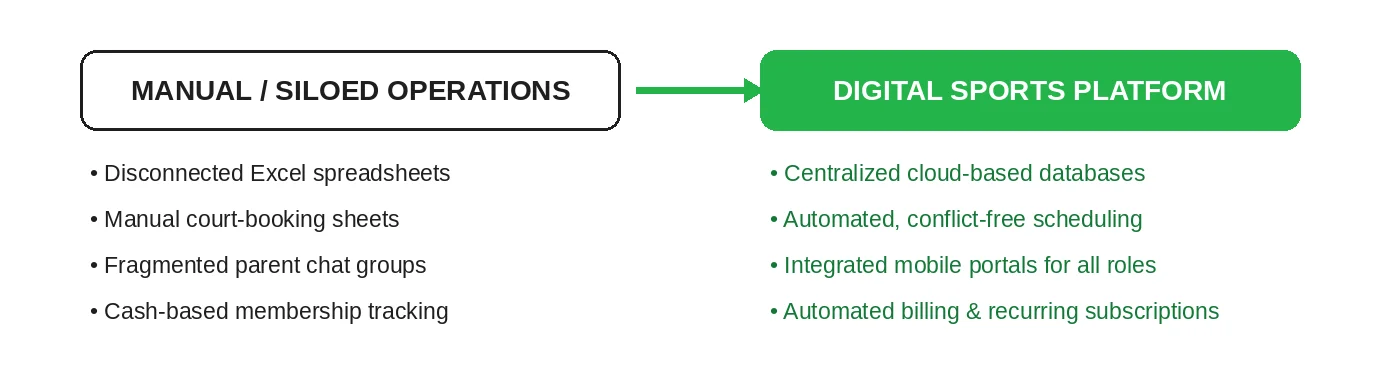 By consolidating these workflows, sports academies can move from a reactive, administratively heavy operating model toward a more connected, data-driven way of working. The impact is felt across several areas of academy operations:
- Administrative efficiency: Connected scheduling, attendance, membership, and reporting workflows reduce repetitive manual work and make routine tasks faster and easier to manage.
- Communication and visibility: Parents, athletes, coaches, and administrators can receive timely schedule updates, access relevant performance information, and view membership or billing details through role-based web and mobile interfaces.
- Operational performance: A shared view of facilities, coaches, training groups, and class capacities helps academies identify scheduling conflicts, improve facility utilization, and coordinate operations across multiple locations.
The goal is not to automate every task or introduce technology for its own sake. The goal is to make core operations easier to coordinate, more transparent, and more scalable as the academy grows.
Why Sports Academies Need Management Software
When an academy relies on manual workflows, clear operational bottlenecks inevitably emerge:
- Conflicting training schedules: Without a centralized database, schedulers run the risk of double-booking a head coach, allocating two different teams to the same court, or forgetting to secure required training equipment.
- Manual attendance tracking: Coaches waste valuable court time manually writing down attendance on paper rosters, which rarely get consolidated into a central student CRM.
- Fragmented communication: Important game announcements, training location changes, and weather alerts are scattered across emails, SMS, and personal chat groups, causing confusion for parents and athletes.
- Inconsistent financial tracking: Relying on manual invoices or cash payments leads to high payment delays, uncollected membership dues, and complicated auditing processes.
- Lack of athlete progress visibility: Without a structured performance tracking system, an athlete's physical development, testing results, and medical notes are lost over time.
These problems are interconnected. A schedule change can affect attendance, communication, facility availability, and billing. That is why digitizing individual tasks in isolation often provides less value than connecting the underlying workflows.
A successful digital transformation therefore starts with the way these processes interact, not with a list of standalone features. The platform should create a shared operational environment where information entered in one workflow can immediately support the others - for example, a schedule change can update calendars, notify affected users, adjust attendance records, and keep facility bookings aligned.
Core Modules of an Enterprise Sports Platform
The core of a sports academy management platform is a set of interconnected modules that share data and support the academy's main operational workflows. Each module addresses a specific area of the business, while their connection creates a single operational picture for administrators, coaches, athletes, and parents.
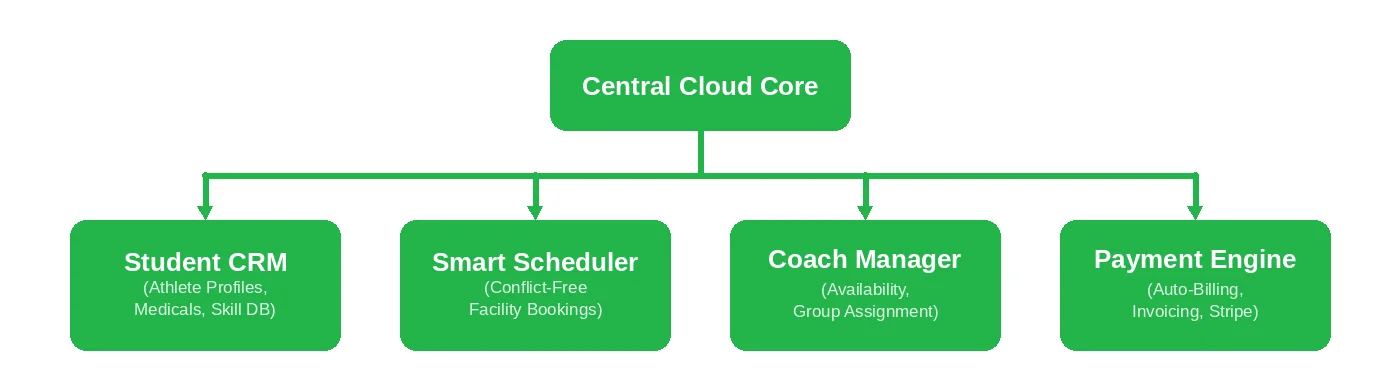
Student management system (CRM)
This is the database core of your platform. It maintains complete profiles for every athlete, tracking their personal details, family contact information, emergency medical records, allergy details, skill levels, attendance logs, and historical performance charts.
Coach management system
This module allows administrators to coordinate staff schedules, track coaching certifications, monitor active workloads, manage group assignments, and evaluate coaching performance metrics.
Smart scheduling and training calendar
The scheduling engine acts as the operational heartbeat of the academy. It automatically creates optimized timetables, coordinates multi-facility court bookings, flags potential coach or court conflicts, manages recurring classes, and updates the mobile calendars of all affected users instantly when a schedule change is made.
Communication platform
A centralized communications module that handles real-time push alerts, emergency notifications, training reminders, and direct text channels between coaches and parents, completely removing the need to use personal social media messaging apps.
Payments and membership management
This engine automates the entire revenue lifecycle of your academy. It manages recurring student subscription fees, handles invoice generation, securely processes credit card transactions through trusted payment gateways, and compiles clean financial analytics dashboards for your administrators.
Athlete performance analytics
This module allows coaches to log performance testing results, monitor physical metrics (such as speed, vertical jump, or heart rate), track competition histories, and publish structured Individual Development Plans (IDPs).
Together, these modules turn separate administrative tasks into a connected operating environment. A student record can inform scheduling and attendance, a schedule change can trigger communication, attendance can contribute to performance history, and membership data can connect training participation with billing. This interconnected model is what allows digital transformation to improve not just individual tasks, but the way the academy operates as a whole.
However, the more workflows an academy connects, the more important the underlying technology becomes. A platform that works well for a small club with standard processes may not provide the flexibility, integrations, or control required by a growing multi-location organization. This makes the choice between an off-the-shelf solution and custom development an important part of the digital transformation strategy.
Software Procurement: Build vs. Buy
Before investing in a new platform, a sports academy should first determine whether an existing solution can support its current workflows and growth plans. The decision is not simply about comparing subscription fees with development costs — it is about balancing implementation speed, flexibility, integration needs, data ownership, and long-term scalability.
Off-the-shelf platforms can be a practical choice when an academy has relatively standard requirements. They typically provide faster implementation, lower upfront costs, and a predefined set of features. The trade-off is that the organization must adapt its processes to the platform's capabilities and work within its available customization and integration options.
Custom development takes the opposite approach: the software is designed around the academy's workflows, user roles, integrations, and long-term requirements. This requires a larger initial investment, but can provide greater control over functionality, data, architecture, and the product roadmap.
Build vs. buy comparison
| Evaluation Factor | Off-the-Shelf Software (e.g., TeamSnap, SportsEngine) | Custom Sports Academy Software Development |
| Upfront Cost | Low. Monthly or annual subscription fees. | High. Initial software engineering investment. |
| Customization | Low; restricted to standard templates and features. | Infinite. Engineered to match your exact processes. |
| Data Ownership | Data is hosted and governed by the vendor. | Absolute. Your organization owns the database and code. |
| Integration Capabilities | Limited to pre-built, standard M365/Google APIs. | Uncapped. Connects to any legacy CRM, wearable, or payment API. |
| Scalability | Costs scale up per athlete or per team. | High. Cloud architecture scales with your expansion. |
| Strategic Advantage | Low; competitors use the exact same software. | High. Unique IP that increases your company's value. |
Recommendation
Standard, off-the-shelf software is often the most practical choice for small, local clubs or single-sport academies with straightforward workflows and limited budgets. It can cover common requirements such as student management, scheduling, attendance, and memberships without the time and investment required to build a platform from scratch.
As operational complexity increases, however, a standard platform can become a constraint. Multi-location sports franchises, professional club academies, and national sports organizations may need greater control over scheduling, user roles, branding, integrations, data ownership, scalability, and security. In these cases, custom sports software development can provide the flexibility to build around the organization's operating model rather than adapting processes to the limitations of a third-party product.
The right choice ultimately depends on the academy's workflows, integration requirements, scale, budget, and long-term growth plans. In some cases, a hybrid approach - starting with an off-the-shelf platform and adding custom integrations or components as requirements evolve - can provide the right balance between speed, cost, and flexibility.
Feature Phasing Framework: MVP vs. Advanced
Digital transformation does not require an academy to implement every possible capability at once. A phased approach allows the organization to prioritize the workflows that deliver the most immediate value, validate the platform in real operating conditions, and introduce more advanced capabilities as the academy’s needs become clearer.
Feature phasing matrix
| Functional Module | Must-Have MVP Features | Advanced Engineering Features |
| User Directory (CRM) |
Basic student & coach profile tables, parent emergency contact linking, medical constraint indicators |
AI-driven athlete performance profiles, interactive, dynamic progression charts, skill gap visualizations |
| Scheduling Engine |
Interactive calendar grid, manual court and coach assignment, simple collision indicators |
Automated calendar optimization algorithms, multi-location weather integration, equipment reservation checks |
| Mobile Access |
Mobile-optimized web schedules, standard push alerts |
Native Student/Parent & Coach mobile apps, offline attendance sync for remote courts, integrated check-in barcode scanners |
| Performance Tracking |
Manual attendance check-boxes, simple physical metric logs |
Real-time wearable data ingestion (biometrics), computer-vision form and speed analysis, interactive video coaching reviews |
| Billing & Payments |
Manual invoice generation, credit card checkouts via Stripe |
Automated recurring membership plans, automated dunning management (failed cards), predictive financial forecasting |
MVP
The first phase can focus on the workflows that create the most immediate operational value:
- Student and coach profiles
- Training schedules and facility bookings
- Attendance tracking
- Membership management
- Basic payment processing
- Notifications and communication
- Role-based access
These capabilities establish the operational foundation of the platform and connect the processes that staff and athletes use every day.
Advanced Capabilities
Once these workflows are stable, the platform can be extended with:
- Automated schedule optimization
- Advanced athlete performance analytics
- Native mobile applications
- Wearable data integration
- Advanced reporting
- Automated payment reminders
- AI-assisted analysis and recommendations
This phased approach keeps the initial implementation focused and manageable while creating a clear path for further digital transformation. Instead of trying to automate everything at once, the academy can build on a stable operational foundation and add capabilities as user needs, data maturity, and business complexity grow.
As these capabilities expand, the platform also needs to reflect how different users interact with the academy. Administrators, coaches, athletes, and parents have different responsibilities and access requirements, so a single interface rarely provides the right experience for everyone. Role-specific web and mobile interfaces can surface the information each user needs while keeping sensitive data and administrative functions appropriately restricted.
Mobile Application Architecture for Sports Academies
To deliver an effective user experience, a sports academy platform should provide tailored, role-specific interfaces rather than exposing every user to the same set of features.
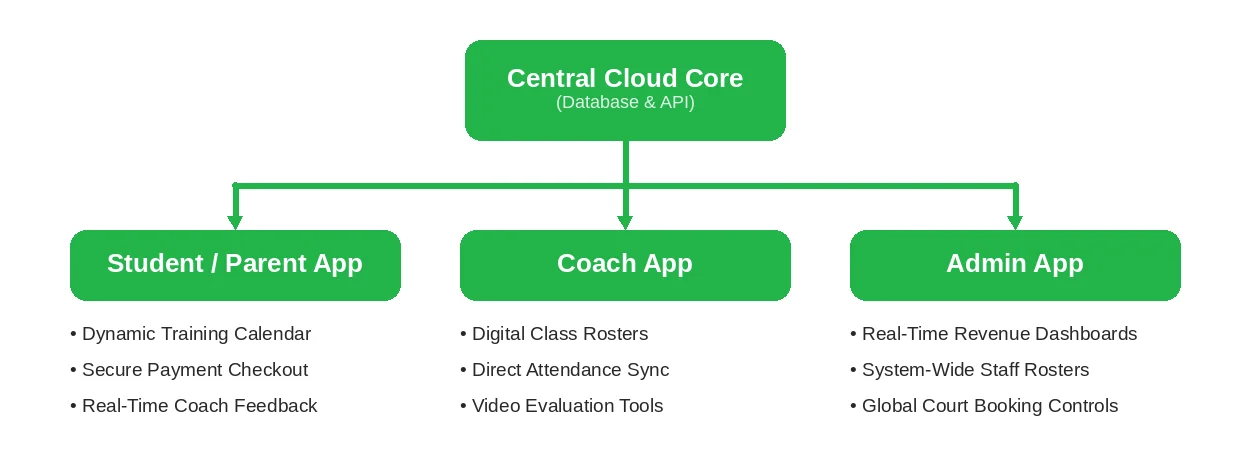
- The student / parent portal: Parents and athletes access their personal training calendars, receive weather alerts and schedule changes, view coaches' performance reports, make secure tuition payments, and message staff directly.
- The coach portal: Coaches view their assigned training groups, record attendance directly on the field, input physical testing scores, view medical constraints, and log video analysis notes.
- The administrator dashboard: Executive staff manage the global roster, schedule court reservations across multiple sites, monitor capacity limits, track tuition revenue, and run financial audits from a central desktop system.
Together, these role-specific interfaces connect the same underlying data while presenting each user with the workflows and information relevant to their responsibilities. This creates a consistent experience across the academy without sacrificing usability, security, or administrative control.
Enterprise Technology Stack for Sports Platforms
The technology stack should therefore be selected around the academy's actual operating requirements rather than around individual technologies. A scalable architecture typically combines modern application frameworks, cloud infrastructure, secure databases, real-time notification services, analytics tools, and payment integrations to support the platform as it grows.
| Technology Category | Selected Stack Elements | Primary Purpose inside App Lifecycle |
| Mobile Applications | Flutter, React Native, Swift, Kotlin | Cross-platform UI development or high-performance native rendering. |
| Backend Services | Node.js, Python (FastAPI, Django) | Managing light transaction routing or running data analytics pipelines. |
| Primary Databases | PostgreSQL, MongoDB | Relational database for student profiles, and NoSQL databases for activity logs. |
| Cloud Infrastructure | AWS, Microsoft Azure, Google Cloud | Secure, multi-zone serverless execution and load balancing. |
| Notification Services | Firebase Cloud Messaging (FCM) | Delivering instant, real-time push alerts and reminders. |
| Performance Analytics | Power BI, Mixpanel | Compiling interactive metric dashboards for coaches and managers. |
| Payment Gateways | Stripe, Adyen | Processing credit card checkouts and automated recurring billing. |
The specific combination depends on the academy's scale, existing infrastructure, integration requirements, security constraints, and target user experience. For a smaller implementation, a simpler stack may be sufficient; a multi-location or enterprise platform may require more advanced cloud architecture, integrations, analytics, and mobile capabilities.
Implementing AI in Modern Sports Academy Software
Modern sports academies can use AI to extend their management platform beyond routine administration and support more informed scheduling, athlete development, and workload management. The most valuable applications are those that build on reliable operational data rather than simply adding AI as a standalone feature.
Automated scheduling optimization
AI algorithms can analyze historical court utilization, coach availability, and athlete commute patterns to automatically design and optimize seasonal training calendars, maximizing court occupancy while eliminating scheduling conflicts.
Predictive athlete analytics and development
Machine learning models can evaluate years of historical fitness scores, injury logs, and match results to identify performance trends, map skill development projections, and automatically highlight high-potential junior athletes.
Wearable-based injury risk mitigation
By ingesting active biometrics (such as heart rate, speed, and recovery metrics) directly from wearable devices, AI models can detect subtle changes in an athlete's physical baseline, predict cumulative fatigue, and warn coaches to adjust workload schedules to prevent strain injuries.
The Custom Software Development Lifecycle
Developing a custom sports training management system requires a structured engineering pipeline to ensure a secure, reliable launch:

Phase 1: Product discovery and requirements gathering
This initial phase aligns business goals with technical constraints. Focus on documenting your precise business workflows, defining user roles (admin, coach, parent, athlete), mapping your target integrations, and scoping your initial MVP backlog.
Phase 2: User-centric UX/UI design
The interface of an academy application must be clean, highly intuitive, and easily operable. Designers focus on building accessible scheduling screens, quick-tap class check-in views for coaches on the field, and a clear mobile interface for parents tracking training schedules and tuition invoices.
Phase 3: Lean MVP development sprint
Avoid building every planned feature in your initial release. Focus initial engineering cycles on stabilizing core transactional mechanics: student CRM database fields, basic court scheduling controls, class attendance tracking, and standard credit card checkouts.
Phase 4: Integration and optimization
Once your core modules are stable, integrate the advanced automation layers. Connect your payment gateway for automated monthly subscriptions, configure native push notifications, establish wearable biometric syncing, and run data pipeline checks.
Phase 5: Verification, migration, and launch
Before going live, execute thorough quality-assurance testing. Conduct device compatibility checks across iOS and Android screens, run security penetration tests to validate medical data privacy compliance, execute mock data migrations from legacy Excel sheets, and begin structured onboarding programs for your coaches.
This lifecycle creates a stable foundation before the academy moves into more advanced stages of digital transformation. Once the core platform is operating reliably, new capabilities can be introduced incrementally based on actual usage data, user feedback, and evolving business needs.
How Much Does Sports Academy Software Cost?
The cost and timeline of developing sports academy software vary significantly depending on the scope of the platform. A basic management system with core scheduling and membership features requires a very different level of effort than a multi-role platform with native mobile applications, complex integrations, wearable data, or AI capabilities.
The following ranges provide a general planning reference rather than a fixed project quote:
Standard project estimates
| Product Type | Development Timeline | Estimated Cost Range | Key Deliverables |
| Basic Academy Management System | 3–5 Months | $40,000 – $80,000 | Central student database, web-based calendar booking, manual attendance logs, and standard billing. |
| Multi-Role Platform with Mobile Apps | 6–12 Months | $100,000 – $200,000 | Custom student CRM, native iOS/Android portals, recurring payment processing, and Push notification services. |
| AI-Powered Sports Tech Ecosystem | 12+ Months | $200,000+ | AI schedule optimization, wearable data synchronization, predictive performance trends, and multi-location architecture. |
The final budget should be determined during discovery, once the academy's workflows, user roles, integrations, data requirements, and MVP scope are clearly defined. Starting with a focused MVP can reduce the initial investment while creating a foundation that can be expanded as the academy's needs and digital maturity grow.
However, a successful digital transformation depends on more than selecting the right features and setting an appropriate budget. Sports academies also need to account for how the new platform will be adopted by staff, how sensitive athlete data will be protected, and how the system will perform as the organization expands. Addressing these challenges early can prevent many of the problems that otherwise emerge after launch.
Challenges When Digitizing Sports Academies
Moving from spreadsheets, paper records, and messaging apps to a centralized digital platform changes how coaches, administrators, parents, and athletes work every day. Three challenges are particularly important to address during planning and implementation.
Challenge 1: Low user adoption and resistance to change
- The risk: If the software is too complex or difficult to navigate, coaches will avoid using the app on the field, returning to offline notebooks, while parents will ignore the platform.
- The mitigation: Prioritize a clean, mobile-first design. Involve your coaching staff early in the design process to ensure the tracking interface works smoothly during active training. Deliver targeted, role-based training programs and execute a gradual rollout to manage the transition smoothly.
Challenge 2: Secure data management and compliance
- The risk: Storing personal student details, emergency family contacts, and private athlete medical histories (such as injuries or diagnoses) exposes your organization to severe security leaks and compliance fines under GDPR and HIPAA.
- The mitigation: Enforce strict role-based access control (RBAC) across your database, ensuring only authorized administrators can view sensitive personal records. Encrypt all student data both in transit and at rest, and implement secure, multi-factor login protocols.
Challenge 3: Scaling across multi-location franchises
- The risk: As your sports academy scales to multiple regional facilities or international franchises, local databases become disconnected, causing scheduling conflicts and fragmented financial reporting.
- The solution: Build your platform using a highly scalable, multi-tenant cloud architecture. This allows your central corporate office to maintain global visibility over revenue and schedules, while giving local branch managers the flexibility to coordinate their site's daily operations.
These challenges show why digital transformation should be approached as an organizational change, not simply a software implementation. The technology needs to fit the way people work, protect the data they rely on, and provide enough architectural flexibility to support the academy as it grows.
For organizations developing sports academy software as a commercial product, however, there is another consideration: how the platform itself will generate revenue. A clear monetization model should be defined early because it can influence the product's architecture, pricing structure, tenant management, payment flows, and scalability requirements.
Monetization Models for Sports Academy Platforms
For technology companies building a commercial sports management platform, several monetization models can be considered. The right choice depends on the target customers, platform architecture, level of customization, and how directly revenue is connected to academy activity.
- SaaS subscription for sports academies: Charge clubs, academies, and federations a recurring monthly or annual fee based on active workspace features, facility size, or administrative users.
- Per-athlete tiered pricing: Align pricing with organizational growth by charging the academy a minor recurring monthly fee per active athlete profile in their CRM.
- Integrated transaction monetization: Partner with payment processors (like Stripe) to take a small percentage of every credit card transaction, session booking, and monthly tuition charge processed through the platform.
- Enterprise custom licensing: Sell dedicated, white-labeled platform deployments to national sports federations, professional clubs, or large franchise chains under customized licensing agreements.
For many commercial sports platforms, a hybrid model can provide the most flexibility - for example, a recurring SaaS fee combined with usage-based charges, transaction fees, or additional costs for enterprise customization and support.
Why Choose Emerline as Your Software Product Development Partner
Transitioning your sports academy from fragmented, manual spreadsheets to a secure, automated, and unified management platform requires an engineering partner that combines deep mobile development expertise with advanced cloud, database, and system integration capabilities.
Building a successful digital product demands more than simply generating code to specification; it requires aligning your entire technology stack to support business growth, protect operational margins, and scale under user load. Minor architectural omissions or weak data configurations during early development can result in technical debt, performance bottlenecks, and eventual system failures.
As an established technology partner with deep capabilities across the enterprise cloud and custom engineering ecosystem, Emerline helps mid-market businesses, venture-backed startups, and global enterprises convert complex digital product ideas into reliable, high-performance software. We focus on optimizing your underlying system architecture, ensuring your product supports rapid business growth while completely removing the burden of technical debt from your core platforms.
Our elite product engineering and dedicated teams collaborate directly with your product owners, security officers, and technology leads to build scalable cloud-native architectures, modernize legacy applications, and implement advanced technologies (such as AI and machine learning) tailored to your exact operational goals.
The right software product development company becomes a strategic technology partner, helping you construct an unshakeable analytical and system foundation that drives permanent growth.
Contact our enterprise software architects today to schedule a comprehensive software product architecture assessment, identify potential optimization opportunities, and establish a secure, automated source of product truth.
Frequently Asked Questions
What is sports academy management software?
Sports academy management software is a unified cloud-based platform designed to automate the operational, financial, and athletic workflows of a sports organization. It integrates scheduling calendars, student databases (CRM), coach assignments, billing, communication tools, and athlete performance tracking into a single secure system.
How do sports academies improve operations through digital transformation?
Transitioning to a unified digital platform eliminates the errors and time delays of manual administration. It prevents double-booked facilities and staff, automates monthly billing cycles, consolidates data across multiple sites, improves parent-coach communication, and builds centralized historical profiles for athletes.
What core features should custom sports academy software include?
An enterprise-grade sports management system must include a secure student CRM, an automated scheduling calendar, a coach management module, an integrated payment checkout portal (supporting credit cards and recurring plans), a secure notification system, and an athlete performance analytics dashboard.
How much does it cost to develop a custom sports management platform?
The development cost of a custom sports management platform typically ranges between $40,000 and $200,000+, depending on project complexity, target mobile platforms, and integration requirements. Simple cloud platforms require less initial investment, while advanced ecosystems with multi-role mobile apps and AI-driven features fall into higher budget ranges.
Can sports academy software track athlete performance and progress over time?
Yes. Custom-built platforms allow coaches and trainers to log fitness scores, competition records, and training metrics directly from their mobile apps. The system consolidates these inputs to generate visual progress charts and compile developmental progress reports for parents and scouts.
Updated on Aug 11, 2026