Choosing the Right Software Engagement Model: Dedicated Team vs. Fixed Price vs. Time & Materials
Table of contents
- Who this guide is written by:
- Short Answer: Choosing Your Sourcing Framework
- Executive Summary: Engagement Sourcing Matrix
- Software Engagement Model Evaluation Scorecard
- Quantitative sourcing scorecard
- Hidden Risks Behind Each Engagement Model
- 1. Fixed price hidden constraints
- 2. Dedicated development team hidden risks
- 3. Time & Materials (T&M) hidden risks
- Sourcing Boundaries: Dedicated Team vs. IT Staff Augmentation
- Structural sourcing differences
- Technical Mechanisms of the Sourcing Models
- 1. Fixed price model mechanism
- 2. Dedicated development team model mechanism
- 3. Time & Materials (T&M) model mechanism
- Decision Framework: Selecting Your Sourcing Model
- Choose Fixed Price when:
- Choose a Dedicated Team when:
- Choose Time & Materials when:
- How to Select a Technology Partner Based on Your Engagement Model
- If choosing a Fixed Price contract, verify:
- If choosing a Dedicated Team model, verify:
- If choosing a Time & Materials (T&M) model, verify:
- Hybrid Sourcing Strategy: The Product Engineering Best Practice
- Cost Comparison: Dedicated Team vs. Fixed Price
- Structural financial comparison
- Why Choose Emerline as Your Software Sourcing Partner
- Frequently Asked Questions
- What is the difference between Dedicated Team and Fixed Price models?
- Is Dedicated Team cheaper than Fixed Price?
- When should I choose Fixed Price software development?
- Dedicated Team vs. typical outsourcing: What is better?
- Can companies combine Dedicated Team and Fixed Price models?
The right software engagement model depends less on price and more on how predictable your requirements are, how much control you need, and whether you are building a one-time utility application or a digital asset that will evolve for years. Selecting an incompatible contractual structure introduces project delays, budget friction, technical debt, and misaligned product-market fit.
For C-level executives, startup founders, and product engineering leaders, selecting the optimal software development engagement model is just as critical as choosing the product's underlying technology stack. The structural framework you choose directly dictates your product's development speed, budget predictability, engineering resource allocation, and overall agility in response to market feedback.
This comprehensive enterprise guide provides a rigorous, objective framework to help technology leaders evaluate potential software development engagement models, uncover hidden operational risks, and select a contract structure capable of supporting long-term engineering success.
Who this guide is written by:
- Enterprise software architects at Emerline with experience managing distributed delivery teams.
- Procurement and sourcing specialists focused on technology vendor contract optimization.
- Agile product managers specializing in cross-functional engineering team velocity.
Short Answer: Choosing Your Sourcing Framework
- A Fixed Price model works best for short-term, small-scale initiatives with stable, locked requirements, a clear scope, and predictable deliverables.
- A Dedicated Team model is the superior business investment for long-term, complex digital product development, SaaS platform scaling, and organizations looking to retain deep domain knowledge within an outsourced engineering department.
- A Time & Materials (T&M) model provides the optimal balance for medium-complexity projects with evolving scopes, allowing organizations to pay strictly for actual developer hours consumed while adjusting product roadmaps dynamically on the fly.
Executive Summary: Engagement Sourcing Matrix
To assist procurement and engineering teams during the partner selection phase, we have consolidated the core operational and financial vectors across these custom software development pricing models.
| Evaluation Vector | Fixed Price Contract | Dedicated Development Team | Time & Materials (T&M) |
| Project Requirements | Static: Fully locked, documented, and immutable upfront. | Dynamic: Backlog-driven, continuously evolving. | Fluid: Iterative requirements that adapt to active marketing inputs. |
| Budget Control | CapEx Fixed: Single, fixed total project budget target. | OpEx Monthly: Predictable monthly invoices based on team size. | Variable: Driven entirely by hourly resource consumption rates. |
| Response to Change | Rigid: modifications require slow, billable change requests. | High: Tasks are re-prioritized seamlessly during sprint planning. | Maximum: Scope scales up or down based on daily operational needs. |
| Risk Distribution | Absorbed primarily by the engineering vendor. | Shared transparently between client and partner. | Borne primarily by the client brand. |
| Best Suited For | MVPs, minor migrations, and tightly scoped utilities. | SaaS platforms, core software platforms, and scaling teams. | Evolving systems, prototypes, and short-term agile sprints. |
| Management Overhead | Low: vendor-side PMs run daily execution streams. | Shared: requires active client product ownership. | High: demands constant monitoring of billable sprint sheets. |
Software Engagement Model Evaluation Scorecard
To evaluate candidate models objectively against your product parameters, reference this quantitative framework during project scoping. If your product roadmap is expected to evolve after development starts, a Dedicated Team usually provides the strongest balance between control, flexibility, and long-term technical ownership.
Quantitative sourcing scorecard
| Evaluation Factor | Fixed Price | Dedicated Team | Time & Materials (T&M) |
| Requirement Uncertainty Tolerance | ✓ | ✓✓✓✓✓ | ✓✓✓✓✓ |
| Upfront Budget Predictability | ✓✓✓✓✓ | ✓✓✓✓ | ✓✓ |
| Speed to Project Kickoff | ✓ | ✓✓✓ | ✓✓✓✓✓ |
| Frictionless Ability to Pivot | ✓ | ✓✓✓✓✓ | ✓✓✓✓✓ |
| Long-Term Product Ownership | ✓✓ | ✓✓✓✓✓ | ✓✓✓ |
| Suitability for SaaS & Core Platforms | ✓ | ✓✓✓✓✓ | ✓✓✓✓ |
| Client-Side Management Overhead | ✓✓✓✓✓ | ✓✓✓ | ✓✓ |
| Value for Iterative Innovation | ✓ | ✓✓✓✓✓ | ✓✓✓✓✓ |
Hidden Risks Behind Each Engagement Model
Every software development model contains systemic constraints and structural vulnerabilities that procurement teams must actively manage. Understanding where organizations typically experience project failure is essential to shielding your bottom line.
1. Fixed price hidden constraints
- The over-specification trap: Forcing a product design team to document every future button and database field before validating real-world user trends leads to building over-engineered, unmarketable feature sets.
- The "Minimal Compliance" inefficiency: When technical issues arise, a fixed-price vendor may prioritize meeting basic contractual specifications over building a high-performance architectural design to preserve their margins.
- Expensive change request friction: Adjustments or feature pivots trigger complex change request workflows, which routinely freeze project velocity and inflate the final project cost.
2. Dedicated development team hidden risks
- Unmanaged capacity waste: If your product management team fails to prioritize user stories or design specs in advance, your organization runs the risk of paying for idle engineering capacity.
- Weak knowledge transfer safeguards: If the vendor does not commit code cleanly to your repositories or lacks robust architecture documentation, you run a high vendor lock-in risk, making a future team transition highly complex.
- Inadequate team balance: Tightly monitored developer retention rates are necessary; high internal team turnover destroys sprint consistency and disrupts velocity.
3. Time & Materials (T&M) hidden risks
- Compounding budget drift: Without hard milestone targets or strict sprint velocity boundaries, project expenditures can easily escape initial financial boundaries.
- Weak delivery accountability: A pure billing-by-the-hour framework can create perverse incentives if there are no independent QA parameters and automated delivery checkpoints.
- Difficult long-term dudgeting: Financial forecasting becomes highly volatile, making it complicated to align development milestones with funding rounds.
Sourcing Boundaries: Dedicated Team vs. IT Staff Augmentation
Many enterprise buyers confuse the Dedicated Development Team model with IT Staff Augmentation. While both leverage external engineering talent, they differ fundamentally across ownership, stability, and product alignment.
Structural sourcing differences
| Sourcing Dimension | IT Staff Augmentation | Dedicated Development Team |
| Primary Structural Purpose | Filling individual capacity gaps or technical skill shortfalls. | Designing, scaling, and maintaining complete software products. |
| Product Engineering Ownership | 100% Client Managed: You run daily task routing. | Shared: Vendor provides architects, delivery metrics, and QA. |
| Talent Stability & Retention | Low: augmented engineers move quickly between accounts. | High: core engineering squad remains assigned to your product lifecycle. |
| Long-Term Domain Knowledge | Minimal: knowledge exits the organization when the engineer leaves. | Deep: team builds custom code standards and architecture guides. |
| Best Suited For | Shorthanded internal teams needing short-term help. | Product startups, SaaS companies, and long-term platform transformations. |
Technical Mechanisms of the Sourcing Models
Understanding how each engagement operates at an architectural level ensures better system governance.
1. Fixed price model mechanism

- Extensive upfront scoping: The entire contract relies on a granular Software Requirement Specification (SRS) document that maps every visual element, API dependency, and database parameter in advance.
- Predetermined payment milestones: Financial disbursements are tied directly to the successful verification and release of specific, pre-agreed product phases.
- Transferred execution risk: The development company assumes the operational risk of delivery delays. If the engineering team underestimation creates extra work within the agreed scope, the vendor absorbs the financial loss.
2. Dedicated development team model mechanism
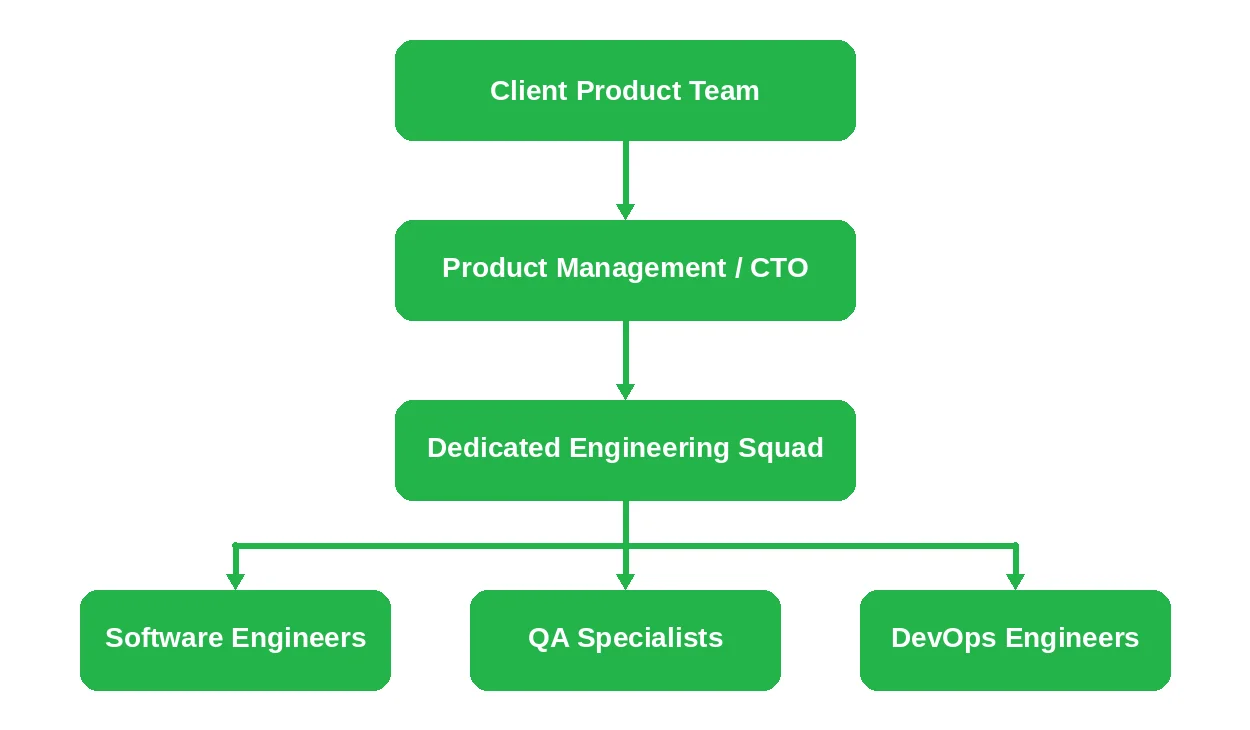
- Sustained asset retention: The assigned developers remain allocated to your platform over the long term, deeply learning your complex business logic and architecture.
- Flexible backlog management: You retain absolute ownership of the product roadmap. Your product managers can add features, alter sprint targets, and pivot priorities without contract friction.
- Integrated DevSecOps delivery: Engineering follows fast-paced Agile methodologies (Scrum/Kanban) with continuous automated testing and cloud production deployments.
3. Time & Materials (T&M) model mechanism

- Pay-as-you-go flexibility: There are no locked scope constraints. You pay standard, pre-negotiated hourly rates for the active engineers engaged on your project.
- Agile scope iteration: Ideal for software environments where developers must test experimental features, collect immediate user feedback, and continuously pivot development paths.
- Transparent resource tracking: Lenders and product owners review detailed timesheets alongside automated code commits to match billing data with real-world development progress.
Decision Framework: Selecting Your Sourcing Model
Use this structured decision framework to determine which model matches your immediate product parameters:
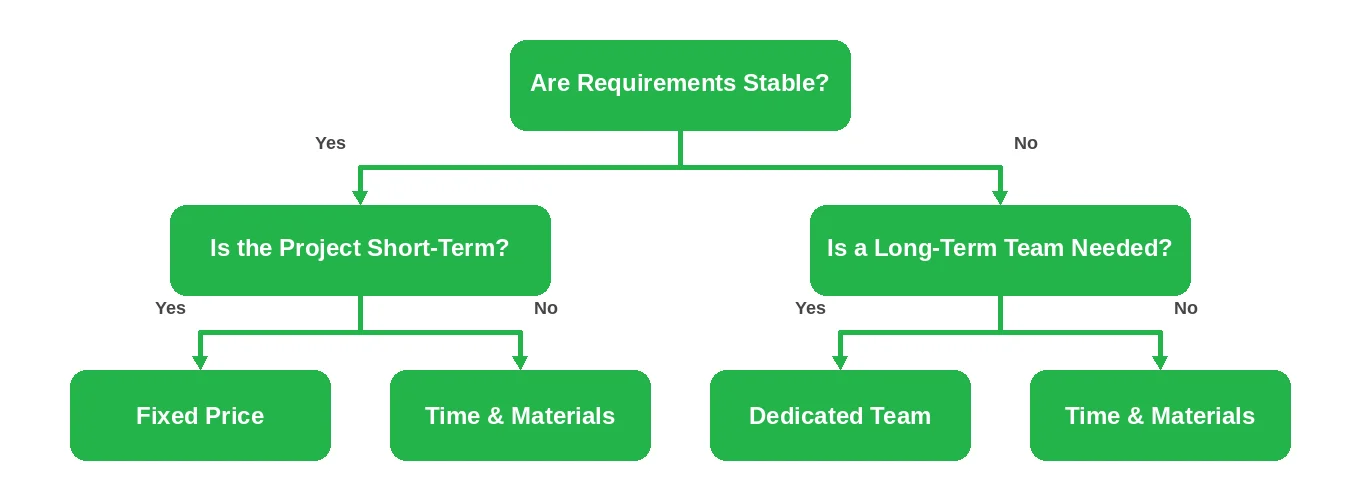
Choose Fixed Price when:
1. The product scope is fully documented, simple, and highly unlikely to change during development.
2. You are executing a highly standardized technical task (e.g., standard API migration or a basic legacy platform upgrade).
3. Your organization operates under strict, non-negotiable budget boundaries.
Choose a Dedicated Team when:
1. You are constructing a highly complex, custom software product or an enterprise SaaS ecosystem designed to scale.
2. The development lifecycle is planned to extend beyond 6 months, requiring continuous feature releases and maintenance updates.
3. You want to build a long-term technology partnership and maintain complete architecture control without vendor lock-in.
Choose Time & Materials when:
1. You are developing an early-stage MVP prototype with rapidly shifting requirements.
2. You need access to specialized technical experts (such as data engineers or machine learning architects) for short-term, iterative sprints.
3. The product-market fit parameters are undetermined, requiring rapid user validation loops.
How to Select a Technology Partner Based on Your Engagement Model
A vendor's delivery capabilities must match your chosen contractual model. Vetting partners requires targeted checks customized to the specific engagement structure:
If choosing a Fixed Price contract, verify:
1. SRS engineering maturity: Ensure the vendor's team contains technical analysts who can construct an exhaustive Software Requirement Specification (SRS) without leaving technical blind spots.
2. Discovery framework depth: The partner must operate with a mandatory, paid discovery phase to validate technical architecture dependencies before providing a financial quote.
3. Change request clarity: Review their change request policy to ensure that minor scope refinements will not attract predatory transaction fees post-signing.
If choosing a Dedicated Team model, verify:
1. Developer retention rates: Insist on auditing the partner's average engineer turnover rate. High staff churn will directly destroy your sprint velocity and leak domain knowledge.
2. Elastic resource scaling velocity: Evaluate how quickly the vendor can deploy additional specialized roles (such as a senior cloud architect or DevSecOps lead) to your squad.
3. IP transfer and code governance: Ensure all contracts explicitly mandate full intellectual property (IP) ownership and continuous code commits to your native GitHub or GitLab instances from day one.
If choosing a Time & Materials (T&M) model, verify:
1. Reporting transparency tools: The partner must provide full, auditable visibility into toolsets like Jira or Azure DevOps, matching every invoiced hour to explicit user stories and commits.
2. Sprint velocity predictability: Review historical case studies to evaluate how closely their agile squads track to pre-estimated sprint points across long development horizons.
3. Asynchronous communication workflows: Confirm their engineering squads have mature, native language proficiencies and established communication tempos to eliminate time-zone disconnects.
Hybrid Sourcing Strategy: The Product Engineering Best Practice
For complex enterprise software applications, forcing your development into a single contract model can introduce unnecessary risks. Forward-thinking organizations often implement a hybrid engagement framework to balance budget safety with engineering speed:

- Phase 1 (Fixed price product discovery): The collaboration begins under a short-term Fixed Price agreement. Emerline's product architects, database designers, and UI/UX teams audit requirements to produce finalized wireframes, validated system architecture diagrams, and a structured, line-by-line project backlog.
- Phase 2 (Dedicated development team): Armed with a clean technical blueprint, the project transitions to a Dedicated Team structure. This squad focuses exclusively on building, testing, and launching the core MVP, adapting to market feedback without processing contract friction.
- Phase 3 (Continuous optimization & scale): Once the core platform is running stably in production, the model transitions to a flexible Time & Materials or on-demand scale structure. Specialized engineering squads (such as data engineers or machine learning experts) are pulled into the project on demand to optimize performance and introduce advanced AI enhancements.
Cost Comparison: Dedicated Team vs. Fixed Price
Understanding the long-term financial dynamics of both models prevents budget surprises down the road.
Structural financial comparison
| Cost Vector | Dedicated Team Model | Fixed Price Model |
| Payment Structure | Predictable monthly invoices based on team size and resources. | Milestone-based or structured installment payments. |
| Upfront Scoping Cost | Low: development can begin while the backlog is being refined. | High: requires deep initial investment in technical specifications. |
| Contingency Markup | Low. Pay for actual resources rather than a vendor risk buffer. | High. Includes a 15% to 35% risk premium built into the quote. |
| Cost of Change | Low. You simply re-prioritize the backlog during sprint planning. | High. Every modification requires a formal, billable change request. |
| Long-Term ROI | Exceptional for complex, evolving software products. | Good for highly defined, single-use utility applications. |
Why Choose Emerline as Your Software Sourcing Partner
Selecting the correct engagement model is only half the battle; the long-term viability of your digital platform ultimately relies on the architectural design standards, testing rigor, and engineering capabilities of your technology partner.
Building a successful digital product demands more than simply generating code to static specifications; it requires aligning your entire technology stack to support business growth, protect operational margins, and scale under live user load. Minor architectural omissions or weak data configurations during early development can result in technical debt, performance bottlenecks, and eventual system failures.
As an established technology partner with deep capabilities across the enterprise cloud and custom engineering ecosystem, Emerline helps mid-market businesses, venture-backed startups, and global enterprises convert complex digital product ideas into reliable, high-performance software. We focus on optimizing your underlying system architecture, ensuring your product supports rapid business growth while completely removing the burden of technical debt from your core platforms.
Our elite product engineering and dedicated teams collaborate directly with your product owners, security officers, and technology leads to build scalable cloud-native architectures, modernize legacy applications, and implement advanced technologies (such as AI and machine learning) tailored to your exact operational goals.
Contact our enterprise software architects today to arrange a comprehensive software platform assessment, select the optimal engagement framework for your workflow constraints, and build a secure, automated source of product truth.
Frequently Asked Questions
What is the difference between Dedicated Team and Fixed Price models?
A Dedicated Team model provides a flexible, exclusively allocated squad of engineering resources who work continuously on your product under your backlog direction. A Fixed Price model locks down a specific project scope, timeline, budget, and list of deliverables before any development begins.
Is Dedicated Team cheaper than Fixed Price?
For long-term, evolving software products, a Dedicated Team is almost always more cost-effective. While a Fixed Price contract seems cheaper upfront, the vendor builds a 15% to 35% risk premium into the quote to offset scope uncertainties. Furthermore, post-signing change requests under a Fixed Price model can quickly inflate the final project cost.
When should I choose Fixed Price software development?
Choose Fixed Price software development only when your project requirements are static, highly documented, and unlikely to change during development. Excellent examples include building simple, static corporate websites, migrating structured databases, or integrating well-documented third-party APIs.
Dedicated Team vs. typical outsourcing: What is better?
Typical task-based outsourcing involves hiring temporary developers to write code to direct specifications with minimal ownership. A Dedicated Team model behaves as a long-term, strategic product engineering partnership. The team contains dedicated software architects, QA specialists, and DevOps engineers who share ownership of your product's performance and business outcomes.
Can companies combine Dedicated Team and Fixed Price models?
Yes. Many organizations utilize a Fixed Price model to execute a structured product discovery phase (defining system architecture, user journeys, and initial backlogs), and then transition to a Dedicated Team to handle core development, MVP launch, and continuous product scaling.
Published on Aug 4, 2026