10 Reasons to Choose Magento for E-Commerce Website Development in 2026
Table of contents
- Quick Answer: Why Choose Magento in 2026?
- Key Takeaways
- Magento’s Market Share
- Global Retail Digital Penetration
- 10 Compelling Reasons to Migrate Your Store to Magento
- 1. Absolute Architectural Flexibility
- 2. Deep Enterprise Feature Set Out-of-the-Box
- 3. High Scalability and Performance Bounds
- 4. Native SEO-Friendly Architecture
- 5. Production-Grade Cybersecurity and Compliance
- 6. Mobile-First and PWA Responsive Design
- 7. Multi-Store, Multi-Currency, and Multi-Language Scaling
- 8. Frictionless Enterprise Software Integrations
- 9. Advanced Analytical Reporting and Insights
- 10. An AI-Ready Technology Ecosystem
- Why Choose Emerline as Your E-Commerce Engineering Partner
Frequently Asked Questions
What is the primary difference between Magento Open Source and Adobe Commerce?
Does Magento scale well for stores with over 100,000 products?
Is custom-built Magento software secure?
Can Magento integrate with proprietary or custom legacy ERPs?
How long does it take to implement or migrate to a custom Magento store?
In today's fast-paced business landscape, an online presence is not just a luxury but an operational necessity. Millions of global retail transactions have permanently shifted to digital channels, forcing businesses to seek robust platforms capable of delivering highly customized, exceptional online shopping experiences.
Magento Open Source (alongside its enterprise counterpart, Adobe Commerce) continues to stand as the definitive industry standard for building dynamic, enterprise-grade online stores.
You might ask, why pick Magento over a number of more popular options available on the market? So, hear it from the experts! At Emerline, we understand the significance of a powerful E-commerce solution, and that's why we specialize in Magento-powered website development.
We’re here to put all your doubts to rest. In this article, we'll explore the 10 most compelling reasons why Magento stands out as the preferred choice for E-commerce website development in 2026.
Quick Answer: Why Choose Magento in 2026?
Choose Magento if your business requires a highly customizable, open-source e-commerce ecosystem capable of handling deep enterprise integrations (ERP, CRM, PIM), multi-store environments, and massive transactional scaling.
Unlike closed SaaS alternatives that charge recurring percentage fees on your GMV, Magento gives you 100% data ownership, unrestricted code control, an AI-ready backend infrastructure, and global multi-currency scalability designed for complex corporate workflows.
Key Takeaways
- Total architectural ownership: Magento Open Source offers a decoupled, flexible framework that allows developers to customize code blueprints without restrictive licensing constraints.
- Enterprise scaling capabilities: Built-in caching, database partitioning capabilities, and modular logic ensure Magento scales smoothly during peak traffic windows like Black Friday.
- Native multi-tenant management: A single Magento admin panel allows your team to manage multiple global storefronts, localized brands, and distinct B2B/B2C warehouses.
- AI-driven personalization: Modern Magento setups leverage third-party AI extensions to run contextual semantic searches, automated product recommendations, and custom customer segmentations.
- Zero GMV tax scaling: Unlike proprietary SaaS competitors, Magento does not penalize your growth by taking a percentage cut of your store's total gross merchandise value.
Magento’s Market Share
In today’s digital realm, the way we interact with others and the way we shop has undergone a huge shift. The rise of online shopping, propelled by technological advancements and changing consumer preferences, has reshaped the business world.
So, before we dive into why Magento should be your go-to E-commerce platform, it's crucial to acknowledge the current trends and market insights that drive this choice.
Global Retail Digital Penetration
| Operational Market Metric | Current Strategic Performance Baseline |
| Total Global Online Transactions | Over 21.5% of all retail purchases are executed via digital channels. |
| Total Global Market Valuation | Projected to surpass a staggering $5.2 trillion worldwide. |
| Magento Operational Positioning | Remains a top-3 platform choice for high-volume enterprise data migrations. |
| Target Scale Environment | Best-in-class performance for stores maintaining over 50,000+ complex SKUs. |
According to recent research by Statista, the global E-commerce market is projected to reach a staggering $5.19 trillion by the end of 2026.
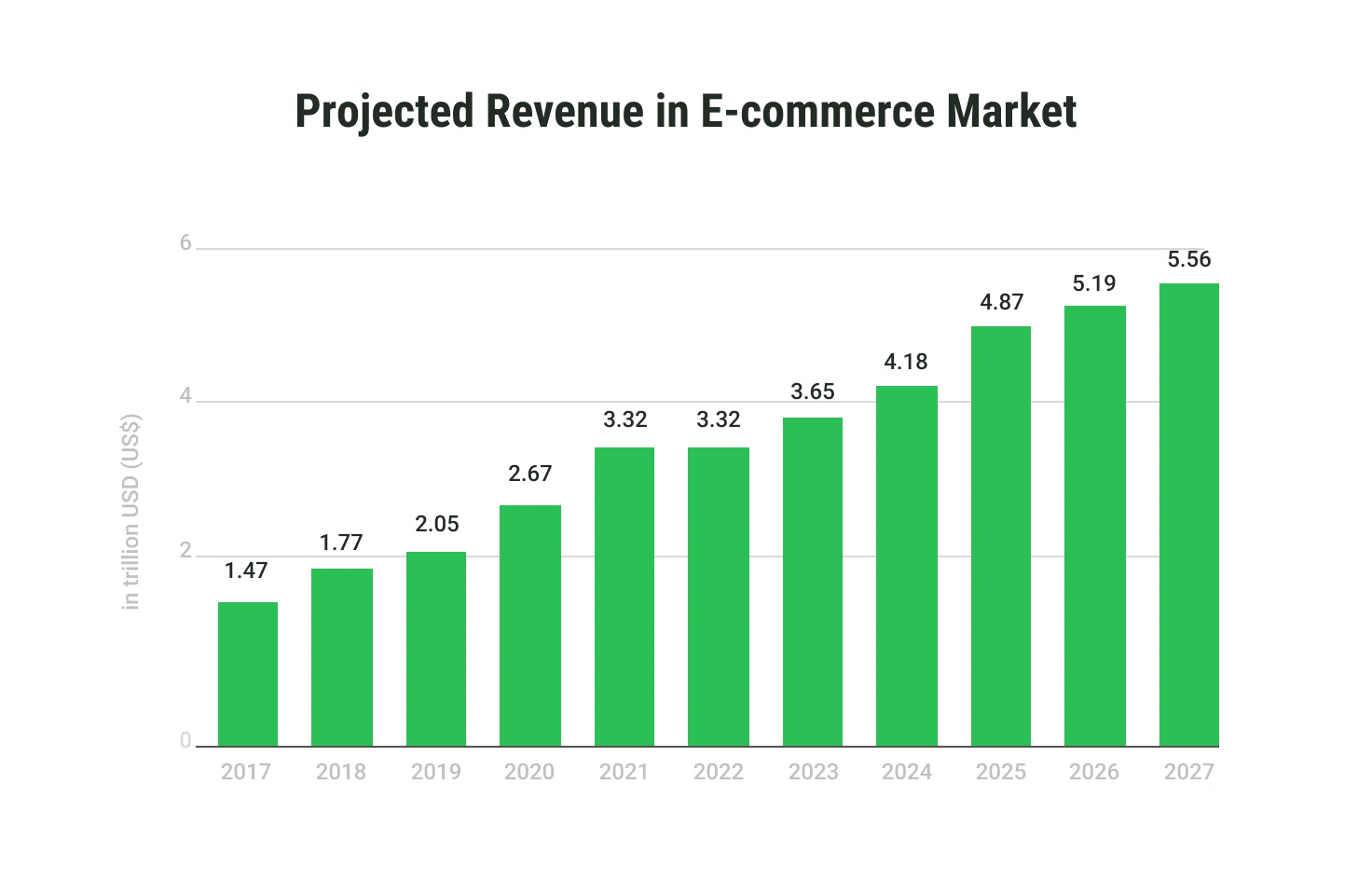
This surge underscores the need for a platform that can accommodate growth, innovation, and customer expectations. Here is where Magento enters the scene. Magento is currently one of the most popular E-commerce platforms globally and shows incredible promise. As per LitExtension’s data, Magento was one of the three most migrated to E-commerce platforms.
10 Compelling Reasons to Migrate Your Store to Magento
Let’s see why Magento still remains one of the top choices for an E-commerce platform and how we can make use of this innovative platform to help you.
1. Absolute Architectural Flexibility
In the bustling world of E-commerce, one size definitely doesn't fit all. The standout feature of Magento is its open-source architecture, which gives developers the artistic license to mold websites according to the exact demands of the business. This means your website becomes a tailor-made reflection of your brand's character and purpose.
2. Deep Enterprise Feature Set Out-of-the-Box
From robust product catalogs to personalized shopping experiences, Magento offers an extensive array of features that empower you to create a comprehensive and engaging online store with a custom theme.
3. High Scalability and Performance Bounds
As your business expands, your E-commerce platform should seamlessly grow with you. Magento's scalability is unmatched, allowing you to handle increased traffic, products, and transactions without compromising on performance.
Emerline Advice: True performance optimization on Magento comes from decoupling your front-end presentation layer from your back-end database queries. By implementing a headless architecture using Varnish Cache, Redis sessions, and Elasticsearch/OpenSearch protocols, you can maximize your straight-through page rendering, keeping average loading speeds well under 2 seconds even during intense concurrent shopping rushes.
4. Native SEO-Friendly Architecture
Visibility on search engines is the golden ticket to E-commerce success. In this digital age, being discoverable can make or break your business. With Magento's SEO-friendly architecture and optimization finesse, your products not only make an entrance but also steal the spotlight when potential buyers hit that search button.
Leverage our Magento development services to create an online presence that not only stands out but also drives meaningful traffic and conversions.
5. Production-Grade Cybersecurity and Compliance
Security is a critical risk vector for modern retail operations. Magento maintains an active security posture, delivering regular security patches and cryptographic release cycles to protect your digital core against newly discovered vulnerabilities.
Implementing Magento within a secure hosting environment allows your business to maintain strict PCI-DSS compliance, prevent cross-site scripting (XSS), and run automated fraud screening to protect sensitive customer records.
6. Mobile-First and PWA Responsive Design
Desktop-only storefront models are obsolete. Magento adopts a strict mobile-first design philosophy, providing fully responsive default themes alongside robust support for Progressive Web Apps (PWAs). A custom Magento PWA setup transforms your website into a fast, app-like mobile experience that supports offline shopping, push notifications, and high mobile conversion rates.
7. Multi-Store, Multi-Currency, and Multi-Language Scaling
If your ambitions stretch across borders, Magento's invaluable multi-language and multi-currency support come to the forefront. Navigating diverse markets requires more than a one-size-fits-all approach. It's about crafting experiences that resonate with different cultures.
8. Frictionless Enterprise Software Integrations
Seamlessly blending your E-commerce platform with your broader business systems is more than just an add-on — it's a strategic necessity. Magento's integration prowess acts as a bridge, syncing inventory, customer data, and more, to create a symphony of streamlined operations.
| Integration Class | Target Enterprise Software | Automated Business Workflow |
| Enterprise ERP | SAP S/4HANA, NetSuite, Oracle | Synchronizes financial ledgers, transactional records, and inventory tiers. |
| Corporate CRM | Salesforce, HubSpot, Microsoft Dynamics | Updates customer loyalty metrics, segmentations, and support logs. |
| Product Data (PIM) | Akeneo, Pimcore, InRiver | Pushes rich product descriptions, media assets, and translations to Magento. |
| Logistics & Warehouses | Fedex, DHL, Custom WMS tools | Calculates shipping rates and automates fulfillment status tracking. |
9. Advanced Analytical Reporting and Insights
Data-driven operations are essential to maximizing conversion metrics. Magento offers deeply integrated analytics tools that allow operators to track real-time sales curves, monitor cart abandonment rates, analyze buyer behavior patterns, and generate automated tax compliance audits.
10. An AI-Ready Technology Ecosystem
Modern retail environments rely heavily on artificial intelligence to drive personalization. Magento natively supports AI-driven extensions that optimize your digital shelf:
- Semantic Search Optimization: Replacing rigid keyword search parameters with intent-aware AI search algorithms that understand synonyms and natural language typos.
- Automated Recommendations: Serving customized "Frequently Bought Together" or "You May Also Like" grids based on real-time viewer history and aggregate consumer models.
- Generative Content Assistants: Speeding up catalog enrichment by leveraging generative AI plugins to draft missing product descriptions and metadata tags automatically.
Why Choose Emerline as Your E-Commerce Engineering Partner
In the dynamic world of E-commerce, Magento stands tall as a powerhouse for creating exceptional online stores. Emerline combines the prowess of Magento with our development expertise to craft tailored solutions that elevate your brand. With the global E-commerce market on the rise, now is the time to leverage the power of Magento and collaborate with Emerline to transform your E-commerce aspirations into reality.
With over 12 years of E-commerce expertise, Emerline is your trusted partner in bringing your Magento-powered vision to life. With a dedicated team of developers, designers, and strategists, we blend the power of Magento with our expertise to create E-commerce websites that captivate, convert, and delight. Contact us for advice and full cycle support in your E-commerce journey.
Frequently Asked Questions
What is the primary difference between Magento Open Source and Adobe Commerce?
Magento Open Source is the free, core codebase that offers complete custom programming freedom but requires internal infrastructure management. Adobe Commerce is the paid enterprise SaaS version built on the same core architecture, offering cloud hosting and pre-integrated premium features like advanced B2B modules and native visual merchandising.
Does Magento scale well for stores with over 100,000 products?
Yes. Magento is engineered specifically to handle high-volume enterprise workloads. By utilizing optimized caching systems (such as Redis, ElasticSearch, and Varnish), Magento can handle extensive catalogs with hundreds of thousands of SKUs without causing database or checkout delays.
Is custom-built Magento software secure?
Yes. Magento provides robust, enterprise-grade security features out-of-the-box. When deployed by a trusted technology partner who implements multi-factor authentication, data encryption, and regular security updates, Magento provides a highly secure environment that meets strict PCI-DSS and global data privacy standards.
Can Magento integrate with proprietary or custom legacy ERPs?
Yes. Magento features a highly mature, decoupled API layer supporting secure REST and GraphQL endpoints. This flexibility allows software engineers to build bi-directional integration bridges that sync data cleanly with any legacy ERP, custom warehouse management tool, or financial database.
How long does it take to implement or migrate to a custom Magento store?
A standard MVP implementation or direct migration from an older store typically takes 3 to 5 months. A comprehensive enterprise-grade rollout featuring bi-directional ERP integrations, multi-tenant global store configurations, and custom AI search logic generally requires 6 to 9+ months of custom engineering.
Updated on Jul 18, 2026