




How a regional wealth management firm leveraged open banking APIs to automate the 'Fact Find' process, uncover $50M in held-away assets, and deliver a seamless mobile experience.

Building a Crypto Integration Platform and Self-Service Portal for SwapKit


Overview
Emerline helped SwapKit extend its crypto infrastructure platform and introduce a self-service layer for integration management. This allowed the client to continue expanding protocol and blockchain support while reducing reliance on manual integration handling.

![]() 200%
200%YoY growth
in transaction volume achieved during the project period
![]() +9
+9New blockchains
integrated into the core platform, alongside support for two additional swap protocols.
![]() 0
0Manual steps
required for customers to set up and configure their integration after the self-service portal launched.
Background
SwapKit is a crypto infrastructure company founded by teams from the USA, Canada, and the UK. The company provides tools that allow other businesses to integrate crypto asset swaps and access multiple blockchain protocols through a single integration point.
The platform was built for companies that want to offer crypto swap functionality without maintaining separate connections to each blockchain network. Instead of building and updating many integrations, customers connect once and gain access to a broad set of protocols and assets.
As the platform grew, the number of supported blockchains and integrations increased. This created a need for better control over integration setup and management, as well as a more scalable and effective way to onboard and support customers.
To support this stage of growth, SwapKit partnered with Emerline, aiming to strengthen the core platform and introduce tools for customer self-service.

Challenges
Rapidly evolving crypto integration landscape
SwapKit operates in a space where new blockchain protocols and networks are continuously emerging. The platform’s value depends on supporting multiple integrations simultaneously while keeping all of them up to date. This required continuous development effort focused on extending and maintaining supported protocols.
The scope of work included not only expansion but also ongoing adjustments to existing integrations as the ecosystem evolved.
Two parallel product streams
The project required work on two distinct areas at the same time. One stream focused on maintaining and extending the core SwapKit platform. The other focused on building a self-service portal for customers to configure and manage their integrations.
These streams followed a different delivery logic. The core platform required continuous development work, while the portal required structured product development with clearly defined functionality for end users.
Expanding the platform while building a customer-facing portal
The project combined two major workstreams. Alongside ongoing development of the core platform, the team was also responsible for delivering a new self-service portal for customers.
Both streams progressed in parallel and required different types of work. The platform team continued expanding and maintaining integrations across blockchain networks and protocols, while the portal team focused on creating a customer-facing product for integration management. Balancing these efforts required coordination across teams and clear alignment on priorities.
Need for coordinated work under shifting priorities
The project required close coordination between teams working on different parts of the system. The work included both planned development tasks and ongoing platform improvements.
This required a flexible approach to prioritization to ensure that platform development and portal delivery progressed in parallel without blocking each other.
Methodology and Approach
To address the dual focus of platform development and customer tooling, the work was split into two coordinated streams. This helped keep both directions aligned while allowing each to progress independently.
The approach combined structured planning with flexibility in execution:
- The self-service portal team focused on defining MVP functionality to enable fast release and reduce manual integration handling
- The core platform team used a hybrid Scrum/Kanban model
- Iteration planning and milestones ensured delivery alignment
- Kanban practices supported continuous flow and dynamic prioritization
This setup allowed the team to maintain steady platform evolution while introducing a structured way for customers to manage integrations independently.
Solution
The work delivered across both teams resulted in two connected components: an expanded core platform and a self-service portal built on top of it.
Together, they addressed the need to extend SwapKit’s integration capabilities and provide customers with tools to manage their setups independently.

Unified API and SDK
The core of the solution is the SwapKit API and SDK. It provides a single integration point for accessing multiple blockchain protocols and crypto assets via a single interface. Instead of building and maintaining separate connections for each protocol or blockchain, clients connect once and use a unified entry point that supports 8,000+ crypto assets.
The platform includes monitoring and observability mechanisms such as latency logging across different layers, request tracing, and custom dashboards. These tools provide visibility into system behavior and on-chain incidents and support ongoing performance analysis.
Protocol and blockchain expansion
In parallel with portal development, the core platform was extended with additional protocols and blockchain networks. This work included processing on-chain data, including collecting and parsing information across different blockchains to support integration and swap execution.
The expansion was carried out continuously, with new protocols and networks added as part of the platform’s ongoing development.


Customer self-service portal
The self-service portal was developed to allow customers to configure and manage their integrations without direct involvement from the internal team. It supports onboarding and setup of integration streams and allows customers to structure their usage across different applications.
Customers can define separate streams for different use cases, such as web and mobile applications. The portal also provides configuration options for integration setup, including custom fee definitions.
Swap widget
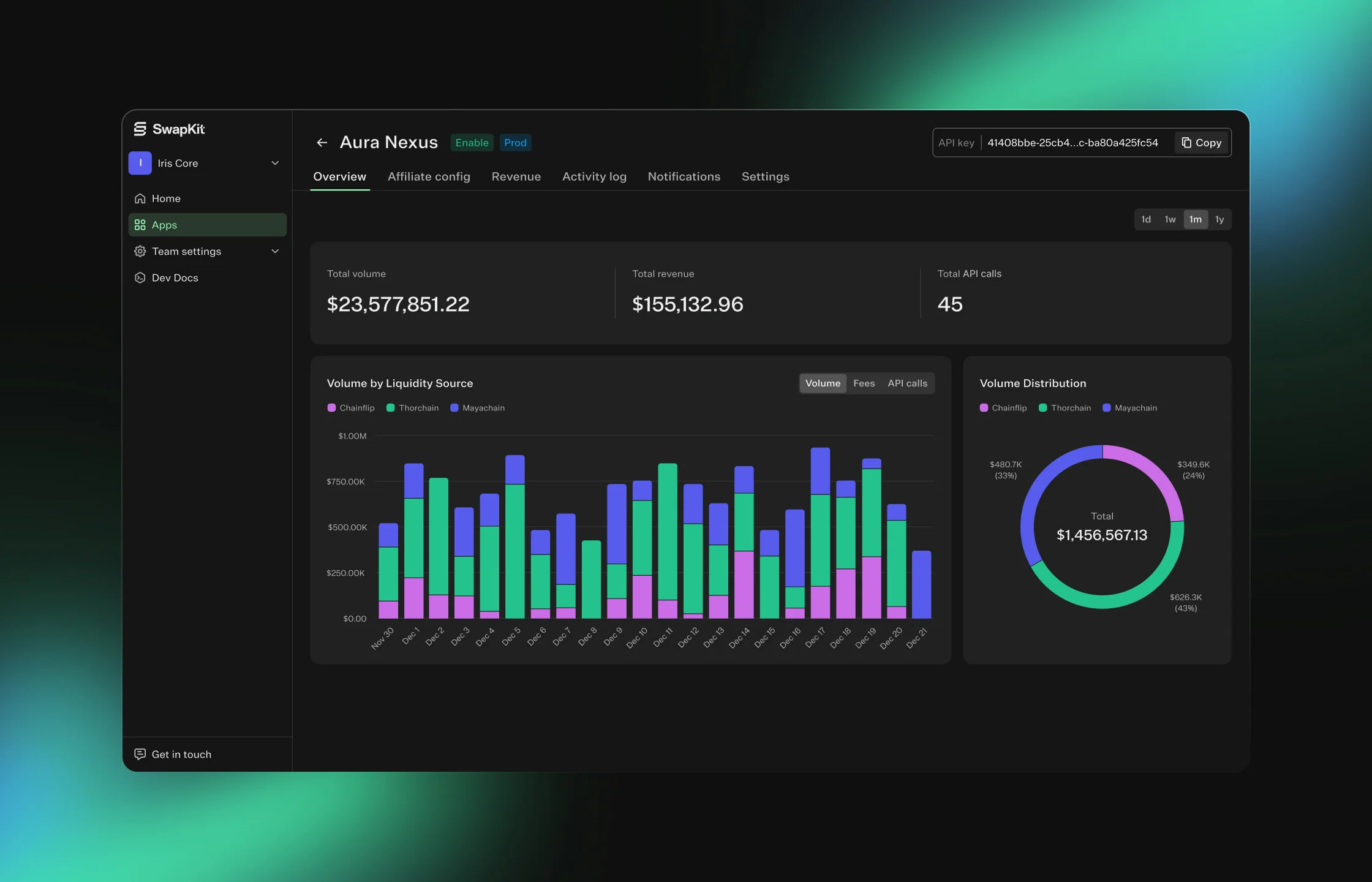
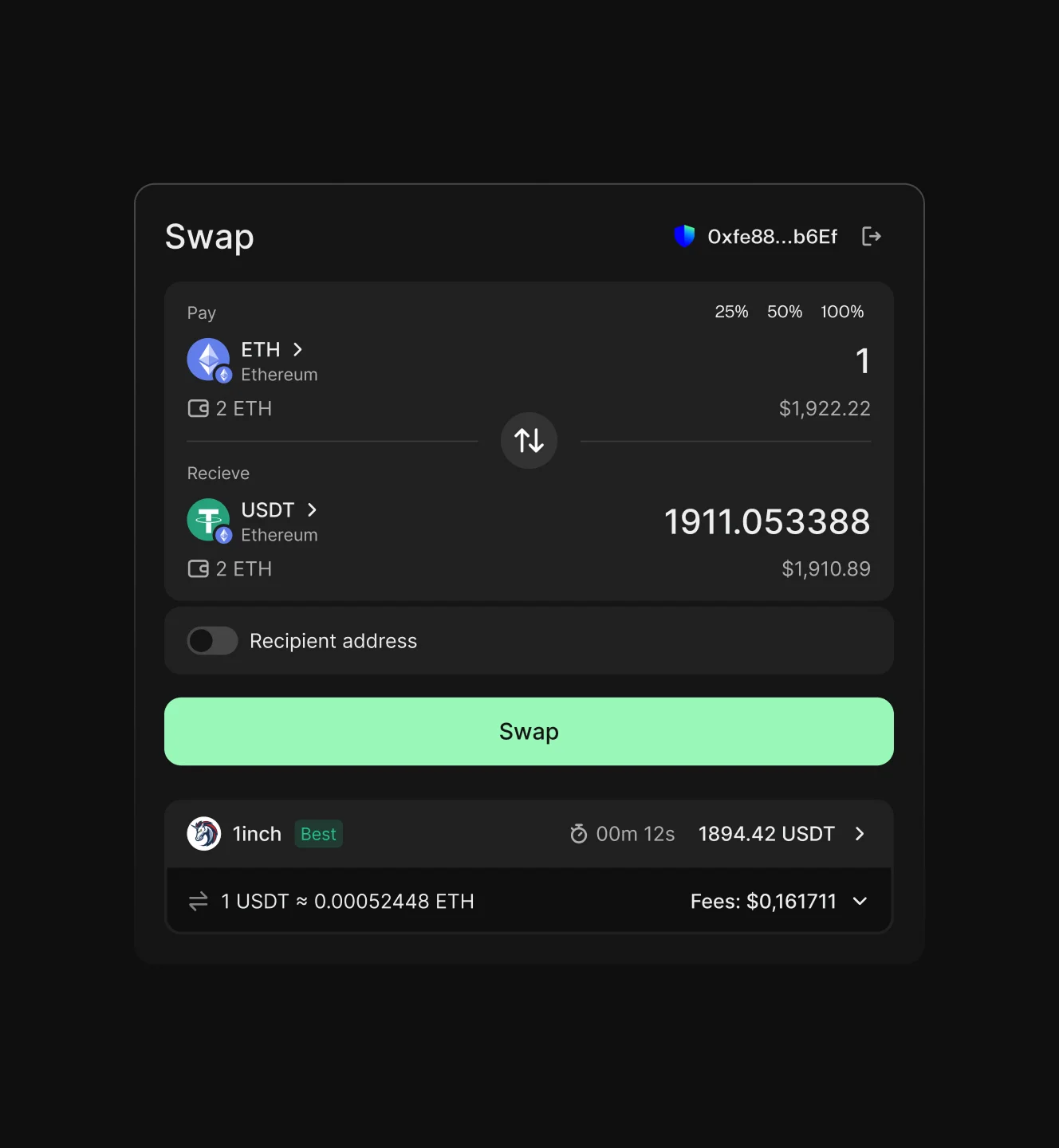
Together, we built the swap widget — a plug-and-play tool that lets customers embed it into their websites and start earning swap fees as an additional revenue stream, no coding required. The widget features a fully customizable UI, and the entire setup and configuration can be completed in as little as 5 minutes
Metrics and usage visibility
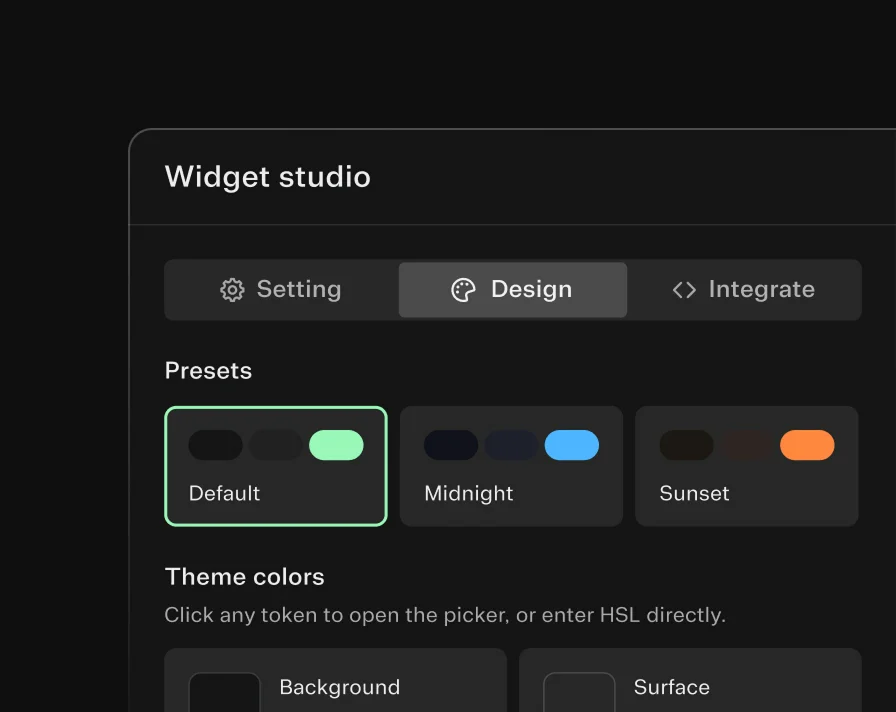
The portal includes access to operational metrics related to integrations. Customers can view data such as swap volume, generated revenue, and API usage. This information is available per integration stream, which allows analysis of usage across different setups and channels.
Technology Stack
Since the platform had to integrate with multiple blockchain protocols and networks, the team built the solution using a JavaScript framework, among other technologies. This provided access to a broad ecosystem of blockchain libraries and tools, as well as strong community support.
Backend
TypeScriptBunFastifyPostgreSQL
Frontend
Next.js
Cloud and infrastructure
Google CloudTerraformPub/SubBigQuery
Engineering practices
Latency loggingRequest tracingCustom dashboards and monitoring toolsOn-chain incident collection
From idea to delivery, Emerline can help scope your project and provide a detailed cost estimate.
Results
The project delivered both an expanded core platform and a functional self-service portal. The portal enabled customers to independently configure and manage their integrations and access operational metrics such as swap volume, API usage, and generated revenue. This removed the need for manual involvement from the internal team in the integration setup process and reduced operational dependency on support-driven configuration workflows.
In parallel, the core platform continued to grow throughout the engagement, expanding support by 2 additional swap protocols and 9 new blockchain networks. Over the same period, the platform recorded more than 200% year-over-year growth in transaction volume.
![]() 200%
200%YoY growth
in transaction volume achieved during the project period
![]() +9
+9New blockchains
integrated into the core platform, alongside support for two additional swap protocols.
![]() 0
0Manual steps
required for customers to set up and configure their integration after the self-service portal launched.
More Case Studies
all case studies
Data Science Solution for the Fintech Sector
Merchant recognition solution based on ML.