
From Standalone Power BI to an AI-Driven Unified Data Platform with Microsoft Fabric


Emerline leveraged Microsoft Fabric to build a unified, AI-driven data platform, centralizing fragmented reporting into a single source of truth. The solution transformed passive data into proactive intelligence, achieving a 71% faster task completion rate for AI application development.
Client and Challenge
The client operated with a traditional Power BI setup, pulling data via direct connections from disparate ERPs, project tracking tools, and financial systems. As the business scaled, this fragmented architecture created significant blind spots.
- Data silos: Disconnected delivery and finance data made it impossible to see how project delays impacted revenue in real-time.
- Performance bottlenecks: Large, granular datasets caused slow report refreshes, leading to "stale" insights.
- Reactive posture: Reporting focused on historical failures rather than predictive warnings, leaving leadership to manage by looking in the rearview mirror.
- Manual overhead: Teams spent more time reconciling conflicting numbers across departments than actually executing projects.
The challenge was clear — evolve Power BI from a passive visualization tool into a unified delivery and operations platform capable of supporting real-time governance and AI-assisted growth.
Methodology and Approach
1. Discovery & audit
2. Architecture design
3. Migration & optimization
4. AI Integration
5. Operational activation
Solution
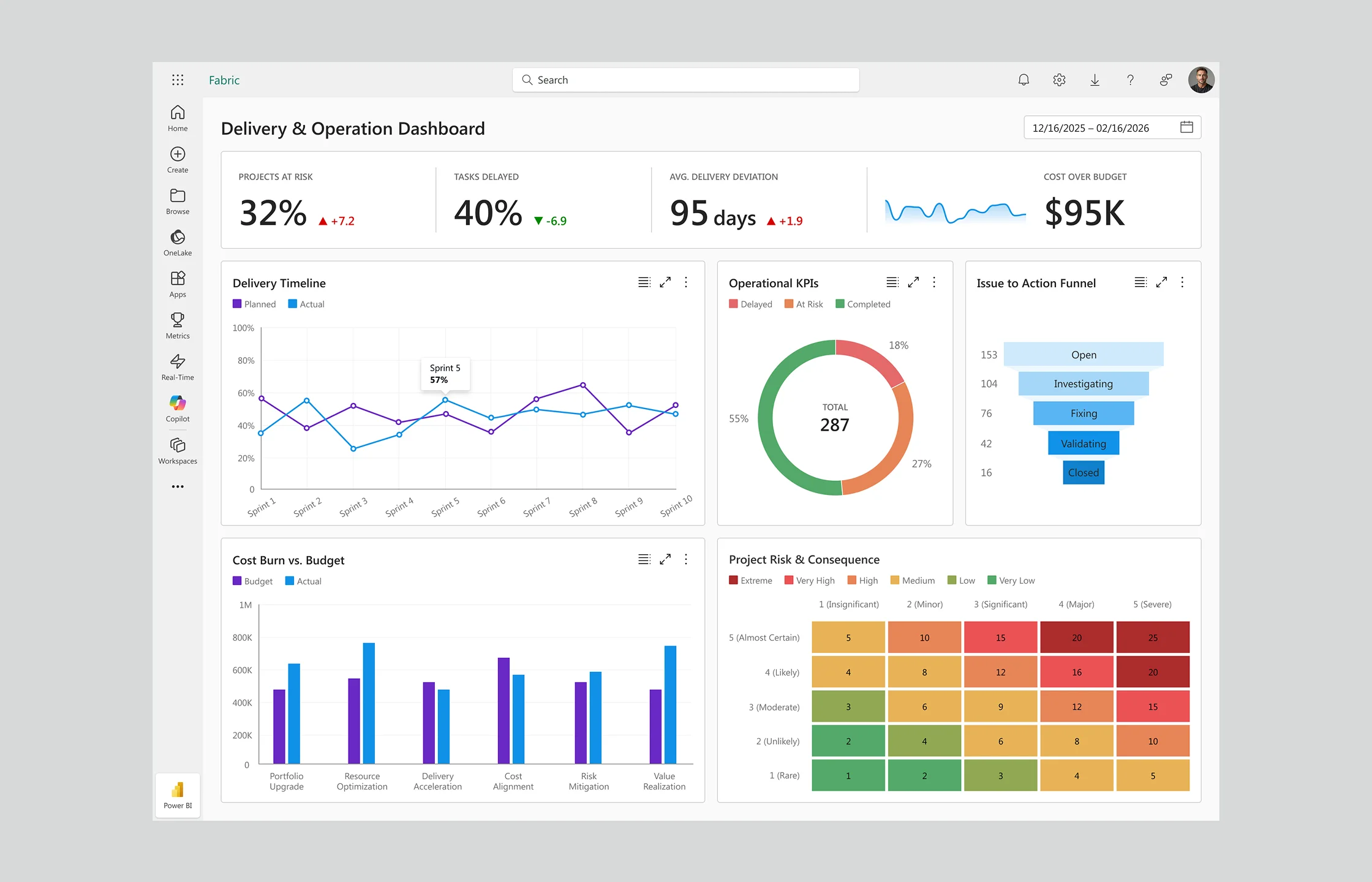
We implemented a Unified Data Platform with Microsoft Fabric, transforming Power BI from a passive reporting tool into a dynamic operational intelligence platform. By centralizing fragmented data, we replaced static dashboards with a live environment where real-time governance, AI-assisted development, and automated action loops drive delivery and growth.
Unified data estate with OneLake
We consolidated delivery, financial, and operational data into OneLake, dissolving systemic silos and establishing a single, governed source of truth. This unified architecture enables seamless cross-system analysis and provides high-quality, reusable data products for advanced analytics and AI use cases.
Direct Lake Mode for high-performance operational analytics
By implementing Direct Lake Mode, we enabled Power BI to query operational data directly from OneLake without data movement. This high-performance approach provides near real-time visibility into project progress and granular delivery signals while eliminating complex refresh logic and duplicated data pipelines.
Semantic models for delivery & portfolio KPIs
We introduced standardized semantic models to govern critical delivery and operational metrics. These models provide consistent, cross-functional tracking of strategic KPIs, including delivery forecasts versus commitments, resource utilization gaps, and real-time cost burn versus budget.
AI-driven development with Copilot
By leveraging Fabric capacity, we unlocked Copilot-powered development to streamline the creation of delivery and operations reports. This AI-integrated workflow facilitates rapid insight discovery and empowered teams to achieve a 71% faster task completion rate for analytics and AI application development.
Embedded insights in Microsoft Teams
Operational insights were integrated directly into the Microsoft Teams channels used by delivery and leadership teams. This ensures that critical data, including delivery risks and capacity alerts, is available during daily stand-ups, eliminating the need to switch between tools and improving response times.
Conversational Analytics with Copilot Studio
We deployed intelligent chatbots using Copilot Studio and Data Agents, allowing stakeholders to access project health insights through natural language. Users can query the system directly for at-risk projects or capacity gaps, empowering non-technical staff and reducing the ad-hoc reporting burden on data analysts.
Real-Time Activation (Reverse ETL)
By implementing Reverse ETL through Data Activator, we moved beyond simple visualization to create a closed loop system that pushes insights back into operational tools. This triggers automated alerts and remediation actions, such as flagging high-risk projects in tracking software, as soon as a delivery risk is detected.
Technology Stack
Results
The migration to Microsoft Fabric fundamentally transformed the client’s operational culture from reactive to predictive. By centralizing data and leveraging AI, Emerline delivered measurable gains in agility and efficiency:
- Operational agility: Real-time visibility through Direct Lake Mode enabled the early detection of delivery risks and bottlenecks, allowing for proactive intervention before delays occurred.
- Efficiency gains: Leveraging a 71% improvement in development speed with Copilot, the data team significantly accelerated their delivery roadmap and reduced the reporting backlog.
- Strategic alignment: Leadership now operates from a single, trusted view of portfolio health in OneLake, linking delivery performance directly to financial margins.
- Embedded and conversational insights: By integrating data directly into Microsoft Teams, the client achieved a higher adoption rate, enabling decisions to be made directly within the flow of work rather than in isolated reports.
- Reduced complexity: By eliminating separate data movement tools, the client reduced the Total Cost of Ownership (TCO) of their data stack while gaining superior AI capabilities.